When it comes to college prep, parents usually focus on grades, test scores, and application deadlines. But there’s another area that’s becoming increasingly relevant and sometimes overlooked: your teen’s social media presence. College admissions officers aren’t just reading essays and transcripts. In some cases, they’re Googling applicants and checking out what’s publicly available online.
So, what should parents know about the role of social media and college admissions, and how can you help your teen put their best digital foot forward?
It’s exhausting searching and scouring the internet for the right information when it comes to helping your student prepare for college. But what if you could use ONLY ONE RESOURCE and find everything you ever wanted to know about college prep? Wouldn’t that be amazing?
Here it is. I’ve done the research, examined the links and their resources, and compiled a list of 100+ college prep resources for you. (If you know of others, please leave them in the comments and I will add them to the list!)
Looking for scholarships? There’s the usual scholarship search sites and scholarship books. You can find them at your student’s counselor’s office and locally. But what about social media–specifically Instagram? It’s a great place to find out about current and future scholarship opportunities.
Sometimes there are scholarships posted on these accounts that you might not easily find in a typical search. They post lesser known scholarships, often with fewer applicants. This increases your student’s chances of winning!
Social media makes it easier than ever to connect with colleges and their representatives. You can follow them on Twitter, friend them on Facebook, connect with them on LinkedIn, and follow their Pinterest and Instagram accounts. Demonstrate genuine interest and contribute to the conversations; but don’t flood their accounts with replies and questions. In this case, less is more.
When application decision time rolls around you should have established yourself as an interested candidate. College admissions officers should be able to look at their records and see that you demonstrated interest. Some will remember your face, look back on your interview and be able to recall any conversations they had with you during the admissions process. You will trump anyone who hasn’t expressed interest and was simply a casual shopper.
Here’s how you can leverage specific social media accounts and use them to communicate with colleges:
Applying for a first job as a student can be tricky. If your student is looking for a part-time job or an unpaid internship to help during their studies, chances are they are worried about their resume. Indeed, it can be hard to know which skills to promote when you have not yet graduated from college. That’s where soft skills and individual interests can make a huge difference.
Employers appreciate that our students don’t yet have a degree. They understand they can’t expect a business-level skill set. However, students don’t need to have completed their degrees to apply for part-time jobs. More importantly, if your student is looking for a meaningful part-time job as an entry-level experience in their dream industry, they need to understand which extracurricular skills are going to make a difference. We’ve identified three skills that can make their resumes stand out.
When a college receives your application, admission officers look for ways to determine whether you will accept their offer of admission. Since all colleges have quotas to fill and determine their admission offers based on percentages of acceptance, showing interest lets them know you will likely accept their offer. As they see it, why offer admission to someone who isn’t interested when there is someone who is likely to accept?
How do you find the colleges that place a strong interest on this?
Which colleges want your student to show them some love? You don’t have to guess. You can use a tool like Collegedata.com to determine if a college uses demonstrated interest in its admission decision. The colleges are asked to rate 19 admission factors by using these four categories: very important, important, considered, and not considered. Each year, colleges are surveyed and this data is used to compile the information on its website.
To access the data, you simply search for the college, click on the Admissions tab, and scroll down to the Selection of Students heading. Then you can see the importance a college places on a student’s level of interest. Harvard, for example, lists this as “not considered.” In comparison, the United States Naval Academy, lists it as “very important.”
Social media makes it easier than ever to connect with colleges and admissions representatives because you don’t have to be on campus to make a connection.
Have you ever had a question about college prep and there
was no one to ask? Do you wonder what other parents have done in your
situation? Is there a question about paying for college that you simply can’t
find the answer to?
Odds are, you can find most answers to your unanswered questions on Facebook (or at least a suggestion on who to ask). From parenting a teen through the college process, paying for college, financial aid, scholarships and connecting with college parents, you can find groups or pages to help.
Here’s a list of my favorite Facebook groups and pages:
This is a widely popular group for parents of both
college-bound and college students. You can connect with experts in college
prep here or get advice from other parents who have been through the process
and/or have current college students. It’s a friendly, conversational group and
if you have a question, it’s easy to post it and usually get an instant
response from another parent or expert in the group.
If you have a question about paying for college, this group
is available to help. Helpful articles are posted daily and questions are
answered quickly by experts and mentors on the page. They cover topics related
to college prep and often offer training sessions and webinars to help you with
the college admissions process.
Financial aid can certainly be confusing for parents and
students. College talk provides parents with tips and strategies related to
college financial aid.
Looking for merit scholarships? This group is devoted to
sharing merit scholarship opportunities and discussing ways to find schools generous
with financial aid and merit scholarships.
Need help searching for scholarships? Need help with
scholarship applications? Have a question about the scholarship process? You capayn
find the answer on this page, along with endless lists of scholarships
available. Check this page daily for the best in scholarship information.
This is my page and you can find the answer to any
college-related question here. I post informative articles daily and am happy
to answer any question you might have about college prep. I also frequently
post scholarship opportunities and free training opportunities as well. Check
back often to see new news about college admissions.
This is the portal for you to ask any question, raise out
any concern or get feedback from the group. This type of forum rarely exists in
the college admissions space, but it’s space for parents to expand their
network, build connections, establish relationships and form a support system in
this competitive field. This is also the place for parents and students to grow
and even enjoy their college admissions journey.
Everything you need to know about the college essay, personal statements and supplemental essays can be found on this page. From podcast episodes to essay samples to expert advice, the College Essay Guy is available to help. Your student can also join his private group page for personalized essay help: College Admission and Application Forum.
A page with over 14,000 members offering great college advice, current articles in the news, and a forum for students and parents to comment on them and ask questions. College Connections’ main objective is to have our students gain admission to the college which is their best match, and where they find happiness, success and a solid academic program.
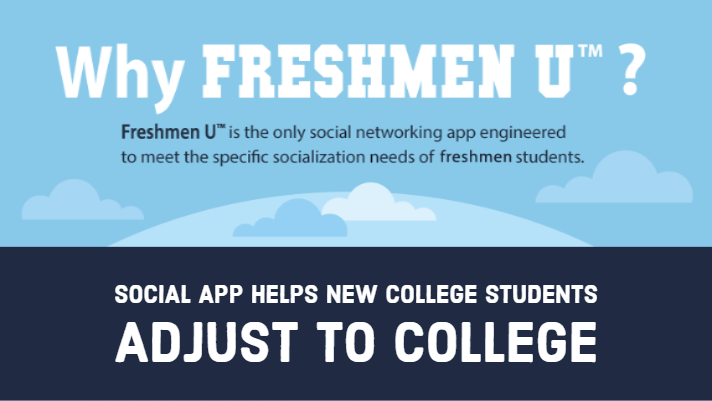
Incoming college students go through big changes as they reshape their entire social circle. They just left all their friends from 4 years of high school behind them and they need a social app that is uniquely tailored to their new college life. Current social platforms don’t have any use on a physical college campus, especially if you don’t know anyone there.
Freshmen U™ addresses new college social environment
Freshmen U™ is targeted for just campus use, addressing specific college student bodies within the individual university settings. Freshmen college students now have their own social app that includes patent-pending augmented reality (AR) technology developed just for social interactions.
Students can meet and interact with other students just by using their username within the app. This allows them to get to know each other before sending out a traditional friend request. This no need to know someone’s real name to start a conversation, which is hard to do when you first arrive on campus. Students just download the app, pick their campus, and start to meet people. It’s that easy.
Designed to get new students to connect with other students
Our app is designed to get new students out of their dorm and start to connect with each other in real life on campus. Users can drop photos of themselves around campus as they walk from class to class or attend a football game, which others can now see through the app’s AR GPS ecosystem and they can rate or comment on these photos or videos. Think of Facebook meets Pokémon Go. The app encourages interaction and more face-to-face meetings around campus and does away with the awkwardness of making new friends.
Customized social interaction
In a quest for profit above all else, the big three social media platforms have ignored a very important demographic group of college students. We did not. College students need customized social interaction, and they want their digital media. We’ve found a way to give them both, with no ads and no unnecessary data sharing with 3rd parties. We are a small group of developers (3 to be exact) that wanted to build something fun but useful on college campuses. I think we did it! Students now have a way to digitally plaster their lives into the real world around campus. It feels like rebellion but is totally safe and secure.
Becoming more employable is something anybody can do with a little patience, determination, and commitment. When you take the time to make yourself more employable, you become a valuable member of any team. You should get more offers, do better in the application process (although you’ll still need to nail the interview), and better yet, gain confidence and learn more about yourself and what you want to do.
In this post, we’re going to discuss 5 simple steps you can take to becoming more employable. Read on if this is something you want to do:
Build Your Social Media Presence
Start by working on your social media presence. Pick your platform and figure out ways to target your audience – are they on twitter, facebook, or instagram? How will you engage them and provide them with valuable content?
Sites like instagram are great because you can share attractive images alongside ‘microblogs’ that can help to give people useful info. You must be consistent. You can’t expect to gain thousands of followers overnight, but you will get to where you want to be if you’re consistent.
Keep Your Resume Up To Date
Make sure you have a high quality resume and that you keep it up to date. If you know the role you want or the industry you want to be in, make sure it’s targeted to that and don’t include anything that may be irrelevant. Make sure your resume will stand out against others. For example, if you’re applying for an online marketing agency, could you show off your skills with an online, interactive resume?
Continue Your Education No Matter What
Make sure you’re committed to continuing your education no matter what. There’s always something new to learn. You might look at something like https://librarysciencedegree.usc.edu, or even a simple online workshop/course. There are a ton of free resources, as well as courses you can pay for and courses you can get funding for depending on what you want to do. Know your strengths and weaknesses and work on them. Just make sure you have fun at the same time!
Network
They say it’s not what you know, it’s who you know, and for the most part it’s true. Networking allows you to introduce yourself to people in industries you may be interested in, and you should find yourself with new doors and opportunities opening for you this way. Network both online and offline. This can be scary, but you can practice by setting yourself goals to meet each day; for instance, starting a conversation with a stranger in a store queue.
Work Placements And Volunteer
By working placements and volunteering, you show that you are committed to your chosen role/industry and your own growth. You also show that you have empathy, and that you have experience, which both make you employable, even if you haven’t held a paid role!
This 5 step guide should help you to become more employable, providing you’re committed to working on it consistently.
According to Kaplan Test Prep’s annual survey of admissions officers, more than two-thirds of colleges (68 percent) say that it’s “fair game” for them to visit applicants’ social media profiles like Facebook, Instagram, and Twitter to help them decide who gets in — despite the fact that less than a third actually engage in the practice. Notably, students agree: a separate Kaplan survey of over 900 high school students finds that 70 percent consider social media profiles “fair game” for admissions officers evaluating applicants — an increase from 58 percent in 2014.
Admissions officers who say it’s “fair game” shared the following reasoning:
“Employers do it all the time. Colleges can do it as well.”
“I think if things are publicly accessible without undue intrusion, it’s OK. If it’s searchable, it’s fair game.”
“We don’t do this, but we could. I think high school seniors make poor choices sometimes when they put stuff online.”
Admissions officers who said they viewed this as an “invasion of privacy” shared the following:
“Their application should be the sole decider.”
“We use social media for recruitment, not admissions.”
“We only look at social media if the applicant includes or provides it.”
But while a strong majority of admissions officers are ideologically comfortable with this practice, only 29 percent say they have actually done it — a decline from 35 percent last year, and down from a 40 percent high watermark in Kaplan’s 2015 survey. But this isn’t because admissions officers are necessarily forbidden from doing it, as only 20 percent say that their school has official guidelines or policies; and of that 20 percent, only 33 percent are not permitted to do so.
“You cannot visit an applicant’s social media profile if you can’t locate them, and as one admissions officer shared with us, ‘Students are harder to find.’ They’ve gotten savvier in hiding or curating their social media footprints, even as they’ve become very comfortable with the notion of having a digital presence to begin with. By the same token, colleges have largely become comfortable, in theory, using social media to help them make admissions decisions,” said Alpher. “That said, in practice, the strong majority are sticking with the traditional elements of the application, like standardized test scores, GPA, letters of recommendation, and personal statements, which still overwhelmingly decide an applicant’s path. For most, these traditional factors provide enough useful information to make a decision, like it has for generations of their predecessors.”
And lest applicants think that what they post online can’t be held against them once they are already accepted, they should think again. Nearly one in 10 (nine percent) admissions officers say they had revoked an incoming student’s offer of admission because of what they found on social media. This finding comes on the heels of Harvard University’s decision last year to revoke the acceptances of at least 10 students for posting highly offensive memes on a private Facebook group for incoming freshmen.
Here’s a short video illustrating the survey results:






 Becoming more employable is something anybody can do with a little patience, determination, and commitment. When you take the time to make yourself more employable, you become a valuable member of any team. You should get more offers, do better in the application process (although you’ll still need to nail the interview), and better yet, gain confidence and learn more about yourself and what you want to do.