
Tag Archives: financial aid

Wednesday’s Parent: Don’t Be Fooled


don't be fooledToday is April Fool’s day. I have to admit, it’s not one of my favorite Hallmark holidays. I’m not much of a prankster and I always disliked being on the receiving end of a prank. None of us do. But colleges, all over the country, are pranking parents and students today. How? With the financial aid award letter. But don’t be fooled.

Colleges don’t back their admission offer up with money–if a college wants your student, they will back it up with a financial “reward”. No award indicates they are counting on your student declining their offer. Read this…

Colleges pack those letters with loans–a prank because every student and parent can get a student loan. Read this…

Colleges misrepresent their true cost on those letter–often leaving out expenses that should be considered and not giving the true cost of attendance. Read this…

Colleges “gap” students–they don’t award enough financial aid to meet the family’s EFC. This leaves a gap in the award and what the family has to pay. Read this…

Colleges consider it an award letter although there’s no award–even if all they offer is a student loan. That’s not an award. That’s not even an olive branch. It’s a slap in the face. Read this…

Be a wise consumer. Don’t be fooled by award letters. Do your due diligence and compare offers, crunch the numbers, and make a wise financial decision. Remember that part of the perfect fit college is the financial aspect. A college who won’t back their offer up with money isn’t a college you should consider.

Don’t be pranked by the colleges. I would never fool you; but Happy April Fools Day!

Read Wendy’s post: How a Joke Helps No Fooling College Prep

++++++++++++++++++++++

Wednesday’s child may be full of woe but Wednesday’s Parent can substitute action for anxiety. Each Wednesday Wendy and I will provide parent tips to get and keep your student on the college track. It’s never too late or too early to start!

The bonus is on the fourth Wednesday of each month when Wendy and I will host Twitter chat #CampusChat at 9pm ET/6pm PT. We will feature an expert on a topic of interest for parents of the college-bound.

Wednesday’s Parent will give twice the info and double the blog posts on critical parenting issues by clicking on the link at the end of the article from parentingforcollege to pocsmom.com and vice versa.
Avoid the Financial Aid Gap


financial aid gapIs your child’s financial aid offer enough to meet their financial needs? If not, they may be a victim of “gapping” or “admit/deny”, when a school accepts a student, but does not give a student enough aid to realistically attend.

Is Your Financial Aid Offer Meeting Your Full Need?

Your child has finally received the financial aid offer from their dream school. You are excited for the great experience they could have at this school, but after taking some time to decipher the offer you realize that the money the school is offering has not completely met your need. You are stunned when you calculate the total amount you will owe after factoring in grants and scholarships from the college.

The practice of accepting a student and then not offering them enough financial aid to afford the college is known as “gapping”, or “admit/deny”.

This practice is shockingly common. According to The 2014 Survey of College and University Admissions Directors, over half of college admissions directors practice gapping at their institutions, although it is much more common in private schools. 72% of private college directors and 39% of public college directors say that they use this practice. The majority of private college directors, and about a third of public school directors say the practice both is necessary and ethical.

This is an issue for both need-blind and need-aware colleges. In theory a need-blind college cannot deny a student based on their ability to pay. In practice, however, these colleges know they will receive a greater benefit by accepting more students who have the ability to pay the bulk of their tuition. Instead of rejecting these low-income students outright, they admit them without offering the financial aid they need, which is in effect, a denial.

How to Fill Financial Aid Gap

Families often have a hard time deciphering financial aid offers, and it may not be immediately clear to them that their full financial need has not been met. Unfortunately, many of these students end up taking out massive loans in order to attend a school that is only meeting 75%, 50% or less of that family’s need.

What they should do instead is learn how to interpret financial aid offers, and compare offers between colleges to see who is offering the better deal. To find the true cost of attending a college, you must know your expected family contribution and subtract that number from the total cost of attending (total cost includes tuition, fees, room, board and living expenses).  Unsubsidized loans and Parent Plus loans are available to anyone regardless of need and should not be considered part of your need-based aid.

Colleges also report how much aid they give out, so you can look up a chosen university to see the average aid they award, as well as how many students receive financial assistance. For example, Stanford is more likely to be a pricey school as they only give aid to about 55% of their students.

Gapping is more likely to happen at private schools, and schools that are a reach for the student. There are some schools that are committed to meeting the full need of the students who apply, though these schools may be more difficult to get into, and are often need sensitive or need aware.

The best defense against gapping is to ensure that the student has applied to colleges that are a good fit for them. If a student is attractive to a college, they will be willing to entice the student with a greater share of financial aid dollars.

_____________________

About the author: Carly Stockwell is the media director at CollegeFactual.Com, a website that helps students make better decisions about where to go to college.


Before the Offers of Admission and Financial Aid Awards Arrive


offersCollege acceptances for regular admission will be posted and arriving soon. Just a little later, will come the financial aid award packages. Before you and your student have to make the final college choice and before the financial aid awards arrive, consider these four activities in preparation:

1. Revisit colleges that have offered admission

Early spring is the perfect time to revisit the colleges that have offered admission. If possible, attend an admitted student session, stay on campus overnight, or just revisit to help your student refresh his memory of the setting and the students. While most would advise that you not accept an offer without a visit, some might disagree. Personally, I believe that visiting campus will help cement the decision in your student’s mind.

2. Discuss money

If you haven’t already done so, discuss what you will contribute and what your student will contribute toward the cost of college. This is an important discussion because once the offers of admission arrive and the financial aid package, it’s conceivable that your student’s decision will be based purely on emotions and not take into consideration the financial aspect of the decision.

University Parent has two great articles that address this topic:  The Money Talk Part 1: Setting expectations with your student and The Money Talk Part 2: Put college funding into high gear!

3. Take a look at your 2nd, 3rd and 4th choice colleges

Before the offers (and rejections) arrive, take a look at your student’s 2nd, 3rd and 4th choice colleges. If necessary, revisit them. Re-examine why these colleges made the list and take a closer look at their offerings. This second look might move one of the colleges to the top of the list.

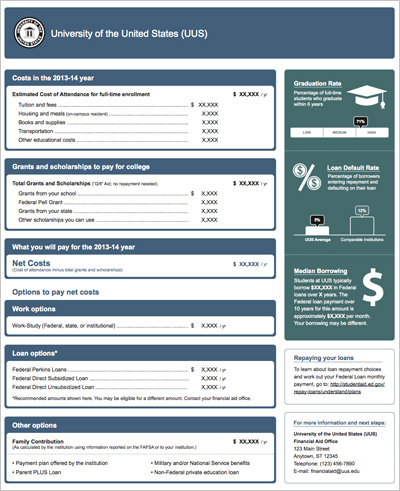
4. Understand the components of the award letter

Before you start receiving those financial aid offers, you should understand what’s in a typical award letter. Thankfully, there are tools available and information to help you look at these letters for what they are: the college’s pitch for your student to accept their offer of admission. You are in control of this process and you hold the cards. It’s your decision to accept or reject their offer based on the amount of aid they are willing to give your student. Money, in this situation, is everything.

Wednesday’s Parent: “We Won’t Qualify for Financial Aid”


fafsaIf I had a dollar for every time parents said this to me, I would be rich. Surprisingly, most parents believe this fallacy. Believing this, they don’t complete the FAFSA and miss out on all kinds of aid. Just because they were misinformed and unaware of how financial aid works.

Why should you complete the FAFSA?

College is expensive and it’s a chance for you to grab yourself a piece of the financial aid pie.

Why should you complete it by February 1st?

The early bird gets the worm when it comes to financial aid. If you want your piece of the pie, you have to be the first in line. Once financial aid packages are disbursed, the money is gone and that means your student’s financial aid package will be composed of student loans only. If your form is filed and completed once the decision for admission is made it puts your student in a good position to receive some of those funds.

What can the FAFSA do for you and your college-bound teen?

There could be federal, state and college funds available. If you don’t complete the FAFSA, you won’t be able to get any of them. Even if your family income is high and you might not qualify for federal aid in the form of grants, your student might be eligible for state scholarships and merit-aid awards from the college. Additionally, any federally subsidized loans, including parent loans, require you to complete the FAFSA.

What should you do if you haven’t filed your taxes before FAFSA filing?

It’s simple. Use last year’s tax figures and update once you file. Don’t wait to file the FAFSA until after you file your taxes.

Why do some people tell you that you won’t qualify for financial aid?

The easy answer is they are misinformed. Remember there are all kinds of financial aid. While not everyone will qualify for federal grants, most students receive some form of financial aid. If you don’t apply your student will not be one of them.

Read Wendy’s post: 4 Strings Attached to Free Financial Aid

____________________

This month Wendy and I will host Twitter chat #CampusChat at 9pm ET/6pm PT on Wednesday, January 21. Our guest will be financial aid expert Jodi Okun. She is the founder of College Financial Aid Advisors, an About.com Expert, Paying for College, and the @Discover Student Loans Brand Ambassador. Jodi has worked for over 10 years in the financial aid industry and helped thousands of families navigate the financial aid process. Don’t miss a chance to get her tips and ask questions.

Read Wednesday’s Parent Night on #CampusChat for some simple instructions to join a Twitter chat.

Wednesday’s Parent will give twice the info and double the blog posts on critical parenting issues by clicking on the link at the end of the article from parentingforcollege to pocsmom.com and vice versa.

Everything You Need to Know About the FAFSA


fafsa

Do you have questions about the FAFSA? or financial aid? Have you looked at the form and find some of the instructions complicated or ambiguous? You’re not alone. If you have a senior headed to college in the fall or you just want to be prepared for your future college bound teen, you should join tonight’s #CollegeCash chat. I’ll be the guest and @JodiOkun and I should be able to answer all your questions.

What: #CollegeCash

When: (Tonight) Thursday 8PM ET

Where: Twitter using #CollegeCash hashtag

Who: Host @JokiOkun and guest @SuzanneShaffer

Don’t forget to follow both of us on Twitter. If you’ve never attended a Twitter chat, here are some simple instructions.

How to Take Part in a Twitter Chat

See you there!


FAFSA Tips, Reminders, and Mistakes to Avoid


fafsaIt’s FAFSA time. “Yuck”, as one parent said. “Dreading, dreading, dreading” from another. “It’s my least favorite time of year (other than income taxes)”, said another. I get it. Nobody likes filling out federal forms, especially when money is on the line. And with the FAFSA, money is on the line.

Today I am sharing some of the best FAFSA advice I’ve found online. If you have a college bound teen, this information will be invaluable. Don’t just skim it, however; you need to read every last word. Not knowing can mean the difference between receiving aid and receiving a big fat zero. Trust me, I have learned from experience and listened to so many parents that neglected to do the research before completing the form.

Avoid These FAFSA Mistakes

My first piece of advice comes from Lynn O’Shaughnessy of The College Solution blog. Her advice is spot on and goes into great detail about some key points regarding marital status, household size, and reporting assets. It’s an easy to understand guide for parents and breaks the government lingo down into simple language.

Read more . . .

10 Tips to Prepare for the FAFSA

I wrote this article for TeenLife.com giving parents tips on what they need before completing the FAFSA. You want to be the first in line for financial aid. Students who complete the government form early are more likely to receive funds set aside by the colleges for financial aid. If you don’t complete the FAFSA, you won’t receive any aid. Everyone should file the FAFSA, even if you think you won’t qualify for federal aid.

Read more . . .

False FAFSA Assumptions

Jodi Okun of College Financial Aid Advisors wrote this piece for AboutMoney.com. One of the most common statements I hear from parents is, “I’m not going to file because we won’t qualify for financial aid”. Jodi points out the huge mistake in making this assumption and others.

Read more . . .

7 Legal Ways to Squeeze More Money Out of the FAFSA

It makes perfect sense, just with your taxes, that you should receive what is owed you. With the FAFSA, this affects your student’s financial aid award. Kim Clark of Time.com/Money shares her best advice on how to complete the form properly to ensure you get the most financial aid.

Read more . . .

Do me a favor and pass this information along to other parents. The more you know, the more you will maximize your financial aid. And…sharing is caring!

Edvisors: Demystifying Financial Aid

EdvisorsEdvisors

Get any two parents of college-bound teens together and the topic of financial aid is likely to come up. Every parent dreams of their son or daughter getting a free ride to college. It happens, but it takes some real determination and planning.

Mark Kantrowitz, the founder of FinAid, left that nationally recognized website last year to create a new online resource at Edvisors.com for parents and students to help them learn how to pay for college.

Topics covered

Here are some of the topics that you’ll find by spending time on Edvisors:

  • Student Aid Secrets for Increasing Eligibility
  • Eligibility Requirements for Financial Aid
  • Federal College Grants
  • How To Choose a Student Loan
  • Finding and Applying for Scholarships
  • Paying Back Parent and Student Federal Loans
  • Military Student Aid

Free Guide to Filing the FAFSA

On the Edvisors’ website, you can also download a free copy of  Filing the FAFSA:  The Edvisors Guide to Completing the Free Application for Federal Student Aid 2014-2015 Edition.

To download Filing the FAFSA you will have to provide information that will put you on Edvisors’ newsletter list, but you can always opt out if you prefer. As an alternative, you can also buy the 249-page paperback version on Amazon.

Education Tax Benefits

There is a section of the website that contains an excellent and informative explanation of federal education tax benefits. The section describes each tax benefit, and teaches you which are the optimal education tax benefits for your family:  Picking the Best Mix of Education Tax Credits and Benefits.

Asking for help

The site gives you an opportunity to post your financial aid questions in a section of the website entitled, Ask the Edvisors. You can also view previously asked questions and the answers provided by the site’s founder Mark Kantrowitz.

Spend some time navigating the site and discover valuable information regarding paying for your student’s college education.

How to Decipher the Financial Aid Award Letter


financial aidAs the offers of admission arrive, the financial aid award letters will follow. If you’re a novice to the award letters, as most first time college parents are, they can be confusing and vague. Added to the confusion is that every award letter is different, making it hard to easily compare them side by side.

Thankfully, there are tools available and information to help you look at these letters for what they are: the college’s pitch for your student to accept their offer of admission. You are in control of this process and you hold the cards. It’s your decision to accept or reject their offer based on the amount of aid they are willing to give your student. Money, in this situation, is everything.

If a college wants your student to attend, they will back it up with money. No money, means their offer is probably based on filling a quota and them expecting you will decline to attend. And you should. Who wants to attend a college that doesn’t place value in your student?

But before you accept, reject, or negotiate with the college, you need to understand the award letter and its components.

Want to know more? Read an article I wrote for TeenLife:

How to Break Down the Financial Aid Award Letter


A Financial Aid Flowchart


Financial aid can be confusing for parents and students. From scholarships, to loans, to 529 funding, it can be an overwhelming process.

Student financial aid comes in all shapes and sizes – and one size doesn’t fit all when it comes to paying for college. With many different student loans to choose from, finding the optimal path to college funding can be tricky. eStudent Loans created this graphic to help those who need more than just scholarships and grants to fund their education and fund it in a way that will help save you money.

So, if you’re one of the thousands of students that are not sure where to start, relax. Simply use their financial aid flowchart to help you explore nearly every possible option available to help you cover the costs of earning your college degree. At the same time, they also show you the order in which you should pursue each funding source.

Financial Aid Flowchart: A Guide for Students Paying for College by eStudentLoan

Financial Aid Flowchart: A Guide for Students Paying for College from eStudentLoan

Download the interactive Financial Aid Flowchart

Getting the Best Bang for Your College Buck


college dataWith the cost of college rising and parents looking for a college that doesn’t cause their students to fall into debt after graduation, where do you go to find the data you need? Where do you find a college with the best bang for your college buck?

CollegeMeasures.org

This site describes itself as “committed to informing and improving the decision-making process for students, parents, and policy makers. By making available key data through websites like our 2-year and 4-year college data tools, we enable users to make smarter decisions, and in doing so help create a more efficient, productive and effective higher education system.” And it certainly delivers.

Upon further investigation, parents can gather data for both 2-year and 4-year colleges. Once you access the data tabs, you can view performance by college, by state, by rank and nationally. The comparison tools are excellent and easy to use. When you choose to examine by college, you can view the college’s performance scorecard listing several different criteria: strategic measures, graduation rate, retention rate, cost per student, cost per degree, cost of attrition, student loan default rates, and my favorite debt to earnings ratio.

With the debt to earnings ratio you can determine if the cost of degree is worth the investment based on earnings after graduation.

COLLEGEdata.com

COLLEGEdata.com tags itself as the online college advisor; and the site certainly lives up to its name. The site offers the following college helps categories:

  • Scholarship Finder
  • Admissions Tracker
  • Net Price Calculator
  • EFC Calculator
  • College Match
  • College Chances

Not only is the site a clearinghouse for college data, using it helps parents find the most generous colleges by using the college match tool. This tool allows you to choose colleges under the “Financial Friendliness” category and see statistics for the financial need met (0-100%); and merit aid scholarship percentages, giving you the option to include only students with financial need. This information will help you make information financial choices about the money you spend on the education.

As with all college search tools, you can filter the information by state, gender, major, graduation rates, freshman satisfaction, entrance difficulty, and on this one, sports offered. If you need to find a college in your state or region, that meets a substantial amount of need, this is the tool to use.

These two tools can help you weigh the financial investment you will make towards your college-bound teen’s education. With college costs skyrocketing, it’s becoming more and more critical to help their student graduate debt free.