Tag Archives: financial aid

8 Facebook Pages and Groups to Help With College Prep

facebook

Have you ever had a question about college prep and there was no one to ask? Do you wonder what other parents have done in your situation? Is there a question about paying for college that you simply can’t find the answer to?

Odds are, you can find most answers to your unanswered questions on Facebook (or at least a suggestion on who to ask). From parenting a teen through the college process, paying for college, financial aid, scholarships and connecting with college parents, you can find groups or pages to help.

Here’s a list of my favorite Facebook groups and pages:

Grown and Flown

This is a widely popular group for parents of both college-bound and college students. You can connect with experts in college prep here or get advice from other parents who have been through the process and/or have current college students. It’s a friendly, conversational group and if you have a question, it’s easy to post it and usually get an instant response from another parent or expert in the group.

Paying for College 101

If you have a question about paying for college, this group is available to help. Helpful articles are posted daily and questions are answered quickly by experts and mentors on the page. They cover topics related to college prep and often offer training sessions and webinars to help you with the college admissions process.

College Talk

Financial aid can certainly be confusing for parents and students. College talk provides parents with tips and strategies related to college financial aid.

How to Find Merit Scholarships

Looking for merit scholarships? This group is devoted to sharing merit scholarship opportunities and discussing ways to find schools generous with financial aid and merit scholarships.

How to Win College Scholarships

Need help searching for scholarships? Need help with scholarship applications? Have a question about the scholarship process? You capayn find the answer on this page, along with endless lists of scholarships available. Check this page daily for the best in scholarship information.

Parenting for College

This is my page and you can find the answer to any college-related question here. I post informative articles daily and am happy to answer any question you might have about college prep. I also frequently post scholarship opportunities and free training opportunities as well. Check back often to see new news about college admissions.

Parents of High School Students

This is the portal for you to ask any question, raise out any concern or get feedback from the group. This type of forum rarely exists in the college admissions space, but it’s space for parents to expand their network, build connections, establish relationships and form a support system in this competitive field. This is also the place for parents and students to grow and even enjoy their college admissions journey.

College Essay Guy

Everything you need to know about the college essay, personal statements and supplemental essays can be found on this page. From podcast episodes to essay samples to expert advice, the College Essay Guy is available to help. Your student can also join his private group page for personalized essay help: College Admission and Application Forum.

…and one more

College Connections Educational Consulting Services

A page with over 14,000 members offering great college advice, current articles in the news, and a forum for students and parents to comment on them and ask questions. College Connections’ main objective is to have our students gain admission to the college which is their best match, and where they find happiness, success and a solid academic program.

Why Complete the FAFSA?

FAFSA

October 1 is on the horizon and that means the FAFSA will be available for students to complete and file. Believe it or not, many students don’t bother completing it and that’s a decision you and your student might regret.

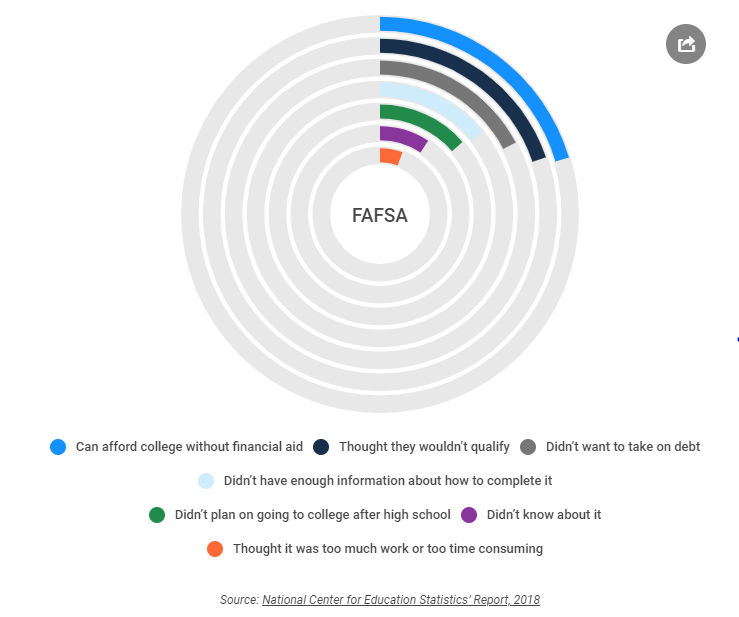
According to the National Center for Education Statistics, Only 65% of high school seniors complete the FAFSA, Why don’t more fill it out? Most either can afford college without financial aid or think they won’t qualify for financial aid. Other reasons include a lack of information — and just planning on skipping college entirely.

FAFSA

Completing the FAFSA is an essential step of the college application.

Why bother completing the FAFSA if you don’t need financial aid?

Even if you and your student can afford to pay for college, why would you pass up free money? Colleges use the FAFSA when distributing merit aid and even some private scholarships require a completed FAFSA.

If you need financial aid, how can completing the FAFSA help?

If you need some form of financial aid to pay for a college education, you MUST complete the FAFSA. In order for students to qualify for federal student loans, state loans, and work-study, they must submit the form. The FAFSA is also required if you plan to take out a Parent PLUS loan to help your student pay for college.

In addition, many students are eligible for federal Pell Grants. High school graduates who didn’t complete a federal financial aid application missed their opportunity for part of $2.6 billion in free money for college, according to NerdWallet’s annual analysis of federal financial aid data.

The money went unclaimed by 661,000 members of the Class of 2018 who were eligible for a federal Pell Grant but didn’t complete the Free Application for Federal Student Aid, or FAFSA.

How much time does it take to complete the FAFSA?

The FAFSA has over 100 questions, which can take anywhere from a half hour to an hour to complete. According to data compiled by Finder.com, new applications less than an hour, averaging 35 minutes. Renewing your application takes even less time — 23 minutes on average. Filling out the FAFSA for the first time takes the longest since you need to fill in answers for each required question.

The bottom line: complete the FAFSA. It doesn’t take that long and most students qualify for some form of financial aid. That doesn’t mean you have to accept it, but why not have that option? And you certainly don’t want to miss out on some of that FREE money!


Paying for College: Borrow Wisely

borrow wisely

I received an email from a concerned parent whose student was going to be attending orientation next week. In the email, he confessed that he might need some help with information regarding financing his son’s college education. I was surprised that he waited so long. Unfortunately, I had to advise him that at this point his only options were private loans and advise his student to apply for scholarships over the summer.

Parents should consider college funding even before their student applies to college. The inevitable result of lack of planning is parents and students borrowing to pay and usually borrowing more than they can repay after graduation.

What do the statistics say?

With school starting shortly, student loan borrowing often appears in the news. It’s especially prevalent now with presidential candidates promising to erase student loan debt. Wherever you stand in the political landscape, it’s clear from the statistics that students have borrowed more than they can repay.

According to a 2018 report by the Federal Reserve Bank of New York, as many as 44.7 million Americans have student loan debt, that’s one in five adult Americans. The total amount of student loan debt is $1.47 trillion as of the end of 2018 — more than credit cards or auto loans.

How do you make wise financial choices?

Before applying to college, you and your student should investigate the cost. You can gather the information either on the college website or by using College Navigator. When viewing these figures, you should also research the college’s financial aid statistics—what percentage of students are awarded aid, how much aid is awarded and how much do students typically borrow. Since every family’s financial situation is different, these figures should help determine if the college is affordable to attend.

How does financial aid play into the equation?

If you complete the FAFSA, your student will receive some form of financial aid. The most common is student loans, but colleges also award grants and merit aid as well. Always complete the FAFSA, even if you don’t think you will qualify for aid. Colleges use the information on the FAFSA when awarding scholarships and grants. No FAFSA, no aid.

What’s the key to avoid borrowing too much?

Use repayment calculators before you sign on the dotted line. The rule of thumb is that students should only borrow as much to pay for college as their first year’s salary. By keeping your debt under one year’s salary, you won’t have to put more than about 10% of your income towards student loan payments. Borrowing more than your student can afford to repay sets them up for overwhelming debt after graduation. Your student can look at salary comparisons for their anticipated career at PayScale.com.

How can you avoid borrowing to pay for college?

The key to not borrowing to pay for college is to receive merit aid, grants, and outside scholarships. Your student should apply to a college at the top of his or her applicant pool. This means the college will be more likely to award aid to attract your student. Grades and standardized test scores are also a key factor in awarding aid. Your student should focus throughout college to pursue excellence in these areas. And, don’t forget outside scholarships. Your student should focus time and effort in applying to every scholarship he or she qualifies for. This means starting early and planning to submit the best application. Click here for scholarship application tips and see how your student can win enough money to pay for college.

Finally, borrow wisely. Only borrow what you need. Your student can borrow the maximum amount, but only borrow what is necessary. Just because you can, doesn’t mean you should. Choose the loans with the lowest interest rates first.

5 Questions to Ask the Financial Aid Office

Keep these questions in mind as you plan your next college visits and take the time to schedule an appointment with the school’s office of financial aid.

1. What are your financial aid deadlines?

In addition to deadlines for the standard financial aid applications: the Free Application for Federal Financial Aid (FAFSA) and PROFILE, the financial aid application service of the College Board, colleges may also have their own deadlines and forms. Be sure to ask if the school’s financial aid forms are different for need-based and merit-based aid when the deadlines are. Note many schools have declared March 1 as their priority filing date for financial aid. Be sure to confirm each school’s priority filing dates.

2. What is your Cost of Attendance (COA) for the current year?

 There are precisely six components to a college student’s complete budget:

  • Tuition
  • Fees
  • Room and Board
  • College Textbooks and Supplies
  • Personal expenses
  • Transportation

Many proposed budgets only include Direct Costs (which are the first three items listed) and typically what you will pay directly to the bursar’s office. However, the U. S. Department of Education requires that colleges fully inform you as to all of the above costs, so find out specifically what those amounts are to establish a complete budget for college expenses.

3. How much of an increase in the COA do you project for next year?

When you ask this question, be sure to request the specifics related to each cost component. Tuition and Room and Board increases are independent of each other. For example, one school may expect an increase of 5 percent in tuition and fees, but a 10 percent increase in Room and Board. This information will help with budgeting but also gives the financial aid officer the impression that you are an informed parent.

4. Are you able to meet 100 percent of financial need?

If they say “No,” find out why, and get details. Is the policy based on “first come, first served?” What’s the average percentage of need the school can meet? What percentage is in the form of grants and how much is in the form of loans? Is there a dollar amount left as a gap (unmet need) for everyone? Do they include Parent Loans (PLUS) in the aid package?

(Note: They shouldn’t do this…those loans are to be used for your EFC-Expected Family Contribution, not for meeting the financial need of the student.)

5. Do you offer Merit Scholarships, and how do you treat private scholarships awarded to the student?

If a Merit Scholarship is being awarded, it normally goes into the financial aid package first, reducing the amount of need-based aid. Find out if a merit award reduces the self-help in the package, or if it replaces other need-based grants. A true Merit Scholarship can go beyond the “need” level, which means that it can lower your EFC. 

How to Prioritize Your Financial Aid Options in College

As the costs of college keep rising each year, many students and their families find it necessary to rely on financial aid to help pay for college. There are many different types of financial aid available, and knowing which one best matches your situation is key to not only choosing the right type of aid, but also maximizing the amount that you can qualify for—and minimizing your debt obligations later on.

Financial aid is a critical part of the college application and attendance process. It can make college a reality for many students and help bridge the gap between family contributions and the overall cost of attendance. Some types of aid don’t need to be paid back; others can leave you in debt for years to come.

With that in mind, it’s important to understand how to best approach the financial aid process, and how to set yourself up for financial success later by putting thought into the process now.

What Should You Start With?

The first step in the financial aid process should be completing the FAFSA. Short for the Free Application for Federal Student Aid, the FAFSA walks you through a complete picture of your finances. If you’re a dependent student—most first-year students are—then it also includes questions about your parents’ financial situation and their potential ability to assist in funding your education.

The federal government is the biggest source of financial aid for college students, and before it’ll consider you as eligible for aid, you’ll need to complete the FAFSA, which serves as your application for all federal aid. The FAFSA is completed online, it’s free, and there is plenty of help available to assist you and your family in filling it out.

What’s the Takeaway from the FAFSA?

Once your FAFSA is submitted to the federal government along with your choices of colleges, a Student Aid Report, or SAR, is generated from the information you entered. The SAR explains how much your expected family contribution (EFC) is. The government takes the position that it’s your responsibility to pay as much as you can to your own education first; the EFC is how much the Department of Education thinks you and your family should be able to contribute to the total cost.

Each year, colleges publish an amount called the cost of attendance. It includes all the expenses that go into attending that school: tuition, room and board, textbooks, fees, and other things like living expenses throughout the school year. Your EFC is subtracted from the Cost of Attendance, and the resulting balance is considered your financial need. The federal government sends your SAR to the schools you listed, and they compile a financial aid package to offer you.

Your federal financial aid package could include a variety of aid products including Pell grants, unsubsidized and subsidized federal student loans, and more. You should always consider Pell grants and subsidized federal aid first. A Pell Grant is a type of aid that does not require repayment, and subsidized loans do not accrue interest while you’re attending school.

After looking at your offer, you may find that your financial aid package isn’t enough to cover the entire bill, but there are other options to consider such as scholarships.

Should You Consider Scholarships?

The short answer is “YES, absolutely!” Scholarships, like grants, are essentially free money that you don’t have to pay back. They should always be a consideration regardless of what year you are in college. You can apply for new ones every year, and there are tons of sources to find scholarships. They can really make up the difference up between the cost of attendance and your financial aid package. Start early and often. If the FAFSA wasn’t so important, this would be the first place to start.

There are thousands of scholarships available every year, but they’re highly competitive. Each program has its own application criteria and deadlines, and the best way to maximize your chances of winning one is to ensure that you follow the program’s directions and meet all of the deadlines—preferably applying as early as possible. The best way to go about winning scholarships is to just keep on applying to any legitimate opportunity you can find.

Is There a Last Resort?

If you find there’s a funding gap left over after scholarships, grants, and other federal aid, then you still have one option: a private student loan. There are distinct differences compared to federal student loans do, but sometimes they’re a necessary tool to cover that funding gap.

Offered by banks, credit unions, and other lenders, private student loans are based upon your creditworthiness; as a result, most students find that they need a qualified cosigner for approval. Further, you may find even the best private student loans still have high interest rates compared to federal loans. After all, interest rates are generally higher for private loans. Also, they don’t come with a grace period like a federal loan. That means you’ll need to start paying it back immediately, just like a car loan or mortgage, even if you’re still in school.

It is clear that private student loans are not as desirable compared to their federal counterparts; however, sometimes they’re a viable option if it’s crunch time.

__________________________________________________

Today’s guest post is By Matt, the site manager & webmaster of The Student Loan Report – a student loan news and education website.

What is a Financial Aid Footprint?

If receiving financial aid is the key to attending college, you might want to look at your college’s financial aid footprint. Every college reports the statistics related to their financial aid profile. These statistics can tell you how generous they are with their scholarships and grants and also the percentage of students who receive help with their tuition. It will also help you determine if you should ask for more merit aid when you receive your financial aid package. If a college is not generous with aid and your student receives some, it’s unlikely they will award more.

The best resource available for these statistics is College Navigator. You can enter the name of the college, or search using criteria such as location, size, and degree plans. Once you’ve pulled up the data, you can use it to compare colleges.

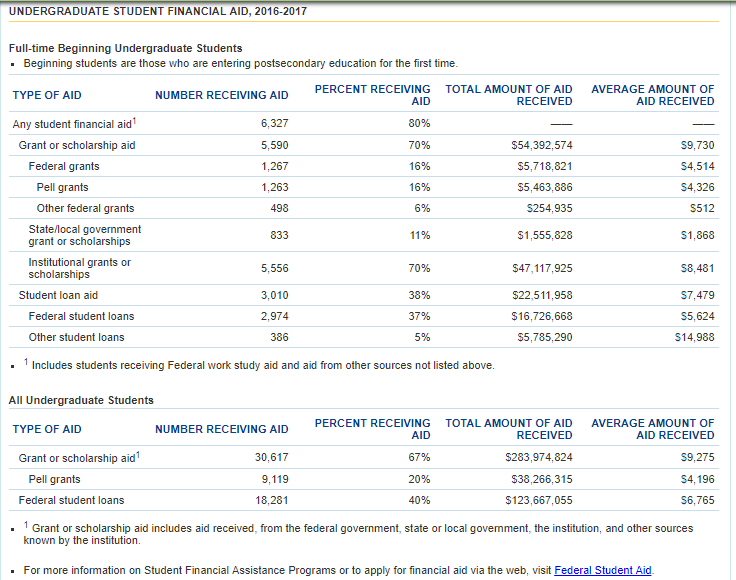
Below is a screenshot of just one university, Ohio State:

financial aid

As you can see, 67% of the full-time beginning undergraduate students receive aid in the form of grants or scholarships; 70% of that aid is from institution grants and scholarships. Also notable, the average amount of aid received in the form of grants or scholarships per student is $9,275. Total tuition/room and board is $27,037 for in-state, on campus students. Therefore, 1/3 of tuition, room and board is covered in the form of grants and scholarships.
covered in the form of grants or scholarships.

financial aid

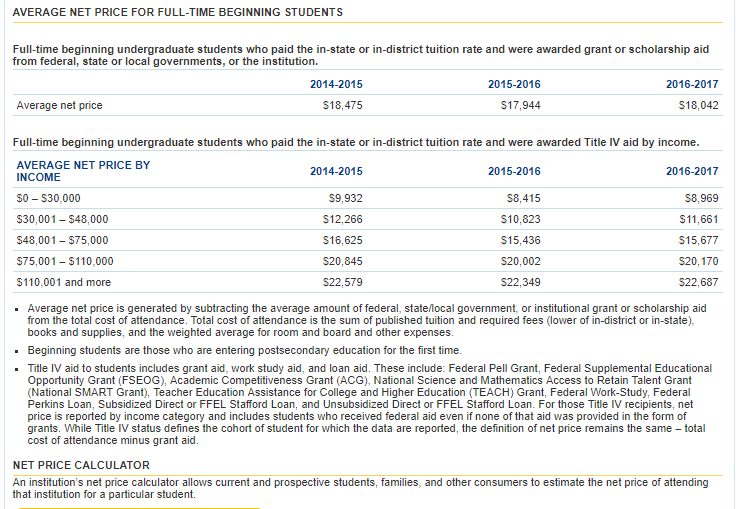
Another valuable part of the information available includes the average net price broken down by household income:

All of this information will help you determine a college’s financial aid footprint and give you the much-needed data you will need to make the wisest financial choice. Finding the college with the best financial aid is part of finding that perfect fit college.

In addition, you can connect with the College Affordability and Transparency Center  provided by the federal government to determine which colleges are the highest and lowest priced and which offer the best value.

Getting In to Your First Choice College

first choiceWhile many students are busy packing their bags and getting ready to leave for their first year at college, still others are working on their applications for the next round of admissions. Of course, if your child fits the latter category, it’s likely that they already have a college in mind that they wish to attend. Happily, by reading the post below you can find out about the tactics that will help them get into their first choice. Keep reading to discover more.


Address any study or subject issues

Number one of the list tactics is dealing with grades, as this is the base level that a college application will address. Happily, this is something that you can definitely help your child with, without micromanaging them as well. Firstly, it’s vital that you take a keen interest in their progress with their studies, without being overbearing and demanding.

Then, if they or their teachers flag up an issue on a particular topic, it will be much easier to address this constructively. It may be that your child is struggling with a specific subject, or that something is going on in their life that creating a distraction for them. However, as long as you are able to have an honest two-way conversation, you will ultimately be able to get them the support or help they need to ensure that their grades remain on target to get into the college of their choice.

Help your child to present a rounded application

Please do remember though that while grades are essential for college, they are not the only thing that the application board with be looking at. In fact, lately, there has been a definite move towards reviewing the whole person and looking at their extracurricular activities as well as their academic ones.

What this means is that you can quickly help your child by encouraging them to engage in activities outside of the home. These may include sports such as basketball, football, and athletics, as well as getting them involved in community projects like food banks, reading programs, and soup kitchens. Even having a part-time job, or getting some work experience in a firm that is related to their studies can go a long way to helping them stand out amounts all the other candidates. Something that can help them secure that much-needed place in their first choice school.

Seek additional help

It’s also wise to remember as a parent that there is plenty of help out there both for you and your child when it comes to making a successful college application. First off there is lots of advice online that can take you through the process step by step, and also help you hone your child’s particular application documents.

Although, if your child is aiming at one of the top schools in the country it can be helpful to approach specialists like Ivy Select admission consulting for some additional help. After all, as they have been through the process of being accepted to an ivy league college, they are the best people to know all the little tips and tweaks to make to your child’s application for the best chance of them getting into their first choice.

Explore financial aid and scholarship options

Lastly, it is important to remember that it may be finance and scholarship issues that are standing in the way of your child getting into their first choice college. In fact, as university fees have risen so sharply in recent times, it is widespread for students to pick the more economically viable options, rather than where they genuinely want to go.

Luckily you can assist your child in dealing with this, by going through the costs of their course with them, and showing them what sort of budget they will be working on. You can even help them by demonstrating how this will affect their income when they are qualified and have to pay any loans back.

It’s obviously also important to openly discuss how much, if any financial help you will be providing to them, and not leave them guessing. After all, this may have a significant impact on whether they end up applying for the genuine first choice or not.

Lastly, it’s crucial that you also go over the options for scholarships with your child as well, and make sure that they understand these entirely before they make their applications. After all, the can be complicated and confusing and they may even need to start working on things like their grades or other requirements before it gets to application time. Something that you can support them with and that can ultimately help them get into their first choice college.

Why Apply for Financial Aid?

financial aidFinancial aid can be a confusing part of the college application process. Even if you can afford to pay for college, it’s a good idea to learn what aid is available and apply for it. You aren’t obligated to accept it, but most students qualify for some form of aid and, if it’s available, why not use it?

What is financial aid?

Financial aid is intended to make up the difference between what your family can afford to pay and what college actually costs. With college tuition rising rapidly, more than half of the students currently enrolled in college receive some sort of financial aid to help pay for college. The system is based on the premise that anyone should be able to attend college, regardless of financial circumstances. However, students and their families are expected to contribute to the extent that they are able.

There are two types of aid: need-based, and non need-based. Need-based aid includes grants and scholarships that are issued based on the family’s ability to contribute to education costs. Non-need-based aid is allocated solely based on availability, not need.

There are three main types of financial aid: grants and scholarships, loans and work study.

What is “free” money?

Not all aid is equal and the best aid is the aid you don’t have to pay back. It’s like getting a huge coupon of savings to use for your college education.

What types of education loans are available?

Not all college loans are equal.

There are two types of government-based loans: subsidized and unsubsidized. Subsidized loans have lower interest rates and are awarded based on the student’s financial need with interest deferred until after graduation. Unsubsidized loans are awarded without regard to financial need with interest payments beginning immediately and regular payments due after graduation.

What is work study?

The Federal Work-Study Program provides a method for college students to earn funds to be used toward their education. The program is based on financial need and students must be accepted into the program to qualify which is determined by completing the Free Application for Federal Student Aid or FAFSA.

What is the FAFSA and do I need to file it?

The FAFSA is the Free Application for Federal Student Aid and you should apply if you want any chance to receive federal and state student grants, work study, loans or merit-based aid. If you don’t complete the FAFSA, you can’t apply for student loans. Colleges also use these figures when determining financial aid eligibility for grants and scholarships. Plus, many states use your FAFSA data to determine your eligibility for their aid.

The FAFSA is available on Oct. 1 of every year and you should complete it as close to that date as possible in the fall of your senior year. Aid is dispersed on a first-come, first-served basis. The sooner you apply, the more likely you will receive a portion of the financial aid pie.

What is the EFC?

The Expected Family Contribution (EFC) is how much money your family is expected to contribute to your college education for one year. Typically, the lower your EFC, the more financial aid you will receive. Factors such as family size, number of family members in college, family savings, and current earnings (information you provide on the FAFSA) are used to calculate this figure. Once your FAFSA is processed, you will receive a Student Aid Report (SAR) with your official EFC figure.

You can calculate your EFC by visiting FinAid.org.

What is an award letter and how do you use it?

As the offers of admission arrive from colleges, the financial aid award letters will follow. They can be confusing and vague. Added to the confusion is that every award letter is different, making it hard to easily compare them side by side.

Thankfully, there are tools available and information to help you look at these letters for what they are: the college’s pitch for you to accept their offer of admission. You are in control of this process and you hold the cards. It’s your decision to accept or reject their offer based on the amount of aid they are willing to give you. Money, in this situation, is everything.

If a college wants you to attend, they will back it up with money. No money means their offer is probably based on filling a quota and expecting you will decline to attend. And you should. Who wants to attend a college that doesn’t value you as a student?

For details on the types of free money, educational loans, how colleges use the financial award letter to hide their agenda, read the original full article I wrote at TeenLife Media:  A Beginner’s Guide to Financial Aid and How to Get It.

Should You “Follow the Money” When Choosing a College?


choosing a college

I’ve said over and over again to parents, “You’ve got to look at the statistics when it comes to paying for college.” Before the list begins, before the college visits start and before the applications are completed, you MUST know how much it costs and if you can afford to pay for it. You should “follow the money” when choosing a college!

Where can you find the statistics? You can do your own research on College Navigator or CollegeData, or you look at these compiled from a survey by the Princeton Review.

Look at these statistics from the Princeton Review’s 2018 Edition of Colleges That Pay You Back:

  • “Best Financial Aid” #1 Bowdoin College (ME) / #25 Macalester College (MN)
  • “Best Career Placement” – #1 Harvey Mudd College (CA) / #25 Cornell University (NY)
  • “Best Alumni Network” – #1 Pennsylvania State University / #25 Union College (NY)
  • “Best Schools for Internships” – #1 Northeastern University (MA) / #25 Gettysburg College (PA)
  • “Best Schools for Making an Impact” – #1 Wesleyan University (CT) / #25 Kalamazoo College (MI)
  • “Top Colleges That Pay You Back for Students with No Demonstrated Need” – #1 Harvey Mudd College (CA) / #25 University of Michigan—Ann Arbor

These are more than statistics. They help you decide if your college investment will be worth the cost. Your student may not be thinking along these lines, but it’s your job to bring them down to earth.

When choosing a college, ROI (return on investment) should be part of the decision mix. Take a look at these Top 50 colleges with the highest ROI.

What does the survey tell us?

Among the 200 colleges (135 private and 65 public) in the book:

  • the average grant to students with need is $26,800
  • the median starting salary of graduates is $55,700 and mid-career salary is $108,700.

Among the book’s 65 public colleges:

  • the average net cost of attendance (sticker price minus average grant) for in-state students receiving need-based aid is $12,700
  • the average admission rate is 53% and 12 colleges admit over 70%

Among the survey findings, 99% of respondents viewed college as “worth it,” but 98% said “financial aid would be necessary” to pay for it (65% of that cohort deemed aid “extremely necessary”).

Why should you consider these factors?

Before my daughter chose a college, we didn’t examine any of these factors. We compared financial aid packages, but we didn’t look for a college that was a good return on our investment. When it comes down to it, you spend a good amount of money on a college education. It’s an investment in your student’s future. We would never knowingly throw money into a bad investment or purchase a home high above market value, but every day parents invest their money in a college that won’t pay their student back.

Whether it’s career placement, networking, internships or tremendous financial aid, you should consider some of these colleges when making that final college list.

5 Ways to Save Money for College


save money

Saving money for school is getting more and more difficult as the prices of school tuition get higher and higher. While some students are given a free ride with an academic or athletic scholarship, others rely on their parents or grandparents to pay for school.

For the rest, it is becoming a common occurrence for students to live at home with their parents for the first year while living frugally and trying to save up for the following semesters. While these students may save a lot of money, it is still possible to get private alternative loans to help cover the expense. Here are five ways to frugally save money for school and contribute to paying for room and board, books and tuition.

1. Save change in a bucket at the finish of each day. Never take it out to spend. Roll the coins periodically with free wrappers from the bank. Do not use a coin conversion machine. It removes a small percentage. Every coin counts.

2. Enroll in a 529 tax deferment plan. The student may be able to shop at certain stores and use their coupons to save money. A percentage of the money will go into a college savings account.

3. Pick up a part-time job. Any earnings will be directly deposited into an individual bank account used only for school. If the student already has one, this could be a second income set aside only for higher learning.

4. Spend less money on fun activities. Rather than going out bowling or to a movie, go to a free concert at the local park or go for a bike ride. Rather than going out with friends, invite them over instead.

5. Use coupons. Clip or download coupons on food, auto repair, and restaurants. Do not spend more money to save more, simply spend less. Using coupons to save money on clothes such as stores like even Jet.com can be of great deal and also using coupons for stores like Target.com; You can save a lot of money.

Those looking to increase their financial well-being and savings should check out these money saving tips.