Tag Archives: financial aid

How Rising Tuition Is Reshaping What College Costs

college costs

If you’re the parent of a college-bound teen, you’ve probably heard the same thing again and again: college costs are rising. Tuition goes up. Fees go up. Housing and meal plans? Also up. And if you’ve ever found yourself staring at those numbers, wondering how families are expected to keep up, you’re definitely not alone.

Tuition increases are changing the entire college-planning conversation for families. Understanding why it’s happening and what it means for your teen’s future can help you plan more confidently.

Continue reading How Rising Tuition Is Reshaping What College Costs

How America Pays for College

how america pays for college

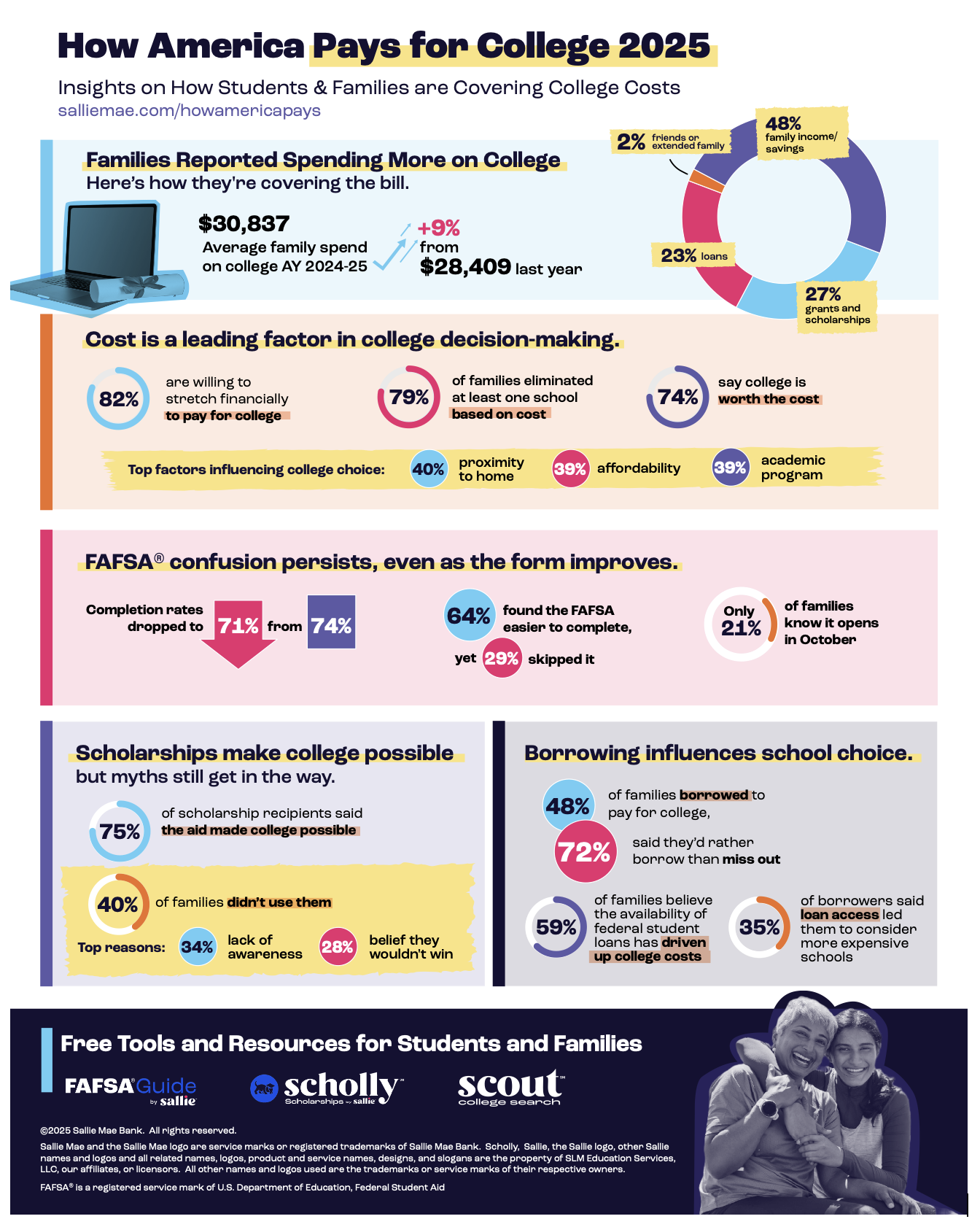
Families reported spending an average of $30,837 on college during the 2024–25 academic year—up 9% from $28,409 last year and a return to pre-pandemic spending levels, according to “How America Pays for College 2025,” the annual study by Sallie Mae and Ipsos. Family income and savings covered nearly half of costs (48%), followed by scholarships and grants (27%), borrowing (23%), and contributions from family or friends (2%).

For more detailed information beyond the graphic above, you can download the full report here.

Private Student Loans: A Smart Option for Parents Bridging the College Funding Gap

private student loans

For many families, even after financial aid, scholarships, and federal loans are applied, there’s still a gap between what college costs and what’s covered. That’s where private student loans can be a helpful solution. While they often get a bad reputation, private loans can be a valuable tool for parents who want to support their child’s education—especially when used thoughtfully and strategically.

The Benefits of Private Student Loans

  • Closing the Funding Gap: Private loans allow families to cover costs that federal loans and savings can’t. This ensures your child doesn’t have to compromise on the right school or program simply because of finances.
  • Potentially Lower Rates: Parents with strong credit can often qualify for competitive, even lower, interest rates compared to federal Parent PLUS loans. This can save significant money over the life of the loan.
  • Flexible Amounts: Unlike federal loans, which have borrowing limits, private loans often allow you to borrow enough to cover the full cost of attendance.
  • Fast Processing: Many private lenders offer quick approvals and disbursements, which can ease the stress of looming tuition deadlines.
  • Customizable Repayment Options: Some lenders offer a range of repayment plans, including options to make interest-only payments while your child is in school, helping keep balances manageable.
Continue reading Private Student Loans: A Smart Option for Parents Bridging the College Funding Gap

When Your Teen Gets Into Their Dream College—But You Can’t Afford It

dream college
Image by Carla Bosteder from Pixabay

When my daughter opened the email, I saw the joy light up her face. Congratulations! She got in. She did it. Her dream college, the one she had been talking about for years, was offering her a spot.

For a moment, everything felt perfect.

I let myself soak in her excitement. I hugged her tightly. I even let myself imagine what it would be like—move-in day, walking around that beautiful campus, wearing the school sweatshirt with pride. I thought about all the years of hard work, the late-night study sessions, the endless applications, the moments of doubt she had overcome. This was supposed to be it.

Then, the financial aid package arrived.

Continue reading When Your Teen Gets Into Their Dream College—But You Can’t Afford It

Will the Funding Freeze Impact Federal Direct Loans and Pell Grants?

funding freeze
Photo by Tim Gouw on Unsplash

There has been a fury of panic over the last several weeks as students and families received the news of federal funding freeze. Students all over Reddit were having meltdowns fearing they would not be able to finish college without this funding. That is not the case.

Continue reading Will the Funding Freeze Impact Federal Direct Loans and Pell Grants?

Understanding the Nuances of Applying for Financial Aid

Navigating the financial aid process can feel like wading through a maze of forms, deadlines, and unfamiliar terms. It can seem overwhelming for many parents, especially first-time or first-generation college families. But with a little guidance, you can make a significant difference in your student’s ability to afford college. Let’s break it down step by step to help you confidently tackle the process.

1. Know the Key Financial Aid Forms

The first step in applying for financial aid is understanding the forms you must complete. The most common ones include:

  • FAFSA (Free Application for Federal Student Aid): This is the gateway to federal grants, loans, and work-study opportunities. Many states and colleges also use FAFSA information to determine their aid packages.
  • CSS Profile: Some colleges, particularly private institutions, require this additional form to award institutional aid. It digs deeper into your family’s financial situation than the FAFSA.

Make sure to check the requirements for each college your child is applying to and note whether they require just the FAFSA, or both forms.

Continue reading Understanding the Nuances of Applying for Financial Aid

Are You Worried About Paying for College?

paying for college
Image from Pixabay

As a parent, I would say paying for college was on my top 10 lists of worries as my children entered high school. We were caring for my elderly father and great aunt, along with battling with breast cancer. It was all we could do to stay afloat with medical and elder care expenses breathing down our necks every month.

My son was looking at a military career, but I knew he wanted to go to college. He also knew that we could not afford to contribute. My daughter was two years behind him, and I knew she had her heart set on Boston University, an expensive private college in the northeast. I worried day and night that her dreams would not materialize, and my son would have few options other than joining the military out of high school.

My children were not first generation students. However, I did not attend college, and my spouse attended a local college that basically accepted anyone who applied. I was lost. My circle of friends were not college graduates and were not encouraging their kids to apply to college. My parents did not encourage me to attend college, so I was clueless about the process. I had no idea where to turn for help and the school counselor was responsible for hundreds of students at a large public high school. She had little time to advise students about colleges and even less time to help with figuring out how to pay.

Dealing with all the family drama and concerned about finances, my son made the decision during his junior year to join the Marines. I was supportive but worried the decision was forced on him because he felt he had no other option. The day he signed a letter of intent, I decided to focus the next few years on my daughter’s dream—attending college.

I knew I had to research colleges, look at finances, and make sure she had a stellar academic and extracurricular record to back up her applications. When she entered her senior year, we had a plan. Here’s what we did:

Continue reading Are You Worried About Paying for College?

Navigating Net Price Calculators

Net price calculators


Before your student applies to any college, it’s important to understand the cost of attendance as it applies to your family’s financial situation. Many disappointments can be avoided if this is the first step before applying to any college. We made that mistake with my daughter and although she got into her first-choice college, we simply could not afford it. If we had been realistic about the cost, we would have discouraged her from applying and steered her toward more affordable options.

With the rising costs of higher education, understanding the true financial implications of attending college has become increasingly crucial for students and their families. Net price calculators, often available on college websites, offer valuable insights into the actual cost of attending a particular institution after factoring in financial aid and scholarships. Here’s a comprehensive guide on how to utilize these calculators effectively:

Continue reading Navigating Net Price Calculators

When Your Financial Aid Award Isn’t What You Expected

financial aid award

As parents, we often have high hopes and expectations for our children’s education, and financial aid plays a crucial role in making those aspirations a reality. However, what should you do when your student’s financial aid award isn’t what you anticipated?

In this guide, we’ll explore steps you can take to address the situation and ensure your child receives the support they need for their academic journey.

Continue reading When Your Financial Aid Award Isn’t What You Expected

Another Delay for the FAFSA

FAFSA

Another FAFSA delay, yet again.

The U.S. Department of Education announced Tuesday that colleges and universities won’t receive students’ FAFSA information until at least early March. The delay, they said, is the result of the department’s decision to fix an error in how a student’s eligibility is calculated.

In its statement announcing the latest delay, the department also acknowledged that students can’t currently make corrections to their forms and wouldn’t be able to do so until the first half of March.

“With this last-minute news, our nation’s colleges are once again left scrambling as they determine how best to work within these new timelines to issue aid offers as soon as possible,” Justin Draeger, president of the National Association of Student Aid Administrators, said. “Financially vulnerable students shouldn’t be the ones to pay the price for these missteps.”

An Education Department website lists a host of other issues on the new form that are affecting applicants, echoing parents’ frustrations over the last month.

Continue reading Another Delay for the FAFSA