A Tool to Master the Dreaded Application Essay


college essay toolThe college application season is now in full swing and if you listen closely enough, you might be able to make out the tap-tapping of millions of seniors across the globe writing their application essays.  If you happen to be one of those students or a parent of one, I’d like to introduce you to Edswell, an application essay management tool that makes the whole process a lot easier.

So…what does it do? First, it gives you all of the application essay and deadline requirements for a student’s college list, in one click. Required, optional, supplemental, program-specific…all of them.  Students often spend days or weeks getting all of this information, now they can get it in a few seconds.

Second, it provides a beautiful essay management system that automatically organizes, syncs, and version controls every draft (built on Dropbox).  Instead of creating a folder and filling it with files, users simply click on the school and essay they want to work on – all drafts are viewable in an attractive feed-style format.

Third, it allows students to easily invite anyone to review a draft.  Reviewers do not need an Edswell account.  When the edited version is sent back to Edswell by a reviewer, it is incorporated into the feed for that essay, where differences between drafts are automatically highlighted.

Finally, it allows parents and counselors to track student progress.  Sometimes seniors need a nudge…Edswell gives the nudgers the information they need to make it happen.

You can give the platform a try for free for 30 days, no credit card required to sign up.  Just visit http://edswell.com and click “Free Trial.”  Oh, and for those interested in more information, there’s a short video walkthrough on the website.

I’d like to end with a salute to the seniors who are undertaking the not-insignificant task of memorializing their narratives, stories, and experiences in their application essays.  And Sam, if you’re reading this, I think it’s okay to start your Common App essay with “What’s a BA without a good burrito?”

_____________________

alex thalerAlex Thaler is the CEO of Edswell and the author of “The Art of the Personal Statement.”  He received his BA from UC Berkeley and JD from University of Pennsylvania.  In his non-existent spare time he enjoys woodworking and dreaming about moving to Hawaii.

Wednesday’s Parent: Choosing Courses to Impress Colleges


coursesHelping your college-bound teen choose the right courses is one of your most important jobs as a Parent College Coach. Along with your teen’s high school counselor and after doing a little research, you should be well prepared to guide your teen in choosing courses that will challenge them academically. There is no substitute for a solid academic, college focused education. Your teen’s transcript will be the cornerstone of their college application and college admissions counselors weigh the content of that transcript to determine your teen’s ability to handle a rigorous college course load.

A college education builds on the knowledge and skills that your teen has acquired during junior high and high school. Most selective colleges with the highest admission requirements look for students who have taken challenging science and math courses beyond the basics. Basic computer skills are essential, along with three or four years of a foreign language.

Advanced Placement (AP) Classes

Many high schools offer AP (Advanced Placement) courses and exams. AP courses are college level courses in approximately 16 different subjects helping students to prepare for college level work while still in high school. After the course is completed, your teen can take an AP test in the subject and many times receive college course credit. There is a difference between Honors classes and AP classes. Honors classes are advanced classes. AP classes and AP Honors classes offer the opportunity for testing once the course is completed. Having these difficult courses on your teen’s transcript communicates that they are up for the challenge of college and they can successfully complete college-level courses.

Dual Credit Courses

Many schools also offer an opportunity to take Dual Credit courses. A dual credit course is a college course taken by a high school student for which the student earns both college and high school credit at the same time. Some courses are taught at the high school campus during high school hours while others are taught at local colleges during the day, evenings, and weekends. By participating in the dual credit program, it enables your teen to make substantial progress toward their college degree before finishing high school. Students who begin taking courses in their junior year can earn thirty or more college credits by the time they graduate from high school if they also take summer classes at the college. It is possible to earn sophomore status even before they start college full time.

Electives

As you begin to plan your teen’s high school curriculum add any electives that might interest them: art, music, theater arts, JROTC, computer science, and business to name a few. If they are interested in pursuing a college education in theater arts, they should definitely add Drama to their curriculum. My daughter felt like that was what she wanted to do after high school. But after taking a few Drama courses, she realized it was not for her. It saved us thousands of dollars in the long run because she would have had to change majors in college and most likely increase the time of attendance. Letting them experiment in high school will also cement their interest and help in choosing the college that is best suited for their specific interest.

Your teen’s high school counselor should be able to offer additional help in the selection process and answer any questions you might have regarding specific college course requirements.

Read Wendy’s Post: High School Courses and College Admissions

_________________

Wednesday’s child may be full of woe but Wednesday’s Parent can substitute action for anxiety. Each Wednesday Wendy and I will provide parent tips to get and keep your student on the college track. It’s never too late or too early to start!

Join @pocsmom and I tonight with a #WednesdaysParent version of #CampusChat at 9PM ET with guest Nicole Lentine (@nlentine), Admissions Counselor at Champlain College, Co-Host of Admissions Live on the #HigherEdLive network discussing “How to Choose High School Courses.

Wednesday’s Parent will give twice the info and double the blog posts on critical parenting issues by clicking on the link at the end of the article from parentingforcollege to pocsmom.com and vice versa.

App Tuesday: Apps to Help Students Act During Critical Situations


apps for college studentsFollowing this week’s Mom-Approved Tips: Going to College May Be Deadly, here are some apps to help students act during critical situations to go along with the conversations you should have with your soon-to-be college students. These apps won’t solve the problem, but they can help save a life.

Apps to get help if needed

Circle of 6

iPhone and Android -Free

The Circle of 6 app is designed to help college students out of potentially dangerous situations. On the app, users should connect the phone numbers of up to six close friends. These should be classmates, roommates or trusted individuals in the area. In uncomfortable situations, users can safely and discreetly send a mass message for help. By pressing the car icon, users send out a text complete with your current GPS location. Your safety network will get your message and pick you up. Tapping the phone icon will send out a message that says, “Call and pretend you need me. I need an interruption,” to the six preset numbers. For true emergencies, students can call 911 from within the app. The app’s chat icon links users to information online about healthy relationships.

On Watch

iPhone and Android – Free

This personal safety app lets college students alert friends and authorities immediately in emergencies. There are six app functions: calling 911 and friends, calling 911 only, calling campus police, the “Watch my Back” setting (timed alert that must be disabled with passcode), contacting friends, and the “I’m here” setting. When you walk home and want to let friends or family know you’ve arrived safely, the “I’m here” setting does just that. The “I’m Here” text, call 911 only and call campus police functions are free with the app. The emergency friends, flashlight and alarm functions are available for a $2.99 fee. The complete package is available for $4.99 a month.

Apps to help deal with stress

Worry Box 

Android – Free

Have you ever wished you could put all your worries in a box, leave them there, and walk away? The Worry Box app may let you do just that. The app functions a lot like a journal: Write down your thoughts, anxieties, and worries, and let the app help you think them through. It will ask questions, give specific anxiety-reducing help, and can even direct you to help you reduce your worries and anxiety. It is all password protected, so you can feel safe sharing the details of your stresses.

Self-Help for Anxiety Management (SAM)

iPhone and Android – Free

The Self-Help for Anxiety Management (SAM) app from the University of the West of England can help you regain control of your anxiety and emotions. Tell the app how you’re feeling, how anxious you are, or how worried you are. Then let the app’s self-help features walk you through some calming or relaxation practices. If you want, you can connect with a social network of other SAM users. Don’t worry, the network isn’t connected to larger networks like Twitter or Facebook, so you won’t be putting your feelings on blast.

Apps to deal with depression

Operation Reach Out

This lifesaving app for iPhone and Android was developed by the military to prevent suicide. Recorded videos and menu options help users assess their thinking and reach out for help in crisis.

T2 Mood Tracker

Tracks symptoms of depression, anxiety, stress and general well-being.  Another excellent app developed by the Department of Defense National Center for Telehealth and Technology (see their complete list), for Android and iPhone.

Mom-Approved Tips: Heading to College May Be Deadly


college may be deadlyYes. I said heading to college may be deadly. At the risk of being a naysayer and offering a negative image, recent news confirms my concern. At least eight freshmen at U.S. colleges have died in the first few weeks of this school year. That’s by no means an epidemic, but it is something parents should address with their future college students.

In an article by Inside Higher Ed, “Lives Cut Short”, the stories of these tragedies is discussed:

At least eight freshmen at U.S. colleges have died in the first few weeks of this school year. The deaths have cast a shadow over the campuses on which the students spent too little time, but they’re also a cross-section of the kinds of issues and decisions facing freshmen as they begin their college careers — and of the choices some young students may not be prepared to make. Even colleges with the best approaches to educating students about mental health issues may have very little time to reach those who may be vulnerable.

Why is this happening?

You’ve lectured them. You’ve warned them. You’ve taught them right from wrong. But have you prepared them to face what waits for them at college: stress, extreme peer pressure, and abundant alcohol?

During senior year you are so focused on getting in to college, that often the most important discussions get shoved to the back burner. We cram those discussions in on the trip to move in and neglect to offer our kids advice on how to deal with the difficult decisions involved during those first few weeks of college.

“It’s a huge transition and all the support systems are different,” said Pete Goldsmith, dean of students at Indiana University at Bloomington. “For students who have lived in very structured situations and environments, going to a college campus when very suddenly they have this new kind of freedom and new choices to make, it can be pretty overwhelming.”

What tools should you give your student before he leaves for college?

Discussions about the dangers he will face in college are great—start there. But discuss the “what-ifs”:

  • What if everyone around you is binge drinking and wants you to join in? How will you respond?
  • What if you see someone who is obviously overindulging? What should you do and who should you tell?
  • What if a student tells you he’s suicidal? Where can you go for help?
  • What if you witness dangerous behavior? What should you do?
  • How do you recognize alcohol poisoning—how much is too much?

Don’t delude yourself into thinking that it’s not going to happen to your kid. Every school is a party school. Alcohol is readily available, especially to freshmen who consider it an “initiation” into adulthood to get when their parents aren’t a factor and they are free to abuse without repercussions. Sticking your head in the sand won’t help you or your student. Discuss the “what ifs” before freshman year.

Scholarship Friday: Scholastic Art & Writing Awards Scholarships


scholastic awardsAttention, Creative Teens: How to Become an Exhibited Artist or Published Author

The Scholastic Art & Writing Awards are accepting submissions from students in grades 7–12 who aspire to follow in the footsteps of Stephen King, Andy Warhol and Lena Dunham and gain opportunities for exhibition, publication, scholarships and more.

The annual Scholastic Art & Writing Awards, the nation’s longest- running, most prestigious scholarship and recognition initiative for students in grades 7–12, is now open for submissions and invites all aspiring teen artists and writers to share their work. Over the past five years alone, the Alliance for Young Artists & Writers, the nonprofit presenter of the Awards, has received more than one million original works from public, private and homeschooled students. The program provides top-winning artistic and literary teens with exhibition and publication opportunities, as well as access to millions of dollars in scholarships, while continuing its legacy of identifying the early promise of some of our nation’s most exceptional visionaries.

To learn more about the Scholastic Art & Writing Awards, visit www.artandwriting.org.

Virginia McEnerney, Executive Director of the Alliance for Young Artists & Writers said, “People who have been successful in their fields, from artists to scientists, all have one thing in common. At one time they were teenagers looking for their first great encouragement. The Scholastic Art & Writing Awards are a platform of opportunity that allow teenagers to push artistic boundaries and explore as they are shaping themselves to be part of the next generation of leaders, no matter what field of study they plan to pursue.”

Students in the U.S. and Canada, and those attending American schools abroad, are invited to submit creative works in the Awards’ 28 categories, ranging from comic art to photography, flash fiction to poetry, video game design to novel-writing and more. All works are evaluated through a blind judging process based on originality, technical skill and the emergence of a personal vision or voice—the same three criteria since the program’s founding in 1923. Submissions are first judged on a regional level by the more than 100 affiliates of the Alliance, which bring the program to local communities across the country. Top regional submissions are then evaluated on a national level by an impressive panel of creative-industry experts. Luminaries in the visual and literary arts, including Andres Serrano, Edwidge Danticat, Kay WalkingStick, Roz Chast and Stephen Savage, have all served as past jurors.

Deadlines for submissions vary by region throughout the winter months, with National Scholastic Art & Writing Award winners announced in March 2015.

What it means to win a Scholastic Art & Writing Award:

  • The outstanding students who win Scholastic Art & Writing Awards walk in the footsteps of celebrated creative leaders such as Andy Warhol, Truman Capote, Richard Avedon, Sylvia Plath, Robert Redford, Stephen King, Myla Goldberg, Richard Linklater, Kay WalkingStick, Zac Posen and Lena Dunham, all of whom won an Award when they were teens.
  • The Scholarship Partner Network includes more than 60 colleges and universities who set aside scholarships for Scholastic Art & Writing Award–winning high school seniors. With more than $10 million available, the program is the largest source of scholarships for creative teens.
  • Each year, 16 high school seniors are awarded the Portfolio Gold Medal, which is accompanied by a $10,000 scholarship—the highest possible honor a student can receive through the program.
  • Cash awards are also available to students of all grades, as well as teachers.
  • Student writers may be published in The Best Teen Writing series of anthologies, which are available for purchase at amzn.com/0545818966.
  • A large selection of student Scholastic Art & Writing Award–winning works will be on display in the Art.Write.Now. National Exhibition in New York City at Parsons New School for Design and Pratt Manhattan Gallery in June 2015. An annual traveling Art.Write.Now.Tour also brings student work to cities across the country. This year’s tour is now open at the Rhode Island School of Design in Providence, RI, and will travel to the Salt Lake City Public Library as well as the Catskill Art Society in Livingston Manor, New York.
  • National winners will be honored during a special awards ceremony at the world-famous Carnegie Hall in New York City, where celebrities, families and teachers congratulate the student winners and encourage them to continue in their paths. To view this past year’s ceremony online, visit www.artandwriting.org/carnegiewebcast2014.
  • Five students in grades 9–11 are selected annually to serve as literary ambassadors as part of the National Student Poets Program, the nation’s highest honor for youth poets presenting original work. Winning a Scholastic Art & Writing Award National Medal in poetry is the exclusive pathway to this honor, which is presented in partnership by the President’s Committee on the Arts and the Humanities, the Institute of Museum and Library Services and the Alliance.

The Alliance is grateful for its generous sponsors, who provide funds to support and produce the Awards: Scholastic Inc., The Maurice R. Robinson Fund, Command Web Offset Co., the Institute of Museum and Library Services, the President’s Committee on the Arts and the Humanities, The New York Times, Kramer Levin Naftalis & Frankel LLP, The National Endowment for the Arts, Blick Art Materials & Utrecht Art Supplies, 3D Systems, The Gedenk Movement, Golden Artist Colors, Bloomberg L.P., the Bernstein Family Foundation, Jacques and Natasha Gelman Foundation, the New York City Department of Cultural Affairs, Duck Tape® and additional contributions from numerous other individual, foundation and corporate funders.

To learn more about the Scholastic Art & Writing Awards, visit the Scholastic Media Room online at mediaroom.scholastic.com/artandwriting.


Wednesday’s Parent: An Extracurricular Match Made in Heaven


extracurricularWhen it comes to extracurricular activities, it requires some careful thought and exploration from your student. Picking a volunteer activity is more than just pulling a name out of a hat. The number one criteria for choosing an extracurricular is: pick something that interests you AND stick with it. Of course, there are the obvious: hospitals, local charities, beach clean-up, etc. But what if your teen isn’t interested in any of these options?

Where do you go to find some unknown volunteer opportunities? Here’s a good list of sites that might help you find the best volunteer fit for your college-bound teen:

Hands On Network: With 250 action centers around the country, it’s easy to connect and get started with a volunteer opportunity that fits your schedule and location.  Plus, they’ll occasionally partner with corporations like Disney to offer special incentives for volunteering.

Do Something: Focused more on teen activism and engagement with causes, their site offers “Virtual Volunteer” opportunities so you can take action without leaving your couch!

US Department of Housing and Urban Development (HUD): Interested in volunteering in our National Parks?  For the Smithsonian?  Start here.   You’ll find a host of ways to volunteer alongside existing government programs.  The HUD site also lists opportunities to provide technology access and job training to those who need it on a volunteer basis.

VolunteerMatch: One of the largest online databases for volunteering, where over 71,000 nonprofits have listed local and regional events and projects.

Go Abroad: Want to volunteer on vacation?  Fulfill your travel bug and your need to do good at the same time by applying for one of the nearly 6,000 “Volunteer Abroad” opportunities from more than 1,300 organizations around the world.

iParticipate: Follow the stars.  Literally.  The Entertainment Industry Foundation launched this project with Ashton Kutcher, Mayor Michael Bloomberg, Katie Couric (and many others) in a campaign designed to encourage Americans to consider volunteering as an integral part of our national identity.

Serve.Gov: One year old today, this site and associated initiatives were created by the Serve America Act.  One of its purposes is to help Americans get back to work by building skills and connections through volunteer opportunities.

Need more ideas? Here’s an article I wrote for TeenLife: 10 Community Service Ideas for College Bound Teens.

Every college expert will tell you that volunteering is an integral part of the high school resume. But remember…one day here and there does not a volunteer make! Consistency over the course of your teen’s high school career shows a level of commitment to the cause and a willingness to give back.

Read Wendy’s post:Pick a Club, But Not Any Club

____________________________________

Wednesday’s child may be full of woe but Wednesday’s Parent can substitute action for anxiety. Each Wednesday Wendy and I will provide parent tips to get and keep your student on the college track. It’s never too late or too early to start!

The bonus is on the fourth Wednesday of each month when Wendy and I will host Twitter chat #CampusChat at 9pm ET/6pm PT. We will feature an expert on a topic of interest for parents of the college-bound.

Wednesday’s Parent will give twice the info and double the blog posts on critical parenting issues by clicking on the link at the end of the article from parentingforcollege to pocsmom.com and vice versa.

Parent Toolkit App


parent toolkit app

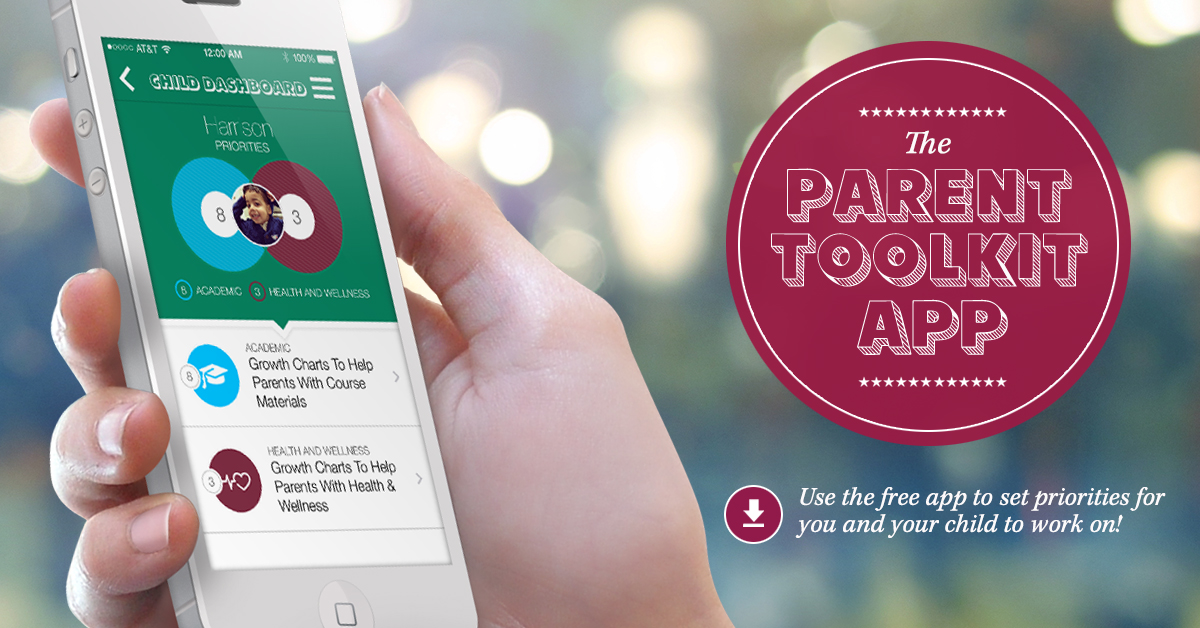
The Parent Toolkit App is designed to help you navigate your child’s growth and development from Pre-K through 12th grade in the classroom and beyond. For each grade, the app offers benchmarks to see what your child will be learning in school, and recommendations for diet, sleep and physical activity. The grade-by-grade tips work into your everyday schedule to support what your child is learning and promote a healthy lifestyle.

Choose whether you want to browse through academic or health and wellness benchmarks and tips. The academic information will help you ensure your child is on the path to success. It also provides helpful advice on homework, parent-teacher conferences and supporting learning at home. In the health and wellness section, you’ll find tips on encouraging physical activity, eating a well-balanced diet, and ways to make sure your child gets enough sleep.

Set priorities for you and your child to come back to using The Parent Toolkit App. A priority is an item that you mark as important to your child’s development. It can be something you want to review later, or a tip you want to remember to try. Use the “+” button to mark items as priorities and create a list for review later. You can then mark items as completed once you’ve accomplished your goals. You can also share helpful information and tips throughout the app with family, friends, and more using social networks or email.

The Parent Toolkit App is produced by NBC News and sponsored by Pearson. It has been accessibility tested and works with VoiceOver. Download The Parent Toolkit App in English or Spanish and get started today — it’s free!

You can download your FREE mobile app here: http://lksn.se/toolkit 

Or text “Toolkit” to 33733

College Rankings


college rankingsU.S. News released their college rankings yesterday. There is always a great deal of emphasis placed on these rankings. Colleges boast about their possession in the pecking order and use it for marketing to students. But are these rankings accurate? What do they mean? What don’t they mean?

Personally, I don’t put much weight on the U.S. News college rankings. These rankings are based on a subjective collection of information from the colleges themselves. Colleges have been known to pad their data, cheat on the reporting, and shift the data in their favor in order to rank high on the list.

Parents have been known to use the list to insist their student attend one of the high ranking colleges. But honestly, it’s just a way to claim bragging rights for the parents and has very little to do with the actual quality of the education for the price.

I always suggest that parents use more than one source when comparing colleges and gathering data.

Custom College Rankings

Custom College Rankings is an amazing site created to help you view all the college statistics on a spreadsheet and change the criteria of the spreadsheet as you view it. There are over 2900 colleges and universities with statistics for each gathered from the most recent data from the U.S. Department of Education.

ETC College Rankings Index

“The ETC College Rankings Index measures the improvement in employability and earnings that a particular college brings to its graduates, relative to students similarly situated at other colleges” – states Michael R. Havis, president and founder of the nonprofit Educate To Career, who adds – “Students and parents are focused on the value-added by going to a particular college and pursuing a specific area of study.”

College Factual

Unlike other college ranking systems, College Factual serves as a decision-making hub throughout the entire college search process, sharing outcomes-based data such as average student loan debt per student and default rates; how well colleges retain and graduate students; graduates’ starting salaries and earning potential; and return on investment based on cost of a degree.

In addition to these sites, you can use College Navigator, Cost of Learning, and College Data to gather more information. Never rely solely on one set of rankings. Use the comparison tools to make a wise college choice.

Wednesday’s Parent: 5 Qualities a Mentor Should NOT Possess


mentorWhen I was in middle school I had a teacher who took a special interest in me. She encouraged me to work hard and spent extra time with me after class to explain the day’s work. Miss Castillo will always be a mentor who influenced my academic life. Because of her encouragement I graduated in the top 10 percent of my graduating class of 900. Because of her I gained self-esteem. She encouraged me, challenged me and supported me during my middle school years.

I’m sure you all have someone who influenced you in school. But mentors aren’t always in the academic realm. They can be coaches, pastors, business leaders and family friends. Mentors take the time to invest in your life and make an impact on your personal life and your future.

There are so many suggestions on how to look for and choose a mentor. But in true Parent College Coach fashion, here are 5 qualities I believe a mentor should NOT possess:

Critical

The last thing you need in a mentor is someone who is constantly criticizing you. There may be something to be said about constructive criticism, but listening to someone constantly criticize and belittle you is not inspiring. It only destroys your self-esteem.

Negative

Nobody likes being around a negative person, especially if it’s someone you are looking to for advice and encouragement. A person who always sees the glass as half empty is not going to inspire you to achieve your goals.

Patronizing

You don’t need someone who is patronizing. A mentor should never act superior or talk down to you in any way.

Disinterested

You need someone who is invested in teaching you, training you and guiding you in your life pursuits. If the person you choose is disinterested and uninvolved it’s a waste of your time.

Controlling

The idea of having a mentor is to teach you, not control your every decision. A controlling person is less likely to help you find your own path—he will want you to follow his.

Choosing a mentor requires thought and careful searching. As in my case, mentors can have a profound effect on your life. Choose wisely.

Read Wendy’s post: Choose a Mentor in 3 Steps

____________________________________

Wednesday’s child may be full of woe but Wednesday’s Parent can substitute action for anxiety. Each Wednesday Wendy and I will provide parent tips to get and keep your student on the college track. It’s never too late or too early to start!

The bonus is on the fourth Wednesday of each month when Wendy and I will host Twitter chat #CampusChat at 9pm ET/6pm PT. We will feature an expert on a topic of interest for parents of the college-bound.

Wednesday’s Parent will give twice the info and double the blog posts on critical parenting issues by clicking on the link at the end of the article from parentingforcollege to pocsmom.com and vice versa.

illustrate-The Video Dictionary


video dictionary

illustrate is a FREE app that is much more than just a dictionary. The app makes use of animated videos and actual conversations to explain the meaning, context and usage of those ever so difficult words. Whether you are a student preparing for an exam, an english buff or just someone who wants clarity on the meaning of a word, “illustrate – the video dictionary” is your app of choice.

Perfect for educators and aspirants of exams such as SAT, GRE, CAT, GMAT, PSA, ACT, ACTII, MCAT and LSAT.

Key Features

  • 20,000 videos available to view
  • Content updated daily
  • Test your english skills with Question of The Day
  • Be amazed by the Fact of The Day
  • See what is popular and trending
  • Buy premium word lists to help you prepare for competitive exams

Here’s what review sites and our users have to say about ‘illustrate – The Video Dictionary’ :

  • Illustrate is an awesome free dictionary app for iPad. The videos are really interesting and help you to understand as well as remember words easily.
  • illustrate provides you with meaning and usage of English words with videos. You get actual scenarios to better understand the context in which each word can be used. illustrate not only helps you understand the meaning of words, but it also shows you new words that you may want to know about. It is designed for folks who are planning to take exams such as SAT, GRE, ACT, and those in an ESL program.
  • Fantabulous! It’s a must have app and the best app for those who want to improve vocabulary. Visual aid does everything when it comes to remembering.
  • Smart application! Easy to use and quick to access. The video illustrations are precise and clear.

 
iOS App Store: https://itunes.apple.com/app/id855051941
Google Play Store: https://play.google.com/store/apps/details?id=com.mocept.illustrate
company: www.mocept.com
facebook: https://www.facebook.com/illustratevideodictionary

Helping parents navigate the college maze