Are private student loans right for you?


private student loansWhen considering different ways to fund college expenses, some students and parents focus on federal loans, scholarships and grants. While these types of aid can provide the necessary funds to complete a four-year or graduate program, they are not the only options available.

Several banks and private lenders offer private loans for college, which are essentially personal loans that can be used for tuition and other college related expenses.  Even if a student applies for federal aid, a private loan can pay for expenses not covered by their government loan.

If you or your child has never considered private student loans, here are four reasons to look into this option.

Flexible repayment plans

If a parent applies for a private student loan to pay his child’s tuition, repayment begins as soon as funds are disbursed. Fortunately, this is not the case for students who apply for their own private loan.

For student who apply, repayment does not begin until six months after graduation from school. This is a plus, as many students need time to find employment and adjust to their new expenses. Of course, students do not have to wait until graduation. There is also the option of making in-school payments. In-school payments can reduces how much a student pays in interest and lowers his overall balance.

Fixed and variable interest rates

Some college students shy away from private lenders because many private loans feature a variable rate. However, fixed rate private student loans do exist. To find these loans, students have to shop around and compare rates with different banks. Fixed rate student loans are desirable because the rate remains the same for the duration of the loan, thus eliminating payment increase and decreases.

Option to add a cosigner

Because private funding is a type of personal loan, banks do require a credit check. Good credit is a criteria for private funding. This can be problematic for college students who do not have a credit history, or those with a limited credit history. But there are ways around this hurdle. Students who need additional funding can add a cosigner – such as a parent – to their loan. This increases the odds of approval, however, the cosigner must have good credit.

Use funds for anything

If applying for a private student loan, funds can be used for more than tuition. This type of personal loan is helpful for covering all college-related expenses, such as books, supplies, a computer, rooming and board, and transportation.

College is expensive, and unfortunately, some people put off their dream of acquiring a higher education because they don’t have enough in savings. But with the help of private student loans, college can be a reality.

A word of advice: Be careful about how much you borrow and gage wisely your ability to repay after graduation. With student debt rising to record levels, smart borrowing should ALWAYS be a priority.

 

Education vs. Income Level


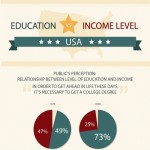
To help parents and students better understand the value of higher education, Varsity Tutors, a premier one-on-one private tutoring and test prep provider, today released an infographic that delves into the perceived importance and actual effects of higher education on income and career prospects. Entitled “Education vs. Income Level,” the infographic compares educational attainment to U.S. employment and salary statistics.

education vs income levelIn 2009, 73 percent of Americans said they agreed with the statement, “In order to get ahead these days, it’s necessary to get a college degree,” compared to just 49 percent in 1978. This increasingly common perception aligns with employment and salary statistics for college-educated adults.

“Data has shown that highly educated individuals are more likely to earn higher wages throughout their lives,” said Varsity Tutors founder and CEO Chuck Cohn. “It’s important for parents and students to understand the value of a college degree when making decisions about their education and future career plans.”

The infographic features survey data from the U.S. Bureau of Labor Statistics and other sources, including these key facts:

  • The unemployment rate for college graduates is well below the national average, and has been consistently lower than the rates of unemployment for individuals without a Bachelor’s degree over the past 10 years.
  • In 2013, the unemployment rate for people with a Bachelor’s degree or greater was 3.7 percent, compared to 7 percent for those with some college experience or an Associate’s degree, 8.1 percent for those with a high school diploma, and 12 percent for those with less than a high school diploma.
  • Individuals with a Bachelor’s degree are expected to earn $2.422 million over the course of their lives, compared to just $1.371 million for those with only a high school diploma.

The infographic also highlights differences in income among individuals with master’s and doctoral degrees, and compares wages and annual earnings across several career fields from Engineering to Social Sciences. To learn more about the impact of higher education on income, view the full infographic athttp://www.varsitytutors.com/blog/education+vs+income+level+in+the+usa+infographic.


For more information about Varsity Tutors and its services, visit www.varsitytutors.com.


About Varsity Tutors


Varsity Tutors is a premier private academic tutoring and test prep provider designed to help students at all levels of education achieve academic excellence. Varsity Tutors delivers in-home, personalized, one-on-one instruction in any subject from STEM to the humanities and customized preparation for all standardized exams, including ISEE, SSAT, SAT, ACT and graduate exams such as the GRE, LSAT, MCAT and GMAT. Students from elementary to graduate school are expertly matched with an exceptional tutor who is best able to address their unique needs and goals. To ensure satisfaction and safety, only the highest caliber tutors are selected to join Varsity Tutors following a rigorous screening process. Varsity Tutors currently serves 19 cities nationwide and offers a variety of tutoring packages. Students and their families interested in learning more about Varsity Tutors should visit varsitytutors.com


Investing in a laptop for college

laptop

If you have a teen heading off to college in the fall, these upcoming weeks are a great time to get ready for college: like purchasing books and dorm room furniture and supplies to be ready for the first day of class.  And hopefully, many students received some of these supplies as graduation gifts.  One of the most necessary items to have before stepping foot on campus in the fall is a laptop.  Laptops offer supreme portability and efficiency, aspects which make them an essential item for all college students.

And parents, laptops have far more uses for your children than checking Facebook every ten minutes and playing online games.  With a laptop, students can easily and more effectively take notes during class and Skype their parents to tell them face-to-face how school’s going.  But there are so many laptops to choose from–how do you decide?

Fortunately, Parents Countdown to College Coach has a laptop comparison tool, powered by FindTheBest, that enables parents and their children to narrow down the best laptops for their needs and preferences.  With the widget below, you can sort through hundreds of laptops by price, display size, battery life, and Smart Rating (a single rating based on technical specifications and review scores from expert sources).  Also, if you want to narrow down the list, just filter the search by price range, display, battery life, and storage range, and also laptop type.  If and when you find the laptop that best fits your child’s needs (and your budget!), you can purchase it directly from Amazon, and it will be at your doorstep in a week or less.

[findthebest container_style=”width:520px;margin:0 auto;” width=”520″ height=”400″ style=”vertical-align:top;” src=”http://laptops-and-notebooks.findthebest.com/w/srp?new=2&w=520&h=400&amazon_id=parecountocol-20″ after_style=”text-align:center;” link_href=”http://laptops-and-notebooks.findthebest.com” link_style=”font:10px/14px arial;color:#3d3d3d;” link_text=”Compare Laptops and Notebooks”]

Also, a crucial accessory to have for laptops in college are headphones.  Whether your child wants to listen to music while he’s in the library, or he needs to watch a documentary for class while his roommate is asleep, this item comes in handy very often.  Like laptops, determining which earphones are right for them is a difficult process.  Check out the widget below to find and purchase the right headphones for your kids!

[findthebest container_style=”width:520px;margin:0 auto;” width=”520″ height=”400″ style=”vertical-align:top;” src=”http://head-phones.findthebest.com/w/srp?new=2&w=520&h=400&filter_by=Price&amazon_id=parecountocol-20″ after_style=”text-align:center;” link_href=”http://head-phones.findthebest.com” link_style=”font:10px/14px arial;color:#3d3d3d;” link_text=”Compare Headphones”]


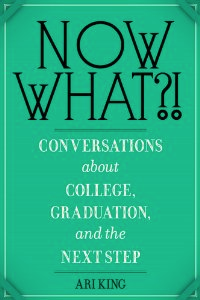
“Now What?”-Conversations about College, Graduation, and the Next Step


I’m always happy to promote books about college and the college process. “Now What?”, a book by Ari King, gives a unique perspective by using more than 60 interviews with new and established college graduates about adjust to college, preparing for graduation, and figuring out what to do next. Here’s some info about the book and how you can purchase a copy. 

_________________

now whatNow What?! Conversations about College, Graduation, and the Next Step (June 2013) shares the highs and lows of the transition from college to the “real world” and shows the breadth of roadmaps college graduates use to make their way in the world after commencement. From the budding marine biologist who studied abroad in St. Croix to the theater director who started out driving actors around, each interview in Now What?! shares honest, practical, and often humorous advice about navigating every aspect of college, coping with graduation, and moving forward in the “real world.”

Now What?! features interviews with Bobbito García, a writer and Renaissance man put on academic probation twice; Kathy Keeler, a job-hopping rower and Olympic gold medalist; Will & Grace creator/producer David Kohan, who got his first break from Sydney Pollack; U.S. Attorney Tristram Coffin, who went building to building in Lower Manhattan to get his first paralegal job; Peapod, Inc. founders Andrew and Thomas Parkinson, whose entrepreneurial streaks started in college; Jane Eisner, editor-in-chief of The Forward, who graduated early to take a newspaper job; actor Bradley Whitford, who lived off ramen and peanut butter after graduation; travel photographer Michael Yamashita, who discovered his passion while unloading cargo in Japan; Daniel Handler, also known as Lemony Snicket, who worked as a dance class pianist, laundry assistant, and bartender while starting his writing career; Kathleen Clyde, a state representative who contemplated fashion instead of politics; author Sebastian Junger, who started out working in construction; Dina Kaplan, who contemplated TV reporting and ballet and later founded Blip; former Ethicist columnist Randy Cohen, who was studying music when he realized he had no musical talent; and Peter Schube, President and COO of The Jim Henson Company, who reluctantly lived with his mother after college while working as a paralegal.

“Everyone has a story to tell about college and the first year out. For some, it was a struggle capped with anxiety, doubt, questions, and feelings of failure. For others, it was a year spent traveling, preparing for graduate school, working a random job, and dealing with the unknown,” King said. “I wrote this book after thinking about how there are guidebooks to cities, and that there should be something comparable for those who are finishing college.”

Now What?! Conversations about College, Graduation, and the Next Step is now available for purchase online at www.amazon.com. Even though Amazon says “temporarily out of stock”, you may still go through with the ordering process and purchase the book and it will be shipped next week. For more information about the book, visit www.ariking.com or e-mail info@ariking.com.

Get the 411 on Student Loans

student loans

The day a son or daughter receives his/her college acceptance letter is one filled with joy and celebration.  The day that parents have to sit down with their children to choose student loans is not.  Selecting a student loan is often an intimidating process: not only are there so many options out there, but it is scary to think that a wrong decision could cost tens of thousands of dollars.   But before you pull out all of your hair just thinking about it, know two things.  One, Almost 60% of college students have to borrow money each year to assist in  tuition.  And two, there is a resource out there that helps parents and their kids find, using objective data, the student loan that best fits their needs and preferences.

FindTheBest just launched the best student loans comparison that lets students and their parents sort through 69 different loans by average fixed and variable interest rates and lifetime limit.  One can also filter down this list by loan type, loan coverage, eligible borrowers, cosigner requirements, and more.  For example, if you are an undergraduate that wants to get a loan from a private bank, you have a list of 7 loans to compare.  From here, you can pick the three or four loans that you like the most, and then compare side-by-side all of their application requirements, coverage, interest rates, repayment options, and more.

To summarize, FindTheBest breaks down the data, makes it easy to view, gives it to students and parents for free, so that scams and hidden fees are no longer a threat.  With this resource, students can make the most informed decision based on the factors that are important to them.  And if you have, no idea where to even start with student loans, check out the “Choosing A Student Loan” tab that guides you through the loan process and how this comparison tool works.  Try out the resource now below:

[findthebest container_style=”width:520px;margin:0 auto;” width=”520″ height=”400″ style=”vertical-align:top;” src=”http://student-loans.findthebest.com/w/srp?new=2&w=520&h=400&filter_by=lender_type,fixed_variable_interest,name_of_lender&amazon_id=parecountocol-20″ after_style=”text-align:center;” link_href=”http://student-loans.findthebest.com” link_style=”font:10px/14px arial;color:#3d3d3d;” link_text=”Compare Student Loans”]

Oh Canada–heading north for affordable college


mcgill university
McGill University-Canada

With American college tuition rising and families feeling the economic pinch, universities in Canada are becoming more and more appealing. Graduating with student loan debt is forcing students to look north to Canada for a more affordable education. That’s right–Canada!

According to the Institute for College Access and Success, the number of U.S. students at Canadian colleges rose 50 percent in a decade, and now about 10,000 Americans attend Canadian colleges. The institute reports that graduates from an American university can expect, on average, to carry more than $26,000 in debt; and 9 percent of those graduates default on student loans within two years.

Compared to American universities, Canadian colleges clearly offer a better bargain (costs for one year of tuition):

  • University of Chicago – $45,945
  • George Washington – $45,780
  • Stanford – $41,250
  • McMaster (Hamilton, Ontario) – $20,966
  • McGill – $14,561
  • University of Winnipeg – $11,115

The overall costs are significantly lower with the added benefit of American students allowed to use college savings plans and U.S. student loans. Many universities also offer scholarships as well.

Continue reading Oh Canada–heading north for affordable college

4 Reasons to consider a Human Resources degree


human resourcesWhen it comes to choosing a program or degree, it’s difficult to prioritize. The best degree is both a job trajectory that your student wants to pursue as well as a degree that employers value when hiring.   However, that combination is sometimes elusive.

One program that has seen a great deal of popularity in the last decade is human resources management.  Many colleges offer specialty certifications in HR, such as the well-known program at Stritch.edu, and your graduate to-be will have plenty of choices if they choose this to go down this path.

Why choose a career in human resources?  Here are 4 reasons for consideration:

1. Companies will always have a need for human resources.  Companies can’t run on machines alone. Although in some industries, automation is a trend, someone still has to be around to ship the products or monitor the machines. A human resources team is needed to pay those employees, manage benefits, handle staffing, etc.  Human resources teams may stay lean in tough times, but they’ll never go away; they’re just as essential as upper management in ensuring that things get done, and HR often picks up the slack where other departments don’t.

2. Human resources departments have jobs for all skill sets.  You might think that you need to be a “people person” to work in human resources, but not all HR staffers spend their time working on direct employee interaction.  HR is now a major technology user itself, for functions like payroll, promotions and review processing, and employee monitoring tools like internet censoring and time cards.  Some HR teams have entire technology teams within them.

Continue reading 4 Reasons to consider a Human Resources degree

5 Things to consider when choosing a study abroad program


study abroadNot all study abroad programs are alike. Some are for a semester while in college. Others are during the summer months. And still others offer study abroad for a year or more. With so many program types and destinations, it can be difficult to decide which program best fits your student’s needs.

Here are five things your student should consider when choosing a study abroad program:

1. Is study abroad right for you?

Study abroad offers an opportunity to travel, explore other cultures, and gain experiences that can enhance your future career. But studying abroad is not necessarily a good fit for every student. Studying abroad is a unique and adventurous opportunity but can also be challenging for a student who isn’t comfortable being far away from home and away from their support system.

2. Where and when would you like to study abroad?

There are so many destinations to choose from and so many options available. Do the research. Study the countries. Ask yourself questions about the length of study and whether or not you want to be in an english-speaking country. Follow student bloggers who are studying abroad and ask questions about the countries they are living in.

Continue reading 5 Things to consider when choosing a study abroad program

10 Summer SAT Study Tips


sat prepJuniors and seniors in high school are looking toward the fall and standardized testing. For seniors, it’s the last chance to get their best score before the college applications are submitted. For juniors the fall test can be a good indicator of areas that need improvement and require more preparation. Taking advantage of the summer to prepare for these tests is just smart academic sense.

Following are ten summer SAT study tips to help your student prepare for standardized tests in the fall.

  1. Read-All SAT test experts will tell you that reading is one of the best and easiest ways to prepare for the SAT. Reading for entertainment is helpful, but reading for content and purpose will help with the reading part of the SAT.
  2. Utilize self-paced study-Use the Official SAT Study Guide produced by the College Board and study at your own pace. Use the free online prep as well. Set a schedule to study, however, and stick with it.
  3. Take a practice test-Practice tests help you evaluate your strengths and weaknesses. Set aside time to complete them just like you would on test day. It helps to familiarize you with time constraints and focus on the test itself without distractions.
  4. Sign up for an SAT course-There are a variety of courses available throughout the summer, both in person and online. Online SAT courses offer students flexible accessibility to test prep solutions that cater to each individual. Barrons Test Prep offers a diagnostic test, lesson videos, practice materials and reports that help your student track their progress. The price is affordable and they offer a free trial to test out their service.
  5. Hire a private tutor-Many students need the one-on-one instruction that a private tutor can give. Tutors can help your student evaluate their academic strengths and give them personalized academic tutoring which will help with the standardized tests. Before you hire them, however, do the research.
  6. Sign up for the SAT question of the day-This is just another way to familiarize yourself with the test and practice one question each day. Sometimes smaller dozes of studying help break it up and can be easier to remember.
  7. Boost your vocabulary-Use flash cards, sign up to receive an SAT word of the day in your email, post words on the refrigerator, and talk about them with the family at dinner. Crossword puzzles also help increase your vocabulary.
  8. Write-Practice writing essays by journaling or blogging. Since most of communication today is done by texting or IM speak, it’s good to write using correct grammar, syntax and complete sentences.
  9. Study with a friend-The buddy system helps your student stay accountable.
  10. Review math skills-The math part of the SAT requires knowledge of basic math concepts and formulas. SAT books provide an index of the math skills required and the practice tests give your student and idea of the type of math questions they will need to become familiar with.

SAT prep doesn’t need to be torturous. In small doses your student will retain what they learn and won’t be cramming the last few weeks before the test. Summer is the perfect time to spread the study out.

10 Scholarships Summer Prep Tips for Students


Today’s guest post is by Monica Matthews of How to Win College Scholarships. Monica’s advice for parents and students is always helpful and timely. Her proven track record of winning scholarships for her own family and her “how-to” approach that helps other parents do the same, makes her an expert in the scholarship search process.

____________

scholarshipsFor students, summer vacation usually means sun, beaches, and fun.  For parents of the college-bound, however, summer means one step closer to college tuition bills and students loans.  There are a number of things students can do to get a jump-start in the college scholarship process during the summer, while at the same time saving time for fun in the sun.

  1. Volunteer – Helping others is a great way to explore career options, meet mentors, and rack up invaluable community service hours that scholarship providers look for in their applicants.
  2. Write – Scholarship essays are how judges get to know students on a deeper level.  Students can find some early deadline scholarships and practice writing the required essays. Continue reading 10 Scholarships Summer Prep Tips for Students