Category Archives: FAFSA

5 Questions to Ask the Financial Aid Office

Keep these questions in mind as you plan your next college visits and take the time to schedule an appointment with the school’s office of financial aid.

1. What are your financial aid deadlines?

In addition to deadlines for the standard financial aid applications: the Free Application for Federal Financial Aid (FAFSA) and PROFILE, the financial aid application service of the College Board, colleges may also have their own deadlines and forms. Be sure to ask if the school’s financial aid forms are different for need-based and merit-based aid when the deadlines are. Note many schools have declared March 1 as their priority filing date for financial aid. Be sure to confirm each school’s priority filing dates.

2. What is your Cost of Attendance (COA) for the current year?

 There are precisely six components to a college student’s complete budget:

  • Tuition
  • Fees
  • Room and Board
  • College Textbooks and Supplies
  • Personal expenses
  • Transportation

Many proposed budgets only include Direct Costs (which are the first three items listed) and typically what you will pay directly to the bursar’s office. However, the U. S. Department of Education requires that colleges fully inform you as to all of the above costs, so find out specifically what those amounts are to establish a complete budget for college expenses.

3. How much of an increase in the COA do you project for next year?

When you ask this question, be sure to request the specifics related to each cost component. Tuition and Room and Board increases are independent of each other. For example, one school may expect an increase of 5 percent in tuition and fees, but a 10 percent increase in Room and Board. This information will help with budgeting but also gives the financial aid officer the impression that you are an informed parent.

4. Are you able to meet 100 percent of financial need?

If they say “No,” find out why, and get details. Is the policy based on “first come, first served?” What’s the average percentage of need the school can meet? What percentage is in the form of grants and how much is in the form of loans? Is there a dollar amount left as a gap (unmet need) for everyone? Do they include Parent Loans (PLUS) in the aid package?

(Note: They shouldn’t do this…those loans are to be used for your EFC-Expected Family Contribution, not for meeting the financial need of the student.)

5. Do you offer Merit Scholarships, and how do you treat private scholarships awarded to the student?

If a Merit Scholarship is being awarded, it normally goes into the financial aid package first, reducing the amount of need-based aid. Find out if a merit award reduces the self-help in the package, or if it replaces other need-based grants. A true Merit Scholarship can go beyond the “need” level, which means that it can lower your EFC. 

Art Imitates Life: Opening the Financial Aid Award Package


What’s more scarier and nerve-racking than waiting for the college decision? Opening the financial aid award package. Families all across the country are waiting for the arrival of their financial aid award, knowing that their student’s ability to attend college depends on the amount of the award.

This is such a universal anxiety among parents, television shows have written episodes around the issue. My three favorites, Gilmore Girls, Dawson’s Creek, and The Middle paint a picture of how the award letter affects college attendance.

Dawson’s Creek

Joey Potter is accepted to a high-priced private university in New England. But accepting the offer of admission depends on her financial aid package. When she receives it, they didn’t offer her a full ride. She and sister meet with the admissions counselor, who tells them that since their business is doing well, Joey doesn’t qualify for financial aid.

financial aid award package

The counselor says, “Nearly everyone these days borrows some money to pay for college.” Joey replies, “I don’t want to do that. i don’t want to graduate with debt.”

Gilmore Girls

As graduation day approaches, Rory learns her financial aid was rejected. The irony, her mother received some financial assistance from her grandfather that altered the FAFSA results. Even though they were financially unable to pay, that money took them out of the running for aid.

financial aid award package

Rory’s mother explains, “We didn’t get financial aid for Yale. No scholarships, no hardship money, nothing.” Devastated, Rory questions, “I don’t understand what happened. Send them proof. A bank statement. I’ll take a student loan out from the bank. That’s what banks are for.” Her mother counters, “I don’t want you to be buried by loans the day you graduate from college.”

The Middle

Sue Heck opens her financial aid package and has problem deciphering it. She’s not alone. Many students and their families have difficulty understanding the award letter and don’t know how to compare awards from different colleges.

financial aid award package

As Sue is opening the package, her parents are screaming, “What’s it say!” Sue responds, “I don’t know. Is it one year or four years?” Her father grabs the letter and immediately exclaims, “Yes! They’ve given us everything we needed. We’re poor. If we had worked a little bit harder, none of this would be possible.”

In each of these episodes, the students managed to attend their first choice college without incurring debt. Two from generous benefactors who paid their tuition and one who received a full ride. But there are underlying realities that parents must face:

1. The college decision is first and foremost a financial one–I’ve said it before and I will say it again: have the “money talk” before you apply to colleges. This avoids any disappointment if the college does not offer enough aid to cover your costs.

2.  Even though a college offers admission, it doesn’t mean you will receive financial aid–Colleges use the money to attract the most desirable students. If they don’t consider that your student is desirable, they won’t offer aid or they will gap you.

3. Families anguish over the high cost of college–College has become increasingly expensive and it’s clear that the decision to attend college is not based on the education alone.

In the next few weeks I will be sharing my own personal experiences how to decipher the award package, how to compare with other colleges, and how to determine if a college is “gapping” you. Before the letter arrives, be prepared to take an honest look at your finances and have a discussion with your student about the weight the package plays in their acceptance of admission.

From FAFSA to Financing: Financial Aid 101

financial aid 101

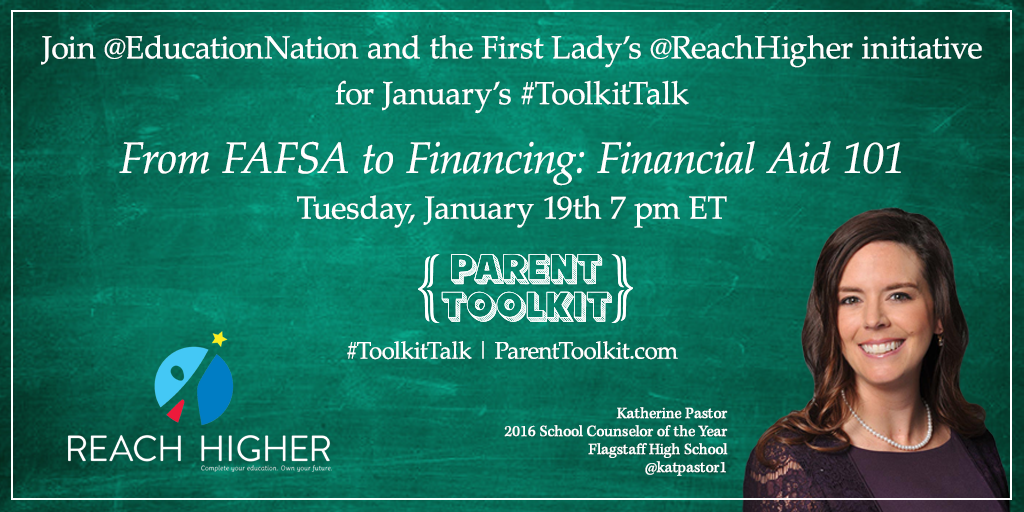
As part of NBC News’ Education Nation initiative and our Parent Toolkit site, my team hosts a monthly Twitter Chat about a variety of different education and parenting topics.

On Tuesday, January 19 at 7 pm EST we will be cohosting our monthly #ToolkitTalk conversation with the First Lady’s Reach Higher Initiative called From FAFSA to Financing: Financial Aid 101.  The chat will focus on information that high school students and their parents need to know about affording a college education.  Our featured guests will include the National School Counselor of the Year and representatives from the Federal Student Aid Office.

Join me and @EducationNation and others discussing tips for parents regarding financing a college education.

FAFSA Week: 10 Good Reasons to File the FAFSA


file the fafsa

Parents of college-bound teens look forward to filing the FAFSA as much as they look forward to filing their income taxes. It’s a federal form and all federal forms aren’t exactly user friendly. Many parents are so intimidated by the form that they choose not to file, telling themselves that their student wouldn’t qualify for aid anyway because they make too much. But don’t fall into that trap.

Here are 10 good reasons to file the FAFSA:

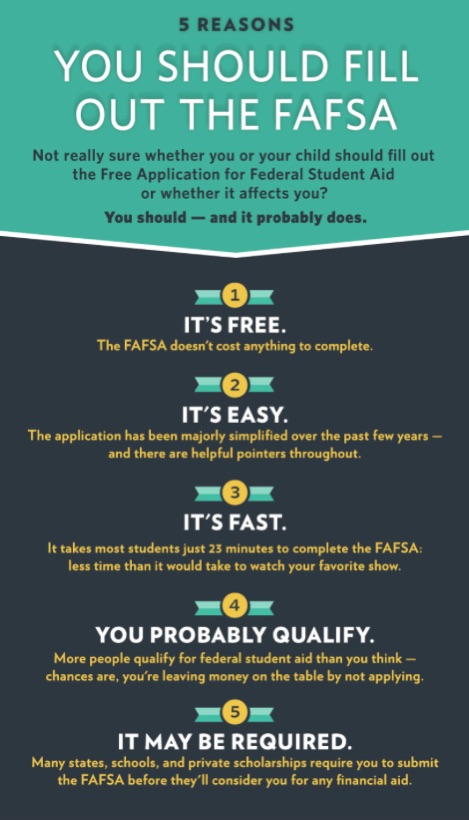
1. College is expensive

Even if you’re rich and can afford to pay for your child’s education, it’s expensive. Why would you pass up an opportunity to help with some of the cost?

2. It’s FREE

That’s right. It’s completely free to complete the FAFSA. You’ll spend some of your time completing the FAFSA and you could get thousands of dollars of financial aid in return. So one could say, it’s BEYOND free–they pay you!

3. Getting help is easy and FREE

If you get stumped, help is available using the online help tool or by submitting a question at the FAFSA web site or calling the help number listed on the site. Many schools even host a FAFSA day where they offer help to parents and students on how to complete the free form.

4. FREE money could be waiting for you

According to a recent Reuters article, about 1.8 million lower income undergraduates who might have qualified for aid neglected to file the FAFSA and missed out on financial aid. No matter what your income level, you should file the FAFSA because there is more money out there to be awarded than just need-based aid.

5. Federal money

The federal government provides over $80 billion dollars in grants, loans and work-study programs every year. The only way to get pell grants, perkins loans, stafford loans and other federal aid is by submitting the FAFSA. Federal loans offer the best interest rates and repayment terms for student borrowers and are superior to private student loans.

6. State money

FAFSA is the gatekeeper for state financial aid programs. Each state’s programs are different but they all require the FAFSA to distribute the funds. Check with your state’s higher education agency for deadlines and requirements. In some states the financial eligibility ceilings are much higher.

7. School money

Colleges and private scholarship sponsors offer billions of dollars in financial aid. Even if you don’t have financial need, you may be eligible for these awards. Some school and private scholarship programs are specifically designed for students who were rejected by federal financial aid. Some schools will not award merit aid unless you complete the FAFSA.

8. Scholarship applications ask if you’ve applied

In addition to the aid that a student may receive from federal and state agencies, many scholarship applications include a box to check asking whether the student has submitted a FAFSA. According to Monica Matthews of How to Win College Scholarships, “Scholarship providers want to know that the student is doing everything possible to get financial help in paying for college and submitting the FAFSA is a very important step in the process.”

9. You have two or more children in college

With two in college, your expected family contribution (what the parents can afford to pay) drops by 50%. Even if you didn’t get financial aid with the first, file the FAFSA because having a second child in college can net you some financial aid.

10. You really don’t have a choice

Look at it this way: FAFSA is the ONLY way to be considered for federal, state and college financial aid. Even if you don’t NEED the aid you still want to get it. Who doesn’t want FREE money?

FAFSA Week: Reporting Parent Information on the FAFSA

Reporting parent information on the FAFSA

Reporting parent information on the FAFSA might make you want to pull your hair out.

If you are completing the FAFSA, some terms can confuse you. Today’s post addresses those questions in an effort to help you understand them more clearly and fill the ambiguous categories like divorced, separated, living together but not remarried, divorced and living together, separated and living together, and stepparent married to biological parent.

Here are some detailed articles that will help you discern which FAFSA parenting category you fit into.

From TeenLifeMedia, “How Divorce and Separation Can Affect Financial Aid”

When students apply to college, there are many forms to complete. And if they are applying for financial aid, the FAFSA is No. 1 on the list. This form asks the obvious questions: name, date of birth, Social Security number, address etc. It also asks questions about parents’ financial information to determine financial aid eligibility.

If you are separated or divorced, this part of the FAFSA raises many questions:

  • How will colleges treat the income of two separate families?
  • Which parent’s income is used for determining the expected family contribution, or EFC?
  • Do both parents have to report their incomes?
  • What do the words “custodial parent” mean?

Read the entire article for clarification.

Studentaid.ed.gov published a PDF, “Who is My Parent When I Fill Out the FAFSA”:

Maybe you know you’re considered a dependent student* by the Free Application for Federal Student Aid (FAFSASM), and you’re supposed to put information about your parents on the application. But what if your parents are divorced? Remarried? What if you live with your sister? Whose information should you report?

Below are some guidelines that might help. Unless otherwise noted, “parent” means your legal (biological and/or adoptive) parent or your stepparent. In addition, the rules below apply to your legal parents regardless of their gender.

Download the PDF for instructions on how to complete this section

EdAdvisors Network addresses the issue of divorce and separation, “FAFSA Tutorial: Divorced and Separated Parents on the FAFSA”:

The marital status and living arrangements of a student’s biological and adoptive parents determines whether the Free Application for Federal Student Aid (FAFSA) requires financial and demographic information from one or both parents.

These topics are addressed:

  • Who is Considered a Parent?
  • Parents who are Married to Each Other
  • Parents who are Unmarried
  • Who is the Custodial Parent?
  • Stepparents
  • Increasing Aid Eligibility

Read the tutorial for detailed explanations of each category

SmartAsset.com provides parents with an easy-to-understand guide and some examples, “Divorce, FAFSA, and the Financial Aid Process”:

The Free Application for Federal Student Aid, known as FAFSA is the Hydra that strikes terror in the hearts of even the most financially savvy parents. Rendering otherwise competent adults mumbling, muttering wrecks. Creative hyperbole aside for the moment, most people are intimidated by FAFSA to some degree but those preparing the form as divorcees face a special kind of torment.

There are several problems with FAFSA when divorce is involved, none of which are insurmountable but lack of understanding can tear open long healed wounds and foster a renewed sense of acrimony. However, knowing the rules of the game can make life and FAFSA easier.

To understand the rules and see some practical examples, read this article


FAFSA Week: 5 FAFSA Myths


FAFSA myths

This week is FAFSA week. An entire week devoted to the FAFSA. I’m going to scour the my blog, the web, and social media to find you the best information, tips and advice related to the FAFSA. If you’re a go-getter and you’ve already completed the FAFSA, congratulations! If you haven’t recovered from the holidays, these words of encouragement should help you get motivated to complete it. If you’re not sure it’s worth your time, this advice should answer that question. If you want to be informed before you complete the form, this information will most definitely help.

Today, I am debunking some FAFSA myths.

Myth 1: If you can’t qualify for federal aid, there’s no point in filing out the FAFSA.

If you don’t complete the FAFSA, you can’t apply for student and parent loans. Colleges also use these figures when determining financial aid eligibility for grants and scholarships. If you don’t complete the FAFSA, you may be missing out on this type of aid. Plus, many states use your FAFSA data to determine your eligibility for their aid. Fill out the application and find out what you can get!

Myth 2: I make too much money to qualify for financial aid.

Actually, there isn’t an income cutoff to qualify for financial aid. Your eligibility for financial aid is based on a number of factors and not just your or your parents’ income. Families who file the FAFSA automatically receive an asset protection allowance based on the age of the oldest parent. The closer you are to retirement, the larger the allowance.

Myth 3: I have too much home equity to qualify for aid.

Most colleges won’t care if you own a house and won’t count home equity against you if you do. The majority of schools rely on the federal aid application, FAFSA, which doesn’t ask parents if they own a home. If the college requires the CSS Profile, home equity is required, but because of the equity cap, has little impact on the award decision.

Myth 4: I have to wait until I file my taxes to complete the FAFSA.

Under no circumstances should you wait until you file your taxes to complete the FAFSA. The new FAFSA filing date of October 1 makes it easy. With financial aid, the rule is “first come, first served”. File early and update if necessary.

Myth 5: The form is too complicated and since I’m sure I won’t qualify, it’s a waste of my time.

The FAFSA is actually pretty straight and can be completed in one sitting; and filing out the FAFSA is never a waste of your time. Colleges and states use this information when awarding grants and scholarships.

The bottom line: there is no excuse to not complete the FAFSA. It’s free and is well worth your time. Even if you can afford to pay for the entire cost of college, you should complete the FAFSA. Colleges use this data when dispusing merit aid as well.


Amping Up for the FAFSA


amping up for the fiefs

If you have a college-bound teen, the FAFSA is how you celebrate the New Year. Honestly, not many parents celebrate filling out the FAFSA, but you should. The FAFSA is your golden ticket for college money. Without it, your student won’t get a dime (even many scholarships ask if you’ve completed the FAFSA).

This should be your FIRST New Year’s resolution: complete the FAFSA within the first week of the new year. It becomes available online on January 1st and although I can’t picture you waiting by your computer at midnight, you should make it a priority over the next few days. And while you’re waiting during the countdown, you should be amping up for the FAFSA.

I wrote an article for University Parent last year (and it’s been updated for the changes) that should help you prepare: An Easy Guide to the 2016 FAFSA. Here’s an excerpt:

If there’s a piece of advice I give parents over and over again, it’s this: whatever your income, complete the FAFSA. Many parents believe that the FAFSA should only be submitted by financially needy students. Nothing could be further from the truth. Colleges use the FAFSA data to determine all types of financial aid, not just need-based. If your student doesn’t complete the FAFSA, he won’t qualify for any aid from the college or the government, including student and parent loans. You may be able to pay for your son or daughter’s education, but why not complete the form? It’s free and you have nothing to lose.

Take a few minutes to read the entire article which includes information about FAFSA basics, the documents you will need, how to team up with your student to get the form completed, and some technical terms, definitions and changes to the upcoming FAFSA.

It would also be good to read Diane Schwemm’s post: Changes to the FAFSA.

You can’t bury your head in the sand and ignore the FAFSA. Get pumped and start amping up for the FAFSA–your golden ticket to free money for college!

Everything You Need to Know About the FAFSA


fafsa

Do you have questions about the FAFSA? or financial aid? Have you looked at the form and find some of the instructions complicated or ambiguous? You’re not alone. If you have a senior headed to college in the fall or you just want to be prepared for your future college bound teen, you should join tonight’s #CollegeCash chat. I’ll be the guest and @JodiOkun and I should be able to answer all your questions.

What: #CollegeCash

When: (Tonight) Thursday 8PM ET

Where: Twitter using #CollegeCash hashtag

Who: Host @JokiOkun and guest @SuzanneShaffer

Don’t forget to follow both of us on Twitter. If you’ve never attended a Twitter chat, here are some simple instructions.

How to Take Part in a Twitter Chat

See you there!


FAFSA Tips, Reminders, and Mistakes to Avoid


fafsaIt’s FAFSA time. “Yuck”, as one parent said. “Dreading, dreading, dreading” from another. “It’s my least favorite time of year (other than income taxes)”, said another. I get it. Nobody likes filling out federal forms, especially when money is on the line. And with the FAFSA, money is on the line.

Today I am sharing some of the best FAFSA advice I’ve found online. If you have a college bound teen, this information will be invaluable. Don’t just skim it, however; you need to read every last word. Not knowing can mean the difference between receiving aid and receiving a big fat zero. Trust me, I have learned from experience and listened to so many parents that neglected to do the research before completing the form.

Avoid These FAFSA Mistakes

My first piece of advice comes from Lynn O’Shaughnessy of The College Solution blog. Her advice is spot on and goes into great detail about some key points regarding marital status, household size, and reporting assets. It’s an easy to understand guide for parents and breaks the government lingo down into simple language.

Read more . . .

10 Tips to Prepare for the FAFSA

I wrote this article for TeenLife.com giving parents tips on what they need before completing the FAFSA. You want to be the first in line for financial aid. Students who complete the government form early are more likely to receive funds set aside by the colleges for financial aid. If you don’t complete the FAFSA, you won’t receive any aid. Everyone should file the FAFSA, even if you think you won’t qualify for federal aid.

Read more . . .

False FAFSA Assumptions

Jodi Okun of College Financial Aid Advisors wrote this piece for AboutMoney.com. One of the most common statements I hear from parents is, “I’m not going to file because we won’t qualify for financial aid”. Jodi points out the huge mistake in making this assumption and others.

Read more . . .

7 Legal Ways to Squeeze More Money Out of the FAFSA

It makes perfect sense, just with your taxes, that you should receive what is owed you. With the FAFSA, this affects your student’s financial aid award. Kim Clark of Time.com/Money shares her best advice on how to complete the form properly to ensure you get the most financial aid.

Read more . . .

Do me a favor and pass this information along to other parents. The more you know, the more you will maximize your financial aid. And…sharing is caring!