For many parents, understanding the FAFSA can be complicated. It’s not meant to be, but as with all government forms, it can be daunting.
The Free Application for Federal Student Aid (FAFSA®) form is the student’s responsibility, but when a student is considered a dependent student for FAFSA purposes, parents have a large role in the application process. Educate yourself about the process and opportunities so you can provide the guidance your child needs to do their part.
This year’s FAFSA changes are mainly cosmetic. The online FAFSA form is receiving a visual update that gives it a similar look and feel that puts it more in line with other tools featured on StudentAid.gov. A new simplified form being released in October of 2022 also has just 36 questions to answer, down from the 108 of previous years.
Noticeable changes you may see if you fill out the FAFSA later this year include:
For many parents, this will be the first year you will complete the FAFSA. Since you have never completed it before, you won’t notice the changes. However, it’s important to note the functionality of the form and the functions of the mobile app.
The Department of Education (ED) released a document this month summarizing the changes to the 2021-22 FAFSA. The most notable changes are the increase of the income threshold for the automatic-zero expected family contribution (EFC) and questions asked about the Schedule 1 tax form.
The 2021–22 FAFSA changes include the following:
The income threshold for an automatic zero Expected Family Contribution (EFC) increased from $26,000 to $27,000 for the 2021–22 award year.
When students and parents use the IRS Data Retrieval Tool (DRT), the IRS DRT will now transfer information about whether they filed a Schedule 1. The answer will be based on all current exceptions for filing a Schedule 1. The transferred data for the Schedule 1 fields will be masked.
For students and parents who don’t use the IRS DRT, the Schedule 1 help topics will be updated to include all current exceptions for filing a Schedule 1. “Capital Gains” has been removed as an exception and “Virtual Currency” has been added as an exception.
Many FAFSA help topics referencing financial forms now feature images of those forms with relevant line numbers highlighted.
In early June, ED published the federal need analysis methodology for the 2021-22 award year in the Federal Register. Per Section 479(c) of the Higher Education Act (HEA), ED is required to annually adjust the income level necessary to qualify an applicant for the zero expected family contribution. This adjustment is made according to increases in the Consumer Price Index (CPI).
New functionalities in the MyStudentAid mobile app will include:
Dashboard – Access various types of popular tasks and a personalized page to help you determine what actions to take.
Settings – Edit/manage your account, using your username and password (FSA ID).
Aid Summary – View your federal student loan and grant history.
Notification Center – View and manage notifications regarding your student aid; household member and enrolled in college calculation assistance.
The paper FAFSA PDF will become available in October, and the color rotation for the paper form is green for 2021-22. FAFSA worksheets in English and Spanish will also be available.
When completing the FAFSA, even though it’s available October 1, it’s generally good to wait a week or two before filing because there will most certainly be kinks in the system–it happens. Don’t wait too long, however. With financial aid, the sooner you apply the better chances you have of snagging some of that free money!
Don’t forget to read the other articles related to FAFSA Week:
If you break it down, the 2021-22 FAFSA isn’t that complicated. Because it’s a federal form (like income taxes), many parents and students are hesitant to tackle it. If you take it step-by-step, it’s much easier. Here’s a synopsis of the requirements and the sections of the 2021-22 FAFSA.
Information you will need to complete the FAFSA
Use this list to gather all the information necessary before you begin:
Your FSA ID, which you can create on fsaid.ed.gov. Note that students and parents will need to create their own FSA ID and keep it private.
Your social security number and driver’s license, and/or alien registration number if you are not a U.S. citizen.
Your federal income tax returns, W-2s, and other records of money earned.
Your parents income tax returns, W-2 forms and 1040 forms if you’re a dependent.
Bank statements and records of investments (if applicable).
At each online step, a “help and hints” box pops up at the side, in case you need guidance. Here’s a short synopsis of each section from CollegeXpress.
Student eligibility
This is pretty basic: the name of your high school, what year in college you’ll be entering, and your parents’ level of education. This is also your chance to opt into federal work-study. Consider saying yes if you aren’t sure; you can always decline later if you change your mind.
You will also be asked if you have registered with Selective Service (the military draft). Nearly all men age 18–26, including undocumented immigrants and people with disabilities, are required by law to register—and if you aren’t registered, you will be denied federal financial aid. You can register via the FAFSA form by checking a box.
School selection
Here’s where you enter the names of the colleges you plan to apply to. You can add as many as 10, but don’t worry if you haven’t finalized your list. If you want to add another or make changes, you can do it later.
For each school you include, you will be asked if you plan to live on campus, off campus, or with your parents (because you won’t need funds for room and board if you will live at home). For state aid, some states require that colleges are listed in a specific order; check the federal aid website to see if your own state is fussy about this.
Dependency determination
Colleges want to know if your parents support you or if you are an independent adult. The vast majority of high school students are considered dependent for college financial aid/FAFSA purposes. However, you’re generally considered an independent student if you are:
24 years old by December 31 of the award year
A graduate or professional student during the award year
Married (or separated)
A parent or have other dependents who currently receive more than half their support from you
An orphan or a ward of the court
A veteran of the US Armed Forces
Otherwise, you are most likely a dependent student.
If your family situation is complex (for example, you are a minor but don’t live with your parents or don’t have access to their financial information), you can find some guidance on the federal student aid website.
Parent demographics
You fill this FAFSA section out if you are a dependent. Aid decisions will consider your parents’ age (because older parents may need to conserve more for retirement), how many children they support, and, most important, if they will have additional children in college that year. Each of these elements affects the calculation for your Expected Family Contribution (EFC), so answer the questions carefully. For example:
Older parents are expected to contribute less since they are closer to retirement.
Parental contribution is divided by the number of students in college.
If the parents are divorced or separated, include only the financial data of the parent with whom the student lives for the greater part of the 12 months preceding the date of the application. If that parent has remarried, the student must include that stepparent’s income and asset data as well. Note: some colleges request information on the “other” natural parent and may expect a contribution from that parent as well.
Financial information
You will need to fill in your parents’ adjusted gross income from the 1040 form, or whichever form they file. (Or your income, if you are independent.)
The IRS Data Retrieval Tool really shines with this part of the FAFSA, because it transfers your tax information directly to the form, saving time and eliminating the chance of a mistake.
You’ll also be asked about assets—both your parents’ and yours. That’s right: the money you’ve saved from summer jobs, birthdays, or bat mitzvah gifts—all of it is fair game. And your colleges will expect you to contribute a percentage of your savings to your college tuition.
Of course, your parents will need to report their savings and investments too, including money market accounts, mutual funds, 529 college savings accounts (yours and any siblings’), and investment real estate (not your family’s primary home).
Qualified retirement accounts—IRAs, 401(k), 403(b), or pension plans—aren’t counted as assets. As always, you can find guidance in the pop-up help boxes at the right side of the page.
Sign and submit
After you’ve finished the FAFSA’s financial section, you add your electronic signature with your FSA ID and hit submit. That’s it.
For a visual step-by-step guide to completing the FAFSA, follow this link:
This week is FAFSA week. An entire week devoted to the FAFSA. Today, I am debunking some FAFSA myths.
As the week progresses, I’m going to scour the my blog, the web, and social media to find you the best information, tips and advice related to the FAFSA. If you’re not sure it’s worth your time, this advice should answer that question. If you want to be informed before you complete the form, this information will most definitely help.
Myth 1: If you can’t qualify for federal aid, there’s no point in filing out the FAFSA.
Reality: There’s more to the FAFSA than federal aid. Colleges use this form to disburse merit aid and grants. Also, if your student is considering a student loan or you are considering a Parent PLUS loan, you must complete the FAFSA. In addition, many states use your FAFSA data to determine your eligibility for their aid and many scholarships ask if you have completed the FAFSA.
Myth 2: I make too much money to qualify for financial aid.
Reality: There is no income cut-off to qualify for federal student aid. Many factors—such as the size of your family and your year in school—are taken into account. Your eligibility for financial aid is based on a number of factors and not just your income.
Myth 3: I have too many assets to qualify for aid.
Reality: Most colleges won’t care if you own a house and won’t count home equity against you if you do. The majority of schools rely on the federal aid application, FAFSA, which doesn’t ask parents if they own a home. If the college requires the CSS Profile, home equity is required, but because of the equity cap, has little impact on the award decision. In addition, money in qualified retirement plans, such as a 401(k), 403(b), IRA, pension, SEP, SIMPLE, Keogh and certain annuities, is not reported as an asset on the FAFSA.
Myth 4: I didn’t qualify for financial aid last year, so filling out the FAFSA form again is just a waste of time.
Reality: It’s super important to fill out a FAFSA form every year you’re in college. Why? Because things can change. For instance, your school or state might create a new grant or scholarship, or the factors used to calculate your aid could change from one year to the next. Either way, if you don’t submit a new FAFSA form, you’re out of luck.
Myth 5: The form is too complicated and since I’m sure I won’t qualify, it’s a waste of my time.
Reality: The FAFSA is actually pretty straightforward and can be completed in one sitting; and filing out the FAFSA is never a waste of your time. Colleges and states use this information when awarding grants and scholarships. (See Myth 1)
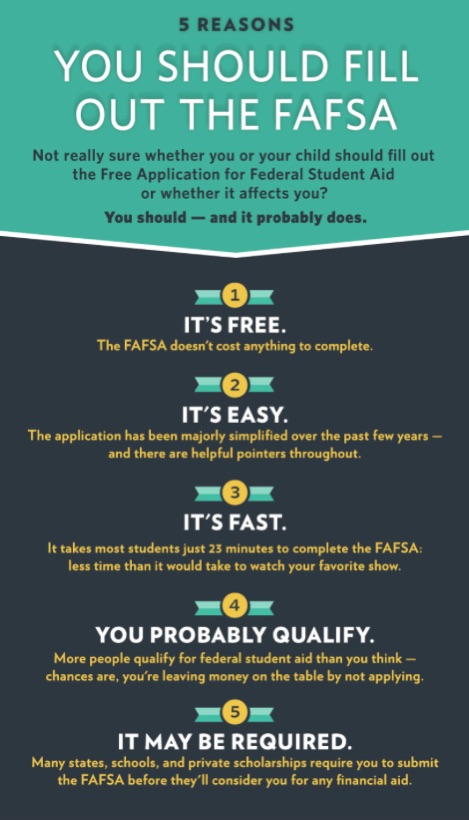
The bottom line: there is no excuse to not complete the FAFSA. It’s free and is well worth your time. Even if you can afford to pay for the entire cost of college, you should complete the FAFSA. Colleges use this data when dispersing merit aid as well.
Financial aid can be a confusing part of the college application process. Even if you can afford to pay for college, it’s a good idea to learn what aid is available and apply for it. You aren’t obligated to accept it, but most students qualify for some form of aid and, if it’s available, why not use it?
What is financial aid?
Financial aid is intended to make up the difference between what your family can afford to pay and what college actually costs. With college tuition rising rapidly, more than half of the students currently enrolled in college receive some sort of financial aid to help pay for college. The system is based on the premise that anyone should be able to attend college, regardless of financial circumstances. However, students and their families are expected to contribute to the extent that they are able.
There are two types of aid: need-based, and non need-based. Need-based aid includes grants and scholarships that are issued based on the family’s ability to contribute to education costs. Non-need-based aid is allocated solely based on availability, not need.
There are three main types of financial aid: grants and scholarships, loans and work study.
What is “free” money?
Not all aid is equal and the best aid is the aid you don’t have to pay back. It’s like getting a huge coupon of savings to use for your college education.
What types of education loans are available?
Not all college loans are equal.
There are two types of government-based loans: subsidized and unsubsidized. Subsidized loans have lower interest rates and are awarded based on the student’s financial need with interest deferred until after graduation. Unsubsidized loans are awarded without regard to financial need with interest payments beginning immediately and regular payments due after graduation.
What is work study?
The Federal Work-Study Program provides a method for college students to earn funds to be used toward their education. The program is based on financial need and students must be accepted into the program to qualify which is determined by completing the Free Application for Federal Student Aid or FAFSA.
What is the FAFSA and do I need to file it?
The FAFSA is the Free Application for Federal Student Aid and you should apply if you want any chance to receive federal and state student grants, work study, loans or merit-based aid. If you don’t complete the FAFSA, you can’t apply for student loans. Colleges also use these figures when determining financial aid eligibility for grants and scholarships. Plus, many states use your FAFSA data to determine your eligibility for their aid.
The FAFSA is available on Oct. 1 of every year and you should complete it as close to that date as possible in the fall of your senior year. Aid is dispersed on a first-come, first-served basis. The sooner you apply, the more likely you will receive a portion of the financial aid pie.
What is the EFC?
The Expected Family Contribution (EFC) is how much money your family is expected to contribute to your college education for one year. Typically, the lower your EFC, the more financial aid you will receive. Factors such as family size, number of family members in college, family savings, and current earnings (information you provide on the FAFSA) are used to calculate this figure. Once your FAFSA is processed, you will receive a Student Aid Report (SAR) with your official EFC figure.
You can calculate your EFC by visiting FinAid.org.
What is an award letter and how do you use it?
As the offers of admission arrive from colleges, the financial aid award letters will follow. They can be confusing and vague. Added to the confusion is that every award letter is different, making it hard to easily compare them side by side.
Thankfully, there are tools available and information to help you look at these letters for what they are: the college’s pitch for you to accept their offer of admission. You are in control of this process and you hold the cards. It’s your decision to accept or reject their offer based on the amount of aid they are willing to give you. Money, in this situation, is everything.
If a college wants you to attend, they will back it up with money. No money means their offer is probably based on filling a quota and expecting you will decline to attend. And you should. Who wants to attend a college that doesn’t value you as a student?
October 1 is on the horizon and that means the FAFSA will be available for students to complete and file. Believe it or not, many students don’t bother completing it and that’s a decision you and your student might regret.
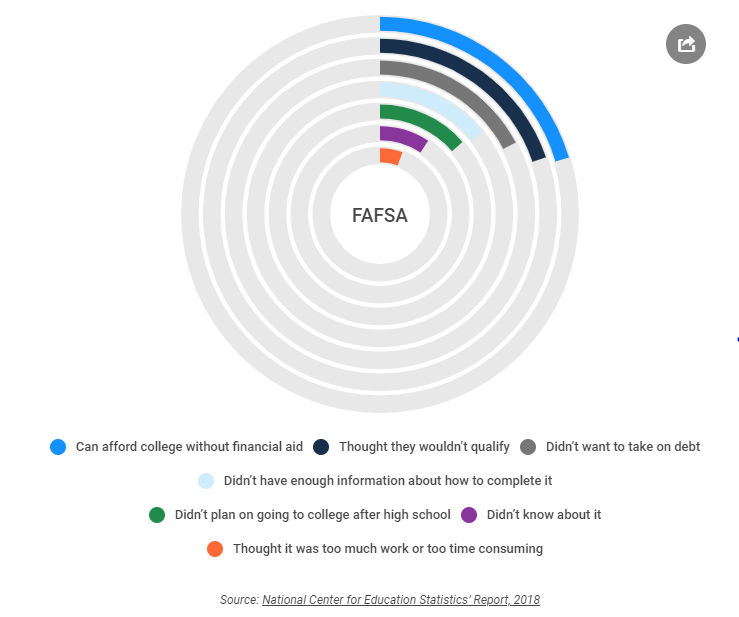
According to the National Center for Education Statistics, Only 65% of high school seniors complete the FAFSA, Why don’t more fill it out? Most either can afford college without financial aid or think they won’t qualify for financial aid. Other reasons include a lack of information — and just planning on skipping college entirely.
Completing the FAFSA is an essential step of the college application.
Why bother completing the FAFSA if you don’t need financial aid?
Even if you and your student can afford to pay for college, why would you pass up free money? Colleges use the FAFSA when distributing merit aid and even some private scholarships require a completed FAFSA.
If you need financial aid, how can completing the FAFSA help?
If you need some form of financial aid to pay for a college education, you MUST complete the FAFSA. In order for students to qualify for federal student loans, state loans, and work-study, they must submit the form. The FAFSA is also required if you plan to take out a Parent PLUS loan to help your student pay for college.
In addition, many students are eligible for federal Pell Grants. High school graduates who didn’t complete a federal financial aid application missed their opportunity for part of $2.6 billion in free money for college, according to NerdWallet’s annual analysis of federal financial aid data.
The money went unclaimed by 661,000 members of the Class of 2018 who were eligible for a federal Pell Grant but didn’t complete the Free Application for Federal Student Aid, or FAFSA.
How much time does it take to complete the FAFSA?
The FAFSA has over 100 questions, which can take anywhere from a half hour to an hour to complete. According to data compiled by Finder.com, new applications less than an hour, averaging 35 minutes. Renewing your application takes even less time — 23 minutes on average. Filling out the FAFSA for the first time takes the longest since you need to fill in answers for each required question.
The bottom line: complete the FAFSA. It doesn’t take that long and most students qualify for some form of financial aid. That doesn’t mean you have to accept it, but why not have that option? And you certainly don’t want to miss out on some of that FREE money!
Financial aid can be a confusing part of the college application process. Even if you can afford to pay for college, it’s a good idea to learn what aid is available and apply for it. You aren’t obligated to accept it, but most students qualify for some form of aid and, if it’s available, why not use it?
What is financial aid?
Financial aid is intended to make up the difference between what your family can afford to pay and what college actually costs. With college tuition rising rapidly, more than half of the students currently enrolled in college receive some sort of financial aid to help pay for college. The system is based on the premise that anyone should be able to attend college, regardless of financial circumstances. However, students and their families are expected to contribute to the extent that they are able.
There are two types of aid: need-based, and non need-based. Need-based aid includes grants and scholarships that are issued based on the family’s ability to contribute to education costs. Non-need-based aid is allocated solely based on availability, not need.
There are three main types of financial aid: grants and scholarships, loans and work study.
What is “free” money?
Not all aid is equal and the best aid is the aid you don’t have to pay back. It’s like getting a huge coupon of savings to use for your college education.
There are two types of government-based loans: subsidized and unsubsidized. Subsidized loans have lower interest rates and are awarded based on the student’s financial need with interest deferred until after graduation. Unsubsidized loans are awarded without regard to financial need with interest payments beginning immediately and regular payments due after graduation.
What is work study?
The Federal Work-Study Program provides a method for college students to earn funds to be used toward their education. The program is based on financial need and students must be accepted into the program to qualify which is determined by completing the Free Application for Federal Student Aid or FAFSA.
What is the FAFSA and do I need to file it?
The FAFSA is the Free Application for Federal Student Aid and you should apply if you want any chance to receive federal and state student grants, work study, loans or merit-based aid. If you don’t complete the FAFSA, you can’t apply for student loans. Colleges also use these figures when determining financial aid eligibility for grants and scholarships. Plus, many states use your FAFSA data to determine your eligibility for their aid.
The FAFSA is available on Oct. 1 of every year and you should complete it as close to that date as possible in the fall of your senior year. Aid is dispersed on a first-come, first-served basis. The sooner you apply, the more likely you will receive a portion of the financial aid pie.
What is the EFC?
The Expected Family Contribution (EFC) is how much money your family is expected to contribute to your college education for one year. Typically, the lower your EFC, the more financial aid you will receive. Factors such as family size, number of family members in college, family savings, and current earnings (information you provide on the FAFSA) are used to calculate this figure. Once your FAFSA is processed, you will receive a Student Aid Report (SAR) with your official EFC figure.
You can calculate your EFC by visiting FinAid.org.
What is an award letter and how do you use it?
As the offers of admission arrive from colleges, the financial aid award letters will follow. They can be confusing and vague. Added to the confusion is that every award letter is different, making it hard to easily compare them side by side.
Thankfully, there are tools available and information to help you look at these letters for what they are: the college’s pitch for you to accept their offer of admission. You are in control of this process and you hold the cards. It’s your decision to accept or reject their offer based on the amount of aid they are willing to give you. Money, in this situation, is everything.
If a college wants you to attend, they will back it up with money. No money means their offer is probably based on filling a quota and expecting you will decline to attend. And you should. Who wants to attend a college that doesn’t value you as a student?
For details on the types of free money, educational loans, how colleges use the financial award letter to hide their agenda, read the original full article I wrote at TeenLife Media: A Beginner’s Guide to Financial Aid and How to Get It.
Reporting parent information on the FAFSA might make you want to pull your hair out.
If you are completing the FAFSA, some terms can confuse you. Today’s post addresses those questions in an effort to help you understand them more clearly and fill the ambiguous categories like divorced, separated, living together but not remarried, divorced and living together, separated and living together, and stepparent married to biological parent.
Here are some detailed articles that will help you discern which FAFSA parenting category you fit into.
From TeenLifeMedia, “How Divorce and Separation Can Affect Financial Aid”
When students apply to college, there are many forms to complete. And if they are applying for financial aid, the FAFSA is No. 1 on the list. This form asks the obvious questions: name, date of birth, Social Security number, address etc. It also asks questions about parents’ financial information to determine financial aid eligibility.
If you are separated or divorced, this part of the FAFSA raises many questions:
How will colleges treat the income of two separate families?
Which parent’s income is used for determining the expected family contribution, or EFC?
Studentaid.ed.gov published a PDF, “Who is My Parent When I Fill Out the FAFSA”:
Maybe you know you’re considered a dependent student* by the Free Application for Federal Student Aid (FAFSASM), and you’re supposed to put information about your parents on the application. But what if your parents are divorced? Remarried? What if you live with your sister? Whose information should you report?
Below are some guidelines that might help. Unless otherwise noted, “parent” means your legal (biological and/or adoptive) parent or your stepparent. In addition, the rules below apply to your legal parents regardless of their gender.
EdAdvisors Network addresses the issue of divorce and separation, “FAFSA Tutorial: Divorced and Separated Parents on the FAFSA”:
The marital status and living arrangements of a student’s biological and adoptive parents determines whether the Free Application for Federal Student Aid (FAFSA) requires financial and demographic information from one or both parents.
SmartAsset.com provides parents with an easy-to-understand guide and some examples, “Divorce, FAFSA, and the Financial Aid Process”:
The Free Application for Federal Student Aid, known as FAFSA is the Hydra that strikes terror in the hearts of even the most financially savvy parents. Rendering otherwise competent adults mumbling, muttering wrecks. Creative hyperbole aside for the moment, most people are intimidated by FAFSA to some degree but those preparing the form as divorcees face a special kind of torment.
There are several problems with FAFSA when divorce is involved, none of which are insurmountable but lack of understanding can tear open long healed wounds and foster a renewed sense of acrimony. However, knowing the rules of the game can make life and FAFSA easier.
If you have a college-bound teen, the FAFSA is how you celebrate the New Year. Honestly, not many parents celebrate filling out the FAFSA, but you should. The FAFSA is your golden ticket for college money. Without it, your student won’t get a dime (even many scholarships ask if you’ve completed the FAFSA).
This should be your FIRST New Year’s resolution: complete the FAFSA within the first week of the new year. It becomes available online on January 1st and although I can’t picture you waiting by your computer at midnight, you should make it a priority over the next few days. And while you’re waiting during the countdown, you should be amping up for the FAFSA.
I wrote an article for University Parent last year (and it’s been updated for the changes) that should help you prepare: An Easy Guide to the 2016 FAFSA. Here’s an excerpt:
If there’s a piece of advice I give parents over and over again, it’s this: whatever your income,complete the FAFSA. Many parents believe that the FAFSA should only be submitted by financially needy students. Nothing could be further from the truth. Colleges use the FAFSA data to determine all types of financial aid, not just need-based. If your student doesn’t complete the FAFSA, he won’t qualify for any aid from the college or the government, including student and parent loans. You may be able to pay for your son or daughter’s education, but why not complete the form? It’s free and you have nothing to lose.
Take a few minutes to read the entire article which includes information about FAFSA basics, the documents you will need, how to team up with your student to get the form completed, and some technical terms, definitions and changes to the upcoming FAFSA.






 Financial aid can be a confusing part of the