Tag Archives: college admissions

FREE “Plan for College” Videos

PlanForCollegeVideos5

When we see the word FREE, we automatically ask ourselves, “What’s the catch?” The promise of FREE usually includes statements like “pay shipping and handling” or “a small subscription cost”. This time FREE means FREE!

My good friend and colleague,Paul Hemphill, is offering to my parent and student readers the opportunity to get his time-honored and valuable video series for FREE. There’s no catch. He’s  doing it because he believes in them and he believes that parents and students need some help with the college process. Paul has sold these videos in the past, but he’s willing to GIVE THEM AWAY to anyone who subscribes to this email link.

http://forms.aweber.com/form/29/616398929.htm

He’s not going to sell your email or contact you about his coaching services. As hard as it is to believe (in this skeptical, not trust anyone culture) there is NO CATCH. Every week, you will receive two emails with video coaching related to the college admissions process. He has unique insight on how to “market” your student to the college and he knows how to get results with this tactic. While counseling clients over the last several years, he has developed this series to share with them during the coaching process. My readers get it FREE!

Here’s what you can look forward to over the next 52 weeks:

  1. Relevance: The videos are topical and address the immediate concerns of most parents and students. By contrast, you will never see a video on how to get into an Ivy League college since the great majority of students will never apply to the Ivys. “My approach”, says Paul, “is not to waste the viewer’s time.”
  2. Controversial: Some of these college admission tips on video are disturbing to colleges, but this isn’t the market for which the videos are designed. Colleges will repel at the suggestion in one video that parents make multiple deposits on the standard May 1 deadline. Another video suggests that a student should absolutely apply to at least 10 colleges.
  3. Short: These videos are no longer than 2 minutes in length; long enough to contain a lot of useful information and short enough to satisfy short attention spans in a fast-pace culture.
  4. Content: The focus is on what will work for both parents and students. For example, a video will suggest what topics must be avoided in writing the college application essay. Or, how a parent can save $11,000 by what a student does with free time.
  5. Humor: It may be in the form of a funny story that drives the point home, or a one-liner, maybe even a facial expression. Introductions to the video’s topic are intended to grab your attention. One video starts this way: “I’m going to show you how to be shallow and superficial in a college admissions office!”
  6. Approach: Each video presents a problem and then suggests a viable solution. Some  solutions are so simple that you’ll conclude you haven’t seen or read about this anywhere else. “My own clients,” says Paul, “are universal in their opinion that these videos are to-the-point and no-nonsense all the way.”
  7. Themes: The easier ways to pay less for college and the easier way to get in. Paul looks for every angle that will make it easier for you to pay for college, and he leaves no stone unturned on some original and creative ways to get into college without appearing brass or slick.

If you still aren’t convinced, listen to all of Paul’s testimonials from current and past clients.


http://www.collegehelp.biz/my-testimonials.html


What’s the best part? For you, it’s absolutely FREE. And if you aren’t interested or don’t find these videos helpful, you can unsubscribe at any time. I know, however, that you will be so impressed that you will contact Paul to help you and your student personally with the process.

What have you got to lose? The thousands of dollars you will save by watching these videos and FREE help with the college admissions process!

 

An interview with the Dean of Admissions and Financial Aid at UNC-Ashville

A special thanks to Dr. Patrice Mitchell for participating in The Parliament Tutors Admission Spotlight Series.  Dr. Mitchell is the Dean of Admissions & Financial Aid at UNC – Asheville.

As the Dean of Admissions, what are your day-to-day responsibilities?
I can definitely say that no two days are ever the same, which is also what I love about working with students to help them navigate through what can often be a nerve-wracking experience.  Depending on the time of the year, I spend a lot of time reviewing enrollment reports to ensure that admissions decisions are being made on a daily basis to ensure we will enroll the desired quality and quantity of new students.  I also spend a lot of time responding to questions from prospective students and their families about the application process and requirements.

What do you consider the most significant parts of an application, the parts which applicants should prepare the most carefully?
In regards to UNC Asheville, the most significant component of the application is the high school record.  Specifically, rigor of course work, grade point average, and class rank.

Is there anything you frequently see on an application that you hope to never see again?
There is nothing that jumps out at me.  However, the one thing that I would caution students on is the tendency to reveal such personal and sometimes tragic information, but do not necessarily correlate those experiences to how they have prepared them to be successful at the institution.

What common pitfalls should applicants be careful to avoid? 

I can not emphasis enough the importance of proofreading all of your supporting documentation that you submit as a part of the application – including having the correct name of the institution on the essay.  (Yes, I have had read “It has been my dream to attend X college all of my life” when the college that I am reading the application for is actually college Y!
Students should also avoid missing deadlines or assuming they have plenty of time to submit information prior to the deadline.  Time for technology glitches and mail delivery problems should always be accounted for when submitting application materials.  Students should also follow up with their counselors and/or individuals submitting recommendations to give them friendly reminders regarding the deadlines.

Are there any myths about the application process which you would like to dispel?

One thing that I would share about the process is that Admissions Offices really do want to make an admissions decision based upon whether or not the individual student will be a good fit and for the institution.  Therefore, it is important for you to take the time to write a good essay that gives some insight into who you really are that SAT and gpa averages won’t tell us.  It is also important to have an individual that truly knows them and the institution the student is applying.  These are the reasons that you sometimes here of a student with a stronger SAT and gpa not getting into a specific college when there classmate does.

What advice would you give to an applicant with below-average test scores but significant extra-curricular experience?
Please remember that there are literally thousands of college options available to you.  You just have to be open to exploring a handful that you may not have initially had on the top of your list.  The reality is that at some schools the admissions process is selective and not having all of the components may keep you from getting an offer.  However, at those schools where the SAT is optional or the SAT being below average many not be as big of a problem, that may be the school where you end up deciding to attend and find yourself having a wonderful experience.   However, you may still want to contact the prospective college and ask to speak to the admissions counselor responsible for your high school.  Establishing a relationship with that individual can sometimes be helpful.

Do you frequently have to turn away applicants whom you wish you could admit? If so, what could those applicants do to be admitted?
Unfortunately, we are not in a positive to offer admission to every applicant.  In that case, the transfer option is discussed.  This option is also being used by students who are admissible but want to get started at a two-year college and transfer in.  There are several universities with articulation agreements with two-year colleges.  Therefore, the idea of transferring in as an upper-classmen has become more of a positive alternative for students who are not competitive for freshmen admission.  The important thing to remember is that sometimes there are different paths to get to the same destination.

How much faith do you have in the ability of the SAT to predict success at in college?

Here at UNC Asheville we take a holistic approach to the admissions process in order to reduce the importance that one variable has on the application decision.  This is particular important to us since the high school rank and grade point average has been shown to be more of a predictor of success here than the SAT.  Having said that, we do have a selective process in place, and we are a part of the UNC system, which requires us to report the average SAT, so it is a factor.

What do you look for in a recommendation letter?
Students should ensure that the recommendation letter is from someone who knows them well enough to speak to the attributes and strengths that make the student a good fit with the college.  It also helps if the letter is written to the specific college.  Not everyone is going to be able provide such detailed information, or even has the time to do so if they wanted to, but I enjoy reading letters from teachers and/or counselors who have some type of story or anecdote to share about the student that I otherwise would not know about them.

Joseph Fernandez conducted this interview.  Joseph is a Tutor with Parliament Tutors. He specializes in SAT Tutoring.

Your teen’s online reputation


I have been harping about your teen’s online reputation for the last year or so. Last week I posted an infographic “Google Yourself Challenge” and encouraged you to have your teen do this simple exercise. Why? Important people are looking at their online profile (Twitter, Facebook, LinkedIn, Instagram, Google)–people who could have a huge affect on your teen’s future.

If you don’t believe me, here’s something that a good friend of mine posted on Facebook this week. He’s the CFO and does the hiring for a major corporation.

Public Service Announcement for those who don’t believe that potential employers actually look you up on Facebook – we do!

If you are looking for a job, take the questionable pictures down (or at least hide them). I’ve reviewed 6 resumes this AM and eliminated 3 of them based off of Facebook profiles.

Your teen may not be job hunting at the moment, but they are college searching and colleges have begun to look at profiles of their applicants. In addition, after college, your student will be looking for a job. Mistakes like this can cause them to be unemployable after graduation.

Pictures aren’t the only thing you need to worry about. Later he posted these LinkedIn profiles with some comments:

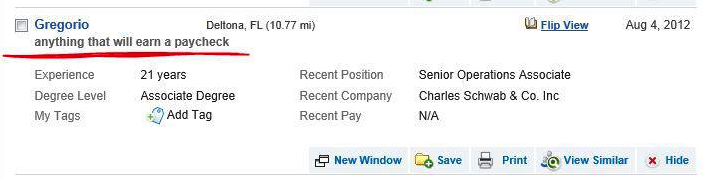
Really…? Why bother posting the resume?

Ummmm this might have been funny if it said Zack of ALL Trades…

It’s clear what your teen posts online should be professional and impressive. Encourage your teen to take some time this week and review their online profiles. Clean them up and/or make things private. The steps they take could help them stand out in a sea of applicants who didn’t take the time to do some simple housekeeping.


Do you need help with the college process?

I’m hearing more and more from parents that they are desperate for help and answers. It seems they are drowning in the sea of college information out there. They don’t know who to listen to, where to go for help, and how to make the best use of the help they find.

There are two tools that will answer every question you ever had about how to handle the multitude of questions related to the college admissions process: my Parents Countdown to College Toolkit AND Paul Hemphill’s Plan for College Videos. Both resources will help you help your student navigate the college maze. If you own both you can finally sleep at night!

For a limited time only (until September 30th), Paul and I are offering parents a 2 for 1 special–buy my Parents Countdown to College Toolkit and you receive a FREE subscription to Paul’s Plan for College Video Series. These tools can save your family hundreds or even thousands in college costs and help you help your student market themselves to the colleges, thus receiving multiple scholarships.

+

Photobucket

=

 The best help available to help parents navigate the college maze.

If you’re a parent of a college-bound teen, you can’t afford to pass up this opportunity. You and your student will have the peace of mind, knowing that all your questions are answered and you have done everything you can to help them get into their first choice college (with scholarships and merit-aid, of course!).

Click this link to learn more about the Toolkit,

purchase and score your 2 for 1 deal!

College Admissions–What’s Important?

Parents are always asking me what admissions officers look for in a well-rounded college application. This infographic gives you a visual of what’s important to them and where your student should put their focus.

College Admissions: What Really Matters?
From: OnlineCollegeCourses.com


WeGotIn.net–Editorial Opinion

From a parent’s perspective, when I come across a college application “help” I look at it differently than most. I have several criteria I use to judge it’s effectiveness, but I came across a site the other day that made me question something more–is it ethically appropriate? My mind is always open to new ways to ease the complicated college admissions process, so I spent a few days reading about the site (on the site itself) to form my own opinion. I haven’t viewed any biased coverage from the colleges, or the College Board. I just spent some time thinking about whether or not, I, as a parent, would encourage my student to use the service.

According to the website, WeGotIn.net, their concept is simple:

Welcome to WeGotIn.Net where you will find copies of actual, accepted applications to Harvard, Yale, Penn, Cornell, Columbia and Brown. These applications contain the entire response to each question. They contain the college application essay as well as the answers to the often difficult short questions that are asked. They are NOT edited in any way (other than the removal of names, addresses, birth dates and social security numbers). Each of them was given to us in 2010 or 2011 directly by the student who submitted it, was accepted and is now a student at the college.

At first look it seems like a beneficial service. It provides students with “samples” of other college applications (helping them see what is expected of them when they complete their own applications). It targets highly selective colleges that are often on students “dream” list.

But is this ethical, or even fair? Is this another form of cheating? Do students really have to resort to this to get into these Ivy League colleges?

Here’s another more obvious question–with all the other colleges available to choose from, why would students even need to resort to this tactic? If competition is so fierce that you have to look at other accepted student’s applications to obtain admission why would you want to attend?

There are thousands of colleges in the United States, not to mention Canada and overseas that offer admission to students without having to stack the deck by viewing other accepted applications. And here’s another question: what are you teaching your student if you encourage them to use this service? It is so much more than a tool; it’s like cheating on a test. It’s like paying to see other tests in a class instead of studying for yourself.

What are we teaching our students if they use this service?

    • Take shortcuts and you’ll be successful.
    • If your own work isn’t good enough, use someone else’s work instead.
    • Achieving success sometimes means that you have to use any method possible to get it.
    • It’s not cheating if it gives you added insight into something you can’t do for yourself.

In an effort to defer the criticism they have received, WeGotIn.net is giving all their profits to the scholarship funds of the Ivy League colleges. Good for them. They also say their method is more effective than admissions coaching:

…instead of listening to someone else’s opinion, however well informed they may be, of what they think the committee is looking for. There are a lot of opinions as to what makes a good application – the only thing that really matters is what actually results in an acceptance letter.

I especially love that last line: the only thing that really matters is what actually results in an acceptance letter. I disagree. The only thing that really matters is that your student finds the school that “wants” them and that they completed the admissions process with integrity and honesty. Getting accepted to an Ivy League college isn’t the be all and end all of success.

As always, I welcome any comments, discussion or debate about this topic. I would love to hear from other parents and students.


Your parent arsenal-strength for the journey

It’s Friday and Twitter’s Follow Friday event reminded me that there are so many parents out there in cyberspace looking for help along the college admissions journey. Here’s a short list of helpful “parents” (along with myself, of course) that you should bookmark, follow and tap into on Facebook for the best encouragement and parent support along your journey.

Jane Kulow (@CvlKulow)

Jane is a parent of college-bound teens and the owner/author of a blog that has chronicled her admissions journey with her kids (Dr. Strange College-or how I learned to stop worrying and love the journey). Her blog is jam-packed with great information, parenting encouragement and tips to help you sift through all the information you are bombarded with during the college admissions process.

Nancy Berk (@NancyBerk)

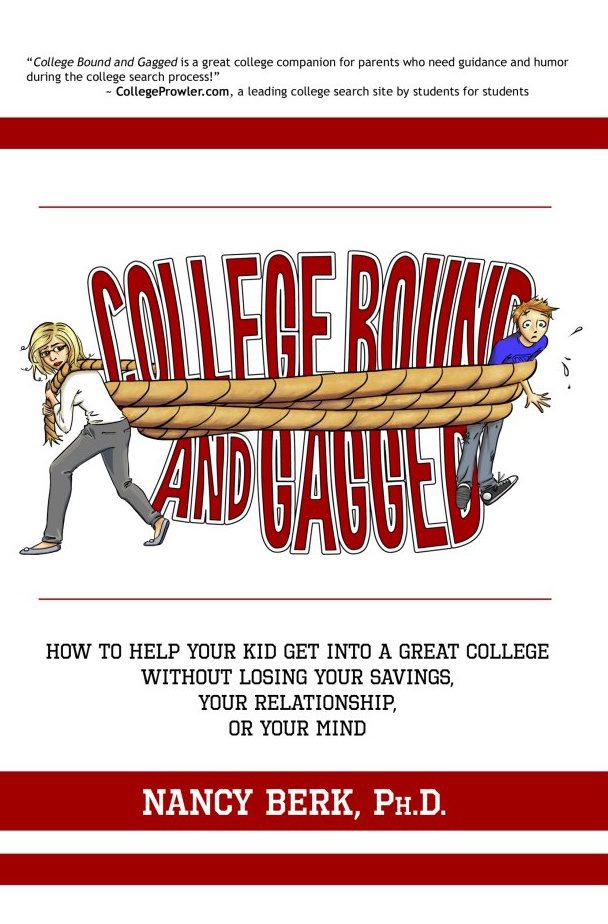
Nancy is also a parent who has survived the journey and written about it in her “hit” book, College Bound and Gagged. Nancy gives parents a comedic break by helping you laugh at yourself and your kids during this stressful time. There’s nothing better than a little laughter to ease the stress and help you see the bigger picture.

Z. Kelly Queijo (@collegevisit)

Kelly is the mastermind behind Smart College Visit, a website providing you with information and resources to help make the college visit a success. Her tools to help you plan your college visits provide parents with all the resources they need in one place. Her cool “mobile app” for Virginia Tech is the first of it’s kind!

Monica Matthews (@AidScholarship)

Monica is a parent herself and she is the scholarship guru, finding scholarships for her sons and teaching parents to do the same. Her simple ebook, How to Win College Scholarships, walks you through the process step by step.  She also blogs, giving parents tips and scholarship updates on a regular basis.

Paul Hemphill (@vcollegeadvisor)

Paul learned the hard way that colleges aren’t necessarily a parent’s friend. His frustration with the admissions process during his sons’ journey, prompted him to help other parents and students learn the secrets to take charge during the journey and “win” in this highly competitive process. His video series is second to none and every parent needs to arm themselves with his arsenal of sage advice.

This is just a short list of parents out there offering you help along your journey. Be an informed parent and tap into their advice and wise counsel. Parents helping parents–what better way to survive the journey?


Inside the mind of an admissions officer

When your student is applying to college, we tend to want to be mind readers and wonder what are those admissions officers using to weigh your student’s college application. Parliament Tutors has been interviewing admissions officers at various colleges across the country and is happy to share one of these interviews with my readers.

********************

A special thanks to Robert Barkley for participating our Admissions Spotlight Series.  Mr. Barkley is the director of undergraduate admissions at Clemson University.  Joseph Fernandez from ParliamentTutors conducted this interview.

What do you consider the most significant parts of an application, the parts which applicants should prepare the most carefully?

The most important part of a student’s application file is the high school record/transcript.  The preparation there begins at the beginning of the high school career.  As to the application form itself, it is important that all information be as accurate and complete as possible.  Especially in these days of online applications, the student is doing the initial data entry efforts for what could be their collegiate academic record.  Something as simple as one single digit in a zip code can affect the receipt of an admissions decision.

What advice can you offer students in regards to their personal statements?  Perhaps you can offer some shining examples that you have seen in the past. 

I read a lot of appeal statements from students who’ve been denied admission.  Many of them focus on grades and the circumstances that affected the grades.  Rarely do they focus on what they learned (despite the grades), which is what you’re really trying to determine when evaluating an application.

Is there anything you frequently see on an application that you hope to never see again? 

On the section for international students…where we ask for visa information…I hope I never see a student provide us with credit card numbers and other personal information.

What common pitfalls should applicants be careful to avoid? 

Applicants need to remember that the application  is the beginning of a dialogue with the college/university.  The information provided is going to be read by adults.  Students need to be careful not to be over-casual in their approach, presenting information as might be shared with their friends.

Are there any myths about the application process which you would like to dispel? 

College Admissions is NOT “The Great SAT Contest”, nor is it “Rush Week” where we sit around and select our friends and people that we like.

What advice would you give to an applicant with below-average test scores but significant extracurricular experience? 

Let’s hope that the information on the transcript shows exceptional performance in the classroom.  Otherwise, the test scores would appear to verify the grades, and show an over-emphasis on out-of-class activities.

Do you frequently have to turn away applicants whom you wish you could admit? If so, what could those applicants do to be admitted? 

They need to realize that many students graduate annually as transfer students.  If they are set on GRADUATING from a specific college or university, they need to explore transfer options that can put them on track towards a degree.

How much faith do you have in the ability of the SAT to predict success at in college? 

The SAT and ACT are excellent tools for helping to predict college success, but should not be used as the sole indicator.  Other factors (most importantly the high school transcript, grades, GPA, strength of curriculum, etc) must be figured into the decision as well.

What do you look for in a recommendation letter? 

Honesty and a true sense of perspective.


Joseph Fernandez is an SATTutor with Parliament Tutors, a NewYorktutoring and test preparation service.


“College Bound and Gagged” left me ROFLMAO


I know text speak is not appropriate blogging title content, but there really is no other way to describe the experience I had reading Dr. Nancy Berk’s book, College Bound and Gagged. Nancy takes the everyday aspects of the college admissions process and puts them into terms that parents can easily understand and relate to by using humor. And if that’s not enough, she sprinkles some of the best college admissions advice along the way by tapping into her own personal experiences and her network of college experts that she utilizes throughout the book.

What did I LOVE about Nancy’s book? She allowed the reader to go inside her own college admissions process with her son and experience all the trepidation and angst that goes along with it. She adds humor by describing parent archetypes so you can avoid those types of behaviors during the process. Her “5 Tips” sprinkled throughout the book simplify each step in the process and her “Top Tips” from college experts put you inside the heads of those who are “in the know” about college admissions.

Quite honestly, every page of her book had me laughing and saying, “Man oh man, do I remember that statement coming out of my daughter’s mouth!” Then Nancy helps you put it all into perspective and get you to the other side of the drama giving you insight into the perfect mental and emotional response.

Here’s an excerpt from her book of a conversation between Nancy (denoted as “me”) and her son (denoted as “teen”) related to college selection:

Me: What about Texas?

Teen: I don’t think I can go anywhere where they speak with southern accents.

Me: But you have a Pittsburgh accent. This really isn’t the place to start throwing stones.

Me: (after deep breath) What about Ohio? There are so many great schools in Ohio.

Teen: I’m not going anywhere that borders our state.

Me: (rough calculations look like he’s eliminated five additional states and Ontario; I am determined to figure this out) And why is that?

Teen: It just doesn’t feel right.

Or this conversation related to college visits:

Son: I’ve seen enough, let’s go.

Parent: But we haven’t even parked the car yet.

Son: You don’t think I can tell already? I DON’T like it here.

Parent: But we’re finally here. Let’s get out and look around.

Son: Nope. You go ahead if you want to. I’m just gonna wait here.

Zing! Every parent can relate to these types of conversations from their college-bound teens and Nancy knows how to get you through them with a little humor and a dose of common sense coping tactics.

After reading this review, I know that you MUST have your own copy and here’s your chance to win one. Nancy has donated a copy for me to give away to one parent and here’s what you will need to do to be eligible for the drawing:

  1. Leave a comment here with your name and email address; then…
  2. Go to my Facebook Fan page and leave a comment on my wall telling me why you NEED Nancy’s book.

On February 8th, one lucky parent will win a copy of College Bound and Gagged to peruse its content and learn all they need to know about surviving the college admissions process.

Good luck!


Inside the mind of an admissions counselor

Getting inside the mind of an admissions counselor gives parents and students valuable information and insight. Parliament Tutors is conducting interviews with admissions counselors all across the country and they asked me to post one of them on my blog. I was happy to oblige because the answers to their questions give applicants an idea of what they consider to be important in the college application process.

**********

A special thanks to Jordan Hassell for participating in our Admissions Spotlight Series.  Mrs. Hassell is an admissions officer at Berry College in Rome, Georgia.  Joseph Fernandez from Parliament Tutors conducted this interview.


As an Admissions Counselor, what are your day-to-day responsibilities?

An Admissions Counselor works with prospective students from the time they first become interested in Berry College until they begin classes as a new student.  We attend college fairs and visit high schools to share information about Berry. We meet with students when they visit campus, we correspond with them throughout the admissions and financial aid processes and we read their applications to make recommendations on admission decisions.
What do you consider the most significant parts of an application, the parts which applicants should prepare the most carefully? 

At Berry, we are mostly concerned with a student’s academic record. Students should pay careful attention to their high school curriculum choices, maintain a strong GPA in core classes and maximize their SAT/ACT scores.

What common pitfalls should applicants be careful to avoid?

Avoid being lazy through the application process. Be sure to complete all required sections of the application, submit a thoughtful essay, use proper grammar and punctuation instead of text lingo and pay attention to deadlines.

Are there any myths about the application process which you would like to dispel?

While we do look for active and well-rounded students, extracurricular activities and multiple recommendation letters do not allow us to overlook deficiencies in the academic record.

What advice would you give to an applicant with below-average test scores but significant work experience?

Maximize your test scores by taking more than one exam. Take advantage of free test prep resources through your school or public library. Use your resume and essay to highlight how you are prepared for college coursework.

What do you look for in a letter of recommendation?

We like to see candid details about a student’s preparation for success in college. We also verify a student’s academic and disciplinary records.

How much faith do you have in the ability of the SAT or ACT to predict success in college?

While scores are not the only factor considered, combined with GPA and rigor of curriculum, exam scores do serve as an indicator of potential success in college coursework.

Suppose an applicant has little or no experience relevant to your program, but has significant experience in other fields.  What can that applicant do to distinguish himself or herself as a good candidate for your program?

Complete a solid high school curriculum, earn strong grades and maximize SAT/ACT scores by taking more than one exam. Share details in your college essay that may help us understand how your interests and experience will contribute to our college community.

This is interview was conducted by Joseph Fernandez, an SAT Tutor from Parliament Tutors — an Houston Tutoringcompany.