Category Archives: college guidance

How to Make a Winning College Application Video Essay


video essay

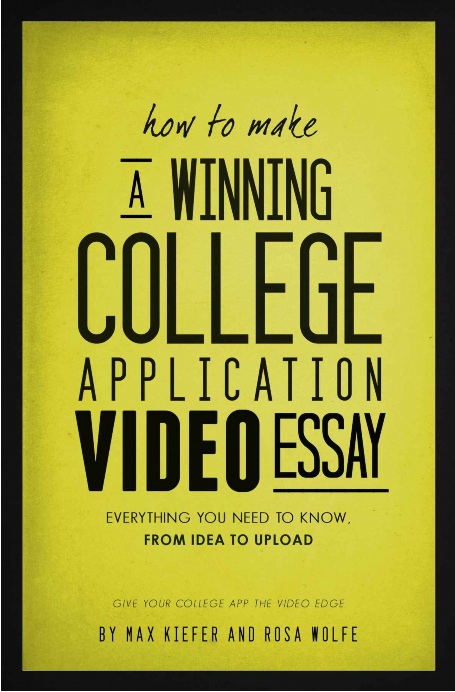
Today, I’m reviewing a book entitled “How to Make a Winning College Application Video Essay” by Max Kiefer and Rosa Wolfe. This book is written by parents for students: “We are a husband and wife writing and filmmaking team who have worked together so long that finishing each other’s written sentences is literally our stock in trade.”

In the beginning text in the book, they talk about the emergence of the video college application essay:

UTube officially arrived in 2009 when Tufts University invited applicants to submit an optional one-minute video. Tufts’ director of admissions, Lee Coffin, made this decision after being so impressed with a student video he famously remarked, “I thought, ‘If this kid applied to Tufts, I’d admit him in a minute, without anything else.’ ” With or without Tuft’s paradigm-changing decision, in the Internet age the college admissions video was inevitable. For a generation that has grown up swimming in social media, for whom images are a critical adjunct to communication, it’s hard to imagine that videos would not eventually become an element in the college sweepstakes. George Mason University, William and Mary, and St. Mary’s College have also begun inviting video submissions. More schools will surely follow. In any case, providing the colleges to which you apply with a DVD or a link to a short video essay won’t hurt. You don’t need to ask permission. If a college doesn’t want to look at your video, they simply won’t… but there’s every chance they will.

Continue reading How to Make a Winning College Application Video Essay

The benefits of getting your university education abroad


study abroadStudying abroad offers a wide range of benefits for university students on both an academic and personal level. The cultural experience alone is worth getting an education abroad, not to mention accruing a number of professional skills that would be more difficult to hone in your home country. The following offers a few of the many advantages you can obtain from attending an international school and getting your university education abroad.

Continue reading The benefits of getting your university education abroad

The benefits of being a student athlete


student athleteGetting a college education is difficult enough, so trying to do it while training at a high level is an incredibly daunting task. The enormous pressure to perform well at games can adversely affect studies and vice versa. Fortunately, the special needs of student athletes are recognized by schools and athletic commissions. Several benefits are provided to help them achieve their full potential both in sports and academics. These typically consist of the following:

Continue reading The benefits of being a student athlete

Music Careers for you music loving student


music careers

If you have a child that is passionate about music, then it is good to know that there are really great career options for them later in life. Having an understanding of what these are can allow you to share them with your child to help them find the right path. There are a few career options worth looking at.

Continue reading Music Careers for you music loving student

Sink or Swim: A Guide to College Graduation Rates


College graduation usually conjures up images of black hats getting thrown into the air and refrains of pomp and circumstance. What you don’t see, however, is the swell who started at the same time as the robe-clad flock but aren’t graduating — a number that would triple the size of grads (and make the ceremony even longer). In fact, at four-year colleges only 31.3% of students actually graduate from the school. The other 68.7% might be sitting at home, working a job that doesn’t require a degree, or maybe they’re still chipping away at the books after switching majors or signing up for a lengthy program. The latter is evident: The number swells to 56% who graduate within six years of starting. On the surface, it might seem like today’s student is lazy or lacks follow-through, but a closer examination reveals steep costs of schooling and family responsibilities a bigger decision-maker for college dropouts. Of course, the numbers vary widely across colleges when looking at college graduation rates, with some earning gold stars for graduating their students and others earning the nickname “dropout factories.” We take a closer look at the best and worst of 2-year and 4-year schools to help degree-seekers navigate to a college that will help them stay afloat.

For the full story, click the image below!
Sink or Swim: A Guide to Buoyant Colleges

Courtesy of OnlineColleges.net

5 ways to go green on campus


green campusIf there’s one thing that’s almost universally true about teenagers it’s that they’re fairly self-involved, and getting them interested in altruistic pursuits can be a chore. But as they get older and start to figure out who they are and what drives them, it may become easier to get them fired up about social and environmental challenges. Most young adults are full of energy and they want to do their part to make the world a better place. If you want to give your own college student some direction, you might suggest that he join the ongoing crusade to make the Earth a cleaner, greener place for all of humanity through his eco-friendly efforts. And here are just a few ways that you can get him on board with doing his part for the environment, and hopefully urging others to go green on campus.

Continue reading 5 ways to go green on campus

What if your student wants to attend an online university?


online universityYou’ve probably dreamed of sending your child off to your own alma mater, not to mention watching him walk to the stage to receive his diploma. Even if your kid is the first generation in your family to attend an institution of higher learning, you probably want him to have the college experience, including living in dorms, participating in Greek life, and so on. But times are changing, and more and more students these days are looking to save time and money by attending online schools to earn their degree.

You might be understandably concerned about the ramifications of going this route. What will it mean for your student and his prospects of gainful employment? If your teen tells you he’d rather attend an online school, there are a few things you’ll want to consider before you agree.

Check the accreditation

The most important thing to keep in mind when choosing an online college is the status it holds; you want to make sure your student attends an accredited school. Luckily, many online universities these days are accredited, and they enjoy the same accreditation status as their brick-and-mortar counterparts. You can find such institutions online via the U.S. Department of Education Office of Postsecondary Education (ope.ed.gov/accreditation/), which is required by law to compile a list of qualified institutions (even though they don’t themselves offer accreditation). But why is choosing such a school so important?

A school that has gained accreditation has proven that it meets certain standards for excellence in academia, and this means that other schools are far more likely to accept students coming out of such an institution. Many employers might question the validity of an online degree as well. Offering accreditation communicates that the courses offered are beneficial as they apply to your work preparation.

Weigh the financial savings

Of course, there could be other issues, as well. If your teen stays home he will certainly save money on tuition and living expenses, and the flexible schedule offered by an online university will allow him to continue working part-time. He won’t get the opportunity to socialize as much; and while this might not sound so terrible, consider that the peers he meets in college could one day be his colleagues. In short, he’s missing out on a prime chance to network with others who will eventually be in his industry. This is a big loss. He also won’t have access to internships and job placement.

Online education can also be costly. Many online universities attract students by offering student loans. Which can seem appealing at first, but later down the road, upon graduation, the debt is unsurmountable. If your son has applied for scholarships and won, verify that they can be used at an oline university.

So while attending University of Phoenix or WSU online might certainly be easier and more cost-effective, it’s important to impress upon your teen all that he might be missing by remaining at home instead of heading to campus. If he’s set on staying home, he needs to consider all of his options before making a choice that could affect the rest of his life.

How to set expectations for your soon-to-be college freshman


college freshmanIt seems like just yesterday that you brought your little bundle of joy home from the hospital, and now he’s a teenager preparing to leave home and head off to college. Luckily, you’ve done your job well, preparing him for the many trials that he’ll face when you’re not present to guide him. You’ve taught him to respect authority and treat others with kindness and compassion, although you’ve also instilled in him a healthy sense of caution, common sense, and self-preservation. He is confident and capable of caring for himself. So while you no doubt feel sad about his departure, you know that he is well-equipped to handle himself like an adult during his time in school. And yet, he may not be entirely prepared for some of the stresses and pressures he’ll encounter on campus as a college freshman. So as your last lesson before he leaves home, you might want to figure out how to help him set his expectations accordingly so that he’s not blindsided.

Academics

The first area you’ll probably want to address is academics, and they’ll likely be a bit more demanding than high school. Hopefully your teen has taken some AP classes, which are much closer to college-level requirements than standard high school courses. With any luck, the college he attends will accept some of these courses in lieu of general education credits, allowing your child a couple of light semesters to start off. Either way, though, he’ll be better prepared if he has taken AP coursework. However, he needs to understand that the onus is on him to attend class, study, and turn in his homework in a timely manner. This means setting a schedule that includes blocking out classes and study time and sticking to them. As a rule of thumb, every hour spent in class should coincide with approximately three hours of homework/study time.

Social activity

Next you should discuss social pursuits. College is not only a great time to make a new and diverse group of friends and participate in social activities and clubs, but it also provides myriad opportunities to network. However, your student should be prepared for the whirlwind that is social life on nearly every college campus. He could easily get sucked into partying and skipping class, and it’s not a bad idea to discuss the drinking and drug culture that seem to go hand-in-hand with college living. The hope is that your teen will stay away from these activities, which could easily derail his academic progress, but you’re fooling yourself if you think he won’t at least be confronted with such options. Talking it out ahead of time can help him to understand what’s out there and come up with a plan to have fun without hurting himself or others.

Consequences

College is a great time for students to test their independence. But it is also possible that those independent choices, right or wrong, will bring consequences. Remind your soon-to-be college freshman to think before they act and weigh the pros and cons of their decision. Help them understand that they will have to face the consequences of their actions and these consequences often affect their future.

The pressure to succeed in college is high, and it can definitely get to the average college freshman that has left familiar surroundings and a solid support network behind for the first time in his life. He may have his heart set on eventually attending criminal justice graduate programs or obtaining a PhD in medicine, but he’ll first have to make it through the stresses of freshman year. And the best way for you to help your student is to prepare him as best you can for what he’ll face in college. Armed with a plan of action he is more likely to proceed with confidence and go the distance.

Should your student attend a public or private university?


public or private universityThe student in your household has many schools to choose from when it comes to deciding where to attend college. And while you can definitely use college rankings and other resources to narrow down the list of possibilities, it might help to consider beforehand whether or not a public or private university is better suited to provide the coursework and degree your student needs.

However, you may not necessarily know the differences that separate a public institution from a private one. For all you know, they might offer exactly the same education. In truth, it could depend largely on the school in question, but there are some general features that can help you to differentiate a public university from a private one. Here are some things you’ll probably want to consider before you push the teen in your household to apply to one or the other.

The cost vs the benefits

The first thing you’ll no doubt notice is that private universities tend to be more expensive than public ones, all things considered. This is partially because they offer a certain amount of exclusivity, not to mention everything that comes with it. However, it is noteable that many private universities offer more merit aid because of generous alumni donors. This type of funding allows private institutions to be more selective when it comes to admittance, meaning they may require a better GPA or more extracurriculars or volunteer work than the average university. As you might imagine, the payoffs of getting accepted to one of these schools can be great. Class sizes tend to be smaller so that students receive more individual attention. If your student needs a bit more supervision to stay on track, this could definitely be a benefit of choosing a private institution.

Religious affiliation

In addition, some private universities are also religious in nature. So if it’s important to you that your child continues to receive religious instruction, a private institution, and specifically one that caters to your religion, may be in order. On the other hand, you’ll almost certainly want to make sure that your choice is based primarily on the academic features the school has to offer since the main goal of attending college is to earn a degree that leads to a fruitful career. All the same, many families are drawn to private schools that offer a religious aspect, and this could definitely play a role in the university you opt to send your child to.

Academic programs

Of course, you’ll also have to consider which universities offer the most highly rated programs for the type of career your student is interested in, and you might be surprised to learn that in some cases the public institutions beat out their private counterparts. You should also keep in mind that some schools have clout or connections within specific industries, which means they’re better equipped to offer internships, job opportunities, and even job placement in some cases. For instance, Texas A&M is infamous for their engineering network and the fact that alumni Aggies tend to hire Aggie graduates. Checking these stats ahead of time could help you to determine not only which type of university is better for your student, but which schools, in particular, are preferable.

Whether your student is looking to study medicine in California or head to a Vermont law institution, you need to look into both public and private universities in order to find the school that will provide the best education and the most opportunities. In some cases a public institution can provide just what you’re looking for, and probably at less expense. But often, private institutions offer the benefits of more merit aid, small class sizes, and an extensive alumni network. That’s why it’s important for parents and students to evaluate each university separately and determine which college is the best fit.


Comprehensive List of College Info Websites

college planning

Here’s a current comprehensive list of my picks for college info websites. Do you have any additional suggestions?

COLLEGE BLOGS

ParentingforCollege.com–You will find the MOST information ere olege news. Come here first to find the latest and bhest tools to hn our blog: college guidance, college planning, college coaching, and colelp you navigate the college maze.

TheCollegeSolutionBlog.com–An excellent resource for college-bound teens and their parents: admissions, testing, and financial aid.

UniversityLanguage.com/blog–Great blog articles about everything related to college admissions geared toward students.

GreatCollegeAdvice.com/blog–An excellent resource about the college admissions process providing expert advice helping students map their college journey.

USNews.com/Education–The education channel of U.S. News and World Reports providing the latest news and information related to college.

CollegeBasics.com–An excellent resource for information about college essays, college applications and high school resumes.

InsideHigherEd.com/blogs–Several different blogs related to higher education.

CollegeAdmissionsPartners.com/blog–An expert blog dedicated to helping students find the right college.

CollegeFocus.com/colleges–A virtual clearinghouse of blogs related to college life, parenting, college searches, etc.

Road2College.com–You can find just about any topic related to college prep at this site: financial aid, college planning, student loans, test prep, and more.

PARENT SITES

UniversityParent.com–A site where parents can ask questions, gather information, and download and view college guides and campus newsletters.

CollegeParentCentral.com–A blog created to give parents useful information about college and the college admissions process.

YourCollegeKid.com–A site with parent forums and other college prep tools.

CollegiateParent.com-A site dedicated to providing parents with information for their college students.

FINANCIAL AID

Fafsa.ed.gov–The official government website for the Free Application for Federal Student Aid.

SallieMae.com/plan–A FREE education investment planner that will help determine college costs, compare college costs, and provides information about student loan repayments.

SavingForCollege.com–Everything you need to know about financing a college education.

FinAid.org–An excellent resource for the answers to all your questions regarding college financial aid.

CollegeFinancialAidAdvisors.com–Help with the college financial aid process.

SCHOLARSHIPS

Fastweb.com–An extensive scholarship search website with a massive database of scholarships, along with articles and helps designed specifically for parents.

Chegg.com–A free service for students and parents where students can showcase themselves, connect with colleges, and search for scholarships.

Cappex.com–The place to go to find merit scholarships and academic scholarships from colleges across the country.

Scholarships.com–An extensive scholarship search engine that helps you search and schedule alerts for deadlines.

How2winscholarships.com–A guide for parents and students on how to effectively apply to and win scholarships.

COLLEGE VISITS

SmartCollegeVisit.com–Created to provide information about college visits, help parents and students plan, and view personal accounts from both parents and students.

CollegeWeekLive.com–A virtual college fair that sponsors free LIVE events with archived presentations, student chats, and college booths.

Youniversitytv.com–Learn about colleges by watching video tours, chat with students on campus forums, post questions and get answers.
CustomCollegeVisits.com–Offer custom tailored to your family’s needs, whether you’re visiting college & university campuses close to home, across the country or from overseas.

COLLEGE PLANNING

Cappex.com–A site created for students to help them simplify their college search, create a profile and search for scholarships.

CommonApp.org–The common application site used by 400 colleges and universities across the country.

PrincetonReview.com–The best value colleges list for public and private institutions across the country.

UPromise.com–UPromise partners return a portion of eligible purchase money back to you. Those earnings accumulate in your Upromise account until you decide to use it to invest in a 529 plan, help pay down eligible student loans or assist with college expenses—all tax-free!

CollegeBoard.com–It’s here you’ll find the CSS Profile application (required by many private colleges), register for the SAT, and read articles about planning for college.

CollegeXpress.com–A search site that groups colleges in categories and provides college “hot” lists (i.e. top college for late bloomers, colleges for students needing a second chance)

VolunteerMatch.org–Find local volunteer opportunities for your college-bound teen and teach them about the importance of giving back to their community with the added bonus of adding that service to their high school resume.

KnowHow2Go.com–A college planning site for college-bound students providing helps and aids from middle school to senior year: interactive and fun!

 BigFuture.collegeboard.org–A planning tool to help parents and students get ready for college.

TEST PREP / TUTORING

TutorsForTestPrep.com–An SAT expert and coach offering tips to help your college-bound teen improve their SAT/ACT scores.

FairTest.org–The site for the National Center for fair and open testing providing information about colleges who do not use the SAT/ACT for admissions decisions.

QuincyTutoring.com–A resource to find a tutor and schedule a tutoring session.

LaunchpadEducation.com–Tutoring to help students with learning disabilities and ADHD.

CramBetter.com–CramBetter uses bite-sized video lessons to help you focus on the material that’s most likely to show up on your exams in math, physics and chemistry.

TEXTBOOKS

ECampus.comFind textbooks, sell textbooks, search for college supplies and college apparel all on this one site.

Chegg.com–A hub for students to compare textbook prices, study for exams, and choose the right courses.

RECRUITING

NCSASports.org–The college recruiting site for athletes.

BeRecruited.com–If you have a teen that’s a student athlete, they can create an online profile here and help colleges and coaches find them and be recruited.