

If you’re the parent of a high school athlete, the college recruiting rules you remember are mostly gone. In the past two years, Division I traded scholarship limits for roster limits, the NCAA stopped using SAT and ACT scores for eligibility, a five-year eligibility clock replaced redshirts, and most states began letting high school athletes earn NIL money.
The basics still hold: your athlete needs the grades, the film and real conversations with coaches. What changed is which questions to ask, and when. Here is what is different for the Class of 2027 and younger, and what to do about it this year.
Scholarship limits are gone at many Division I schools
Since July 1, 2025, Division I schools in the House v. NCAA settlement have had no scholarship limits. Each sport has a roster limit instead, and any athlete on the roster can receive a full or partial scholarship. The College Sports Commission counted 319 participating schools in 2025-26, including every school in the ACC, Big Ten, Big 12, Pac-12 and SEC.
The new limits are tight: 34 players in baseball, 25 in softball, 28 in men’s and women’s soccer, 15 in basketball and 105 in football. Walk-ons count against those limits too, so a “preferred walk-on” offer is a coach’s commitment, not a guaranteed spot.
Outside those schools, much less changed. Division II, the NAIA and junior colleges still split a fixed number of scholarships per team, so partial awards are normal: Division II baseball has 9.0 scholarships and softball 7.2. Division III offers no athletic scholarships, but the NCAA reports that 80% of Division III athletes receive other aid.
What it means for you: when a coach shows interest, ask whether your athlete would be on next year’s roster, not only how much money comes with it. Our guide to 2026 scholarships and roster limits lists every sport’s numbers.
Grades matter more than test scores
The NCAA stopped using SAT and ACT scores for Division I and II eligibility in 2023. What counts now is the GPA in NCAA-approved core courses: a 2.3 in 16 core courses for Division I, and a 2.2 for Division II. Colleges may still ask for test scores for admission or academic scholarships, so check each school.
Two details catch families off guard. Division I’s 10/7 rule requires 10 core courses, 7 of them in English, math or science, to be finished before senior year starts, and those grades lock in at that point. And a class counts only if it is on your high school’s NCAA-approved core-course list, which you can look up in the Eligibility Center’s High School Portal.
The NCAA recommends registering with the NCAA Eligibility Center before ninth grade. A free Profile Page is fine at first. Athletes recruited by Division I or II programs need the certification account, which cost $120 in October 2026, with fee waivers for families who qualify. Our NCAA eligibility guide walks through registration step by step and includes a checklist for each grade.
A new five-year eligibility clock
In 2026, Divisions I and II replaced the old seasons-and-redshirt rules with an age-based model. Athletes get up to five years of eligibility. The clock starts at the earliest of three moments: first full-time enrollment at any college, the start of the academic year after the athlete turns 19, or a first college competition.
The new model applies on its own to students who first enroll in fall 2027 or later, which includes this year’s high school seniors. Once the clock starts, it does not stop for a redshirt year or a transfer. The practical takeaway: a gap year after age 19 now uses eligibility, so plan any postgraduate year with that in mind.
NIL has reached high school
As of October 2026, high school athletes can earn money from their name, image and likeness (NIL) in 42 states. Seven states do not allow it: Alabama, Arkansas, Hawaii, Mississippi, South Carolina, Texas and Wyoming. Every state that allows NIL bars using the school’s logo, uniform or facilities, and most ban categories such as alcohol, tobacco, gambling and weapons.
Two rules apply in every state. If your athlete will play Division I, NIL deals worth $600 or more paid since the start of junior year must be reported within 14 days of enrolling, so keep the records. And NIL income is taxable, including free products: net self-employment earnings of $400 or more mean filing a tax return, even for a teenager you claim as a dependent.
State rules change often. Our state-by-state NIL guide lists each state’s current rule.
What parents can do this year
- Sit down with the school counselor and map all 16 core courses, checking each one against your school’s NCAA list.
- Register with the NCAA Eligibility Center, starting with the free Profile Page.
- Get an honest read on which college levels fit your athlete’s measurables and grades, then build a list that spans Division I, II and III, the NAIA and junior college.
- Have your athlete email coaches directly. Coaches want to hear from the athlete, with stats, a film link and a reason the school fits.
- When interest turns serious, ask about the roster spot, what the aid covers, how renewal works and what happens if the coach leaves.
- If your athlete signs any NIL deal, keep the contract and payment records from junior year on.
How NextCommit can help
Full disclosure: I co-founded NextCommit, a college recruiting platform that helps high school athletes find and email college coaches. Two of our tools are free:
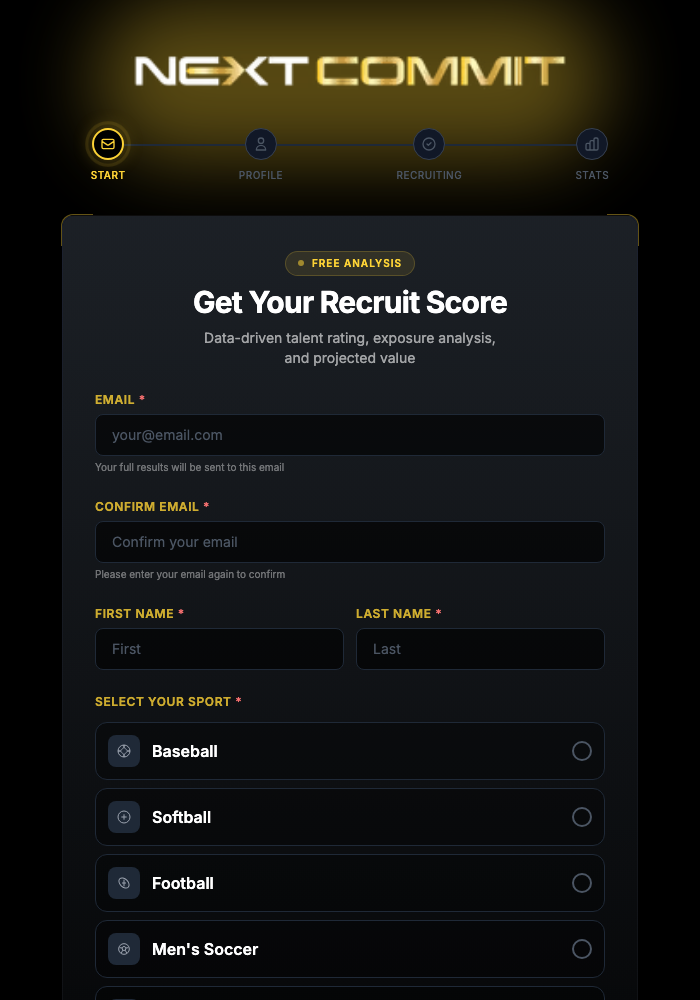
- The Recruit Score asks for your athlete’s sport, position, measurables and academics and returns an AI evaluation of which college divisions are a realistic fit right now. Results are emailed to the athlete.
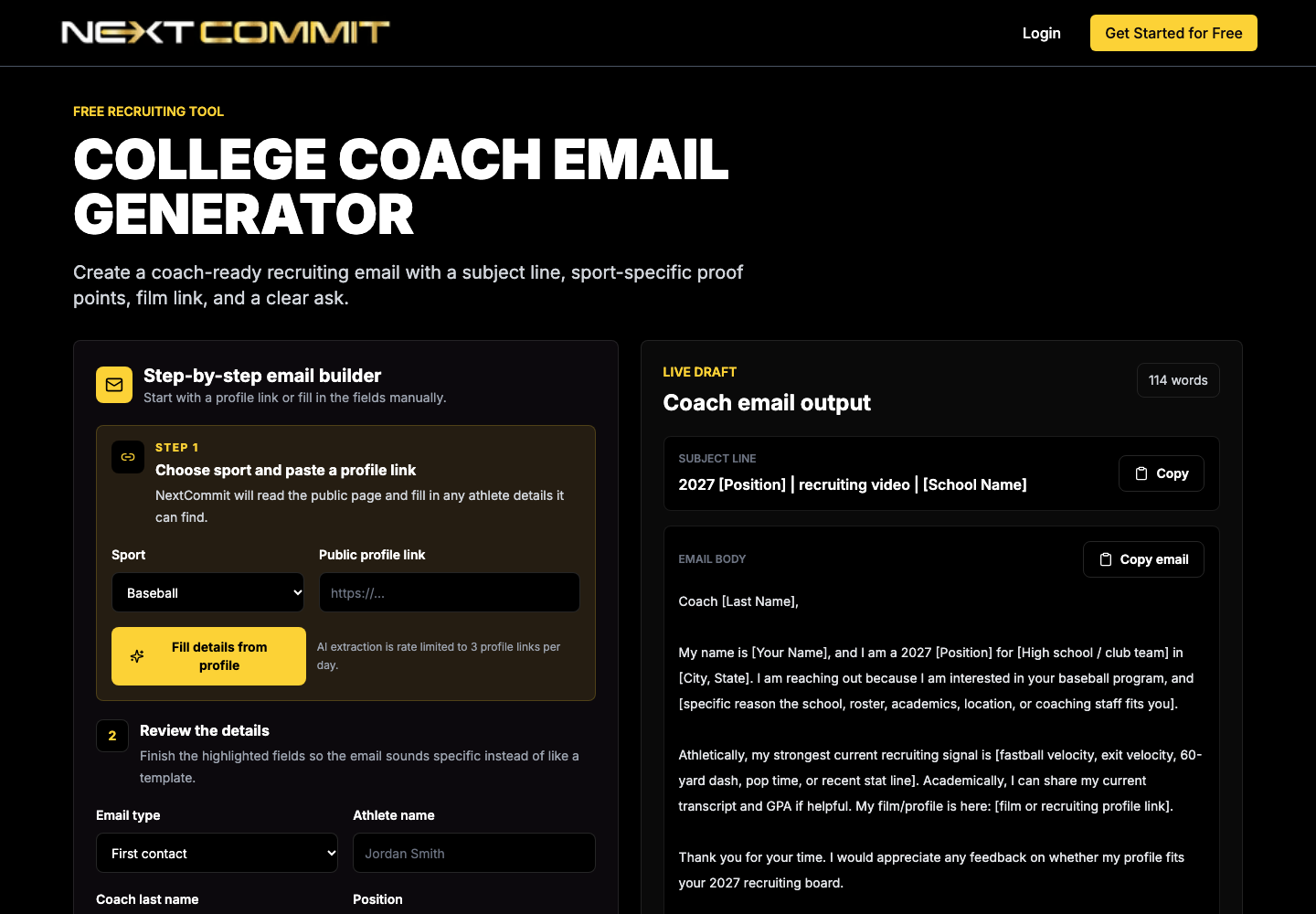
- The Coach Email Generator drafts a first email to a college coach from your athlete’s sport, grad year, stats and film link. No account needed.
With a NextCommit account, athletes can also search 35,000+ verified college coaches across Division I, II and III, the NAIA and junior college, and send personalized emails from their own Gmail, so replies come straight to them.
Today’s guest post is by Adam Paganelli, a co-founder of NextCommit. He played college baseball at Green River College, Sacramento City College and Northwest Nazarene University, and he builds the recruiting tools athletes use at nextcommit.ai.