If you’re a parent with a college-bound teen you might be feeling just a bit overwhelmed. With tuition costs rising and many colleges reducing their financial aid packages, it’s easy to wonder if you’ll be able to afford that hefty college price tag and focus on college sticker shock. Whether you are looking at fall college admission payments coming due, or you have several years to go before forking over the cash, you’ll appreciate these simple cost savings tips.
Encourage your teen to search and apply for scholarships. There are all types of scholarships available for all types of students at all ages and education levels. Summer is the perfect time to search and apply, thus conquering summer boredom.
Get college credit early with AP exams. If your teen is enrolled in high school AP courses, make sure they take the AP exams. If they score well, they will receive college credit, which can save you thousands of dollars in tuition alone.
Don’t discount private universities. Your EFC (Expected Family Contribution) will be the same no matter which college your teen attends. Private universities often have substantial alumni donors and also have the largest aid packages with many paying the total cost of tuition.
Consider programs
that provide funds during college in exchange for a service commitment. These
programs such as ROTC, AmeriCorps, VISTA and
the Peace Corps offer tuition reimbursement, stipends and also provide an
opportunity to serve.
Apply for financial
aid even if you don’t think you will qualify. Every family should
complete the FAFSA (Free Application for Federal Student Aid). Every college
uses this form to distribute need-based and non-need based aid. Even if you
don’t qualify for need-based aid, your teen might qualify for an academic
campus-based scholarship.
Be a penny pincher. You
can save big bucks on textbooks, computers, meal plans, dorm furnishings and
transportation. Investigate alternatives to paying top dollar for new items and
save on second-hand items.
Encourage your teen
to take summer classes at your local community college. The
cost for these courses will be substantially less that at a four-year
university. However, make sure that these credits will transfer to your teen’s
chosen college upon completion.
Before your teen heads off to college, create a simple budget that will
help your teen and your family plan for college-related expenditures. These
simple college cost savings tips should help you save a large chunk of change;
and in today’s economy, every dollar counts.
The National Center for Education Statistics requisitioned a study that followed the attainment and persistence rates of a nationally representative sample of 19,000 American students, following them over the past six years.
The report found that within six years of enrollment:
35
percent of students had not received any type of degree and were no longer
enrolled at any institution
46
percent of students who initially enrolled in two-year institutions did not
receive any type of degree and were no longer enrolled at any institution
50
percent of students who enrolled in a four-year college did not attain a degree
from that college
These statistics show that there is a significant amount of students who enter college and do not attain a degree. What can be done to assure that you don’t become one of those college dropout statistics?
1. Research
colleges and majors before applying—It’s just plain smart to do the
research and know why and where you want to go to college. Refine your list of
choices to include the colleges that offer the academic program that suits your
interests and the college setting and faculty that you feel most comfortable
with and could see yourself flourishing in that environment.
2. Study the
cost of attendance and know your financial aid options—Before you choose a
college, make sure you can pay for it and that you’re comfortable with repaying
any loans you secure to finance it. Verify that your scholarships will be
available for the course of your enrollment and what requirements need to be
met to keep them. Do some calculations that show you the true cost of
attendance using college cost calculators.
3. Find the “perfect fit” college—If you feel like you fit at the college you are attending, you will be more likely to stay and complete your degree. That perfect fit means that you want to be there AND the college values you and wants you there as well.
4. Be invested
in the process—If college is your goal, you need to be invested in the
process. Contribute to the education financially and you will be more likely to
stay invested and complete the process. Going just for the sake of going or
because you think it’s what you are supposed to do will not keep you there.
5. Be realistic
about obstacles and get help if necessary—College, like life, will have its
own set of obstacles. When you encounter them, get help. Seek advice from a
mentor or another student. Get tutoring if you find you’re struggling with your
classes. Speak with a professor if you need clarification or assistance on
projects. Use your RA (Resident Assistant) to help resolve roommate conflicts.
Before you make such a
large investment, the wise consumer will do the research and be realistic about
what is required to finance the education, while admitting that you will face
obstacles along the way.
It’s time for your senior to start planning college visits; and an important part of any college visit is the college interview. Here are some tips to help your student prepare:
Your palms are sweating. Your throat is dry. You are sitting in an admissions office waiting for your turn to be interviewed by someone from the college you are intent on attending. You’ve heard all the horror stories and you’ve prepared as best you could for the questions that will be asked. You know that this interview is an important part of the admissions process and it could contribute to the college’s final decision.
Here are three things
you need to remember before you walk in to the admissions office:
1. Be Yourself
The admissions officer
is not looking for the person you
wish you could be or the person you think they want to see. They want to get to
know you and get a feel for how you will fit in to their college population.
Being yourself benefits you and the colleges by helping both of you get to know
one another and find that perfect fit. You do yourself and the college a
disservice by pretending to be someone other than who you are. It’s a bad way
to begin your college career and a poor example to set in an interview.
2. Take some time to
prepare
Don’t walk into a
college interview unprepared. Research some of the common questions asked and
think about how you would answer them. Know a little about the college and be
prepared to tell the admissions officer why you are interested in attending
their college. If you’re excited about attending, they will be excited about
offering you admission. Every college wants students who want to be there and
who know how they will fit in to their campus. If you show little motivation,
they will show little interest.
3. Remember that you
are also conducting an interview
Colleges are not the only ones conducting the interview. You are interviewing them to find out whether or not you would feel comfortable attending there. Prepare some questions in advance; but don’t ask questions that can be found on the website or in the admissions literature. Admissions officers welcome questions that communicate an interest in their college and a willingness to learn more about their specific academic programs. Don’t just sit there and answer “yes” and “no” to their questions without having a conversation. It’s your opportunity to get to know them as well as theirs to get to know you.
The college admissions
interview communicates that you are interested in attending and gives the
colleges an opportunity to get to know you by putting a face with a name. When
decision time comes around, colleges will remember your interest and the
interview could very well put your name above someone who didn’t take the time
to schedule one.
Many times, students and parents just “let the college decision happen”. They automatically assume that once they make the decision to attend, they will be able to get in somewhere, even if it’s a local community college. You should take charge of your college process and make it your “job” to find a place where you can get a college education that is worth the money.
1. Establish relationships
Start early establishing
those relationships that will help you in the college admissions process. You
will need recommendations from teachers, counselors and even business
professionals. You should also make contact with admissions personnel at the
colleges you are considering. These relationships will cement your desire to
attend their college and keep your name at the forefront of their minds
when they receive your application.
2. Choose to choose
Don’t let the college decision happen. Make a decision
to choose the colleges. Take control of the process from researching, to
visiting, to applying, to final acceptance. It’s up to you to evaluate your
financial aid awards and determine the best value. You don’t want your
college education to be an “impulse” buy.
3. Be wise about
funding
Part of taking charge of
the process, is taking charge of the funding. Know what your budget is and what
you are willing to spend. Don’t bury yourself in debt. Look at the repayment
calculators and evaluate your earning potential upon graduation. Don’t take the
“I’ll-think-about-that-when-I-graduate” approach. Most importantly, fill out
the FAFSA (Free Application for Federal Student Aid) because this qualifies you
for government grants, loans and college merit aid scholarships.
If you follow these
simple suggestions, you will be the one in charge of your college search. Don’t leave the process to fate, luck or someone you
don’t even know. It’s your future. It’s your decision. It’s your education.
Your senior is looking ahead. The last few months of high school. Major decisions to make. A huge to-do list. Then…it’s off to college. How will your student adapt? How will you adapt? Here’s a letter to your student (save it for later) and prepare yourself for their first day of college and the longest goodbye.
This is it!
You have made the college applications, you have been to those (not for the faint of heart) college visits, you have been accepted for a place, and then, finally, your alarm clock wakes you from your slumber. The day has finally arrived.
The day you leave home and embark on your college education.
Oh, the joys, the excitement, the nerves, the cold dread of fear…
It’s time for some survival tips to help you get through your first day.
Tip #1: Operate an open day policy
If you have a roommate, then you will automatically have one candidate for your social circle (let’s hope you like them). But if you are in a room of your own, don’t shut the door when you arrive. Well, don’t shut it for long anyway, as your day will be a lot easier if you manage to say “hello” to somebody. An open door is an opening for other residents to come and introduce themselves to you, so while you might want to curl up in bed if you’re stricken with nerves, know that operating an open door policy on your first day will help you make contact with similar others.
Tip #2: Make your room your own
Homesickness is common for first-day students, and while you may be tempted to ring your parents every five minutes for comfort, you can also make any negative feelings disappear by decorating your room with your some homely touches. Photos of friends and family, posters from your old bedroom, and any knick-knack you might possess are all useful ways to transform your dorm room from something strange and unfamiliar to something comforting and reassuring.
Tip #3: Get out and meet people
Don’t stay in your room alone for long. Hopefully, you may have met people through the open door policy we advocated, but if not, you need to be proactive. Wander down the corridor and knock on other people’s doors. Introduce yourself, and let them know your room number. And go out into the wider campus and find out where people are hanging out. It takes courage to go up to groups of people, but try and do so, or if you see other people wandering about alone, go and say “hello.” They are probably in the same boat as you are, trying to make sense of their first day in a new place.
Tip #4: Explore the campus
You are going to get lost – a lot – in your first few days at college. Don’t worry, this is normal, and if you are late for a few classes here and there, then you have an excuse. Still, you can make life easier for yourself by exploring your surroundings. Especially as you won’t have much to do on your first day, this is the perfect opportunity to spend time getting to know where things are. From the cafeteria to the library, make a mental note of how to get to places, or make notes on your phone. You might also meet people this way too, so remember to be polite and introduce yourself as you’re on your walk around the campus.
Finally
Don’t despair if you don’t meet anybody you like. Don’t worry if your first day threatens to overwhelm you. It will get easier, so try to stay calm and carry on, even when your nerves threaten to get the better of you. There is plenty more advice online on how to survive college life, including this excellent blog from Stephen Troese Jr, so gather as much info as you can to help you on your college journey.
As the costs of college keep rising each year, many students and their families find it necessary to rely on financial aid to help pay for college. There are many different types of financial aid available, and knowing which one best matches your situation is key to not only choosing the right type of aid, but also maximizing the amount that you can qualify for—and minimizing your debt obligations later on.
Financial aid is a critical part of the college application and attendance process. It can make college a reality for many students and help bridge the gap between family contributions and the overall cost of attendance. Some types of aid don’t need to be paid back; others can leave you in debt for years to come.
With that in mind, it’s important to understand how to best approach the financial aid process, and how to set yourself up for financial success later by putting thought into the process now.
What Should You Start With?
The first step in the financial aid process should be completing the FAFSA. Short for the Free Application for Federal Student Aid, the FAFSA walks you through a complete picture of your finances. If you’re a dependent student—most first-year students are—then it also includes questions about your parents’ financial situation and their potential ability to assist in funding your education.
The federal government is the biggest source of financial aid for college students, and before it’ll consider you as eligible for aid, you’ll need to complete the FAFSA, which serves as your application for all federal aid. The FAFSA is completed online, it’s free, and there is plenty of help available to assist you and your family in filling it out.
What’s the Takeaway from the FAFSA?
Once your FAFSA is submitted to the federal government along with your choices of colleges, a Student Aid Report, or SAR, is generated from the information you entered. The SAR explains how much your expected family contribution (EFC) is. The government takes the position that it’s your responsibility to pay as much as you can to your own education first; the EFC is how much the Department of Education thinks you and your family should be able to contribute to the total cost.
Each year, colleges publish an amount called the cost of attendance. It includes all the expenses that go into attending that school: tuition, room and board, textbooks, fees, and other things like living expenses throughout the school year. Your EFC is subtracted from the Cost of Attendance, and the resulting balance is considered your financial need. The federal government sends your SAR to the schools you listed, and they compile a financial aid package to offer you.
Your federal financial aid package could include a variety of aid products including Pell grants, unsubsidized and subsidized federal student loans, and more. You should always consider Pell grants and subsidized federal aid first. A Pell Grant is a type of aid that does not require repayment, and subsidized loans do not accrue interest while you’re attending school.
After looking at your offer, you may find that your financial aid package isn’t enough to cover the entire bill, but there are other options to consider such as scholarships.
Should You Consider Scholarships?
The short answer is “YES, absolutely!” Scholarships, like grants, are essentially free money that you don’t have to pay back. They should always be a consideration regardless of what year you are in college. You can apply for new ones every year, and there are tons of sources to find scholarships. They can really make up the difference up between the cost of attendance and your financial aid package. Start early and often. If the FAFSA wasn’t so important, this would be the first place to start.
There are thousands of scholarships available every year, but they’re highly competitive. Each program has its own application criteria and deadlines, and the best way to maximize your chances of winning one is to ensure that you follow the program’s directions and meet all of the deadlines—preferably applying as early as possible. The best way to go about winning scholarships is to just keep on applying to any legitimate opportunity you can find.
Is There a Last Resort?
If you find there’s a funding gap left over after scholarships, grants, and other federal aid, then you still have one option: a private student loan. There are distinct differences compared to federal student loans do, but sometimes they’re a necessary tool to cover that funding gap.
Offered by banks, credit unions, and other lenders, private student loans are based upon your creditworthiness; as a result, most students find that they need a qualified cosigner for approval. Further, you may find even the best private student loans still have high interest rates compared to federal loans. After all, interest rates are generally higher for private loans. Also, they don’t come with a grace period like a federal loan. That means you’ll need to start paying it back immediately, just like a car loan or mortgage, even if you’re still in school.
It is clear that private student loans are not as desirable compared to their federal counterparts; however, sometimes they’re a viable option if it’s crunch time.
One of the key lessons you can teach your teenager is how to get along with others. Participating in sports on a team is a good way to raise a team player.
Taking part in sports and more active activities is a positive substitute for overindulging in technology as it will ensure that your teenager will be getting plenty of exercise so they can stay fit and healthy. Unfortunately, though, encouraging your teen to get into sports isn’t always easy. After all, we aren’t all natural sportsmen!
You might need to use all of your talents of persuasion to encourage your teen to become sporty. It’s not completely impossible, though, especially if you use all of these tips.
Encourage Them To Choose A Team Sport
Firstly, you will need to help your teen decide which sport they want to get into. It’s usually a good idea to encourage them to try out a few different ones to start off with to see which they enjoy the most. You might find that they prefer team sports, such as soccer and baseball, as being part of a team can help them make friends and encourage sportsmanship.
Buy The Right Kind Of Sports Gear For Them
Before your teenager gets started, they will need the right kind of clothes for the activity. From track and field uniforms to soccer jerseys, you will find that all kinds of sports have their unique clothing. There’s a reason why all these sports clothes are so different, and it’s that the player’s body can be as flexible as the sport requires. So, making sure your teen is dressed in the right clothes will help them perform better out on the field or pitch, as well as making sure they look the part.
Promote Watching Sports At Home On TV
If your teenager is quite stubborn and refusing to try out any sport, you might want to start watching a few sports at home as a family. This should pique your teen’s interest in at least one of the sports. After a while, they may even want to try it out for themselves. Hopefully, watching sports on TV in this way can help to spark a life-long enjoyment of one sport.
Get Them Some Lessons Or Coaching
Your teen might not be too skilled when they start taking part in a sport. This can be quite off-putting for them at first, and they might end up embarrassed or think that they are letting the team down. There is one way around this, though – they might just need to take part in some lessons or coaching. This should help them greatly improve their skills, and it can also be a valuable way for them to gain some experience playing a sport before they are part of a team.
Hopefully, all of the tips above help you persuade your teenager to get into sports. The hardest decision for them might be which sport to follow as there are so many to choose from!
If receiving financial aid is the key to attending college, you might want to look at your college’s financial aid footprint. Every college reports the statistics related to their financial aid profile. These statistics can tell you how generous they are with their scholarships and grants and also the percentage of students who receive help with their tuition. It will also help you determine if you should ask for more merit aid when you receive your financial aid package. If a college is not generous with aid and your student receives some, it’s unlikely they will award more.
The best resource available for these statistics is College Navigator. You can enter the name of the college, or search using criteria such as location, size, and degree plans. Once you’ve pulled up the data, you can use it to compare colleges.
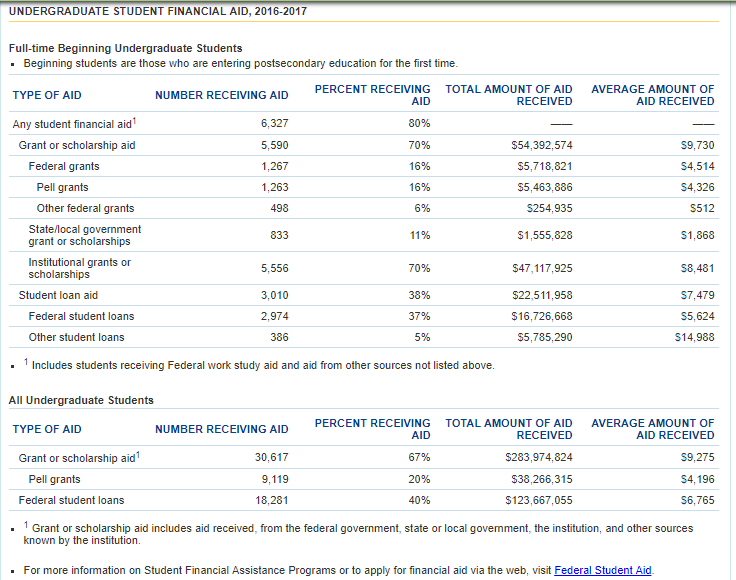
Below is a screenshot of just one university, Ohio State:
As you can see, 67% of the full-time beginning undergraduate students receive aid in the form of grants or scholarships; 70% of that aid is from institution grants and scholarships. Also notable, the average amount of aid received in the form of grants or scholarships per student is $9,275. Total tuition/room and board is $27,037 for in-state, on campus students. Therefore, 1/3 of tuition, room and board is covered in the form of grants and scholarships.
covered in the form of grants or scholarships.
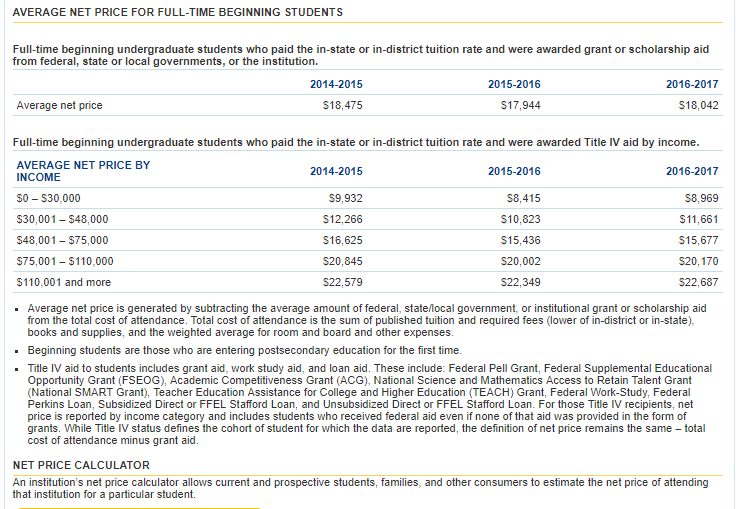
Another valuable part of the information available includes the average net price broken down by household income:
All of this information will help you determine a college’s financial aid footprint and give you the much-needed data you will need to make the wisest financial choice. Finding the college with the best financial aid is part of finding that perfect fit college.
In addition, you can connect with the College Affordability and Transparency Center provided by the federal government to determine which colleges are the highest and lowest priced and which offer the best value.
When I was in high school, parents would never think of helping their student with college prep. The high school counselors handled any questions and most my classmates attended the local four-year university. But parenting has changed and so has college prep. With record numbers of students applying to college and the soaring costs of college, parents can help students relieve some of the stress of college prep by offering some help when needed.
Just remember that “help” is the operative word. Your student should always be in charge of the process. Here are just a few ways you can help your student with college prep:
Scholarship searches
Parents can assist students with scholarship searches. With all the opportunities online of scholarship postings and search engines, it’s easy to spend some time on your smartphone looking for scholarships that fit your student. You can do a Google search with scholarship parameters, use apps like MyScholly, or even search on Twitter by following users like @AidScholarship or @Scholarships360. Once you find a scholarship that matches your student’s interests and/or qualifications, pass the information along to your student.
Interview tips and information
Parents can certainly provide useful interview tips for their students. They can advise them on appropriate dress and give interview tips and encouragement. You might even go as far as passing along useful articles about college interview questions and answers like this one: College Interview Questions to Ask and Answer.
Essay proofing and editing
While it’s not advisable for parents to contribute content to the student’s college essay (admissions officers can spot this instantly), it’s perfectly acceptable to help your student with proofing and editing. Your student may need to bounce off some ideas before starting as well. If you find it necessary, you can even provide further help by paying for an essay writing coach like The College Essay Guy to help.
College visits
Accompanying your student on college visits can be another way you can participate in the process. While on the visit, let your student take the lead. You should listen, take pictures, and even notes if necessary to help with the information gathering process. Scheduling multiple visits over a few days can also be helpful for both you and your student.
Test prep
Your student should set aside some time to prepare for standardized tests. You can help by scheduling study time during the week, monitoring practice tests, or even paying for a professional test prep tutor. Affordable and even free test prep is available for every student if you find this will help them better prepare
College choice
Even though the final choice of college should always be left to your student, you can certainly offer input and advice along the way. You can help your student stay within the financial guidelines you should set before applying and also help with the final decision.
If your child (or soon to be adult…) is off to college, then you could be worried about a few things. Are they going to fit in? Will they enjoy their experience away, or get homesick and struggle in their new city? Do they have enough knowledge about finances to get by? Well, we’ve spent a lot of time considering the latter question, so that you can be sure that your child is prepared when it comes to finances. Rest easy knowing that they’ve got it covered, by remembering these simple tips:
Teach them what you know
The reason that many kids at college struggle so much with finances, is because nobody has taught them how these things truly work. You don’t have to sit down and lecture your kids on this, but make sure you give them some tips in the months leading up to their big move to college. If they can’t cook breakfast and don’t know how to pay rent, they’re going to have some real problems. You can prevent all of this with a bit of advice, and it will go a long way, so show your child how to manage things like bills and rent (especially if they’ve been planning to eat cereal for every meal of the day…).
Use technology to budget
Helping your child to sort out a budget will be really useful to them, especially when they’re going it alone. The days of sitting down and trying to distinguish what you’ve spent, and where, are gone, and you no longer need to sit there with a pen doing the math for hours. Utilize the technology that is out there, and make sure your kids have the best money management app available. Your child probably spends a long time on their cell phone, and won’t forget about budgeting if it is right in front of them. We can’t promise that, but it’s worth a shot.
Emphasize the importance of researching
Ok, we don’t mean academic researching here, but if they have the skills to do it, then why let it go to waste. Many college kids decide that they need something – and this could even be a textbook – and then just buy the first copy of it that they come across. Please, don’t let your child do this, when they could get second hand copies from places like eBay for a fraction of the cost. There are plenty of online stores that specialize in used books, and doing your research first could save you hundreds of dollars over the academic year. Research, research, and research again. You won’t regret it when your wallet shows you the benefits.
So, there we have it. Some simple tips to help you to help them, when it comes to sending your kids to college. Teach them everything you know about finances, bills and rent, use the latest technology to budget, and make sure that they research before they splash out on expensive resources. Good luck!