All posts by Suzanne Shaffer

Motivation for Students Starts at Home


helping without harmingAfter finishing high school, which means the end of the obligatory studies, some students struggle to maintain a positive attitude towards learning, especially if they have found a job offer. If you were to ask them, “what do you prefer,money now or money in 10 years,” you’d find out how some of them are so impatient that they prefer the money now, even if it’s a smaller amount. That’s why us, parents, have to be there to motivate them to go to college or to study an occupation and in that way in which they don’t believe it’s only a mandatory thing imposed by adults. In this post we’ll see how to motivate our kids from an early age to always choose to study:

The family is the environment in which our child’s education begins, and also the main model of values and behaviors that guides the cognitive and affective student’s future development. Here’s where parents have the opportunity to get that their children enjoy learning.

Everything should start by educating by an example to follow. Parents who show interest and enthusiasm for their child’s learning tasks and express their curiosity to learn new skills convey this attitude to the student naturally. Several researches say that parental behavior can influence the motivation or demotivate their children to learn, so it’s important too to adopt this disposition in leisure time: parents should teach their kid from an early age to look for the answer to questions, to participate in activities with enthusiasm and to get satisfaction when they get significant achievements in life.

Family should also encourage and appreciate this effort over the results; if we want our child to be motivated in its tasks, they need to suit its capabilities and to increase the difficulty as the student gains new skills cause otherwise, if he’s always required to do the activities he doesn’t understand yet, it’s easy that he feels frustrated and demotivated if he sees his efforts were not worth it. In these cases, it’s necessary to teach him to overcome his problems through perseverance and constant work and to be confident in his skills.

Now, regarding formal education, parents can also influence their children’s motivation by helping them with homework, in order to teach them to deal with problems and to have a good relationship with their teachers. If parents and children share objectives and strategies, the interest of the children to learn will always win.


Wednesday’s Parent: Stress, Stress and More Stress


stressThere is nothing more stressful than college prep while dealing with teenage drama. Following are the “best of” tips from Wednesday’s Parent on stress.

Surviving Standardized Tests

Nothing speaks more stress than standardized tests. Those two words or their acronyms are yelled, and screeched and treated with disdain in every college-bound household. Those two words cause fights, stressful days and nights, frustration over the teen’s lack of commitment, and absolute terror in the hearts of most college-bound teens. Nobody, and I mean nobody, likes taking tests.

For some tips on dealing with stress from the parent’s and the student’s perspective read more.

Pushing Buttons

Raising teenagers is stressful. Kids, especially teens, know exactly how to push your buttons. It might be back talk, or constant complaining or eye-rolling, but whatever the behavior, nearly every parent will experience the tactic of pushing buttons. Instead of giving my own advice on this topic, I’ve taken from two sources that should help you see both sides of the coin and perhaps help you deal with this inevitable conflict.

For tips on dealing with all the buttons teenagers push and seeing how parents in return push buttons as well, read more.

The Stress of College Prep

Stress. It’s a killer. Parents and teens deal with stress on a daily basis; and when the college prep season arrives, the stress intensifies. Do you know what to expect and how to deal with it? Just as with any family situation, anticipating problems that can or might arise should help you respond properly and deal with stress during college prep.

For tips on how to react to stressful college prep scenarios, read more.

Sibling Rivalry

Siblings. The very word conjures up thoughts of rivalry. A house with siblings is a house with sibling rivalry. As with any family, competition among siblings begins at an early age. They compete over just about everything: toys, bedtimes, gifts, food, clothing, and the list goes on and on. It’s only natural that the rivalry would increase during the college prep time, thus increasing stress. But is the rivalry between the siblings of their doing or are you initiating the rivalry by comparing one child to another?

For tips on how to deal with sibling rivalry, read more.

Read Wendy’s post: Wednesday’s Parent: Favorite Lines and Tips

+++++++++++++++++++++++

Wednesday’s child may be full of woe but Wednesday’s Parent can substitute action for anxiety. Each Wednesday Wendy and I will provide parent tips to get and keep your student on the college track. It’s never too late or too early to start!

The bonus is on the fourth Wednesday of each month when Wendy and I will host Twitter chat #CampusChat at 9pm ET/6pm PT. We will feature an expert on a topic of interest for parents of the college-bound.

Wednesday’s Parent will give twice the info and double the blog posts on critical parenting issues by clicking on the link at the end of the article from parentingforcollege to pocsmom.com and vice versa.

Mom-Approved Tips: Does It Matter WHERE You Go to College?


where you go to collegeMuch is debated about college names and prestige, especially among parents. It’s logical that parents want their kids to have the best opportunities available. It’s illogical that they place more value in the name than in the education itself. But so many parents encourage their kids to make illogical college choices. Where you go to college is not as important as you might think.

A rose by another other name is just as sweet

The college education itself is more important than the college name. Your student can get an excellent education at a community college, a small liberal arts college, or are large state university.

Attitude means more than status

If a student isn’t invested in college, the college reputation won’t make him any more committed to the education. Attitude is everything. A student who desires a learning and life experience can make that happen in any college environment.

There’s more to an education than the cost

Expensive institutions would want you to believe that their price is high because your student will receive a better education. That is not the case. There are over 400 four-year universities and colleges in this country providing quality education.

Employers don’t care about the names

A colleague of mine told me that some of the best government contractors will shun Ivy League graduates over those of the state colleges. Here’s on recruiter’s perspective:

Sometimes the poor kid who had to pay his way through Chico State has the most pluck and is the most driven. These types of employees are sometimes the most successful of all, because they are used to working hard from the get-go and did not come by anything in life through their dad’s connections. They have no sense of entitlement, so are willing to get their hands dirty for the mission.

Read the rest of the article and you’ll see why a college name doesn’t always fly with job recruiters.

Bragging rights for parents doesn’t translate into a good college investment. What matters most is the fit—does the college fit into your student’s wants and needs academically, financially, and socially. Plopping down big bucks in the hopes of a big payback after graduation is not a wise decision unless all the criteria are met.

Debunking 6 Scholarship Myths


truthEveryone has his or her own opinion about college scholarships. But the truth is most of those opinions are incorrect. Don’t believe what you hear from skeptics. Here’s the real truth about scholarship myths.

Myth 1

“Only low income families get help paying for college.”

Truth: Absolutely FALSE!

There are all sorts of reasons for scholarship awards: academics, special interests, talents, achievements, personal qualities, activities, skills, family heritage, geographical location, and the list goes on and on!

Myth 2

“Most scholarships are for athletes or minority students.”

Truth: Categorically FALSE!

Minorities and athletes encompass only one small portion of the scholarship landscape. For instance, there are scholarships for surfers, filmmakers, horse groomers, southpaws, and even descendants of revolutionary war and civil war vets; just to name a few.

Myth 3

“Only the smartest students win merit awards.”

Truth: Completely FALSE!

Many of the best scholarships are designed for students who devote time to music, performing arts, foreign languages, community service, web design, science projects, leadership, amateur radio, writing, photography, oratory, and even part time jobs.

Myth 4

“Once you’ve graduated from high school, it’s too late to apply for a college scholarship.”

Truth: WRONG!

Even if you’re already in college there are still scholarships to apply for. They may be a bit harder to find, but they are out there.

Myth 5

“Past actions and choices pre-determine scholarship success.”

Truth: FALSE if you utilize this tip!

Turn weaknesses into strengths. What your teen does from this point on can make all the difference. You can’t change your past but you can certainly use it as a tool to show others that you learn from your mistakes and rise above them.

Myth 6

“It’s best to just apply for a few awards because that maximizes your odds of winning.”

Truth: Extremely FALSE!

It’s a numbers game; apply for as many as you can. You never know which application will hit pay dirt.

Before you dismiss searching for scholarships, you should know all the facts. Don’t believe what the skeptics tell you. There are too many students attending college on scholarships to believe any of these myths.


Edvisors: Demystifying Financial Aid

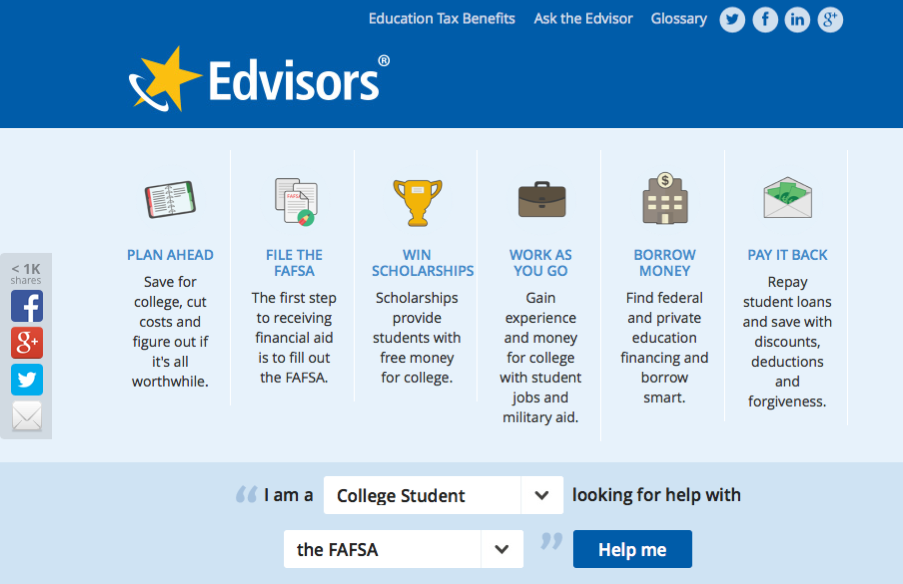
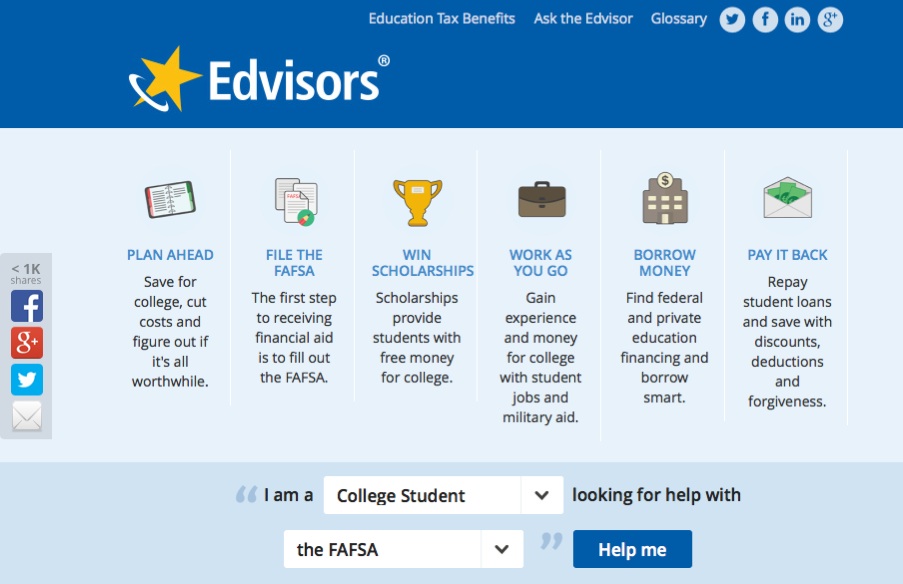
EdvisorsEdvisors

Get any two parents of college-bound teens together and the topic of financial aid is likely to come up. Every parent dreams of their son or daughter getting a free ride to college. It happens, but it takes some real determination and planning.

Mark Kantrowitz, the founder of FinAid, left that nationally recognized website last year to create a new online resource at Edvisors.com for parents and students to help them learn how to pay for college.

Topics covered

Here are some of the topics that you’ll find by spending time on Edvisors:

  • Student Aid Secrets for Increasing Eligibility
  • Eligibility Requirements for Financial Aid
  • Federal College Grants
  • How To Choose a Student Loan
  • Finding and Applying for Scholarships
  • Paying Back Parent and Student Federal Loans
  • Military Student Aid

Free Guide to Filing the FAFSA

On the Edvisors’ website, you can also download a free copy of  Filing the FAFSA:  The Edvisors Guide to Completing the Free Application for Federal Student Aid 2014-2015 Edition.

To download Filing the FAFSA you will have to provide information that will put you on Edvisors’ newsletter list, but you can always opt out if you prefer. As an alternative, you can also buy the 249-page paperback version on Amazon.

Education Tax Benefits

There is a section of the website that contains an excellent and informative explanation of federal education tax benefits. The section describes each tax benefit, and teaches you which are the optimal education tax benefits for your family:  Picking the Best Mix of Education Tax Credits and Benefits.

Asking for help

The site gives you an opportunity to post your financial aid questions in a section of the website entitled, Ask the Edvisors. You can also view previously asked questions and the answers provided by the site’s founder Mark Kantrowitz.

Spend some time navigating the site and discover valuable information regarding paying for your student’s college education.

Wednesday’s Parent: Making the Illogical Logical-The Final College List


final college listLast week, I talked about Illogical college choices; choices that college-bound teens make that have nothing to do with the quality of education. Without strong parenting and some tough love, those illogical choices might make their way onto the final college list. Be strong and remember that you are the parent and often they need a slight dose of reality to snap them back into the realization that this decision is an important one.

Here are the three components of a final college list: reach schools, best fit schools, and safety schools.

Following a name—the dream team

So many students believe that attending a college with a “name” guarantees success. It’s your job to help them understand this is not necessarily true. The best college is the college that fits their academic, social and financial goals. It could be a “name”, but it will most likely won’t. Those colleges have low acceptance rates and give little financial aid. I’m all for dreaming but when it comes to a college list, practically and logic reign.

Following the money—the best bets

The colleges that populate this part of the list are colleges that would put your student at the top of the applicant pool. Of all the reasons, this is the most logical. After careful research, these colleges should be ones that offer everything on your student’s list: financial aid, academic fit, and an emotional connection. It’s not all about the money, but it sure does make the final decision easier.

Following a whim—the sure things

So many students add colleges on a whim just because they can’t decide. This happens more often than not when choosing the safety schools or sure things. These colleges could end up being the colleges that accept them and/or give them the most financial aid. Discuss the choices and make sure that these colleges are colleges your student wants to attend. It will relieve pressure and stress if they offer admission.

Turning illogical choices into logical ones is a delicate balance. Guiding your student in the right direction without forcing is the key. It’s easy—about as easy as threading a camel through the eye of a needle.

Read Wendy’s post: 5 Fantastic Tips to Refine a College List

 _____________________

Wendy and I will share more insights into making a great college list on Wednesday’s Parent night (the fourth Wednesday of each month) on #CampusChat, Wednesday, July 23, 9pm ET/6pm PT. We will talk about the many factors to consider, how to finalize the list and the parent role in the process. Join us and bring your questions and comments.

_________________________

Wednesday’s child may be full of woe but Wednesday’s Parent can substitute action for anxiety. Each Wednesday Wendy and I will provide parent tips to get and keep your student on the college track. It’s never too late or too early to start!

Working While Taking a Gap Year


working gap yearFor many students, a gap year is nothing but a time for adventure and self-discovery. Gap years often seem frivolous to others, but they provide students with some relaxation and the opportunity to pursue some dreams before going to university, or between graduation and starting their career.

Gap years are more than just a long holiday. They are character building and give an individual a broader view of life and the world around them. Many employers are also impressed with students who have followed their ambition to travel extensively and to live for a time in foreign environments; it shows courage and resourcefulness, two important skills in business.

However, while students with wealthy parents do not have to concern themselves with financing their year out, others need to raise some funds to finance their travels. There is now a growing trend of people going on gap years who would not normally be able to afford it; they are working their way around the world.

Work options

There are many work opportunities overseas, but you really need to plan well ahead; few countries will allow tourists to simply walk into a job, and the jobs on offer are often low paid.

One popular choice is to teach English. There are few countries where children are not learning some English, and if you obtain a qualification from TEFL (Teaching English as a Foreign Language) you will be in high demand.

Many young women chose to work as an au pair. Being an au pair is a great way to thoroughly immerse yourself in a city. You are provided with secure accommodation and food as well as receiving some pocket money. Often you will have evenings and weekends to yourself. There are several good websites that match au pairs with host families.

Bar work is also very popular; if you have some bar experience you should be able to find work, especially in tourist resorts. Bar work does not always pay well but you have the advantage of being able to explore a city during the day and working at night.

Go contracting

Contract work is very competitive, but if you have some work experience already it is a good option.

Another option for contracting is to seek a role within an American company that has overseas offices. If you can agree a six month contract this will provide you with an excellent income and a base for weekend exploring. It may also lead to a career with the company when you have completed your studies.

Managing your finances

Managing your finances while travelling can be very difficult, but one option available to contractors is to employ the contractor services at Atlantic Umbrella who will take care of your income and taxation while you are working.

Work for yourself

Some careers are possible if you work “from home.” Copywriting is always in high demand and you can do this anywhere so long as you have access to a computer and the internet. Copywriters can gain a lot of experience overseas that they can then use in their work.

You can still enjoy a gap year even if money is a little tight. If you plan well and find some work you will be able to have a great year without breaking the bank.s

Top 5 FREE Language Apps


If your student is heading for college, they may also be studying abroad. Once you’re in a country that doesn’t speak English, it’s so much easier if you are fluent in the language there. Even if you’ve studied that language in high school, living among the culture and speaking fluently is another story.

Apps are a great start to start to understand and learn a new language, once you get the grasp then you can look to further your knowledge with things like specific french lessons.

These five language apps should help:


Duolingo

Duolingo language appThis app is extremely well structured for a free language-learning program. The program has you drill through exercises, which are part of larger lessons, to learn basic words, phrases, and grammar. Then you practice what you’ve learned by working on translations of real-world content from blogs and websites. Other Duolingo users then rate these translations, a practice that has been shown in some studies to actually work (Duolingo was originally conceived at Carnegie Mellon University).

Languages: English, French, German, Italian, Portuguese, Spanish.


Byki Mobile

byki language appByki is a flashcard program that you can use to learn new words in any one of dozens of languages. It’s the free component to the much more rigorous and Transparent Language program, and you’ll find a few prods to upgrade or buy the larger software package occasionally (but not too much).

Languages: Afrikaans, Albanian, Altai, Arabic, Armenian, Azerbaijani, Bashkir, Belorussian, Bengali, Bosnian, Bulgarian, Buriat, Chechen, Chinese, Croatian, Czech, Danish, Dari, Dutch, Estonian, Farsi, Finnish, French, Georgian, German, Greek, Haitian Creole, Hausa, Hebrew, Hindi, Hungarian, Icelandic, Indonesian, Irish, Italian, Japanese, Kazakh, Korean, Latin, Latvian, Lithuanian, Luxembourgish, Macedonian, Malay, Mirandese, Mongolian, Norwegian, Pashto, Polish, Portuguese (Brazilian or European), Romanian, Russian, Scottish, Serbian, Slovak, Spanish, Swahili, Swedish, Tagalog, Tajiki, Thai, Turkish, Turkmen, Tuvan, Ukrainian, Urdu, Uzbek, Vietnamese, Zulu.

Memrise

memrise language appMemrise is a language learning program that extends beyond vocabulary and language to things like history and science, but at its core it’s a flashcard-style program that’s augmented with memory tricks, images, and other useful tools to make learning a new language easier. Its focus is largely on memorization, but it’s also designed to help you have fun learning the language you’re trying to pick up. Memrise gamifies the process a bit, awarding you points and reputation as you learn, and the opportunity to compete against other users while you learn and complete activities. If you’re interested in seeing what you can learn before you sign up, you can browse some of their courses before you give it a try.

Linqapp

linqapp language appAsk a question on Linqapp via text, photo or audio recording and a push notification goes out to all users who are fluent in your target language. A points-based reward system encourages people to provide quick and accurate answers. Linqapp works very well, especially for the most popular languages on the platform, which are currently English, Chinese, Spanish and Japanese.

To use Linqapp, you can sign up with a Facebook account or email. Once you log onto the app, you are prompted to select your native language, the languages you are fluent in and the ones you are seeking answers about. Text questions can be asked for free, while queries with photos or audio recordings require Linqapp points (each user starts with free bonus points, and more can acquired by answering other people’s questions). Once you post your question, a push notification is sent to fluent speakers and a timer is set for 15-minutes so people who respond within the timeframe are eligible for points. You decide which answers are helpful and how many points you want to reward to the user. Each person has the option of filling out a profile and contacting other users (for example, I can envision using the app to eventually find other people in Taipei who enjoy U.S. cult films or “Breaking Bad,” based on the questions they ask and answer). Linqapp’s community is the most important aspect of the app.

busuu

busuu language appNew to the App scene but not new on the web is busuu. Practice speaking with native speakers and apply what you have learned. Use the listening, reading, writing and speaking task to improve your language skills, take on interactive learning exercises and quizzes and stay motivated with regular feedback. The community has over 35 million native speakers, so there are plenty of help to practice speaking the lingo.

Languages: English, Spanish, German, Italian, French, Japanese, Polish, Russian, Turkish, Chinese, Portuguese

Mom-Approved Tips: Talking to Your Student About Drinking in College


If you have a college-bound teen, you are more than likely concerned about drinking in college. Today’s guest post is from Susan Jones of Quad2Quad, the award-winning mobile app for college visits. For more than three decades, she was a psychotherapist in Washington D.C. specializing in substance abuse, and she spent ten years with Dunbar Educational Consultants counseling students and families on the college admission process. Most importantly, Susan is the mother of two grown sons who successfully navigated the college alcohol culture and had enjoyable and productive experiences, emerging as solid citizens with no regrets.

_____________________

drinking in collegeAs parents, we can and should play a key role in helping our sons and daughters create a healthy, thoughtful relationship with alcohol in college. This important responsibility can’t be outsourced. Our students cannot count on their peers, who are also living in a culture where moderation is not valued, for perspective.

Because binge drinking is common in college — though it is not the norm — students assume it must be okay and safe for them as well. They expect to pass through this portal unharmed. That will absolutely not be the case for many students. Parents need to help students figure out if they are “vulnerable current or potential problem drinkers“(VPDs) and advise them accordingly. Be prepared for the discovery that your student may not be able to drink in college. The combination of youth along with a student’s unique genetic response to alcohol may make the college alcohol environment too dangerous. Alcoholism is a progressive disease. The earlier problem drinking begins, the greater the likelihood of future addiction.

The 1st critical conversation to have before your student leaves for college:

Be sure your student understands that alcohol affects everyone differently. If she wants to emerge from college ever able to drink normally, she needs to be alert to signs of problem drinking in college. Because “everyone else is doing it” does not mean it will be safe for her.  If at any point she becomes worried about her relationship with alcohol, tell her to let you know and you will help her figure out how to get advice and support, or she can go directly to student health services.

The 2nd critical conversation for parents to have with students after first semester and throughout college as needed:

Ask your student very directly: What kind of effect does alcohol have on you? Are you feeling comfortable about your alcohol use? Have you gotten into any compromising situations because of it that you regret?

How do I know if my student is a “Vulnerable Problem Drinker” (VPD)?

Here are some risk factors:

  • A family history of alcoholism
  • Acquiring a taste for alcohol early (high school or before)
  • Being impulsive or capable of poor judgment in social or academic situations independent of alcohol; may be a disinterested or struggling student
  • Having a high capacity for drinking large amounts of alcohol without adverse physical reactions, triggering a taste for large amounts of alcohol
  • Or being very reactive to alcohol and prone to sickness, blackouts or irresponsible behavior after even one or two drinks
  • Being disinterested in drinking in moderation.

 What should I do if I believe my student is a VPD?

  • Don’t assume the problem will get better by itself, or imagine it’s “just a phase” your student will outgrow.
  • In a similar vein, do not allow your student to take blackouts or risky sexual behavior lightly. These behaviors are not healthy or acceptable. Refer your student to a mental health professional at school.
  • Make sure she gets actively involved with the alcohol recovery community on campus. Be extremely encouraging about this. When she’s home for vacations, steer her towards a local recovery group.
  • Greek membership is not to blame for the misbehavior of its members, but your student’s housing and social affiliations are going to play a big role in how much and how safely she drinks. Discourage membership in a fraternity or sorority unless your student can investigate the alcohol culture to see if there is ample opportunity for participating in divergent drinking styles.
  • If your student continues to exhibit problem behavior, it may be time to consider a semester off along with outpatient or inpatient rehab.

Scholarship Friday: The Scholarship Essay


scholarship essayParents love scholarships. They love the idea of a scholarship. They love it when their kids apply for scholarships. Who wouldn’t? Scholarships are free money. But scholarships require just as much effort as the college application, if not more. You have to create a resume, gather information and often write a scholarship essay. It requires drive, perseverance, and a desire to achieve success.

The scholarship essay

For those scholarships that require an essay, the essay is usually the focus. It’s imperative that your student craft an excellent essay; one the addresses the subject matter and follows the requirements. Look online at past winners to help you craft the essay.

The multi-use scholarship essay

Scholarship essays often overlap in the required subject matter, giving you and opportunity to use one essay over and over again. If you can enter with multiple scholarships with one essay, it will save you time. Just be certain when applying that any scholarship specific information is removed for the next one. The worst mistake you can make is apply for a Target scholarship with a WalMart heading.

Don’t forget to follow the guidelines

A simple way to make sure your essay is read and considered is to follow the guidelines. Pay special attention to word count, character count, font size, and subject matter. Any of these oversights will cause your essay and your scholarship application to be tossed.

Make your essay stand out

The essay is your best chance to stand out from other candidates and communicate why you should receive the scholarship. U.S. News and Education provides us with 4 ways to make your scholarship essay stand out:

  1. Know your audience
  2. Plan far in advance
  3. Make it personal and passionate
  4. Find an editor

It’s a no-brainer that finding and competing for scholarships takes time. But the time will be well spent when those awards start arriving. Follow the rules and but forth your best impression. Scholarship committees are looking for the best candidate to receive their scholarship award. Be that candidate, and the award checks will come flying in.