Tag Archives: parenting

The Summer Before Sophomore Year of High School (10 Tips for Moms)


Not much advice is given for the sophomore year of high school. It’s almost as if it’s not an important year in high school. But it is. Every year in high school is important if your child wants to move on to higher education.

Your teen has jumped in and is now a “seasoned” high schooler. Hopefully you have both gotten use to the high school routine. Sophomore year brings your teen closer to their goal of attending college. It’s during the 10th grade that your teen will begin to take some baby steps toward realizing their goal of a  college education. The focus for this year should be: preliminary testing, looking at careers, delving deeper into the college search, and getting heavily involved in a few activities.

Here are 10 tips to help parents prepare for sophomore year:

1. Begin talking about life after high school

Is your student drawn to traditional college or more toward a technical education or even entrepreneurial endeavors? These are important discussions to have as your student proceeds through high school and on to graduation. Technical colleges like Penn College address both issues by providing hands on training and a liberal arts education. But if your student wants only the technical training which is often a shorter time frame, you should also explore these options as well. Just remember, however, that this is only a discussion. Your student may change his mind many times over the next few years; but be open to any possibility.

2. Do Preliminary Testing

This is the year to take the PSAT (preliminary SAT) and PLAN (preliminary ACT). Why take them so early? First of all, because it doesn’t count and it’s great practice; secondly, because it will give your teen an idea of their testing strengths and weaknesses while they still have time to make improvements.

The key to utilizing these early tests is for your teen to get the scores and the test booklet and review the questions to find out which ones were answered incorrectly. Don’t just take the test, file the scores, and cross that task off your list. The whole point of testing early is to utilize every resource available to help your teen achieve testing success. There is nothing more disappointing than receiving low test scores when your teen excels in academics in school. Testing is all about being relaxed and knowing what to expect. These preliminary tests will help alleviate the stress of the unknown and help your teen prepare for the ones that really matter.

3. Explore careers

By now, your teen should know what interests them in school. Are they drawn to the sciences? Or is drama their cup of tea? Do they excel in math? Or are they interested in literature? These interests will serve to guide your teen down the right career path. It would be useless to pursue a career in the medical field if science and math are your teen’s least favorite subjects. It would also be frivolous to head down an acting career path if your teen does not like being on stage in front of people. Analyze their interests and strengths to guide them in choosing the career that would best suit them and feed their passion.

4. Take personality and/or career inventory tests

You can start here: http://www.allthetests.com/career-tests-job-quizzes.php and search for other tests online. Most of them are FREE and can be used as a tool to further determine the direction your teen might be heading in the college/career search. Many schools have software and testing as well that they offer to their students to help them find the right match.

5. Attend career days

Many cities offer career days with speakers from various walks of life. Encourage your teen to attend these and ask questions. Find out where the speaker attended college and the types of classes he/she might recommend if your teen is interested in that career. There’s nothing more beneficial than speaking with an actual doctor, lawyer, engineer, actress, musician, teacher, fashion designer or entrepreneur.

6. Delve deeper into the college search

You’ve done some internet surfing, looked online at some colleges that might appeal to your teen, and done some preliminary reading. This is the year that you increase the depth of your college search. As you progress through the process and the research you should get closer to narrowing down the schools that best fit your teen.

7. Start making a preliminary list

This is your teen’s list of college possibilities. Every teen has their “dream” college. They may not voice it, or allow themselves to think about it, but most of them have that name sitting in the back of their mind. Once they begin to know what their interests are and what is important to them, the list will start to take shape.

8. Take some online college tours

You and your teen can take some virtual tours of college campuses, and even purchase DVD’s of specific colleges if you want more in-depth information. These preliminary tours will give you and your teen a feel for the campus and prepare you when summer comes along and you start visiting some campuses. These visits are extremely important, and I will go into greater detail during the junior year plan. However, getting an early jumpstart, especially with some colleges within driving distance, will help your teen get an indication of what to expect when the tours become more focused as you begin to narrow down the final college choices.

9. Get heavily involved in a few activities

Admissions counselors have antenna for students that “pad” their high school resumes. These are the ones that dabble in a little of everything but never get involved in depth. While it’s important to try many different activities during high school, it is also important to settle on the few that interest you and stick with them. The goal is to eventually take on leadership positions or an active role in the mechanics of the organization. Help your teen to find the one activity that interests them and stick with it throughout high school. My daughter got involved in NJROTC and eventually became an officer in the corps. She also joined the drill team and the academic team, showing a level of commitment and focus.

10. Don’t forget the scholarship applications

You should encourage your teen to continue applying for scholarships. This task becomes more important during the next few years because many scholarships have age requirements and restrictions. Stay on top of the application deadlines and don’t get the “sophomore slacker” attitude. Your teen is headed into the home stretch and junior year is looming on the horizon.

The Summer Before Senior Year of High School (10 Tips for Moms)


seniorIf your life isn’t crazy enough right now, it’s about to get even crazier. Once your child becomes a high school senior, your time is not your own. Anything and everything is focused on college. Your family (not just your teen) will eat, drink and sleep all things college. Before the year ends you will wonder how you will survive mentally, physically and emotionally. It will be a rollercoaster of highs and lows for both you and your college-bound teen.

We entered the beginning of my daughter’s senior year with anticipation and halfway through I began to think we would never survive. By the time she walked across the stage at graduation we were both exhausted. Senior year begins with a slow pace and amps up in January, culminating in a feverous pitch in April and May.

Here are some tips to help you keep your sanity and navigate the college maze productively.

1. Do the prep work

Get ready for the mounds of catalogs, test prep booklets, flyers and email reminders. Start your filing system now, before school starts. Set up an email account (firstname_lastname@gmail.com), purchase a small thumb drive for filing computer files, create a landing zone for all college-related materials, start adding tasks on a calendar (either a wall calendar or an app that can be synchronized with the family. Here are 5 Free Apps for College-Prep Organization.

2. Do your best to control your emotions

It’s going to be an emotional time for both you and your student. Angry words will be spoken if you don’t make a conscious effort to bite your tongue, count to 10, and take a deep breathe. You are the parent and your teen needs emotional stability during this time, not an emotional basket case.

3. Prepare for rejection

The upcoming year will most likely mean that your student (and you) will have to deal with rejection. It’s not personal, but you will feel like it is. I know it’s tempting to spew platitudes like, “Everything happens for a reason”, or “I know how you feel”, or “They didn’t appreciate you.” But the reality is, all the platitudes in the world aren’t going to remove the disappointment. Once the dust has settled, however, it might be good to offer some words of wisdom from those “in the know” about the college admissions process: The Truth About College Rejection Letters.

4. Decide what role you will take

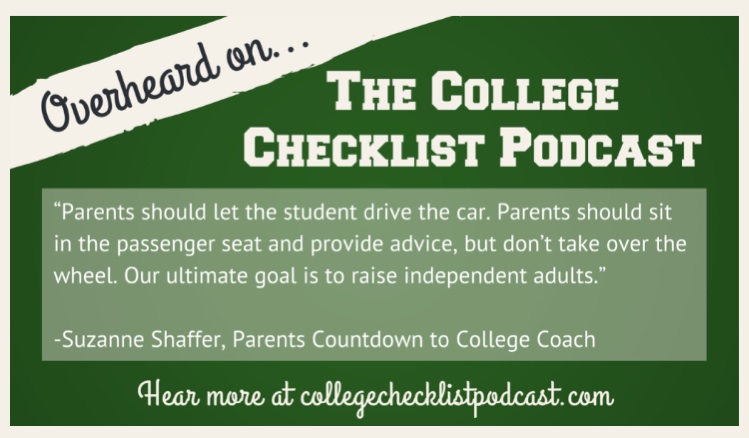
Please. I beg you. Do NOT be the parent that shoves, manipulates, and actually does the work for their student. Be the parent who encourages, supports and offers help and advice when needed. Be a coach, not a bully. Decide before things ever get crazy to let your teen OWN the process, or “drive the car” as one admissions officer often told me.

5. Prepare for emotional outbursts

This is one of the most stressful times in your family. There will be emotional outbursts as the stress intensifies. Your student will say things she does not mean. You will lose your temper and wish you didn’t. Just remember that most of what is said is fueled by the stress of the process and when it’s all over everyone will breathe a sigh of relief, hug and move on.

6. Discuss the money

If you want to avoid disappointment when offers of admission arrive, have the “money talk” before your student applies to colleges. Decide what you can afford, what you will be willing to contribute toward the costs, and what you expect your student to contribute.

7. Accept there will be consequences to actions

Your student will most likely fail or mess up at some point during senior year. When she goest to college, your student will have to fix her own problems. Let her do it now, while she lives at home, and it will be easier for her once she is gone. Rescuing your kids all the time only makes them into dependent adults and colleges aren’t impressed with those type of students or the parents that come with them.

8. Be open and not pragmatic

Be open to any college choices your student might make. You will not be the one attending the college and it’s not up to you to choose for her. You can give your advice and direct her in what you think would be the best path for her; but don’t shove her toward your alma mater or toward a college with a prestigious name if that is not her choice. If your teen mentions a gap year, don’t panic. Gap years are becoming more popular and it might be exactly what your teen needs. Read this post for some insight on gap years: What Parents Need to Know About a Gap Year.

9. Don’t push-it simply won’t help

If your student is unmotivated, it’s not going to help to nag her and push her to do the college prep work. If there is one thing I learned with both of my kids (and clients), if your student is not invested in the college process she won’t be invested in college. Save yourself some time, money and heartache and wait until she is. If not, she can learn from the college of hard knocks (as my son did)–minimum wage jobs are the BEST motivator! Here’s a post about my son and how he finally saw the light: Motivating an Underachiever Toward College?

10. Enjoy the journey

This is an exciting time in the life of your teenager. She has worked hard and will be planning her future. You can be proud as well. Enjoy the next year, even when you feel stressed and overwhelmed. It will pass all too quickly and before you know it she will be walking across the stage accepting her diploma and heading to college in the fall.

Mom-approved Tips: 6 Ways To Prepare the Summer Before College


summer before collegeThe Disney Pixar movie Toy Story 3 offers an unexpected insight into the lives of parents with teens going off to college. As young Andy prepares to leave home, his toys try to deal with what his departure means to them. Just as the old saying goes, Andy realizes that it’s time to put away childish things.

That doesn’t mean you have to incinerate your child’s toys, but it is time to think of things in a new light. How can you help your own “Andy” transition into college life? Consider these six tips and you’ll be well on your way to help your college-bound teen prepare the summer before college.

1. Put them to work.

If your teen has not been working, now is the time to make sure they are given some kind of responsibility. Encourage them to get a job, an internship, or volunteer for the summer. This work will give your child confidence and a taste of the “real” world. Also, it allows them to meet other professionals in a work setting. Any job will do, but if it is something that ties at least loosely into a set of career goals, all the better.

2. Offer a crash course in Adulthood 101.

There are probably many things that you think your child knows that he or she simply does not. For one thing, encourage your son or daughter to do their own laundry all summer long. Also, teach them rudimentary accounting skills: how to balance a checkbook and make a budget (a job helps here, too). Depending on where they’re going to school, how to use public transportation might be something to work on; most freshman don’t have access to a car, and you won’t be there to drive your son or daughter around. Some basic cooking and grocery shopping skills should be included as well—one way to augment this is to have your teen cook for the family at least one night a week. You’ll still be surprised by the late night calls asking, “How do I make a doctor’s appointment?” or “What do I do if I’ve locked my keys in my car with the engine running?” But at least they’ll be prepared with the basics.

3. Take a look in a book.

To prepare for the amount of reading that will be necessary in college, get your child into the habit of reading as much as possible—reading every day on the bus to work would be grand! This is more about building study habits rather than worrying about specific material, however many colleges have books they would like freshman to have read before they start classes. These titles will be a great place to begin. If your child knows what classes he or she is taking, then gear the books toward these courses.

4. Teach time-keeping.

Encourage your child to maintain a schedule or planner by themselves. Show them how to keep track of work, social, and family events—they should refer to the schedule all summer and write down their comings and goings. It’s easy enough to do that on a computerized calendar or in a datebook.

5. Don’t let go quite yet.

Of course, your teen is going to want to spend the summer with friends, but you can still get your time in surreptitiously. Schedule a few family outings and meals at favorite restaurants. Fit in a vacation if possible—even a weekend or a Fourth of July outing can have real future value. P.S. Going to the store for college shopping doesn’t count as family fun.

6. Be true to their school.

Learn everything you possibly can about your son’s or daughter’s new school, and talk with them about opportunities. Go over the information on classes and extracurriculars. In particular, check if there are any “superstar” professors and encourage your child to take their classes. Also look for a history of achievement in any particular extracurricular, such as a winning debate team. It’s wonderful to work toward being part of a tradition of excellence.

Most importantly, be patient and keep lines of communication open. There’s no getting around it—it’s going to be rough emotionally, but you can help your child be prepared for everything that is to come. And isn’t that what parenting is all about?

+++++++++++++++++++

About the Author

Ryan Hickey is the Managing Editor of Peterson’s & EssayEdge and is an expert in many aspects of college, graduate, and professional admissions. A graduate of Yale University, Ryan has worked in various admissions capacities for nearly a decade, including writing test-prep material for the SAT, AP exams, and TOEFL, editing essays and personal statements, and consulting directly with applicants.

Wednesday’s Parent: Parent vs Student Reasoning


parent vs student reasoningThe stress of the college admissions season weighs heavy on your college-bound teen. I read an old NY Times blog article that went inside the mind of a college-bound teen by asking them exactly what they were feeling and thinking. Students voiced their concerns related to college prep; but what would the parents say? What is the parent vs student reasoning?

Fear

Students may seem fearless at times, but as they approach the final months of high school fear sets in. One teen, Phoebe Lett, 16 talks about how she feels as a junior.

“I fear for my rapidly approaching senior year. Should I really spend nine hours a night on school work? As I rack up as many extracurriculars, community service hours and “beneficial relationships” (college-prep speak for impressive recommendations), I can’t help but think that it’s not good enough. Better grades, higher scores, more varsity letters, more leads in the play: have I been bulking up an application that perhaps doesn’t reflect who I am, but instead just represents what a college wants from me? That is my true fear.”

Parents, on the other hand, feel fear as well. They fear their student will experience rejection on so many levels. Along with this, they fear their student won’t make the right college choice and regret it later.

Pressure

The pressure they feel is of paramount proportions. This pressure will be exhibited in all kinds of emotions from tears, to anger, to denial to frustration. Robin Karlin, 17 felt the pressure of failing.

“Around the application deadline you’re studying for finals, and it’s your senior year. You already have a lot of classes and you have to write essays and you’re already stressed out thinking “what if they don’t want me?’’ And you worry what if you don’t get into any school at all? I’m not from a big city. We have pretty good schools, but I think in a bigger city with more people you have more perspective on where you stand in the nation. I’m not really sure how good I am.”

Parents feel pressure as well—from other parents, from themselves and sometimes from the students as well. Other parents can make them feel inadequate. They feel pressure when it comes to the finances related to college. They also feel pressure from their student when they choose a college that is out of their financial reach.

Rejection

If your student hasn’t experienced rejection, get ready. There’s a strong possibility some of the colleges they apply to won’t offer them admission. Sam Werner, 18, felt disappointment when the rejection letters started arriving.

“Everyone I had talked to, once they heard “perfect SAT,” they said, “You can get in anywhere.” That was the hardest part, having everyone tell me I would and then not getting in. It was a rough few days. The rejection letters and my parents both kept telling me it’s not a case of me not being good enough, but a case of too many qualified applicants. But it’s really hard not to feel like you got rejected….”

Parents feel the same rejection students feel when they aren’t offered admission—perhaps more. It’s hard to watch your student do their best, only to realize they didn’t achieve their goal (through no fault of their own).

Relieving some of the pressure

College admission is how students (and parents) define their success. Years down the road, you will see that some of those rejections probably sent you and your student into better directions. In the meantime, recognize your feelings and empathize with your student. You can both weather the college admissions storm together.

Read Wendy’s Post: How Parents and Students Can Be on the Same Page

++++++++++++++++++++++++++

Wednesday’s child may be full of woe but Wednesday’s Parent can substitute action for anxiety. Each Wednesday Wendy and I will provide parent tips to get and keep your student on the college track. It’s never too late or too early to start!

The bonus is on the fourth Wednesday of each month when Wendy and I will host Twitter chat #CampusChat at 9pm ET/6pm PT. We will feature an expert on a topic of interest for parents of the college-bound.

Wednesday’s Parent will give twice the info and double the blog posts on critical parenting issues by clicking on the link at the end of the article from parentingforcollege to pocsmom.com and vice versa.

Mom-Approved Tips: How to Help Your Child Get Into College (Without Being a Helicopter Parent)


Today’s guest post is from Ryan Hickey, Managing Editor of Petersons & EssayEdge

how to help your child get in to collegeYour child is filling out forms, applying to schools, and getting ready to take the leap into the world of college life. As a parent, you may feel like your baby is slipping away, and as they begin acting more like an adult, your role becomes increasingly blurry. It’s not uncommon for parents to feel as confused, anxious, and overwhelmed as their college-bound kids.

The truth is, the college search process requires a delicate balancing act between parents and their children. As parents prepare to let go of their kids, they must offer their support and guidance while encouraging independence. In other words, show them that you trust them enough to make their own decisions, but be prepared to speak up when they make questionable choices.

Ultimately, establishing a parent-child relationship built on mutual respect and trust is one of the most rewarding things you can ever do for your offspring. By following these tips, you can help your child get into college, adjust to the coming changes and keep your sanity, making you proud of what you’ve both accomplished.

Set aside plenty of time and energy to focus on the college search.

Taking the time to really decide on a college is not a simple or straightforward process — for you or your child. In fact, it can be unpredictable and haphazard. Don’t put things off until the last minute, when you might be distracted by work or they’re just trying to get through exams. Instead, get started early; ideally, you should begin looking for schools at least in your child’s junior year. If you organize right and work together, you can get it all done during their senior year, especially if you start early in the semester.

Use the resources available to you.

Colleges and universities know that this can be a trying time for both you and your child, and they have numerous resources available. Even before your child gets accepted into a school, ask as many questions as necessary to your contacts in the school. Knowing the answers to your questions gives you a leg up on the future, as well as helping alleviate some of your fears. Find out what kinds of resources are available before your child starts class, and use them early and often. It’s important to keep your child up-to-date on any communications you may have with contacts at schools — they should feel just as involved in the process as you do. When they have questions of their own, guide them to the resources they need to find answers.

Let your child make the final decision.

You may have your own ideas about where you want your child to go, but remember that choosing is an important part of growing into an adult. Make them part of the process, helping them to identify what draws them to one school versus another. This can help you bridge the gap between what you both want. Showing support for such an important decision can also help you, as the parent, show that you trust your child, something that can pay dividends down the road.

These tips can help you get started, but it’s up to you and your child to keep the momentum going. By making the process a unified approach between yourself and your child, you stand a better chance of making everything come together when your loved one steps out of your home and into their first college classroom.

_______________________

About the Author

Ryan Hickey is the Managing Editor of Peterson’s & EssayEdge and is an expert in many aspects of college, graduate, and professional admissions. A graduate of Yale University, Ryan has worked in various admissions capacities for nearly a decade, including writing test-prep material for the SAT, AP exams, and TOEFL, editing essays and personal statements, and consulting directly with applicants.

Mom-Approved Tips: What Frustrates Parents Most About College Prep?


college prep

What frustrates parents most about college prep? I hear the frustration in parents’ voices every day about the overwhelming amount of knowledge a parent and student need to navigate the college maze. I call it a maze because that’s exactly how it feels. All throughout the process, parents feel lost, confused, off-track and often bewildered.

Not understanding your part in the process

It’s difficult for parents to know how involved you should be in the college prep process. It’s a balancing act between helping and hurting. Where do you pitch in? Should you teen handle everything alone? When do you cross the line?

In today’s world of highly involved parents, you need some help to define your boundaries and give your student the slack he needs to become independent:

Top 10 Dos and Don’ts of Parenting a College-Bound Teen

Motivating your student

I had an unmotivated student. It’s not that he wasn’t capable of achieving academic success; it was just that he didn’t have the motivation or the desire to do his best. He never soared in high school, or in the first semester of college, but he did reach his academic potential, finally.

It was hard having a child who didn’t grasp his full potential, no matter how much I told him he was capable of straight A’s. It just didn’t matter to him. Passing with average grades was good enough for him. Those grades, however, contributed to some difficult life choices and some hard lessons along the way. In the end, there were four tips that finally motivated him academically:

4 Tips to Motivate an Unmotivated Student

Finding a way to pay for the high costs

If you have a college-bound teen you’re well aware of the cost of college–it’s high. In a recent story in Business Week, one graduate confessed she had given up on her student loan debt of $186,000. She is not alone. With the nation struggling under a $1 trillion student debt crisis, stories like hers are nothing uncommon. For the first time ever, the national student loan default rate exceeds the credit card delinquency rate, and so long as student loans remain one of the few types of debt that can’t be discharged in bankruptcy, chances are the situation won’t improve any time soon.

As her parent, it’s up to you to make sure she doesn’t fall prey to debt that she cannot repay after graduation. Before she ever accepts an offer of admission, you need to talk to her about financing college. Following are a few tips to help broach that uncomfortable topic with your college-bound teen:

Talking to Your Kids About Financing College 

And you might also like to read:

10 Ways to Attend College for Free (or almost free)

Getting help and knowing who to ask

I was speaking with a parent the other night about advice her daughter received from an independent college counselor regarding standardized tests. The counselor told the student not to bother with either the SAT or ACT; they weren’t necessary. He made this statement before receiving a list of colleges and asking if she was applying to test optional schools! The parent questioned the validity of this advice, and rightly so.

With college admissions becoming ever more competitive, it may seem logical to consider working with an independent counselor. They can offer expertise and a personalized approach to the complex, time-consuming, and often stressful college prep, search and application process. But ask any group of parents and you will hear a variety of opinions. While some parents feel that engaging an independent counselor is an essential part of helping their student be a competitive applicant to his or her top choice schools, others question whether hiring someone adds value beyond what a student can already receive from parents and the high school.

Some parents choose to guide their student through the process and some choose to hire a professional. Neither is right nor wrong. The decision should be based on each family’s individual needs and resources.

Need some help trying to decide? Here’s an article I wrote for University Parent:

Should You Work With an Independent Counselor?

How to handle rejection

It was the best of times; it was the worst of times. The best of times—getting an offer of admission. The worst of times—getting a letter of rejection. Or is it really? Is there any way to spin the disappointment? Parents have dealt with their kids facing rejection throughout their lives, but there is no greater disappointment that losing what you feel is your dream—getting in to your dream college.

I’ve found some very wise words from some very wise experts over the last several weeks. When the emotions subside and your college-bound teen is ready to talk, show them these words. It could open their eyes to the truth about college rejection letters:

The Truth about College Rejection Letters

The Race to Nowhere: Are We Pushing Our Children Too Much?


race to nowhere

With all the talk and the hype about college prep, we should ask the question: Are we pushing our children too much? I believe in preparing for college. I don’t believe in pushing so hard and preparing so much that your student becomes stressed, over-anxious, and burned out. Recognizing that there’s a real problem, Vicki Abeles, a concerned parent, directed a documentary about the pressures our students face. The result was a documentary called, “The Race to Nowhere”.

“Race to Nowhere” is a film that calls us to challenge current thinking about how we prepare our children for success. Named by TakePart.com as one of “10 Education Documentaries You Don’t Want to Miss”, “Race to Nowhere” brings communities together to spark dialogue and galvanize change in America’s schools.
 
Featuring the heartbreaking stories of students across the country who have been pushed to the brink by over-scheduling, over-testing and the relentless pressure to achieve, “Race to Nowhere” points to a silent epidemic in our schools. Through the testimony of educators, parents and education experts, it reveals an education system in which cheating has become commonplace; students have become disengaged; stress-related illness, depression and burnout are rampant; and young people arrive at college and the workplace unprepared and uninspired.
 
Shown nationwide and internationally in more than 7,000 schools, universities, cinemas, hospitals, corporations and community centers, “Race to Nowhere” has become the centerpiece of a nationwide, grassroots movement for the transformation of education.

Do yourself and your kids a favor and watch the trailer for this film and encourage your student’s school to set up a screening for parents. It might change the way your family views college prep and relieve the stress around the process.

The Parents’ Role in College Prep (The College Checklist Podcast)


college checklist podcast

About a month ago I was happy to be a guest on a podcast with Lauren Gaggioli of Higher Scores Test Prep. The topic of the conversation: What is the parents’ role in college prep? For 30 minutes I shared my own family’s college prep experience and why I became a Parent College Coach.

I answered the following questions:

  • What do you see as the parent’s role in college admissions?
  • Where is the Goldilocks zone? That “just right” amount of involvement in the process?
  • What can parents do to reduce the family’s stress around the cost of college and make sure there is clarity regarding tuition responsibilities?
  • How can parent further help to reduce stress around college admissions?

If you’ve ever asked these questions or would like to hear about my college prep journey, you can listen to the podcast here:

Or download the podcast to your smartphone and listen at your own convenience.

Subscribe to The College Checklist Podcast on iTunes
Subscribe to The College Checklist Podcast on Stitcher Radio

What is a podcast: a podcast is an on-demand radio​ show that you can access online through your smartphone. They’re like a blog post or news article you can listen to at the gym, on the road, or while making dinner.


T is for Tuesday, Top 10 and Tips


top 10 tipsIt’s Tuesday. It’s not hump day. It’s the day before New Years Eve and time to reflect on 2014. And nothing says Tuesday more than Tips. Put it all together and you have Tuesday’s Top 10 Tips from 2014.

Tip #1: Insist your student graduate in 4 years or less

Did you know that at most public universities, only 19 percent of full-time students earn a bachelor’s degree in four years? Even at state flagship universities — selective, research-intensive institutions — only 36 percent of full-time students complete their bachelor’s degree on time.

Nationwide, only 50 of more than 580 public four-year institutions graduate a majority of their full-time students on time. Some of the causes of slow student progress are inability to register for required courses, credits lost in transfer and remediation sequences that do not work. Studying abroad can also contribute to added time and credits lost when abroad. According to a recent report from CompleteCollege.org some students take too few credits per semester to finish on time. The problem is even worse at community colleges, where 5 percent of full-time students earned an associate degree within two years, and 15.9 percent earned a one- to two-year certificate on time.

Read more . . .

Tip #2: Be wise—apply to backup schools (but make sure those schools are ones you want to attend)

Being admitted into your first choice school is a challenge and not a guarantee. No matter how positive you are about your application, no matter how hard you’ve worked to be an ideal applicant, it is important not to assume that gaining admission to your top choice for college is a sure thing. But don’t get dejected or cynical! Here are three ways to increase your chances of being accepted by applying to backup schools.

Read more . . .

Tip #3: It’s never too early to prepare for college

How early is too early to prepare for college? We’ve all seen those movie clips where the parents are agonizing over the right preschool to prepare their kids for the right kindergarten, the right grade school, and the right college preparatory school. These overachieving parents are convinced that college prep begins at birth. They take it to a whole other level elevating college jerseys into full blown college prep. But just how early is too early and how far should parents go when preparing their children for college?

Read more . . .

Tip #4: It matters very little where your student goes to college

Much is debated about college names and prestige, especially among parents. It’s logical that parents want their kids to have the best opportunities available. It’s illogical that they place more value in the name than in the education itself. But so many parents encourage their kids to make illogical college choices. Where you go to college is not as important as you might think.

Read more . . .

Tip #5: Don’t neglect the college visit

A few years ago, I wrote an article for Smart College Visit about the importance of the college visit: Don’t Pick a College Sight Unseen:

As a parent of two kids who attended college, I learned a very valuable lesson: never pick a college sight unseen. The rules that apply to any major purchase are even more important when making the decision to invest thousands of dollars on a college education. You would never buy a car without test-driving it, or move into a home without taking a walk through and getting a home inspection. Based on my experience with both my kids, I can tell you that your teen should never accept admission to a college without getting a feel for the campus and campus life.

 Read more . . .

Tip #6: Know when to hold ‘em; know when to fold ‘em

In just a few short months, your student will be making college decisions by the May 1st deadline. For some families, it’s easy. For others, it’s emotional and gut wrenching. If your student got into their dream college and the money is there, congratulations. If your student was waitlisted, or there’s a financial issue, or they didn’t get an offer of admission to their first choice college it’s time to examine the deck. By doing this, you can help your teen make the best decision.

Read more . . . 

Tip #7: Practice tough love

Parenting is easy if you give into your child’s every whim, never be consistent with discipline, or simply don’t pay attention. Parenting children who strive for excellence in everything requires some tough love. And tough love is not easy; especially when it comes to the raising a motivated, educated, and successful student.

How do you, as a parent, raise a child that’s motivated to strive for excellence where their education is concerned?

Read more . . .

Tip #8: Listen to college podcasts

Every day I grab my trusty iPod and head to the mall to do my 2.5 miles of walking. I hate walking. To me, it’s boring and a waste of my time. However, it’s critical to my health and every day I tell myself it’s just something I have to grin and bear.

But then I discovered podcasts. Not only are they great when exercising, you can listen when you’re cooking dinner, commuting to work on public transportation, eating your lunch, or any other time that you are performing daily tasks and want to make them more productive.

Read more . . .

Tip #9: Don’t ignore the FAFSA

The most important advice I can give parents is: don’t ignore the FAFSA! Many parents are misinformed when it comes to the Free Application for Federal Student Aid (FAFSA). They believe that they make too much money to qualify for any kind of financial aid—and they decide not to file. That is the worst mistake you can make. I encourage every family of a college-bound senior complete the FAFSA (and complete it before February 1).

Read more . . .

Tip #10: Teach your teens the value of money

Before you send your teens off to college, they need to learn about the value of money. Ideally, it starts at an early age; but if you haven’t started, there’s no time like the present!

When your children are away at college they are going to be responsible for their own spending (and saving). There will be offers galore from credit card companies because college students are their biggest target market. If they hook them while in college it usually means they have them for the rest of their lives.

Read more . . .

Mom-Approved Tips: Helicopter Parents Gone Wild


helicopter parents
photo credit: screenshot Foxnews.com


Unless you have been “off the grid” over the holidays, you’ve probably heard about the colorado parents who moved to college with their daughter. Call me crazy but when I first heard it, my mouth fell open. Could this possibly be true? And much to my surprise, there they were on Fox and Friends openly discussing their decision. They are calling it their “gap year”. (Did you know you can’t go a day without a good rationalization?)

I do not understand why any parent would make this choice, let alone any student be agreeable to it. It’s one thing when a student chooses to live at home to commute to school or to save money. It’s another when the student’s parents pack up their lives and move close to the college.

I heard a story years ago about a 4-star general whose mother bought a house on the outskirts of Westpoint Academy. She might have been the first documented helicopter parent. But today’s parents are following her lead. According to college admissions officials and Coldwell Banker real estate it is becoming more and more common for helicopter parents to move with their students to college.

What happened to independence?

In my generation, when you moved away from home you moved away for good. Apparently there is an alarming progression happening. The “boomerang generation” (the crop of the last 10-15 years of college graduates) have moved home after graduation because they either can’t find a job or have to live at home to afford their student loan payments. And now, we have students who basically never leave home (or parents who won’t allow them to leave). All of these behaviors hinder the student’s independence and delay their entry into adulthood. Parents who constantly bail their children out when things become difficult are doing them a disservice in life.

How is this helpful to the student?

In no hemisphere could I possibly justify this type of behavior. I have known parents who bought a home for their student to live in during college, but they did NOT move in with them. Neither of my children would have agreed to this arrangement. Apparently, this generation of students might be more willing to find this acceptable. I do not care what they say or how they justify their behavior, these parents need to cut the apron strings and let their student sink or swim.

As one commentor wrote on the Fox News story: “Her wedding night will be awkward.”

What do you think? Is this acceptable? Would you do it? Would your student agree to this? Leave a comment!