Tag Archives: financial aid

How much financial support should you provide for your college student?


imagesIt is estimated that by the time a single child reaches the age of 18, his parents will have spent approximately $300,000, according to the U.S. Department of Agriculture (which releases annual reports on family spending). And that doesn’t include the cost of college. Of course, this report factors in housing, childcare, food, transportation, healthcare, and a number of other elements. But it comes out to about $13,000-14,000+ per year in expenses for a child in a median-income household (earning roughly $60,000-100,000 annually in taxable income). Unfortunately, your costs don’t end when your kids head off to college. In fact, they could increase significantly. You’ll still have to pay for your own home, car, food, and more, but you’ll also be on the hook for additional living expenses for your kids since they are no longer at home, not to mention tuition, books, fees, and other costs associated with college – unless of course you decide not to pay.

In truth, you have no onus to pay for your kids’ college education. However, most parents feel that it is their duty to ensure that their children attend college so they can start a career and realize their full potential on a professional level rather than toiling away at the dead-end jobs that high-school grads are often relegated to. In short, many parents want to set their kids up for the best chances in life, and that often includes the advanced education and expanded job prospects that college can provide. But you might not have the money to pay for it all, especially if you have a limited income and a large family, and the truth is that you don’t have to. The only question is how much you should pay.

This figure can be difficult to determine. The government has some guidelines in place, which is why you’re required to submit financial information via the FAFSA(based on previous year’s tax returns) when your kids apply for federal financial aid. They expect parents to take responsibility for at least a portion of the expenses associated with sending their kids to college. However, you can always provide more or less, depending on the needs of your children and your own financial situation. A good rule of thumb, in general, is to offer what you can afford while still keeping your own budget in order. There are a couple of good reasons to do this.

For one thing, it’s important to teach your kids to live within their means, and you can set a good example by doing so yourself. This could mean that your kids end up attending a less expensive institution or living at home so that they can save on living expenses and put that money towards higher tuition costs at their school of choice. Or they might be forced to work a part-time job to pay a portion of their own expenses so that they can attend their dream school. Either way, you avoid financial ruin and your kids learn some very adult lessons. Whether you are able to send them overseas to attend Oxford or they stay home and attend colleges like the University of Cincinnati, the most important thing is that you be honest about what you are willing and able to offer in terms of financial support so that your kids can make an informed decision about their future.

Website Heads Up: Frugal Dad

frugal dad

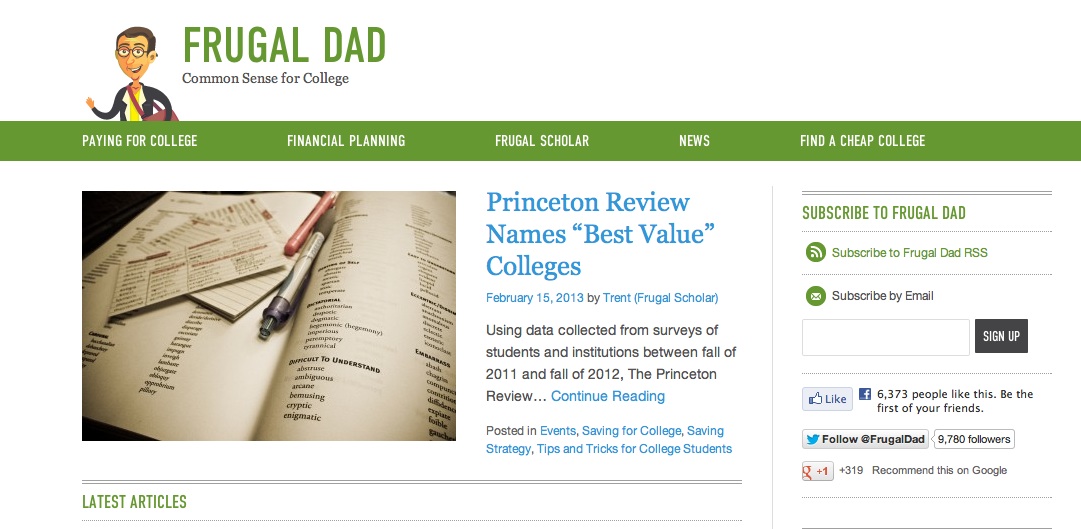
When I come upon a website that I think is a valuable resource for parents I like to spread the word. I came across this site: FrugalDad and found it loaded with parent resources. According to the “About” page:

What we at FrugalDad have noticed is that our readers were largely worried about two things in the aftermath of the financial meltdown: their retirements and their kids’ educations. A lot of very smart people are out there offering retirement, investment and personal financial advice. We didn’t want to become just another voice in the crowd, so FrugalDad.com has decided to focus its subject matter more narrowly on issues of higher education and how to pay for it. Although there are other sites that offer advice on the same types of topics, FrugalDad.com brings its own unique voice to the conversation – a voice that has been featured and profiled in the national media ever since it appeared on the scene.

FrugalDad is a blog, news, and research site that aims to inform the public on financing for higher education. The site offers a prolifera of news that can and will affect how families will save and pay for college as well as tips on how to finance an education in a way that makes sense for most people. This site is special because it was created by a father who had trouble financing a university education for his children. Along with life lessons and insights, this blog brings you news and tips that will be beneficial to parents and families with children who are planning to go to college.

Spend a few minutes browsing the site, checking out the blog posts and using their “find a cheap college” search tool.

University of savings: financial aid tips

mini college graduation cap on cashBig college dreams have a big price tag. Most students use some form of aid to pay for college. According to CollegeBoard, more than $207 billion in aid is available. From federal loans to scholarship contests, opportunities to knock down college costs appear to those who search. Leave no stone unturned and look into these college aid resources to cover the costs.

FAFSA

With the potential for grants, loans and work-study incentives, the Free Application for Federal Student Aid (FAFSA) is square one when it comes to paying for college. The FAFSA analyzes family financial information through the federal-need formula. Among other things, FAFSA takes tax information into account, so Collegeboard.org recommends filing tax returns before starting the application. However, if your taxes aren’t ready, file with estimated amounts from last year and update with correct amounts after filing.

Aimed at providing a path to college for any student, the FAFSA is particularly advantageous for disadvantaged students, who have a better chance to receive free grants and scholarships.

Students can fill out this lengthy application at Fafsa.ed.gov.

Scholarship Contests

Students with 4.0 GPAs and high SAT scores aren’t the only ones who can take advantage of scholarship money. Scholarship contests offer students an equal playing field to show their stuff. Whether it’s an essay, video or presentation, these performance-based contests highlight talent in any field.

Scholarships.com lists news opportunities in various categories, including minority scholarships, corporate scholarships and even non-academic scholarships. A quick Google News search for “scholarship contests” will return the latest contents and deadlines.

Ask your guidance counselor for additional local opportunities, and explore the internet for the latest scholarship offers.

Student Loans

Free money is preferable, but loans enable students to have a classic college experience even if they can’t pay for it up front. This growing trend in financial aid is putting thousands of students through college and collecting payments from millions. In early January, student loan debt in the U.S. surpassed $1 trillion, according to Foxbusiness.com, and that number is expected to grow even more.

The FAFSA provides opportunities for federal student loans. Sallie Mae bank offers a private option to compete with these government offerings.

Loans can provide a worry-free college experience, but don’t over-borrow and saddle yourself with too much debt. Once graduation comes, failing to make payments can compromise your financial stability. The rule of thumb with student loans–borrow wisely.

Unconventional Aid

Some scholarship opportunities don’t fit into traditional molds. Unique scholarships give students that may not otherwise stand out a chance at college aid. The vertically-challenged student, for example, can take advantage of the Little People of America Association’s scholarship for students 4’10” or shorter. Left-handed students that have had to deal with awkward desks and sloppy writing are in luck, too. The Frederick and Mary F. Beckley Scholarship Program offers money for southpaws who demonstrate leadership skills.

Every student has something unique about him or her. Search for the scholarships that separate you from the crowd.

Work and pay as you go

Many students are choosing to work and pay as they go. High school students work during the summers and save for textbooks and other essentials not covered in tuition. Some students choose the community college route, attending classes as they can afford to pay for them. Other students opt to use the work study program at their college to supplement tuition expenses.

Colleges are recognizing that tuition costs are rising the average family cannot afford to chunk down tens of thousands of dollars at the beginning of the school term. They offer payment plans which spread the tuition out over the school year to help parents budget and pay as they go.

College is in reach if you take the time to research the many opportunities available and use that information to make a college choice that best fits into your available budget. Don’t let financial barriers keep you from achieving your dreams; and don’t let financial barriers lure you into overwhelming debt just to pay for a high-priced college.


Preparing your student for college graduation

Last night in the #CampusChat discussion we were talking about moving into college and what to pack. One participant stated she took her whole life with her to college because she never planned to move back home after college graduation; and to her credit she did not.

Most parents believe (or hope) that once their student goes off to college they will only be temporary visitors at home. We often talk about getting into college, but rarely discuss what happens after graduation. Unfortunately, in today’s economy, many students are forced to move back in with their parents after they graduate. For those boomerang students, the top two reasons are no job or job prospects and too many student loans exceeding their expected income.

These reasons alone make it important for parents to be involved in the financial decisions that their students make related to the college they choose and the loans they choose to incur while attending. Of course your student may WANT to go to an expensive private college, but can you, as a family, afford it? Is your student prepared for the ramifications of taking out massive student loans and not being able to repay them?

Three scenarios

After the student returns home three scenarios usually play out.

Scenario One

Your student returns home and still can’t find a job with their college degree. After weeks of depression and frustration, they make the decision to attend graduate school. Since it’s expensive, they opt to take out graduate student loans to supplement the financial aid and provide living expenses. After they complete their graduate degree, they are able to gain employment and begin paying back their loans.

Scenario Two

Your student finds a minimum wage job, defers their student loans and still can’t find a job related to their college degree and major. They end up working in a field that is completely unrelated to their area of interest, in a job they do not like, and are still unable to pay back their student loans. They borrowed too much and will probably never crawl out of the hole they dug for themselves.

Scenario Three

Your student returns home, finds a minimum wage job, defers their student loans and saves every penny they make while living at home. They are able to begin paying back their student loans with their savings and continue the job hunt while working full time. Many times, those temporary jobs end up being avenues to find college degree employment either through networking or company advancement.

With scenario one, if your son or daughter opts to pursue the graduate degree path, it’s critical they do their homework, research interest and payback rates, and degrees that are worth their investment. If they don’t, they could end up as the student in the second scenario with too much debt and no job prospects.

Summing it up (my opinion)

Advise your student wisely about debt, college value, and degree prospects after graduation. It’s not just a decision on which school they “like”. It’s a decision that affects the rest of their life and could have overwhelming negative consequences. Parents are key role players in this decision. It’s our job to point out the possible ramifications of their decisions and allow them to have input. But (and this is is hard) if they won’t listen to reason, you might have to be a parent. I know because I had to take that role with my daughter and her college choice. I had to be the “bad guy” and kept her from attending her first choice college. Today she thanks me. At the time, she wasn’t very happy with me–but she fell in love with her second choice college and graduated with minimal debt.

Being a parent can be extremely hard; we have to balance guidance with “helicoptering” and know when to take a stand for the well-being of our kids. It’s a difficult job on the best of days and downright frustrating on the worst of them. Helping them with the college choice as it relates to financial consequences is one of those “take a stand” moments.


College Sticker Price

Most parents are shocked when I tell them to ignore the college sticker price printed in the book, catalog, or college info site. Why do they “say” it costs X amount of dollars and not charge what the printed price states? Because while most can’t pay the price, some can. It’s the same with any commodity: houses, cars, airfare, vacations, and more. They post a price because many will pay that price; others who can’t will search for the bargain. Enter the college admissions process with the mind of a bargain hunter and you’ll be pleasantly surprised what you will pay.

Following is an infographic that makes it easy to comprehend:

Tuition Prices
Created by: Online University

10 Good reasons to file the FAFSA


Parents of college-bound teens look forward to filing the FAFSA as much as they look forward to filing their income taxes. It’s a federal form and all federal forms aren’t exactly user friendly. Many parents are so intimidated by the form that they choose not to file, telling themselves that their student wouldn’t qualify for aid anyway because they make too much. But don’t fall into that trap.

Here are 10 good reasons to file the FAFSA:

1. College is expensive

Even if you’re rich and can afford to pay for your child’s education, it’s expensive. Why would you pass up an opportunity to help with some of the cost?

2. It’s FREE

That’s right. It’s completely free to complete the FAFSA. You’ll spend some of your time completing the FAFSA and you could get thousands of dollars of financial aid in return. So one could say, it’s BEYOND free–they pay you!

3. Getting help is easy and FREE

If you get stumped, help is available using the online help tool or by submitting a question at the FAFSA web site or calling the help number listed on the site. Many schools even host a FAFSA day where they offer help to parents and students on how to complete the free form.

4. FREE money could be waiting for you

According to a recent Reuters article, about 1.8 million lower income undergraduates who might have qualified for aid neglected to file the FAFSA and missed out on financial aid. No matter what your income level, you should file the FAFSA because there is more money out there to be awarded than just need-based aid.

5. Federal money

The federal government provides over $80 billion dollars in grants, loans and work-study programs every year. The only way to get pell grants, perkins loans, stafford loans and other federal aid is by submitting the FAFSA. Federal loans offer the best interest rates and repayment terms for student borrowers and are superior to private student loans.

6. State money

FAFSA is the gatekeeper for state financial aid programs. Each state’s programs are different but they all require the FAFSA to distribute the funds. Check with your state’s higher education agency for deadlines and requirements. In some states the financial eligibility ceilings are much higher.

7. School money

Colleges and private scholarship sponsors offer billions of dollars in financial aid. Even if you don’t have financial need, you may be eligible for these awards. Some school and private scholarship programs are specifically designed for students who were rejected by federal financial aid. Some schools will not award merit aid unless you complete the FAFSA.

8. You’re divorced

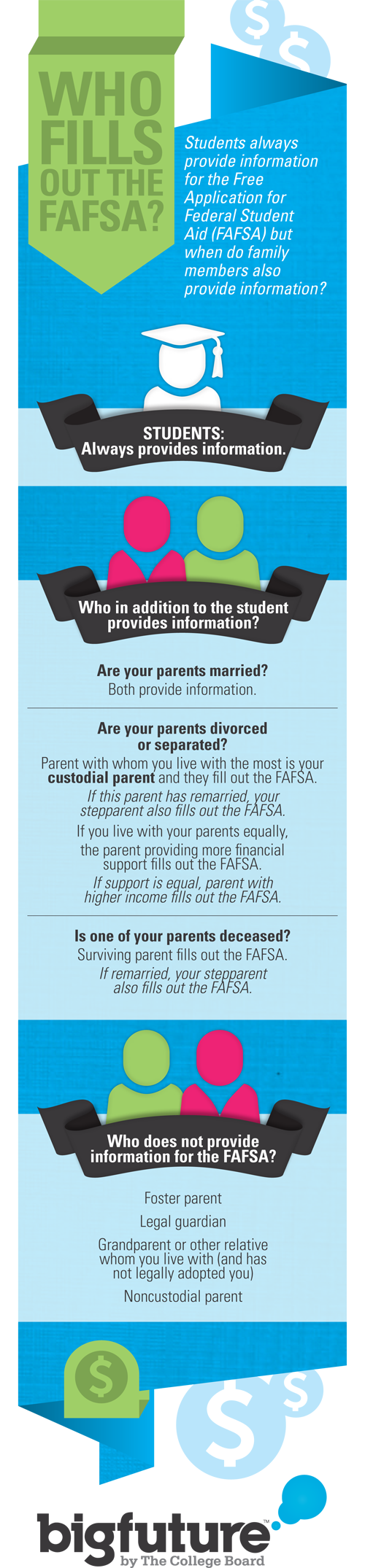
The FAFSA only asks about the income and assets of the custodial parent. For financial aid purposes, the custodial parent is the one who has cared for the student for the majority of 2011. If the custodial parent earns a modest income, a student could qualify for financial aid.

9. You have two or more children in college

With two in college, your expected family contribution (what the parents can afford to pay) drops by 50%. Even if you didn’t get financial aid with the first, file the FAFSA because having a second child in college can net you some financial aid.

10. You really don’t have a choice

Look at it this way: FAFSA is the ONLY way to be considered for federal, state and private financial aid. Even if you don’t NEED the aid you still want to get it. Who doesn’t want FREE money?

********

For a different perspective, visit my colleague Wendy David-Gaines’ blog (POCSMom) for 10 Reasons NOT to file a FAFSA.

Wendy was a (POCSmom) Parent of a College Student and was once a pre-POCSmom as well. She likes to help parents de-stress during the college process and has written a book of stories and anecdotes to help parents see the lighter side of college.

Financial Aid Myths

Here’s a great infographic that applies to the recent student loan news. The only “myth” that I might question is #5-Student Loans aren’t worth it. While the statistics show that college graduates do earn enough more over their lifetime than high school graduates, you have to be savvy about the amount of money you borrow and your ability to repay it.

Financial Aid Myths
Created by: Online Graduate Programs

Financing College No Matter What Your Income Level

If you have kids, then chances are you’ve already thought about college affordability and how or if you’ll be able meet the expenses associated with higher education.

But you shouldn’t allow the worry of college costs to consume your life.  There are many practical and successful ways to pay for college (without drowning in debt) no matter what your income level may be.

Many families labor financially to make ends meet and they feel like it will be impossible for their children to attend a 4-year university.  This simply isn’t the case.  I’m not saying it’s going to be easy, but there are ways to send your children to college on just about any level of income.

Saving For College – Reduce Your Debt

Anyone can save money for college; all you need is to remove the excuses from your life.  Starting with financial basics, the best way to begin saving for college is to pay off all your debt (or at least live within your means and be actively involved in a debt payoff plan).  Sound too difficult you say?  That sounds like an excuse to me.

Living with debilitating debt and allowing bills to circle your life like a vulture is a surefire way to live paycheck to paycheck and never have the available funds to save for college.  What I’m trying to say is this:  paying for college isn’t some magical happenstance that you uncover on some random day.  It’s going to take hard work, and in some cases, a change in your financial landscape.

Regardless of your current income level, you have the ability to save for your children’s college fund. You might have to trim your expenses, adjust your spending habits, and redirect your lifestyle in order to free up money for the college fund.  But if you want to send your kids to college without financing 100% of their education with borrowed money, then you’ll have to decide what’s more important.

Think of it like this; if you can scrounge up even $100 a month to save for your child’s college when they’re born, you’ll end up with $21,600 (and that’s without interest or anything).  Sure, that might not pay for 4 years of tuition, room, and board, but it’s definitely a great start.

Saving For College – 529 Plans and Educational Savings Accounts

A 529 Plan is a tax advantaged college savings account designed to encourage families of any income level to save for their children’s education.  529 Plans are “qualified tuition plans” sponsored by states, state agencies, and educational institutions and are authorized by section 529 of the IRS (hence the name 529 Plan).

The encouragement to save for college within a 529 Plan comes in two forms: the ability to save money free from Federal taxes and the ability to receive a deduction on State taxes.  One benefit to a 529 Plan is that anyone, upon creation of the account, can be named the account’s beneficiary, regardless of age.

The 529 Plan is a lot like a Roth IRA for your college savings fund. The savings will grow tax-deferred and any withdrawal is tax-free as long as you use the money withdrawn for qualifying educational expenses.

A Coverdell Educational Savings Account (ESA) is another tax advantaged college savings account which is meant to inspire families to save for future educational expenses.  The difference between an ESA and a 592 Plan is that an ESA’s beneficiary must be a student under the age of 18.

An ESA also has a maximum annual contribution limit of $2000 and the owner of the account has the freedom to choose what types of securities they would like to invest in (stocks, bonds, ETFs, mutual funds, etc.).

With both types of college savings accounts, you’ll incur a hefty 10% tax if you withdraw any amount of money from either account and use it for non-education related expenses.

Paying For College – Grants and Scholarships

No matter how much or how little you’re able to save for your child’s college education, you’ll always want to be aware of and informed about college grants and scholarships.  After all, this is free money we’re talking about.

Scholarships are offered by high schools, colleges, and other organizations usually recognizing some sort of educational, athletic, or humanitarian achievement.  Scholarships vary by amount and length. Some are one-time gifts and others are recurring payments made as long as grades and other collegiate performances are maintained.

Information about college scholarships is usually available from your high school, your hometown city hall, and the university you wish to attend.  You can also search for scholarships on the web.  Some of these scholarships may be smaller than a say a university’s alumni scholarship, but $500 here and $1000 there really starts to add up.

Grants are another “free money” option.  The government offers need-based grants to families with a low income.  Other organizations are free to offer grants to students that show academic promise or that meet other requirements.

Paying for College – Financial Aid Student Loans

There are numerous kinds of financial aid and student loan programs available, but these loans should be your last resort when it comes to financing college.  I’m not saying student loans are bad, but financially responsible parents won’t rely solely on borrowed money to fund their children’s college.  As I mentioned earlier, if you save even $100 a month, you can drastically cut the amount of money you need to borrow to send your child to college.

There are Federal Stafford Loans, Perkins Loans, Plus Loans, and numerous other student loans available from private institutions.  If you qualify, you can apply for subsidized student loans that are basically interest free until you graduate and begin loan repayment.  FAFSA is your Free Application for Federal Student Aid.

Final Comments

Jamie Scott from CreditDonkey also reminds you that while “student credit cards are a convenient option to help students pay for short-term small expenses such as groceries,” there are other options available for long-term larger expenses such as tuition.

The bottom line is that you’ll probably use two or three different sources to fund your child’s college expenses.  Don’t give up just because of your low income and don’t think that your high salary will always be there for you.  No matter where your income level is at, research, preparation, and responsibility will go a long way when it comes to saving and paying for college.

******

Today’s guest post is from Jamie Scott, social media advocate with CreditDonkey. Jamie helps parents and students prepare for college by evaluating student credit offers. As a parent herself, she knows all too well the concerns most families have about responsible credit usage.

The Key to Financial Aid Success: Preparation!

In just under a month, it will be time to file your Free Application For Student Aid (FAFSA) for the 2011-12 school year. The FAFSA is the key to accessing your Federal Student Aid – including grants, work-study and Federal loans – and other valuable financial assistance. Whether or not you think your family will qualify, you should always apply for aid; you might be surprised at the results!

To help you make sure that you do everything necessary to get your college aid, below is a list of tips for preparing the FAFSA for submission. These are just the basics – there’s a much more detailed checklist at the bottom of this post.

If you have any questions, please feel free to reply in the comments and we will do our best to help you out!

Where to File

Starting January 1, 2011, the 2011-2012 FAFSA can filed online or downloaded at http://www.fafsa.gov. Some high schools may also have printed FAFSA forms available.

1. Determine Who Will File: You or Your Student?

The FAFSA is filed in the name of the student – the one who will be receiving the financial aid. You may submit the FAFSA on behalf of your student.

Regardless of who does the actual filing of the FAFSA, the student’s signature is always required, and if the student is considered a dependent, at least one parent must also sign.

2. Determine Dependency Status Ahead of Time

Every student who applies for financial aid with the FAFSA will either be considered a dependent or an independent student. There is a special worksheet created to determine dependency status.

To access the worksheet on the FAFSA website, click here.

NOTE: The current version is for the 2010-11 school year, but there are not likely to be major changes for 2011-12.

3. File Your Tax Returns Early

In order to complete the FAFSA fully, parents of dependent students and students who worked during the past year need to have their 2010 tax return information ready.

4. Gather Documents Before Starting

Filing the FAFSA will be much easier if you have everything together before starting. For the 2011-2012 school year, you’ll need the following documents:

  • Social security and driver’s license numbers
  • Student’s 2010 W-2s and tax returns
  • Parent’s 2010 W-2s and tax returns (if student is Dependent)
  • Bank statements
  • Business financial statements (if student or parents own a business)
  • Citizenship records – alien registration or permanent resident card (if you are not a U.S. Citizen)

5. Use the FAFSA on the Web Worksheet

The FAFSA on the Web Worksheet is a convenient way to organize all of the required information you’ll need to fill out the FAFSA. To access a PDF version of this worksheet, click here. (Note that the 2011-2012 worksheet isn’t available yet)

6. Apply for FAFSA PIN Now

In order to file your FAFSA form electronically online, you will need to sign it. This can be done electronically with a PIN, or you can print, sign, and mail in the signature page which will be provided to you when you complete the FAFSA. Both students and parents need to sign the FAFSA.

See the Department of Education’s FAFSA PIN website for more information.

Questions?

If you start preparing now, filling out your FAFSA on January 1st will be a breeze! If you have any questions or need additional guidance, feel free to reply in the comments below. We look forward to helping you!

******

This guest post is contributed by Jeff Sheely, who blogs about financial aid and education financing at Overture Student Loan Marketplace, where students and parents can get information or compare private student loans to make more informed decisions about how to pay for college.

He’s happy to answer your questions in the comments, or you can connect with him on Twitter or Facebook.