Tag Archives: college admissions

Mom-Approved Tips: “Where You Go Is Not Who You’ll Be”


where you go is not who you'll beRecently a new book was released by the New York Times op-ed columnist Frank Bruni: Where You Go Is Not Who You’ll Be: An Antidote to the College Admissions Mania. As you can imagine, it’s quite the controversial topic, especially among Ivy League colleges, current students and alumni.

Of course, I (and so many other college counselors) have been saying this for years: Does it Matter WHERE You Go To College? Mr. Bruni just put it down on paper and in a best-selling book. Parents and students are resonating with its message. Why? Students and parents are filled with stress, anxiety, and frustration over the college prep process–test prep, essays, college choice, financial aid decisions and more. We are tired of our students putting all their future expectations of success on a college name or reputation.

Read some of the reviews of the book:

“For students, parents, teachers, and everyone else suffering during the college admissions process, Frank Bruni offers an outstanding resource. Where You Go Is Not Who You’ll Be is a thought-provoking look at how the system works-and a fresh, reassuring reminder of what really matters in the college experience.”
-Gretchen Rubin, bestselling author of The Happiness Project and Happier at Home

“The supposition that intelligence can be measured, that success can be predicted, and that the combination of the two creates happiness is rightly exploded in this sharply observed and deeply felt book. In deconstructing the college admissions process, Frank Bruni exposes the folly by which enfranchised people measure their own lives. He speaks with a voice of urgent sanity.”
-Andrew Solomon, National Book Award-winning author of Far From the Tree: Parents, Children and the Search for Identity

“Frank Bruni provides the perfect course correction for students and parents who get sucked into the college admissions frenzy. I should know. I was one of them.”
-Katie Couric

“Frank Bruni has a simple message for the freaked-out high school students of America. Calm down. Where you go to college matters far, far less than what you do once you get there (and afterward). He urges families to look beyond the usual suspects and find a school that’s going to offer something more useful than a window sticker. His clear, well-researched book should be required reading for everyone caught up in the college-admissions game.”
-William Deresiewicz, bestselling author of Excellent Sheep: The Miseducation of the American Elite and The Way to a Meaningful Life

“For families caught up in college-application madness, this book provides a much-needed tonic. For the rest of us, it’s an inspiring call for a wiser, saner approach to American higher education.”
-Paul Tough, bestselling author of How Children Succeed: Grit, Curiosity, and the Hidden Power of Character

“Your worth is not determined by the university you went to. Or, in other words, “Where You Go is Not Who You’ll Be.” Alleluia. That’s the exact mantra every student and parent must heed as they navigate the stressful college admissions process. I’m doing it for the fourth time and this excellent writer’s new book could not have come at a better time for me. As Frank Bruni brilliantly demonstrates, your worth is your worth and it’s yours to make wherever you go.” 
-Maria Shriver

Read this quote from Frank Bruni’s guest post on The College Solution:

…What we desperately need to do in this country is change the focus of the discussion from where you go to college to how you use college. In what directions do you need to grow? In what ways does your frame of reference need broadening? If kids were coached to worry about that, and not about the college name splashed across the sweatshirts they’re wearing, they’d be better for it. All of us would.

Do yourself (and your teens) a favor–focus on the education, the experience, and the joy of the college search. Years down the road, it really won’t matter where they got their diploma.


Mom-Approved Tips: How to Help Your Child Get Into College (Without Being a Helicopter Parent)


Today’s guest post is from Ryan Hickey, Managing Editor of Petersons & EssayEdge

how to help your child get in to collegeYour child is filling out forms, applying to schools, and getting ready to take the leap into the world of college life. As a parent, you may feel like your baby is slipping away, and as they begin acting more like an adult, your role becomes increasingly blurry. It’s not uncommon for parents to feel as confused, anxious, and overwhelmed as their college-bound kids.

The truth is, the college search process requires a delicate balancing act between parents and their children. As parents prepare to let go of their kids, they must offer their support and guidance while encouraging independence. In other words, show them that you trust them enough to make their own decisions, but be prepared to speak up when they make questionable choices.

Ultimately, establishing a parent-child relationship built on mutual respect and trust is one of the most rewarding things you can ever do for your offspring. By following these tips, you can help your child get into college, adjust to the coming changes and keep your sanity, making you proud of what you’ve both accomplished.

Set aside plenty of time and energy to focus on the college search.

Taking the time to really decide on a college is not a simple or straightforward process — for you or your child. In fact, it can be unpredictable and haphazard. Don’t put things off until the last minute, when you might be distracted by work or they’re just trying to get through exams. Instead, get started early; ideally, you should begin looking for schools at least in your child’s junior year. If you organize right and work together, you can get it all done during their senior year, especially if you start early in the semester.

Use the resources available to you.

Colleges and universities know that this can be a trying time for both you and your child, and they have numerous resources available. Even before your child gets accepted into a school, ask as many questions as necessary to your contacts in the school. Knowing the answers to your questions gives you a leg up on the future, as well as helping alleviate some of your fears. Find out what kinds of resources are available before your child starts class, and use them early and often. It’s important to keep your child up-to-date on any communications you may have with contacts at schools — they should feel just as involved in the process as you do. When they have questions of their own, guide them to the resources they need to find answers.

Let your child make the final decision.

You may have your own ideas about where you want your child to go, but remember that choosing is an important part of growing into an adult. Make them part of the process, helping them to identify what draws them to one school versus another. This can help you bridge the gap between what you both want. Showing support for such an important decision can also help you, as the parent, show that you trust your child, something that can pay dividends down the road.

These tips can help you get started, but it’s up to you and your child to keep the momentum going. By making the process a unified approach between yourself and your child, you stand a better chance of making everything come together when your loved one steps out of your home and into their first college classroom.

_______________________

About the Author

Ryan Hickey is the Managing Editor of Peterson’s & EssayEdge and is an expert in many aspects of college, graduate, and professional admissions. A graduate of Yale University, Ryan has worked in various admissions capacities for nearly a decade, including writing test-prep material for the SAT, AP exams, and TOEFL, editing essays and personal statements, and consulting directly with applicants.

Mom-Approved Tips: Waiting for admissions decisions


Sign up for my FREE parent tips email and get my FREE Ebook on college financing! Or subscribe to my blog on the left and get email updates.

waiting for college admissionsAnd so it begins–the waiting game. Every parent of a college-bound teen has to experience this right of passage: waiting for admissions decisions. Will she or won’t she get in to her dream college? Will she get enough financial aid to ease the financial burden? How will she react to the news (good or bad)?

If your teen applies EA (Early Action) or ED (Early Decision) the wait should be over soon. For those of you whose teens have chosen regular admissions, the wait will be much longer. During the waiting period, tension ensues in the household with both students and their parents. The stress over college admissions decisions can weigh heavy on your college-bound teen. It’s more important to them than getting asked to the senior prom. So, as I’ve said before, “gird your loins”!

What can you do to help ease the pressure and alleviate some of the stress?

Create diversions

Family activities, especially over the holidays, will help them push the anxiety and stress to the back of their minds. Diversions will help them focus on other things besides what they consider to be the “ultimate acceptance or rejection” from the colleges.

Focus on their strengths

When you see them do something “grand”, acknowledge it. Even the little things like helping a friend with homework or taking the time to give a younger sibling attention. This well improve their self esteem and if and when a rejection letter arrives the blow might be a little softer.

Reinforce your love for them

You may think your kids know how you feel, but use every opportunity to tell them and show them you love them. Your love will help them with the anxiety and stress. They will find it much easier to discuss their distress when they know you love them.

Take a second look at the safety schools

With so much competition for college admission, it’s likely your college-bound teen will gain an offer of admission to one of their safety schools. Surprisingly, many students tell stories of how their safety school was a better choice, especially after they examined their strengths.

Remind them that this is only one step in the rest of their life

No parent likes their child to face rejection; but it’s a fact of life. I like to remind parents and students that often what you consider to be a disappointment could create another opportunity for success and growth. One (or more) rejection does not define who you are, just as offers of admission do not as well. The key is to attend the college that wants you and best fits your needs and expectations.

Celebrate their success

They have made it through 12 years of school and are able to apply to college. That’s an accomplishment in itself. Focus on this milestone in their life while you wait.

Parenting college-bound teens can be challenging, but it’s also very rewarding when you see them become independent adults who embrace their futures.


Top 10 Ways to ruin your college admissions chances


college admissionsIt’s not a done deal until it’s a done deal. Your teen has work to do—their college applications. It’s a tough road and one that can be finalized with offers of admission or rejection letters. It’s not a task to be taken lightly and it will require all their hard work and stamina the beginning of their senior year. If done right and taken seriously, your teen’s hopes (and yours) will be realized.

But, if they commit the following fatal errors, their hopes could be dashed and offers of admission might be a pipedream.

1. Spout off on social media
A recent article in the NY Times, a student attended an information session with a college and began tweeting negatively using their hashtag. What happened? They ultimately didn’t offer her admission; not based on the twitter posts but based on the fact her application wasn’t up to their specifications. But if it had been, she would not have been offered admission. In  recent telephone survey by Kaplan Test Prep, of 381 college admissions officers who answered a telephone questionnaire this year, 31 percent said they had visited an applicant’s Facebook or other personal social media page to learn more about them — a five-percentage-point increase from last year. More crucially for those trying to get into college, 30 percent of the admissions officers said they had discovered information online that had negatively affected an applicant’s prospects.
2. Lie on your application
This should be a no-brainer but students in this competitive admission environment are tempted to say just about anything to pump up their resume for the application. Liars never win and if a college finds out you have lied on your application they will wonder if you will be dishonest academically.
3. Neglect standardized test prep
Less than 20% of students prepare for the SAT and/or ACT. You can move ahead of the crowd with just a little preparation. Standardized test scores weigh heavy in your application and stellar ones mean admission and scholarships.

4. Be frivolous about your grades
The GPA is a definitive part of the application. Not focusing on grades during high school and hoping to bring them up before your senior year can be costly. It starts your freshman year and builds up as the years go by. Once you enter your senior year, your GPA is set in stone and very little can be done to improve it.

5. Don’t devote time to your application essay
The application essay tells colleges who you are and why they should consider you for admission. If you don’t take the time to tell them about yourself they won’t have a reason to add you to their student body. It’s the one part of the application that you can make personal.

6. Don’t take the admissions interview seriously
Show in holey jeans and a dirty t-shirt and you might as well kiss that college goodbye. This is like a job interview. The impression you make will be implanted in their minds when they receive your application. Make it your best, not your worst.

7. Sit on your couch and do nothing
Offers of admission aren’t going to land in your lap. If you think once you become a senior you can just apply somewhere and get accepted, you’re wrong. There are thousands of other students who take the process seriously.
8. Skate through senior year after you’ve applied
It’s not uncommon for colleges to reject offers of admission after they receive your final transcript. Senioritis can’t hit a college applicant. Even after the application is complete and the acceptance letter has arrived, you need to remain focused academically.

9. Use a tasteless email address
Make a bad impression by emailing an admissions officer with tasteless email addresses. You know what they are. Use firstnamelastname@gmail.com. It’s easy for them to remember and it gives the impression that you are serious about the process.

10. Ignore deadlines
Late means late. There are no second chances. Miss a deadline and miss an opportunity. If you can’t follow instructions and meet the deadlines, how can you be expected to hand in your assignments on time in college? It’s simple math.

Bottom line—don’t let your student make these mistakes. It could mean living at home after graduation working at a minimum wage job while their friends head off to college. That should produce fear in the heart of any teenager!

Keeping “overwhelm” out of the college application process


Today’s guest post is from a lovely lady I met at Blogher13 a few weeks ago. She’s written a book about attitude reconstruction and I thought some of her ideas might be helpful to parents and teens to alleviate feelings of stress.

______________________

Sign up for my FREE parent tips email and get my FREE Ebook on college financing!

college application stressThe college application process can feel overwhelming. Successfully completing this task requires breaking big jobs down into small doable pieces, dealing with the fear, keeping your thoughts constructive, and staying focused on what is in front of you today.

Find a buddy

Regardless of how involved your parents are in the process, find a buddy who also needs support and help each other. This will counter feelings of isolation. Decide how often you’ll check in to keep motivated, set up a regular time, and follow through. Offer each other appreciations for tasks completed and use this as a time to get clear on your next steps.

Outline your goals

Start the application process by outlining your goal in getting a higher education. Then identify potential schools that meet your qualifications. Assemble a list by going to the library, meeting with school counselors, or tapping into other resources, such as college guides. If this seems too daunting, do your research in small blocks of time. For example, make an appointment to talk with someone one day, visit a campus, or gather information by surfing the Internet for a half hour at a time (or even less). When your list is complete, select your chosen schools.

Continue reading Keeping “overwhelm” out of the college application process

A new tool for college admissions


statfuse college admissionsWhen I come across a product or service that can benefit parents and students during the college admissions process, I like to pass it along. StatFuse.com is a FREE service to help in choosing a college.

Getting into college these days is not as easy as it once was. The process for college admissions has changed over the years and become increasingly difficult. Even though the bar has been raised, admissions to college still are at the forefront of every prospective students mind.
Creating a list of schools to attend and crossing off the list as you get to know these institutions better. StatFuse.com takes all of your information and compares it to the standards your choice colleges have set. Our services can tell if you have what it takes, what you should do next, and maybe find a school that you didn’t even think about.

StatFuse allows students to create a free account where they can calculate their chances to colleges (through the “Chanculator”), find recommendations to colleges, track their progress to specific colleges, and much more. Parents can now plan their students’ future properly with the help of these tools while saving money on applications and other unnecessary fees.

This company was launched by two Southern California students, Jeet Banerjee & Supan Shah (ages 19 & 17) who wanted to help their fellow students solve some of the problems they faced as high schoolers. These young entrepreneurs developed the algorithm and innovative tools offered on the website and are focused on keeping this website free so that it is accessible to all students.

When asking the co-founders what their plans in the future for this company were, they simply said: “Our goal is to let every high school student and parent know about our product and how they can benefit from it.”

While StatFuse is beneficial in the college process, it’s important for parents and students to remember that statistics may predict your chances, but the human factor is also important. Choose your college wisely: using statistics, preferences, academics and future goals.


ApplyKit: An Online Personal Assistant for College Applications


Last night during #CampusChat I noticed a new participant–@applykit. Naturally it peaked my interest and after the chat I did a little research about them. As luck would have it, the founder Bobby Touran emailed me with the 411 about their service.

Heads up parents and students–there’s another tool available to help organize the college planning process. The app manages all aspects of the college application process, including recommendations.

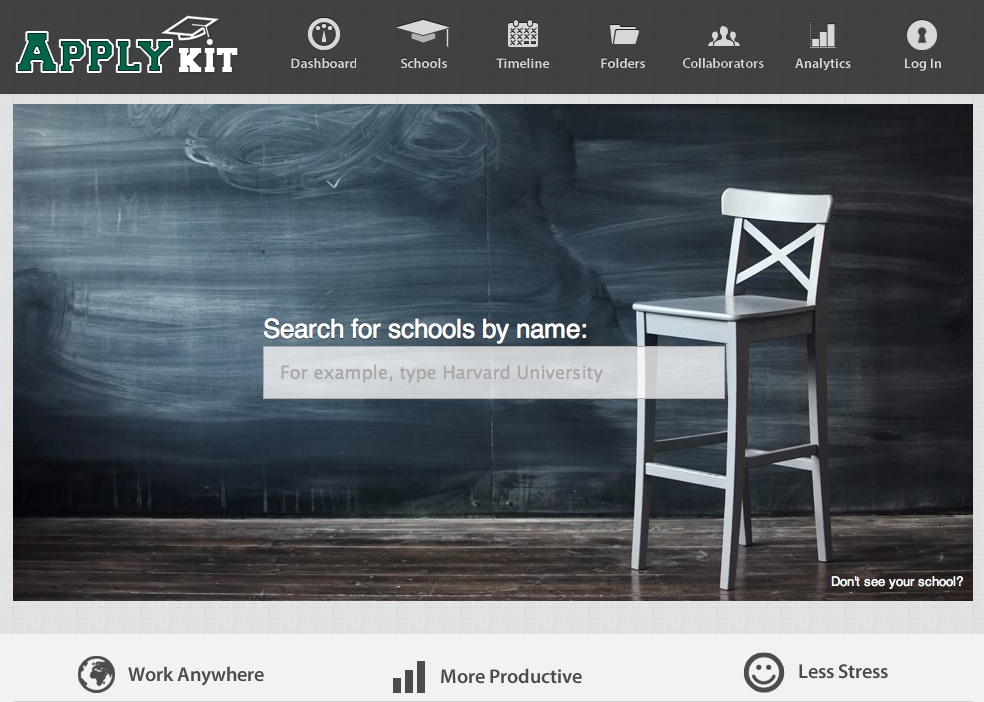
applykit

ApplyKit, the online personal assistant for the entire college application process, today announced the beta release of its ApplyKit service, cloud-based software that helps high school seniors manage their own efforts as well as those of interested stakeholders such as recommenders and parents.  ApplyKit manages the college selection process by bringing the entire process online, and connecting everyone involved.

The ApplyKit software includes the following features:

  • Add a desired school with one click, and ApplyKit will automatically load its deadlines and requirements in checklist form
  • Personalized dashboard tracks a senior’s progress against all applications, as well as any upcoming deadlines
  • A single, secure online space for students to work on application materials with collaborators like recommenders, consultants, and parents

“I’ve built a business around the inefficiencies of college applications,” said Craig Plummer, a professional college counselor.  “ApplyKit will help me manage the application process for my students in a way not previously possible.”

When a student creates an ApplyKit account, she can search for schools and add them to her dashboard. ApplyKit automatically adds dates and deadlines to a student’s master timeline for each school she chooses.  These dates and deadlines trigger email reminders to make sure she doesn’t forget a single step in the process.

ApplyKit then provides an online “Folder” for each school to keep materials and workflow clear and organized.  A student can use the “Collaborators” feature to involve others in the application process as appropriate.  For example, a teacher can compose and submit a letter of recommendation online.  If desired, ApplyKit will even automatically send newsletters to parents to keep them in the loop, including analytics on their student’s overall progress.

ApplyKit was founded by Bobby Touran, a serial entrepreneur from a family of educators, who was stunned by the hassle and manual grunt work required to manage his business school applications.  “At ApplyKit, we plan to disrupt the archaic college application process,” said Touran. “We have launched our product, we have new customers signing up daily, and we will be announcing a number of key relationships in the coming months.”

Touran built ApplyKit as part of Wasabi Ventures’ Entrepreneur-in-Residence program, based in both Nashua, New Hampshire, and Baltimore, Maryland.  Said Touran, “This is a fantastic time for EduTech innovation, thanks to all the great resources available.  For example, in addition to the Wasabi Ventures EIR program, we are an applicant for Pearson’s “Catalyst” program.  Catalyst exposes startups to Pearson’s API and arranges sessions with Pearson advisors.”

Pricing and Availability

ApplyKit uses a Freemium pricing model.  Any student can sign up and manage a single college application for free; a Basic plan that covers 5 applications is $12 per month, and a Premium plan that allows unlimited applications is only $25 per month.  Discounts are available for students who pay for 6 or 12 months in advance.

 _____________

About ApplyKit

ApplyKit manages a student’s college selection process. Students can access, track and share all research and application materials in one place. Applications to undergraduate institutions are at record highs, and students need an advantage more than ever. ApplyKit is positioned at the heart of the college prep industry. Bobby Touran—an Entrepreneur-in-Residence at Wasabi Ventures, started the company in 2012. Visit http://www.applykit.com/about for more information. 


Online college resources for parents


Recently, I prepared a list of what I believe to be invaluable college resources for parents online. I’ve found these resources to be helpful during the college admissions process and can vouch for the quality of the information they provide. This is not an all-inclusive list, but some of my favorite go-to resources. After all…”we get by with a little help from our friends”.

Youtube

Researching Colleges
SAT Prep tips
90 second videos to help students and parents with admissions
College Auditions
Tips for students who will be auditioning for an arts (music, theater) college

Parent help sites

Student Advisor
Guides and an App to help parents with the admissions process
University Parent
A comprehensive site for parents with tips and guides

Blogs

Dr. Strange College
A parent’s perspective step by step through the college journey
The College Solution by Lynn O’Shaughnessy
Info on admissions, aid, and great advice on how to choose the right college
Admissions Game
Comprehensive info for parents and students with Q&A available
SAT Tutoring Blog
Tips from the writer of “Outsmarting the SAT”

Tutoring

ADHD tutoring-Jennifer Cohen
If your student is ADD/ADHD this is the BEST tutoring available
Quincy tutoring network
Network of tutors to help in school
Hoot.me
Use facebook to connect with other students and get help with homework

Sat prep

Bell Curves
Exceptional SAT/ACT prep company focusing on diversity with integrity
Word Nerd
The BEST way to study SAT vocabulary in preparation for the test
Revolution Prep
Hosts a tutoring season on Facebook–giving great tips

College searching

Student Advisor
Offers free guides for parents and students on all college topics
The College Board
Great site for students to begin their college search
College Prowler
by students for students–info on college campuses to help with the college search
College Application Wizard
Plan and organize your college search

College visits

Smart college visit
Plan your trip, book your travel, get insight about college visits
Join Parent Advocate program to get/give expert advice
Welcome to College
Find schools, review the school info, read and give peer reviews and even schedule and keep track of visits
College Week Live
A virtual college fair where students can talk to other students and admissions counselors online

Scholarships

Zinch
Cappex
Fastweb
How to win college scholarships
Scholarships 360

Admissions

CollegeData
Gives parents and students help with choices, admissions tracking, and percentages to gauge admissions
College Navigator
Stats on colleges for parents and students to compare cost, aid awarded, acceptance rates and export results into a spreadsheet
Ask a question about college
Type your question in the box and get answers from experts
Unigo
Advice from college experts and students with a Q&A platform

Financial Aid

College Affordability and Transparency Center
FinAid
College Money Insider
The best info on loans, repayment, and financial aid advice
College Financial Aid Advisor
Help for parents and students with the FAFSA and finding financial aid

College Recruiting

NCSA Sports
Learn about the college recruiting process and how it works
Be Recruited
Register and get in touch with coaches and recruiters

College Tax Tips

College Tax Guides
Bone up on all the tax information you need to know about college-related expenses.

College related chats on Twitter

#campuschat
#collegechat
#collegecash
#collegebound

Top 10 Video Application Dos and Don’ts


college video application

With the mountain of applications colleges receive, the challenge is for students to find a way to stand out.  A video essay is a dynamic new way to make your application gleam.  It’s a chance to deliver a message via a video application about who you are, and to make an impact as your personal statement plays out on an admissions officer’s laptop.

1. Watch other students’ videos

What makes for a great application video?  To find out, spend some time viewing other students work.  You’ll see various video “genres,” songs and raps, poems and performances, animation and “slices of my life.”  Watch analytically. When you see a video you like, ask yourself what makes it work.  Think about the ones that don’t work too – you can learn as much from misses as from hits. Consider what an applicant communicates, and notice the camera work, music, editing and pacing.  You’ll see that some of the best videos are very simple, often shot in one place with a webcam.

2. Say something meaningful about yourself

This is a chance to transcend your numbers and to tell colleges something you feel is important about yourself.  Consider what abilities, qualities or talents you want to convey.  Be genuine. Follow your heart and your imagination.

3. Make it memorable

Find a hook, an angle, or something unique.  This doesn’t mean being fancy or gimmicky, but distinctive.  As with a written essay, you want your video to stick in an admissions officer’s head. Think about videos you’ve watched. Which do you remember a day or a week later?  Understanding what made them memorable can help you make yours stand out from the pack.

4. Have a script or shooting plan

Unless you’re doing a webcam rap, you will need a script or shooting plan. You can deviate from it on “the set” – sometimes great ideas come on the fly – but having a game plan will help you stay focused and on track.

5. Communicate clearly

If you are appearing on camera, rehearse what you are going to say.  Try to relax.  Doing a number of takes will help loosen you up, and will also give you more options when you edit.  Smile, take your time, and speak clearly and naturally.

6. Don’t have testimonials from people saying how wonderful you are

Not even President Obama!  Colleges are not interested in hearing your coach, teachers, or best friends sing your praises.  They want to hear from you.

7. Don’t make a “laundry list”

Some students think that they will sound interesting and impressive if they show off everything they’ve done since they were out of diapers.  The problem with this approach is that it can have an impersonal quality – by focusing on all the stuff you do, you the person gets lost.  Yes, “laundry list” videos often display an impressive range of activities and abilities, but they focus on the outer, not the inner self.  And colleges already know what you do from your transcript and brag sheet.

8. Don’t upload without getting feedback

Show drafts of your video to other people and get feedback. Is your voice clear over the music?  Does the pacing work?   Do people “get it?”  Your video will become stronger as you cut and fine tune.

9. Don’t forget to show your face

A common mistake is shooting too far from the subject (you).  If you’re small on screen, you’re harder to see and hear.  Being close on a person’s face helps convey their emotions.  Let them see into your eyes!  Close ups will help an admissions officer connect with you.

10. Don’t make a video longer than one or two minutes, max!

Admissions officers are far too busy to look at anything longer.  The last thing you want is for someone to get bored, glance at his watch, and turn you off in the middle of “Here’s what I plan to do with my life.”

As with your college essay, making a great video takes time and thought, but doing so may help give you that extra edge at Top Choice U.

Here are some great video essays to get your inspired:

http://www.youtube.com/watch?v=xLykpU6r2CI

http://www.youtube.com/watch?v=fgVOLepuVSU

http://www.youtube.com/watch?v=DJnf7zw_30Q     

http://www.youtube.com/watch?v=Ky52SUPUjPY

 ___________________

 Max Kiefer and Rosa Wolfe are filmmakers and authors of How to Make a Winning College Application Video Essay: Everything You Need to Know from Idea to Upload   Their website www.ThisIsMeVideo.com  is a place where students can learn about making application videos.  

5 tips for finding the “right fit” college

images-6


If you are reading this article, then you can probably relate to the saying “time flies”. One day, you were taking your child to their first day of school and now it’s time to help them start filling out applications for college. In what probably feels like a matter of just a few moments, your son or daughter has reached a huge milestone that requires a great amount of preparation.

We’re hoping that we can help the process by providing you with a list of some things that you can do to support your teen in finding the “right fit” college. Check out these five tips below:

1. Steer them away from peer pressure. According to US News & World Report, there was a report that was conducted a few years ago citing that a whopping 79 percent of high school students selected the college they would attend based on where their friends were going. It is important to discuss with your teen that college is a time of fun and learning a new level of independence, but it’s also a season of preparing for their career as an adult. Therefore, going somewhere to follow their best friend should not be considered a good enough reason.

2. Know what you’re working with. Say that your child has a particular school in mind but either they don’t have the right grades or it’s something that’s close to impossible to afford (even with a particular scholarship or financial aid). Before they put a lot of time and energy into applying, it’s a good idea to first sit down and discuss what schools will accept them based on their grades, ACT/SAT test scores and yes, what is financially feasible.

3. Discuss living arrangements. Once you know the realm of what you have to work with, it’s then time to discuss things like living arrangements. Do they want to stay at home? Do they want to live on campus? And if they do want to live in the dorm, how far away from home are they interested in attending? Also, is studying aboard an option? The reason why this is so important is because your child needs to feel comfortable and safe wherever they are; feeling secure will only help them to progress academically.

4. Make sure it complements their core values. If the best resume writer could provide your teen with some good advice on filling out their college applications, one of the things they would probably tell them is that it’s just as important to select a college that complements their values as it is to write a stellar college application essay. That is why some people go to a college that is based on a certain religion or is all-male or all-female. Definitely knowing what’s important to you, both in and outside of the classroom, is important when picking the right college.

5. Tour a few college campuses. Thanks to the power of technology, there are many college websites that offer interactive tours, but that doesn’t come close to personally going on some college campuses and seeing what they have to offer. So, if your teen does want to live on campus and/or doesn’t mind living in another state, take out a few weekends during their senior year to visit some schools. Talk to the administration, visit some of the dorms, discuss with your child is they feel better on a large or small campus. All of these things will help them in deciding which school will prove to be the most beneficial to them over the next several years of their academic life.