I was forwarded an opportunity from my son-in-law who works for an aerospace engineering company in Dallas that has a summer internship available. The application process starts now. I want to pass it along to parents of college students who are majoring in engineering or engineering related fields. It’s a great company and an amazing opportunity for any college students. And, you don’t have to live in the Dallas area to apply.
Here’s the details–pass it along to friends, family, colleagues and anyone you might know that would be interested in an internship this summer. If your students applies, post a comment below and I will give you a referral name to use; and I will pass your student’s name along to my son-in-law.
The 2015 Summer Intern application is now open. If you have a referral, please have them apply online and let Jeanne and I know that they have applied.
L-3 Mustang’s 2015 Summer Intern Program begins mid May 2015 and runs through August (approximately). Our intern program is for Engineering students entering their junior or senior year and typically majoring in Electrical, Mechanical, Computer, Software, Industrial, Aerospace, Mathematics or Science.
·All candidates shouldAPPLY ONLINE –Application Deadline – January 31, 2015
·All candidates should provide aRESUME with your current GPA and expected graduation date
·All candidates should provide an unofficialTRANSCRIPT for review if contacted for an interview
·Interviews are generally conducted in the January – February timeframe.
·Due to the nature of our business we require U.S. Citizenship.
There are times we all wish we were more organized. We are not born organized; quite to the contrary, organization is a learn skilled. It is imperative we help instill the life skill of organization into our children at an early age so that they may better their chances at a successful future as college students and fully functioning adults. Applying to college is an exciting and nerve-racking time for both parents and students. There are some tips and strategies to help your student get organized so he or she will posses the required skills for future success.
List making and checklist
It is never too early to start a to-do list. Utilizing checklists will help your child create and maintain their daily assignments, household chores and responsibilities. Help your child understand the benefits of writing and keeping daily and extended goals. By organizing their responsibilities into lists student can ensure tasks are completed on time and in full. By completing the check list, students also gain a sense of accomplishment and accountability. These will become necessary and vital life skills for a successful future as college students.
Applying to colleges is also a involved and complex undertaking, requiring vast amounts of paperwork and preparation. The more organized you and your child become the easier that process will become in the near future. Many schools are utilizing online tools like the ones found at www.meridianplanners.com, which offer eplanner solutions to facilitate one to one teacher and student relations. Be sure to find out if your school is using their own online 1:1 solutions or if they are using a BYOD, bring your own device, to best prepare your budding student.
Create a dedicated and organized work space
Children and students thrive in environments with set and understandable boundaries. Boundaries don’t have to stop at household rules. Creating dedicated places for study helps create an environment of success. Students often preform much better and with much more efficiency when studying in a dedicated workspace. It helps them understand that this space is for them and for study. This location doesn’t have to be in any particular place but any space dedicated to study should be quiet, consistent, and organized. This also helps create a separation between family and leisure activities, cutting down on wanted or unexpected distractions. By creating a dedicated space for study you will help condition your child/student’s mind into entering a state of calm and purpose dedicated to study. Organizing and retaining organization in the space is important. The space should be occupied only with tools and materials related to study and learning.
Dedicated set times of study
Routine is very important aspect in fostering an organized lifestyle. Students and children preform better when expectations are set. Having a consistent time dedicated to study will help your future college student organize and prioritize their time responsibly. Contrary to popular belief the best time may not be directly after school. Students need some time to decompress and unwind. Be sure to make an agreement with your child. Including them in the decision making process with help begin to make important decisions on their own. It can also become easier to make them accountable if their time agreements are not met. Be sure what ever time you both agree on leaves enough time for the work to be reviewed and completed without cutting into their sleeping or resting hours. Well rest students often out preform sleep deprived students.
When considering college
Help your child start making important considerations early. What areas of study are they most interested? Which schools specialize in these areas? What do these college look for when considering potential applicants? Every college has its own set of requirements and their own application process. Be sure you and your child begin to research each college of interest early so that they can start working toward specific goals geared to their college’s desires and requirements. Asking the right questions early can help you and your child create a plan of attack. What do their colleges of interest value beyond GPA? What types of extracurricular actives are considered most important? What steps do these college expect students accomplish during and before the application process? Organization is a key to success during this time of research and consideration. Keep separate up to-date files and folders containing all pertinent information for each school.
Understanding and keeping deadlines
When your student/child is old enough to begin thinking about applying to colleges keep on top of looming deadlines and requirements. The college application process is complicated and complex and deadlines are firm. Be sure what ever steps you took in organizing the application process includes the a calendar designed to help you prioritize and keep on top of deadlines. Having a fully inclusive calendar will help you visualize any looming deadlines and help ensure you stay current with any requirements. Many colleges require student to take standardized testing. These test also have their own deadlines and dates. It is important to include these dates into any calendar you have created. By staying organized you can allay much of the stresses associated with the college application process.
Twitter is a wealth of resources for parents of college-bound teens. Just about any question you have about college prep can be answered on Twitter. And if you’re looking for scholarships (and who isn’t) follow these Twitter scholarship accounts from two lists compiled by US News:
Campus Steps, the first free platform for students, parents and counselors to connect, communicate and navigate the road to higher education, launched recently. The company is being incubated by Campus Explorer, a leader in college recruitment technology in partnership with developers from Learning Core, which provides integrated school communication and content delivery systems.
Campus Steps addresses the nation’s broken college preparedness system. Nearly 75 percent of high schools lack online counseling technology solutions that can fundamentally improve the success of college and vocational school-bound students. For every 477 students, there is just one counselor and the average student receives less than 30 minutes of college counseling over their entire high school career. According to the American Psychological Association, high school students are now considered the most stressed-out age group with 80 percent of their stress related to workload.
“Students lack the critical support they need to find the right college or vocational school,” said Mark Eastwood, general manager, Campus Steps. “Campus Steps brings transparency and empowerment to the college admissions process. Just as adults use Linkedin to manage their professional profiles, our goal is for students to use Campus Steps to manage and track their academic profiles.”
Campus Steps hosts multiple online and mobile ready apps to easily allow a student to keep tabs of their academics, search colleges, apply for colleges and communicate with their counselor via text or email. The platform matches students to colleges based on a database of more than 8,500 public and private four-year universities, community colleges and trade/vocational schools, regardless of their academic level, socioeconomic background or location.
Key apps for students include:
High School Resume – Students track academic info and accomplishments with a mobile friendly, easy to use tool. The Resume Score shows where a student stands compared to the national average.
College Matching – Discover new colleges with the personalized matching technology.
My College Goals Manager – Students create a college goal list and manage their application process all in one place.
Student Resources – Articles, resources and guides answer all college related questions.
Campus Steps also helps counselors better manage their workflow through setting appointments, automated messages and tracking their students’ college search and application plans.
About Campus Steps
Campus Steps is the first free platform with powerful apps for students, parents, and counselors to connect, communicate and navigate the road to higher education. The platform currently has 150,000 users and democratizes access to higher education, regardless of a student’s academic level, socioeconomic background or location. Based in Santa Monica, Calif., the company is being incubated by Campus Explorer, a leader in college recruitment technology in partnership with developers from Learning Core, which provides integrated school communication and content delivery systems. For more information, visit www.CampusSteps.com. Follow us on Facebook @CampusSteps and Twitter @CampusSteps.
Most parents don’t begin to think about college prep until junior or senior year of high school. But the problem with that strategy is that by that time you will be at the end of the line. While I’m certainly not a proponent of ramming the thought of college down your middle schooler’s throat, I do believe there are some tasks you should do for college prep in middle school.
In a Forbes article about preparing for college, Director of Admissions MaeBrown said, “Start preparing for college at grade six. ”That’s when parents and students should increase the focus on the final goal after high school graduation: college.
Start planning academics
Middle school students should begin planning their academic path that will carry into high school. Meet with the school counselor and discuss the courses that can be taken in middle school to prepare for high school, especially in the math and science categories. Many middle schools offer classes that were traditionally reserved for high school students. These math classes are required to take more advanced math classes in high school and to take science classes like chemistry and physics. In addition to taking math every year in middle school, your child should take:
English: Every year.
History (including geography) and science: As many classes as possible.
Foreign language: Many colleges require at least two years of a language, which your child can begin in middle school.
Because college work and many jobs now require computer skills, your child should also try to take advantage of any computer science classes offered in middle and high school. He’ll gain new skills and may discover a career path.
Read, read, read
Establish an environment at home that encourages reading. Students can start adding to their vocabulary by reading diversely. Tweens should be reading all types of books, articles, blogs and news articles. This increases their vocabulary, which is a strong component in essay writing and standardized tests. While you’re at it, why not make vocabulary building a family game by learning a word a day? There are lots of free subscription services that will email a word of the day.
Partner with your child’s educators
Middle school is the time parents tend to be less involved, but it’s the very time your child needs encouragement and guidance. Meet your child’s teachers, if you haven’t already done so, and make it clear that you want to be kept up to date about any changes in your child’s work or behavior.
Go over your child’s standardized test results with the counselor to identify strengths and weaknesses. Talk to the counselor about your child’s interests to see if there are electives and extracurricular activities that will help him develop his talents. If your child needs extra help or more challenging assignments in a subject, talk to the counselor about how to arrange it.
Start working on extracurriculars
A key ingredient in the college application is extracurriculars. Begin looking at areas that interest your child in middle school. Try out some volunteering, connect with a mentor for an internship, and explore hobbies and interests. If your child enters high school committed to one activity, it will be much easier to carry that through the next four years.
Wednesday’s child may be full of woe but Wednesday’s Parent can substitute action for anxiety. Each Wednesday Wendy and I will provide parent tips to get and keep your student on the college track. It’s never too late or too early to start!
The bonus is on the fourth Wednesday of each month when Wendy and I will host Twitter chat #CampusChat at 9pm ET/6pm PT. We will feature an expert on a topic of interest for parents of the college-bound.
Wednesday’s Parent will give twice the info and double the blog posts on critical parenting issues by clicking on the link at the end of the article from parentingforcollege to pocsmom.com and vice versa.
About 20 years ago, my son came to me and said he wanted to join the Marines. You can imagine–as a mom my heart dropped. I felt pride and angst all at the same time.
My father was a World War II veteran and I always loved to hear his war stories. Of course, I’m sure he spared me the painful ones, but I know he had some.
I’m sitting here today, as are we all, because these men in my life served in the military to defend our freedom. It was a decision they made and it took great courage knowing they might pay the ultimate sacrifice. I will always have admiration and respect for our veterans.
What better way to honor our veterans than by sharing some of my favorite posts from my blog and from others:
Being admitted into your first choice school is a challenge and not a guarantee. No matter how positive you are about your application, no matter how hard you’ve worked to be an ideal applicant, it is important not to assume that gaining admission to your top choice for college is a sure thing. But don’t get dejected or cynical! Here are three ways to increase your chances of being accepted by applying to backup schools.
Photo Courtesy of Andre Lüd
Why You Should Apply to Backup Colleges
Rather than be overly confident or too doubtful during the college application process, try to balance your reason with your desire by applying to more than one school. The responsible way to deal with the possibility of being rejected from your first choice is to apply to backup schools. Applying to more colleges and keeping your options open will only increase your chances of being accepted somewhere. Since it is possible that you’ll get in to a backup school over your ideal school, it’s a good idea to take the time to consider several colleges that you’re interested in attending.
The Number of Colleges You Apply to Matters:
Application fees can be costly, but it’s a good idea to invest your time and funds on more than just a few applications. For most students, anywhere from 5-7 applications is a good number. If you under-apply, you run the risk of not getting in anywhere; if you over-apply, you may get overwhelmed and unable to complete the whole process.
Although quantity is vital in increasing your chances of getting in, the quality of your applications also affect your chances of being accepted. Many state schools have one application portal for every school location, which makes applying to more than one school easier. Regardless of whether you’re interested in public or private, try to apply to a manageable number of colleges without overexerting your energy.
Applying to the “Right” Colleges for You
When choosing backup schools to apply to, think thoroughly about major options, location, tuition fees, and each school’s unique application process. If you’re undecided about your major or open to changing it in the future, apply to schools that have many strong programs.
Even if you’re not adventurous, try to picture yourself living in more than one college town. Consider affordability and look for schools that have good scholarship or work study programs. Research what schools like in an applicant and how they accept students to see if you’re their ideal candidate. For instance, if you’re a poor test taker but have a high GPA or write great application essays, apply to colleges that rely more heavily on the latter.
Photo Courtesy of Minh
Bottom line: widen your educational horizons by keeping an open mind. When you apply to several schools, you give yourself the opportunity to have a variety of options or the chance to be surprised by your acceptances. It’s likely that the “right” college for you picks you rather than you pick it.
Due to intense competition and circumstances beyond your control, you may not get in to the college of your choice or be able to afford it. If you’re serious about higher education and gaining a degree, then be wise and apply to backup schools. If you want to make the best of your college experience, be open and pro-active during your application process.
++++++++++++++++++++++++
Javaher Nooryani is a writer and editor based in Denver, CO. She has a BA in American Literature & Culture from UCLA and a Masters in English & American Literature from NYU. As a former private tutor and college prep advisor, Javaher is passionate about higher education and is happy to share her knowledge onCollegeFocus, a website that helps students deal with the challenges of college. You can follow CollegeFocus on Twitter and Facebook.
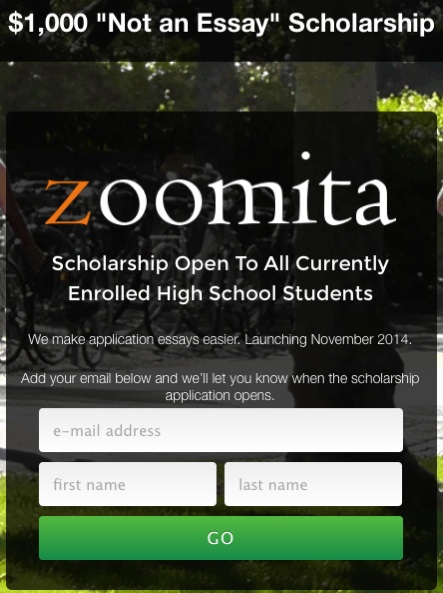
Who doesn’t love the no essay scholarship? Zoomita is running a $1,000 scholarship for college-bound high school students. It’s free to apply of course and requires a short response to a mystery question. The application opens in November, but students can join the list now to get first dibs when it becomes available: www.zoomita.com. This one is available to ALL high school students. If you have a freshman, start the scholarship application process EARLY!
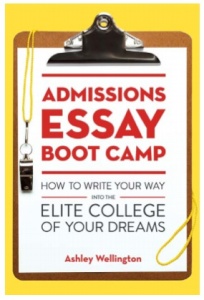
Periodically, I review books for authors who write about the college prep process. Today’s review is on Admissions Essay BootCamp (How to Write Your Way into the Elite College of Your Dreams). If your student needs some help with the essay, check it out.
_______________________________
“From the founder of elite college prep agency Mint Tutors comes this hard‐hitting essay‐writing advice manual tailored to each student’s strengths and potential pitfalls, inspiring students to write as if guided by their own personal college admissions tutor.”
The book begins by helping students identify what type of applicant they are and then helps them think through the essay process.
According to Ashley Wellington, the book’s author:
By nurturing the voice of the student as an individual [it] gives tailored advice that empowers real students to craft higher‐quality essays that will get them into Ivy‐level institutions. Admissions Essay Boot Camp replicates an editing session with a private tutor who knows how to dish out both encouragement and tough love—and get results.
What I like about the book
It outlines the five prompts on the Common app essay and pairs them with the student’s personality type
It helps you organize your thoughts and get them down on paper
There’s a much-needed grammar lesson
It helps the student craft their own version of the essay prompts by giving examples and analyzing the good and bad points
It helps students recognize the “red flag” topics and how to tackle them
Why can this book help student’s with the essay?
If you student needs help brainstorming and recognizing the strong aspects of their essay along with the negative ones, this book will help. Sometimes, a little brainstorming and some examples of how to handle topics is all a student needs to begin crafting an amazing essay.
Today’s topic: applying EA (early action) and ED (early decision). It’s the first week of November and those applications will be arriving at the colleges. Granted, it’s a quick process to complete once school begins in the fall, but there are some good reasons to take advantage of these options.
Your application arrives with fewer applicants (you stand out)
It stands to reason that the bulk of the students will be applying regular decision, which falls in early January. If you apply EA or ED, your application will be at the top of the stack.
My colleague and good friend, Paul Hemphill, talks about the choice to apply early, in Applying to college: How early? Which “early”? “Applying early,” claim the authors of The Early Admissions Game, “provides a significant admissions advantage, approximately equivalent to the effect of a jump of 100 points in SAT-1 score.”
You get to cross that task off your list (and relax)
When the holidays arrive, your applications are complete and you can load up on all the sweets and turkey your heart desires. You can relax during the break and know that you are ahead of the game.
You get your acceptances early (and it’s done!)
ED decisions usually arrive in December. EA decisions arrive in January or February. You don’t have to wait until April when all the other offers of admission arrive. If you are applying EA, you have more time to make your final decision.
You can focus all your energy on scholarships (it’s all about the FREE money)
Now that you know you’re accepted, you can focus your time and energy over the next few months on searching for scholarships. You will need to pay for that education. And there’s nothing better than FREE money to pay for that huge price tag.
You can focus on your academics (don’t fall prey to senioritis)
You’re in—but that doesn’t mean you can skate through senior year. Colleges have been known to pull offers of admission. Final transcripts are important so use the extra time you have to bump up that GPA.
Wednesday’s child may be full of woe but Wednesday’s Parent can substitute action for anxiety. Each Wednesday Wendy and I will provide parent tips to get and keep your student on the college track. It’s never too late or too early to start!
The bonus is on the fourth Wednesday of each month when Wendy and I will host Twitter chat #CampusChat at 9pm ET/6pm PT. We will feature an expert on a topic of interest for parents of the college-bound.
Wednesday’s Parent will give twice the info and double the blog posts on critical parenting issues by clicking on the link at the end of the article from parentingforcollege to pocsmom.com and vice versa.


 There are times we all wish we were more organized. We are not born organized; quite to the contrary, organization is a learn skilled. It is imperative we help instill the life skill of organization into our children at an early age so that they may better their chances at a successful future as college students and fully functioning adults. Applying to college is an exciting and nerve-racking time for both parents and students. There are some tips and strategies to help your student get organized so he or she will posses the required skills for future success.





 Today’s topic: applying EA (early action) and ED (early decision). It’s the first week of November and those applications will be arriving at the colleges. Granted, it’s a quick process to complete once school begins in the fall, but there are some good reasons to take advantage of these options.