FAFSA Week: Reporting Parent Information on the FAFSA

Reporting parent information on the FAFSA

Reporting parent information on the FAFSA might make you want to pull your hair out.

If you are completing the FAFSA, some terms can confuse you. Today’s post addresses those questions in an effort to help you understand them more clearly and fill the ambiguous categories like divorced, separated, living together but not remarried, divorced and living together, separated and living together, and stepparent married to biological parent.

Here are some detailed articles that will help you discern which FAFSA parenting category you fit into.

From TeenLifeMedia, “How Divorce and Separation Can Affect Financial Aid”

When students apply to college, there are many forms to complete. And if they are applying for financial aid, the FAFSA is No. 1 on the list. This form asks the obvious questions: name, date of birth, Social Security number, address etc. It also asks questions about parents’ financial information to determine financial aid eligibility.

If you are separated or divorced, this part of the FAFSA raises many questions:

  • How will colleges treat the income of two separate families?
  • Which parent’s income is used for determining the expected family contribution, or EFC?
  • Do both parents have to report their incomes?
  • What do the words “custodial parent” mean?

Read the entire article for clarification.

Studentaid.ed.gov published a PDF, “Who is My Parent When I Fill Out the FAFSA”:

Maybe you know you’re considered a dependent student* by the Free Application for Federal Student Aid (FAFSASM), and you’re supposed to put information about your parents on the application. But what if your parents are divorced? Remarried? What if you live with your sister? Whose information should you report?

Below are some guidelines that might help. Unless otherwise noted, “parent” means your legal (biological and/or adoptive) parent or your stepparent. In addition, the rules below apply to your legal parents regardless of their gender.

Download the PDF for instructions on how to complete this section

EdAdvisors Network addresses the issue of divorce and separation, “FAFSA Tutorial: Divorced and Separated Parents on the FAFSA”:

The marital status and living arrangements of a student’s biological and adoptive parents determines whether the Free Application for Federal Student Aid (FAFSA) requires financial and demographic information from one or both parents.

These topics are addressed:

  • Who is Considered a Parent?
  • Parents who are Married to Each Other
  • Parents who are Unmarried
  • Who is the Custodial Parent?
  • Stepparents
  • Increasing Aid Eligibility

Read the tutorial for detailed explanations of each category

SmartAsset.com provides parents with an easy-to-understand guide and some examples, “Divorce, FAFSA, and the Financial Aid Process”:

The Free Application for Federal Student Aid, known as FAFSA is the Hydra that strikes terror in the hearts of even the most financially savvy parents. Rendering otherwise competent adults mumbling, muttering wrecks. Creative hyperbole aside for the moment, most people are intimidated by FAFSA to some degree but those preparing the form as divorcees face a special kind of torment.

There are several problems with FAFSA when divorce is involved, none of which are insurmountable but lack of understanding can tear open long healed wounds and foster a renewed sense of acrimony. However, knowing the rules of the game can make life and FAFSA easier.

To understand the rules and see some practical examples, read this article

 

FAFSA Week: 5 FAFSA Myths


FAFSA myths

This week is FAFSA week. An entire week devoted to the FAFSA. I’m going to scour the my blog, the web, and social media to find you the best information, tips and advice related to the FAFSA. If you’re a go-getter and you’ve already completed the FAFSA, congratulations! If you haven’t recovered from the holidays, these words of encouragement should help you get motivated to complete it. If you’re not sure it’s worth your time, this advice should answer that question. If you want to be informed before you complete the form, this information will most definitely help.

Today, I am debunking some FAFSA myths.

Myth 1: If you can’t qualify for federal aid, there’s no point in filing out the FAFSA.

If you don’t complete the FAFSA, you can’t apply for student and parent loans. Colleges also use these figures when determining financial aid eligibility for grants and scholarships. If you don’t complete the FAFSA, you may be missing out on this type of aid. Plus, many states use your FAFSA data to determine your eligibility for their aid. Fill out the application and find out what you can get!

Myth 2: I make too much money to qualify for financial aid.

Actually, there isn’t an income cutoff to qualify for financial aid. Your eligibility for financial aid is based on a number of factors and not just your or your parents’ income. Families who file the FAFSA automatically receive an asset protection allowance based on the age of the oldest parent. The closer you are to retirement, the larger the allowance.

Myth 3: I have too much home equity to qualify for aid.

Most colleges won’t care if you own a house and won’t count home equity against you if you do. The majority of schools rely on the federal aid application, FAFSA, which doesn’t ask parents if they own a home. If the college requires the CSS Profile, home equity is required, but because of the equity cap, has little impact on the award decision.

Myth 4: I have to wait until I file my taxes to complete the FAFSA.

Under no circumstances should you wait until you file your taxes to complete the FAFSA. The new FAFSA filing date of October 1 makes it easy. With financial aid, the rule is “first come, first served”. File early and update if necessary.

Myth 5: The form is too complicated and since I’m sure I won’t qualify, it’s a waste of my time.

The FAFSA is actually pretty straight and can be completed in one sitting; and filing out the FAFSA is never a waste of your time. Colleges and states use this information when awarding grants and scholarships.

The bottom line: there is no excuse to not complete the FAFSA. It’s free and is well worth your time. Even if you can afford to pay for the entire cost of college, you should complete the FAFSA. Colleges use this data when dispusing merit aid as well.


3 New Years Resolutions You Should Keep


new years resolutions


I’m not, nor ever have been, a fan of New Years resolutions. I like the line from Hitchhikers Guide to the Galaxy, “I like the sound of deadlines as they go whooshing by.” That’s how I feel about resolutions. Not all resolutions are bad, however. Some (the ones that are logical and attainable) can and should be kept.

Here are three resolutions you should keep if you have a college-bound teen. They are simple goals and will help make the entire college prep process less stressful and overwhelming.

Stay organized

Resolve at the beginning of the new year to stay organized. The college prep process requires organization: test registration deadlines to meet, recommendation letters to pursue, college applications to complete, financial aid to apply for, scholarships to submit applications and the mounds of college information your student will receive during the process. Whew, that was a LONG list!

Without committing to stay organized, the process becomes stressful and overwhelming. Use separate email accounts, calendar programs, file folders, usb drives, and don’t forget to create a college landing zone for everything your student receives at school that is college related.

Work as a Team

It’s impossible to expect a teenager to handle this monumental task alone. I’m not suggesting you write the essay, fill out the applications, apply for the scholarships, or make the college choices. But I am encouraging you to help with the organization, remind about the deadlines, proofread the essays, help find the scholarships, and give advice when asked.

You should also make it perfectly clear that this is their decision, but they don’t have to make it alone. If you work as a team, not only will your teenager be less stressed, but you will feel like you’re part of the process and less likely to take over.

Focus on the big picture

In the end, it won’t matter much which college your student attends. Focus on the big picture. It won’t matter what their SAT scores were or if the college has a prestigious name. Concentrate on finding the perfect fit college (the one that socially, academically, and financially fits). Then your student will have the best four years of their lives, along with an education and tons of lifelong memories and friendships.

All the best to every parent who is navigating the college maze. May 2016 be a year of success, fulfillment and absolute joy for you and your college-bound teen.

Getting Ready for Dorm Life


dorm life

With offers of admission rolling in from ED and EA applications, now is a good time to start thinking about preparing for dorm life in the fall. With stores offering huge discounts during the holidays, there’s no better time to start stockpiling those dorm essentials in preparation for move in day.

College is an exciting time and getting ready for the move is a busy time. It’s essential to prepare and pack for your dorm as well as to think about some considerations associated with dorm life. The following tips will help you prepare for this important time in your life.

Dorm Rules

Before you run out to purchase expensive appliances, be sure to consult dorm room policies and procedures. Your dorm floor may have a fully-functioning kitchen and might frown on dorm-room appliances like hotpots used for cooking. You can also find out exactly what’s included in the dorm room–usually a closet, desk, and bed. Some universities will even supply a checklist of common items that their students bring along.

 Bedding

You’ll need to bring bedding with you like sheets, pillowcases, and blankets. Bed Bath & Beyond has stylish and affordable bedding sets that you can purchase for use at college. You’ll find a great selection of throw pillows that will add to your comfort and can even be used on the floor to prop you up when doing homework.

Roommate

If you college provides you with the name and number for your dorm roommate, it’s a good idea to talk about a few things before moving in together. For instance, it can help to map out some rules for living together. Although everyone’s bedtime preference is different and something you’ll just have to deal with, you can agree on times when the television or music should be turned off out of consideration for the one who as that 8 AM class the next morning. You can also work out things such as who is bringing the T.V., coffee maker, or other items you’d be willing to share.

Shower Robe and Caddy

Since few dorm rooms have their own bathroom and shower, you’ll need to prepare for life in the dorm’s community bathroom. A robe, towels, and a shower caddy to tote your toiletries to and from the shower are essentials. While you’re at it, be sure to have a hamper in your room to discard your dirty laundry.

 Storage Containers

Dressers aren’t standard dorm furnishings so be sure you bring plenty of hangers to hang up your clothes and storage containers to store clothing items like socks and underwear. Additional storage items like crates or baskets can be used to hold items like books, snacks, and outer wear like hats or mittens.

 Pack for the Season

If you plan to visit home during or between semesters, you might want to pack only those clothes that you’ll need for the first semester. That way, it’ll be easier for you to keep your dorm room clean and clutter free. You want to bring along what you need, but you don’t need to bring everything either. Dorms are notoriously small, so keep the room dimensions in mind when you pack.

 Living in a dorm can be so much fun, but it’s even better when you pack and prepare well for this big move. Keep these tips in mind and you’ll find they’ll enhance your dorm room experience.

_______________________________________

Robert Paulson is a life coach and has a grown-up family. He likes to share his insights and experiences on preparing for milestones in our life. Robert writes regularly for a number of consumer lifestyle websites.

Amping Up for the FAFSA


amping up for the fiefs

If you have a college-bound teen, the FAFSA is how you celebrate the New Year. Honestly, not many parents celebrate filling out the FAFSA, but you should. The FAFSA is your golden ticket for college money. Without it, your student won’t get a dime (even many scholarships ask if you’ve completed the FAFSA).

This should be your FIRST New Year’s resolution: complete the FAFSA within the first week of the new year. It becomes available online on January 1st and although I can’t picture you waiting by your computer at midnight, you should make it a priority over the next few days. And while you’re waiting during the countdown, you should be amping up for the FAFSA.

I wrote an article for University Parent last year (and it’s been updated for the changes) that should help you prepare: An Easy Guide to the 2016 FAFSA. Here’s an excerpt:

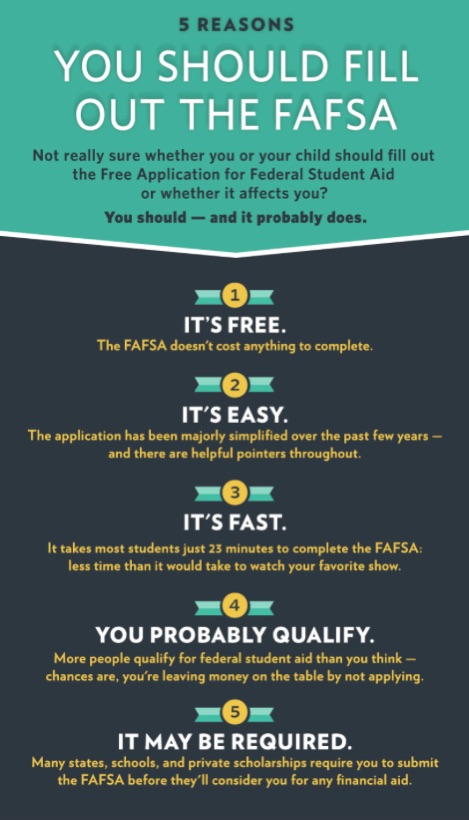
If there’s a piece of advice I give parents over and over again, it’s this: whatever your income, complete the FAFSA. Many parents believe that the FAFSA should only be submitted by financially needy students. Nothing could be further from the truth. Colleges use the FAFSA data to determine all types of financial aid, not just need-based. If your student doesn’t complete the FAFSA, he won’t qualify for any aid from the college or the government, including student and parent loans. You may be able to pay for your son or daughter’s education, but why not complete the form? It’s free and you have nothing to lose.

Take a few minutes to read the entire article which includes information about FAFSA basics, the documents you will need, how to team up with your student to get the form completed, and some technical terms, definitions and changes to the upcoming FAFSA.

It would also be good to read Diane Schwemm’s post: Changes to the FAFSA.

You can’t bury your head in the sand and ignore the FAFSA. Get pumped and start amping up for the FAFSA–your golden ticket to free money for college!

College Planning for 2016


2016

With the Christmas season upon us and students out of school, it’s a good time to look at what lies ahead and make some plans to hit the ground running in January 2016.

First things first, take a look at scholarships with January deadlines. These should be at the top of your list to begin 2016. Make scholarship searching and applying a priority in 2016. Say you don’t need money for college? Everyone likes free money! The more scholarship money your student earns the less you will have to pay. Save for retirement. Take a cruise. Remodel your home. Wouldn’t you rather keep the money you saved and use it for other family expenses? It’s a no-brainer–every student should apply for scholarships.

For seniors, it’s FAFSA time. Yes. It’s the dreaded FAFSA (much like the dreaded IRS forms). Don’t procrastinate. With the FAFSA, the early bird gets the worm (or in college terms, gets the money). School award aid on a first-come, first-serve basis. Once it’s available on January 1, get that puppy done. Even if you don’t want federal aid, fill it out. Colleges use this form when awarding other types of financial aid like grants and scholarships.

For juniors, it’s SAT/ACT prep time. If you’re taking the test in 2016, you’re going to be staring the new SAT in the face: it’s going to be available in March 2016. Use the next couple of months to prepare for the test. There are free tools on line to help you study and consider hiring a tutor if you think it will help your student focus and prepare.

Don’t wait to register for these tests at the last minute. If you plan to take the tests in January, REGISTER NOW! And it it’s in the spring, register now to avoid late registration fees. For a comprehensive guide on these registration and test dates, click here.

For sophomores and juniors, it’s time to start thinking about college visits. Sophomores should plan preliminary college visits (visit some colleges to get a feel for college life and prepare a list of wants and needs). Juniors will be making visits to show the college they are interested. Sign up for the tour and schedule and interview. Colleges keep tract of these visits and it will give you an edge when your application is received.

With a new year, comes new challenges and college-related tasks. Planning in December can help you hit the ground running in January and move forward in 2016.

Scholarships with January 2016 Deadlines

scholarships with january 2016 deadlines

It’s almost the end of December and it’s time to share some scholarships with January 2016 deadlines. Just in time to spend your holiday break applying for scholarships.

Cappex list of 17 Scholarships with January deadlines

About.com list of 97 College Scholarships with January deadlines

JLV College Consulting list of 82 Scholarships with January deadlines

This list should keep you busy over the holiday break!


Don’t Let the Wrong Things Stand in the Way of Your Child’s College Dreams


college dreams

What are your student’s college dreams?

There are many reasons your child may not get into a specific college—but you should never be one of them.

Sometimes it simply comes down to other applicants being more qualified—whether that be through grades or extracurriculars, maturity level or how admissions officers feel a student will jibe with the university, its mission and the makeup of its incoming class.

But there are many external roadblocks we put on our children that can limit them. Here are three of the most common—and the most detrimental.

  1. Show me… money!

Of course, tuition is astronomically expensive, and no one wants to saddle their child with the huge debts that have been the bane of the current generation of post-grads. That being said, there are always scholarships and fellowships available to people with the right skill level.

If your student has a high level of achievement and is looking toward a trajectory that seems like it will break your bank, start your research on these opportunities early—at least a year in advance of application dates. Many scholarship applications are hard work and require essays, financial statements and recommendation letters.   

College counselors may be able to help outline solutions too, and there are also a great many free college fairs around the country. Check out the calendars for these, because they not only have people there as representatives of major universities, they also have resources to help your student find the financial aid that is necessary for him or her to achieve a college dream.

In the end, if you have to go with loans, don’t fret… it’s possible that all will be forgiven sometime soon!

  1. But where in the world is it?

Many students (and parents) get hung up on staying close to home, with friends, or in a warmer clime. Encourage your student to look deeper into the kind of education they will receive, rather than whether it gets too far below zero (at say the University of Minnesota). What you know (that they likely do not) is that four years is not a long time. Your child can always return to the bosom of the family, or back to sunny California, once they have a solid degree in hand. But who knows—maybe ice fishing will become a favorite new hobby.

  1. I don’t know where I want to go!

Another common roadblock to finding the right university is too many choices when it comes to the future. It’s important to sit down with your child and have a conversation about what they want in a school, even if they keep saying “I dunno.” Keep in mind there is no perfect place and there are many “right” schools to choose from. I know it seems like a massive decision, but it’s one you can get wrong and not suffer too much—a student can always transfer if things don’t work out.

Here are some areas to focus on to help your child whittle down their list of potential schools:

  • Size of school: Would they be excited about the opportunities of a large campus or prefer the individualized instruction of a smaller school?
  • Faculty: Look up the achievements of the professors in certain areas that might interest your son or daughter. Keep in mind elite professors may be on sabbaticals, but it demonstrates a level of commitment to a specific subject at a university. Research opportunities are another part of this. Is the University participating in cutting-edge research in an area that is exciting to your young student?
  • Extracurriculars: Actively investigate where extracurriculars that interest your child are strongest. This will be part of finding the right fit. See if clubs, athletics or performance groups have a high level of achievement.
  • Study Abroad Possibilities: Is this something your student wants to pursue? Make sure the options are available.
  • Post-Graduate Opportunities: It’s much easier to get into grad school at the university where you receive your bachelor’s. If your child is on a path that requires this kind of education, see if this added criteria helps make a choice of where to apply.

Ultimately, it’s imperative to give students the latitude to make their own decisions based entirely on their qualifications for college rather than on any other factor. Everything else can be figured out. Remember, where there’s a will, there’s a way.

___________________________________________

About the Author

Ryan Hickey is the Managing Editor of Petersons and EssayEdge and is an expert in many aspects of college, graduate, and professional admissions. A graduate of Yale University, Ryan has worked in various admissions capacities for nearly a decade, including writing test-prep material for the SAT, AP exams, and TOEFL, editing essays and personal statements, and consulting directly with applicants.

College Prep: A Podcast Interview with Prepped and Polished


college prep

A few weeks ago, Alexis Avila from Prepped and Polished interviewed me on his podcast about college prep. The jest of the interview: how did you get involved helping parents with college prep? Of course, this is my favorite topic.

Alexis and I talked about college prep and the obstacles I faced. We discussed what I learned along the way and the mistakes we made. You will learn about my “Ah ha” moments. And also how I started helping parents along with what parents need to know to be an effective college coach.

Take 15 minutes out of your day and listen to the interview. Have questions? Feel free to email me at suzannemshaffer@gmail.com.

Need MORE expert advice, check out my posts here:

50 College Info Websites

50 More College Info Websites

College Prep Resources

Here are the experts I recommended along with Alexis’ podcast links (apart from test prep recommending Prepped and Polished):

Financial Aid: Jodi Okun and my podcast with Jodi Okun

College Visits: Kelly Queijo and my podcast with Kelly Queijo

College Planning: Paul Hemphill

College Essays: College Essay Guy 

Check out the interview with interview notes and links:
The Prepped and Polished Podcast-Parents Countdown to College

Scholarship Search Extravaganza


scholarship search

It’s Scholarship Friday here at Parents Countdown to College Coach. Today I’m sharing my best scholarship search tips from TeenLife.com.

Five Steps to a Winning Scholarship Application

Once you find the scholarship, even if you qualify, it’s important to “package” yourself to get the attention of the scholarship judges. Here are some great tips that should help you when completing your scholarship application.

Read the article at TeenLife.com

How to Search for STEM Scholarships

If your student is considering a STEM college major, there are scholarships available specifically for these majors. But the key is knowing where to look for them.

Read the article at TeenLife.com

6 Better Ways to Search for Scholarships

It’s easy to get overwhelmed with the scholarship search. Where do you start? How to you find them? What method should you use?

Read the article at TeenLife.com

How to Use Pinterest to Find a Scholarship

Pinterest for scholarships? You bet! There are numerous boards on Pinterest highlighting scholarships. I have a scholarship board and so does Monica Matthews. Here’s how to use Pinterest to find scholarships.

Read the article at TeenLife.com

Raise.Me: A New Way to Earn Scholarships in High School

Cash in on grades, volunteer activities, community service, and other high school projects and see the scholarship dollars add up.

Read the article at TeenLife.com

5 Uncommon Ways to Find and Win Scholarships

You know the drill for the scholarship search: use the search engines and ask your high school counselor about scholarships. But don’t stop there, use these five unusual ways to search and apply for scholarships.

Read the article at TeenLife.com

Helping parents navigate the college maze