Category Archives: Uncategorized

Teaching Young Adults the Value of Money


money

Learning by your mistakes is part of what life is all about and how you gain valuable experience, but when it comes to money matters, getting your sums wrong can prove to be a costly life lesson that you could do without and could mean money down the drain.

Get a handle on the value of money

It seem an obvious thing to say but it can make a big difference to how you fare in your financial life, if you work on understanding the true value of money.

It is all too easy these days to pay using your smartphone or by card, meaning you don’t really encounter real cash or perhaps get a handle of its true value to you.

A good example of this would be if you want to buy a new gadget that has a price tag of $500. Buying that item on credit will mean that you end up paying much more for the item than the original price of $500, so the sensible thing to do would be to pay with cash in your bank.

Even if you earn as much as $20 per hour, by the time you add in taxes that you have to pay on your earnings, you will have to work about 33 hours at your net income rate, to be able to earn enough money to buy you must-have item for $500.

Understanding how hard you have to work to pay for something like this will instill a sense of financial awareness and discipline within you that should help you to minimize any indiscriminate spending habits.

Always try to have an emergency fund

One of life’s financial lessons that too many of learn the hard way, is that things don’t always run smoothly and you are almost certain to experience a few bumps in the road.

Not having the money to get your car repaired when it breaks down unexpectedly or running out of cash before you next get paid, can leave you to resort to some short-term lending solutions or to spend on your credit card, both of which will turn out to be costly.

Accidents that require medical treatment can certainly be added to this list. In addition to the funds to cover these emergencies, you may also have to pursue a personal injury claim and rely on the help of experienced attorneys like The Law Offices of David E. Gordon.

A great bit of financial advice is to set up an emergency fund. Put away some small amounts of money on a regular basis and you should soon have a pot of cash tucked away in a savings account, that you can use as an emergency fund.

This allows you to pay for that car repair by borrowing from yourself rather than a lender, so you can get on with your life, and arrange to pay back the money into your savings ready for the next bump in the road.

If you follow these simple tips on how to manage your money and always try to use a budget in order to keep an eye on your spending, you should have a better chance of turning into money savvy adult who manages to cope with most financial events that life can throw at you.

_________________________

Sienna Horton is a Mom of 2 grown, or almost grown, kids. She’s working on making them financially independent and able to stand on their own two feet in the world and sharing her tips, and failures, with other parents!


Is Your Student’s Screen Time Affecting His Vision?


vision

The average person now spends just short of seven hours a day staring at some sort of screen, either on their computer, smartphone or TV.

Students have grown up in a digital age and probably don’t consider how vulnerable they might be to a condition known as computer vision syndrome. A growing number of patients contemplating the idea of laser eye surgery on the NHS, is testament to the fact that many of us are experiencing eye strain and other problems with our eyesight. You can find out more about NHS options here.

Here is a look at what computer vision syndrome is and how you can take steps to try and prevent it happening to you.

Computer Vision Syndrome explained

You might also hear the syndrome referred to as Digital Eye Strain, but the end result and the symptoms are the same.

These terms are generally used to describe a specific group of eye and vision-related issues that are associated directly with prolonged use of your computer and other devices that have a screen.

Typical symptoms you will experience with Computer Vision Syndrome are eye strain, regular headaches, blurred vision and discomfort from neck and shoulder pain.

In basic terms, viewing a computer or a digital screen, will often involve making your eyes work a bit harder in order to adjust to the glare of the screen and if you have not adopted a good posture or setup to view the data, this will have consequences sooner or later.

You will be vulnerable to Computer Vision Syndrome if you spend two or more continuous hours looking at a screen each day, creating visual demands on your eyes that exceed their normal abilities.

Feeling the strain

There are a number of things that you might be doing every day at your desk, which will aggravate an existing problem and lead to you suffering from eye strain.

The performance of computer screens has greatly improved in recent years, so if you are still using a low-resolution screen, this will be harder on your eyes and lead to an increased risk of eye strain, so consider switching to a high-resolution flat panel version, which should be easier on your eyes and put less strain on them.

Sitting on an ergonomically designed chair to do your work at a screen will also help, as it should improve your posture and put you at a comfortable viewing distance if used correctly.

Lighting and glare

It is not just your computer screen that can aggravate your eyes and lead to strain, as many of us are not working under the correct lighting conditions.

Eye strain can often be caused by excessively bright light that is either coming from sunlight or from harsh interior lighting. You should aim to try and get ambient lighting that is about half the brightness of a typical strip light in an office.

If you already wear glasses, you might want to consider getting an anti-reflective coating, which will minimize glare and reduce the risk of eye strain.

If you are a student spending plenty of time in front of a computer screen, make sure you don’t ignore any warning signs like regular headaches, and get your eyes checked regularly to ensure that you are not suffering from Computer Vision Syndrome.

___________________

Hannah Fox is at medical school and wants to be an ophthalmologist doctor. When she can find a quiet moment she enjoys using her new-found knowledge to write articles about eye health. These appear on health blogs around the web.

Sometimes College Isn’t the Right Choice


right choice

When our student graduates from high school we flaunt college names like a badge of honor. “My daughter is going to Harvard.” “My son will be attending college at Texas A&M.” You get the picture. Sometimes our desire to prove we raised a successful teenager clouds our judgment and causes us to push our children in the wrong direction. The simple truth is: college isn’t for everyone. And that’s ok. There are alternatives to college.

For some young adults, the thought of college terrifies them. They didn’t do well in school and they know college is academically more difficult. For others, they are simply burnt out—the prospect of another four years of school does not appeal to them. Others prefer to take a different path such as the military or trade school.

With all the talk about college during high school, other options are rarely discussed. My son never saw himself in college. He was an average student but from the time he entered high school he had military aspirations. He joined the Naval Junior ROTC program and as a senior, he enlisted in the U.S. Marines. It was a good decision for him at the time, even though I protested strongly because I wanted him to go to college.

If your student seems disinterested in college there are other options to consider. A gap year might be in order. During that time he can work at an internship, learn a trade, or find a volunteer opportunity abroad. He could always work for a year, take a few classes at the community college and test the waters. Another bold initiative would be to become an entrepreneur–start a business or invent a product to sell. All the college acceptances in the world make your child happy if he’s not invested in the process or willing to commit to study.

The bottom line: college is not always the right choice for every student. And, as I said, that’s ok. The important thing is that you know your child. Don’t push if you sense strong resistance.  Discuss options and make a plan. It’s perfectly acceptable to delay college, work to discover a career path, or concentrate on a trade. College isn’t for everyone.

Reflecting on Memorial Day


memorial day

While my daughter was studying abroad in Paris, my husband and I made a trip to visit her. Being a history buff, my husband wanted to visit Normandy. I remember staring at those cliffs along the beach in awe of the men who knew they were most likely going to die trying to scale them and take the enemy’s stronghold there. Standing in the enemy’s machine gun bunkers, I looked at the beach below and thought of all those brave men who simply would not give up. There was a price—and they paid it with their lives.

Afterwards, we visited the graves of all those men who died during the Normandy invasion. There are no words to describe the feeling you get standing there gazing at the endless crosses above the graves of those military heroes.

About 30 years ago, my son came to me and said he wanted to join the Marines. You can imagine–as a mom my heart dropped. I felt pride and angst all at the same time.

My father was a World War II veteran and I always loved to hear his war stories. Of course, I’m sure he spared me the painful ones, but I know he had some.

Neither of them paid the ultimate sacrifice but were well aware of the risk they took when they volunteered to serve. They knew every day their lives were at risk, but they also knew that freedom has a price.

On this Memorial Day, I am sharing some past articles that are appropriate today as we celebrate Memorial Day and remember the true heroes who died protecting our freedom.

Veteran’s Day—Thanking Those Who Served

Scholarships for Military Dependents

Is Military College Right for Your Student?

Steps for Attending a Military Academy

Do You Need to Go to College to Be President?

president

Everyone remembers the scene from “Goodwill Hunting” when Will confronts a Harvard student spouting off his formal education knowledge. Will contends his high-priced Ivy League education is simply that–high priced. He contends you can get a college education with a simple library card. According to Will, the key is to read. Read everything written by the experts in any field that interests you. Fill your library, and your mind, with wisdom from the greats. Abraham Lincoln and George Washington would agree with him.

Neither Washington or Lincoln graduated from college, along with seven other presidents: Andrew Jackson, Martin Van Buren, Zachary Taylor, Millard Fillmore, Andrew Johnson, Grover Cleveland, and Harry Truman. But if you notice from the list, every president since Harry Truman, who withdrew before finishing, has been able to present a college degree as a qualification to hold the highest office in America.

Do you need to go to college to be President of the United States? In this day and age where education is valued and often a badge of intelligence, it would be unlikely to win even a nomination without a college degree. As a matter of fact, every candidate for president in 2016 is able to say they have a college degree, many have advanced degrees. But every degree is meaningless without a thirst for knowledge, a willingness to learn, openness to listen to other viewpoints, and a curiosity about the world in general.

But Will Hunting would say: just get a library card and read! Granted, he was a math genius and most likely had a photographic memory.  But it’s not bad advice for every college-bound student. Reading is the key to all education. You don’t have to set foot in a lecture hall to read Shakespeare, study history, or experience the world. Books can open all those doors and more!

For a list of past Presidents and their college degrees, read Where’d They Go to College?-The Presidents

For a list of presidential candidates and where they went to college, read 2016 Democratic Presidential Candidates-Where’d They Go to College? and 2016 Republican Candidates-Where’d They Go to College?

In This World of College Experts


world of college expertsMy heart is heavy today because we have lost a colleague and a friend, Wendy David-Gaines. She passed away yesterday after a long, hard-fought battle with ovarian cancer. She helped thousands of parents face life before and after college with her book, Parents of College Students Survival Stories. She and I collaborated each week on Wednesday’s Parent, giving advice for parents from two different perspectives. We co-hosted one week a month on #CampusChat sharing advice and helping parents.
She gave her time, her advice, her talent and for me, her friendship. She was a true parent advocate. She helped countless parents on Twitter and Facebook deal with college-related problems with little or no reward for her expertise.

Wendy would never say she was a victim of ovarian cancer and never craved the spotlight. She was an advocate for early detection, a fighter who searched for anything and everything that might help her overcome this disease, and someone who valued life and her family above all else. She will be missed.

If you are so inclined, please give to this worthwhile cause and leave a comment if you were a “cyber” friend of Wendy or she was of help to you along your college journey. I’m sure her family would love to know how she touched your life.

From FAFSA to Financing: Financial Aid 101

financial aid 101

As part of NBC News’ Education Nation initiative and our Parent Toolkit site, my team hosts a monthly Twitter Chat about a variety of different education and parenting topics.

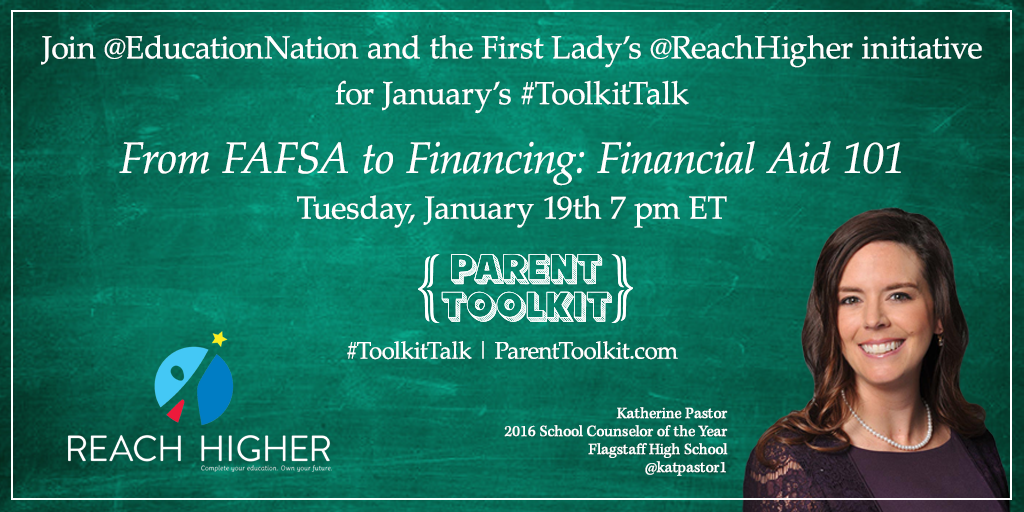
On Tuesday, January 19 at 7 pm EST we will be cohosting our monthly #ToolkitTalk conversation with the First Lady’s Reach Higher Initiative called From FAFSA to Financing: Financial Aid 101.  The chat will focus on information that high school students and their parents need to know about affording a college education.  Our featured guests will include the National School Counselor of the Year and representatives from the Federal Student Aid Office.

Join me and @EducationNation and others discussing tips for parents regarding financing a college education.

FAFSA Week: 5 FAFSA Myths


FAFSA myths

This week is FAFSA week. An entire week devoted to the FAFSA. I’m going to scour the my blog, the web, and social media to find you the best information, tips and advice related to the FAFSA. If you’re a go-getter and you’ve already completed the FAFSA, congratulations! If you haven’t recovered from the holidays, these words of encouragement should help you get motivated to complete it. If you’re not sure it’s worth your time, this advice should answer that question. If you want to be informed before you complete the form, this information will most definitely help.

Today, I am debunking some FAFSA myths.

Myth 1: If you can’t qualify for federal aid, there’s no point in filing out the FAFSA.

If you don’t complete the FAFSA, you can’t apply for student and parent loans. Colleges also use these figures when determining financial aid eligibility for grants and scholarships. If you don’t complete the FAFSA, you may be missing out on this type of aid. Plus, many states use your FAFSA data to determine your eligibility for their aid. Fill out the application and find out what you can get!

Myth 2: I make too much money to qualify for financial aid.

Actually, there isn’t an income cutoff to qualify for financial aid. Your eligibility for financial aid is based on a number of factors and not just your or your parents’ income. Families who file the FAFSA automatically receive an asset protection allowance based on the age of the oldest parent. The closer you are to retirement, the larger the allowance.

Myth 3: I have too much home equity to qualify for aid.

Most colleges won’t care if you own a house and won’t count home equity against you if you do. The majority of schools rely on the federal aid application, FAFSA, which doesn’t ask parents if they own a home. If the college requires the CSS Profile, home equity is required, but because of the equity cap, has little impact on the award decision.

Myth 4: I have to wait until I file my taxes to complete the FAFSA.

Under no circumstances should you wait until you file your taxes to complete the FAFSA. The new FAFSA filing date of October 1 makes it easy. With financial aid, the rule is “first come, first served”. File early and update if necessary.

Myth 5: The form is too complicated and since I’m sure I won’t qualify, it’s a waste of my time.

The FAFSA is actually pretty straight and can be completed in one sitting; and filing out the FAFSA is never a waste of your time. Colleges and states use this information when awarding grants and scholarships.

The bottom line: there is no excuse to not complete the FAFSA. It’s free and is well worth your time. Even if you can afford to pay for the entire cost of college, you should complete the FAFSA. Colleges use this data when dispusing merit aid as well.


Scholastic Art & Writing Awards

 
CallforSub_Poster_9_16_15

The Scholastic Art & Writing Awards—the nation’s longest-running and most prestigious recognition initiative for creative teens—are now accepting submissions for the 2016 program year with new scholarship opportunities provided by Neiman Marcus, The Herb Block Foundation and RBC Capital Markets.

For 93 years, the Scholastic Art & Writing Awards have identified the early promise of some of our nation’s most accomplished visionaries including alumni Andy Warhol, Truman Capote, Sylvia Plath and more recently, Stephen King, Richard Linklater, Zac Posen and Lena Dunham. Each year, exhibition, publication and scholarship opportunities are made available to students in grades 7–12 honored through the program for their original creative work in 29 categories ranging from architecture, photography and poetry to painting, video game design and more—with opportunities expanding each year.

These awards don’t just apply to seniors–7th through 12th graders are eligible to apply.

New to the 2016 program year:

  • A special Editorial Cartoon category sponsored by The Herb Block Foundation to promote awareness of the editorial cartoon medium and provide three young artists with $1,000 scholarships for their outstanding work;
  • The Neiman Marcus Fashion Award and The Neiman Marcus Jewelry Award to provide one artist in each category with $1,000 scholarships; and
  • The RBC Flaunt It Award to provide two $1,000 scholarships to students whose work showcases and celebrates individual differences.

For all the details read the the full press release with the link for the contest information.

One-Week Online Common App Bootcamp

common app boot camp

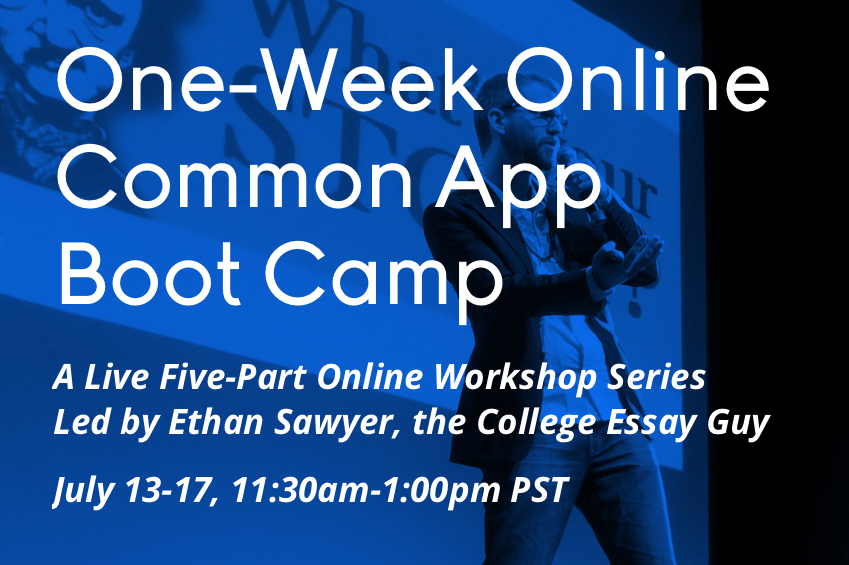
Everyone knows the importance of the college application. Books are written about it, articles published, and seminars taught about how to complete it. One of my Twitter colleagues and an essay expert, Ethan Sawyer @CollegeEssayGuy, knows how to craft the perfect college essay and personal statement, and he’s offering help with an upcoming common app boot camp webinar.

If a private university or college is in your future, the Common App is your one-way ticket. You’ve got one shot at a winning application, and Ethan Sawyer, the College Essay Guy, is here to help!

Using the Secrets of Screenwriting to Write Your Personal Statement is his five-part webinar series for students and counselors that runs July 13-17.

In just five days, you’ll finish your:

  • First draft of your Common App main statement
  • Activities list
  • Additional info section

Plus you’ll get tons of tips and step-by-step help to conquer the Common App.

Click here for more info.

Can’t make a particular session? No worries: He’ll email what you missed.

Can’t afford it? Don’t worry, there’s a pay-what-you-can option.

Are you a counselor? You’re invited too!

Click here to reserve your spot.