Category Archives: Uncategorized

Wednesday’s Parent: College Visits from the Trenches


Sign up for my FREE parent tips email and get my FREE Ebook on college financing! Or subscribe to my blog on the left and get email updates.

Wednesday’s child may be full of woe but Wednesday’s Parent can substitute action for anxiety. Each Wednesday Wendy and I will provide parent tips to get and keep your student on the college track. It’s never too late or too early to start!

Wednesday’s Parent will give twice the info and double the blog posts on critical parenting issues by clicking on the link at the end of the article from pocsmom.com to parentingforcollege and vice versa.

_____________________-

college visitsAutumn leaves signal the beginning of fall (for those lucky enough to live in a state where the leaves change color) and the beginning of college visits. For juniors it’s time to start the process. For seniors, it’s time to visit again and narrow down the college list. What better way to kick off the season than to give some “past parent” experiential advice and draw from the stories I’ve heard from others. Sit down, grab a cup of coffee and exhale. You’re in for a wild ride.

You’re going on a nice visit to some colleges. You’ve done your homework and you’ve planned several within driving distance of each other. You’re proud of yourself and you know that your kid is going to fall in love with at least one of them. You’re all decked out for the college tours (dressed to not get noticed or embarrass him) and you’re ready to listen and let your kid ask the questions. Sounds like a perfect trip–adventure and information gathering all at the same time.

But your kid forgot to read the notes. He’s nonchalant about the whole thing and acts disinterested in the car as you are driving towards the first college. What happens after this disrupts your mojo and you begin to wonder if an alien isn’t inhabiting your kid’s body.

The skeptic

Before you even get out 0f the car your kid announces that he’s just not feeling it. Don’t even attempt to decipher what that means because it’s impossible to understand. You’ve driven (or flown) to go to a college he had on a list and now he’s just not feeling it. Bench your anger, take a deep breath and get out of the car. You’ve come all this way and you’re going to visit the college. In the best of worlds he will get out with you. In the worst of worlds he’ll stay in the car. There’s not much you can do with an obstinate teenager; it’s best to move on.

The architect

And yet another alien appears. You’re walking around campus and your kid announces that he doesn’t like how it looks. Never mind that he’s not going to college for the buildings or the landscaping. He’s going for the academics. But for some reason his blinders aren’t allowing him to see anything but the buildings and no amount of pointing out the pluses is going to change his mind.

The critic

You’re walking around campus and your kid announces that the students don’t seem friendly. Mind you he’s probably not even spoken to any of them and it’s a good bet he didn’t like the tour guide. Don’t try to convince him otherwise because the more you say, the less likely he’ll come around. Just wait until a cute girl approaches him. He’ll change his tune quickly.

The panic-stricken

You get back into the car after your last visit and he announces, “I’m not sure I want to go to college”. Don’t panic. He’s just realized the whole thing is real and he’s terrified. Give him some time to think it through and tomorrow he’ll most likely change his mind again. The worst thing you can do is draw a hard line in the sand now because his feelings are likely to go up and down like a roller coaster over the next few months (or years).

What’s a parent to do?

Even though your kid wants you to treat him as an adult, he’s still a teenager. His emotions are all over the place and this next step in his life is frightening. Remember that college is largely an emotional decision and you should expect that emotions will play into that decision. When the dust settles and the emotions clear, he will make a decision based on all the factors, including his campus visits. After all, you don’t want him to attend a college he just isn’t feeling and you don’t want him to make a decision and leave out the emotional factor. He’s going to spend the next four years of his life at this school. It will become his second home and it’s important that he likes where he is.

Before the college visits start resolve to be flexible. Your lives will be less stressful and the college application experience will be more exciting. And in the end, your kid will move on to the next phase in his life–college.

For another look at college visits, check out Wendy’s blog: Collegecation.

 

Why study or improve your level of English?


Sign up for my FREE parent tips email and get my FREE Ebook on college financing! Or subscribe to my blog via email on the left.

englishFurther to our recent article highlighting the benefits of studying a foreign language, we thought it logical to next discuss the importance of learning English. It is after all, the most widely used language today, both socially and in the working world. It is hardly surprising then, that a high level of English is highly sought after by employers in an increasingly competitive and international work market. As a native English speaker, be it in the US, UK or Australia for example, it is often easy to take for granted our English speaking and writing capabilities. Is your fluency in English as good as it could or should be? As for non-native speakers, English is most commonly studied as a second language. Education systems around the world now place greater emphasis on the teaching and learning of English from an early age, not just as a subsidiary subject, but as essential as mathematics or science.  This article will seek to answer some of the most important issues when it comes to studying English, and to hopefully convince you that it´s never too late to get out those books and start learning something new!

The Benefits

Okay so we´ve already touched on this, but why else should you learn English? In simple terms, English is a truly global language. Let´s have a look at the figures… According to the British Council, English is the first language of approximately 375 million, while it is believed that around 750 million speak it as foreign language. One in four of the world´s population has at least a basic command of the language, and this is growing.

Of course there are benefits attached with learning any language, as discussed in our previous article. Specific to English however, it allows native speakers to consolidate and improve their current level, and perhaps even lead to a future career in English teaching. After all, the demand for such profession is huge and often lucrative. Nowadays it is not just enough to write in your CV “Fluent in English”. Employers want proof. For assistance in gaining an English qualification, you can take an IELTS course at an English language school in England. Such courses are also recommendable for those learning English as a second language, as visiting and learning in an English-speaking country (where better than London, England?) is one of the best things you can do to improve your fluency. This brings us neatly on to…

Continue reading Why study or improve your level of English?

Mom-Approved Tips: The Truth about College


Sign up for my FREE parent tips email and get my FREE Ebook on college financing!

truth about college

During our student’s senior year of high school we live in a bubble. All sights are set on one goal—getting into college. Students and parents focus on college selection, college applications, financial aid forms, and then we wait. We wait for the offers of admission to come pouring in and then we compare financial aid packages and help them pack their bags for college.

But wait. Is it really that simple? Hardly. Most parents would say it’s anything but simple; it takes work, commitment and perseverance on both parts—parents and students. Before your student sends off those applications, you should know the truth about college.

Acceptance doesn’t mean graduation

Did you know that graduation rates differ wildly from school to school. About 400,000 students drop out of college each year. When you research the college, look up their graduation rates. Low rates could send up a red flag. True, graduation rates don’t determine the quality of a degree. Yet students who start college but don’t finish are typically no better off than those who never even started, and in some cases might be worse off, if they took on debt.

I owe, I owe, so off to work I go (if they can find a job)

Even if your student graduates, it’s no guarantee they will secure a job; at least not one that will pay enough to cover too much student loan debt. Having that conversation about college costs should be a priority before they apply.

According to the College Board and other statistical resources student loan debt among graduates is at an all-time high:

•As of Quarter 1 in 2012, the average student loan balance for all age groups is $24,301.  About one-quarter of borrowers owe more than $28,000; 10% of borrowers owe more than $54,000; 3% owe more than $100,000; and less than 1%, or 167,000 people, owe more than $200,000.

•In 2010‑11, about 57% of public four‑year college students graduated with debt. They had borrowed an average of $23,800 (in 2011 dollars). About two‑thirds of those earning bachelor’s degrees from private nonprofit institutions had debt averaging $29,900.

Be cautious about student loans and if at all possible avoid them.

Will they stay, or will they go?

As many as one in three first-year students don’t make it back for sophomore year. The reasons run the gamut from family problems and loneliness to academic struggles and a lack of money. If schools you’re considering have a low freshman retention rate, you’ll want to ask the admissions office why. Some colleges do a great job of taking care of their freshmen; some don’t. That’s why it’s important to look at these rates when making college choices.

It’s a jungle out there

Even if you and your student do everything right, there’s going to be bumps in the road. They will call complaining of roommates, homesickness, and frustration with their classes. The best thing to do is listen and know that most times, those complaints get less and less and they eventually cease after they have settled in. Don’t be surprised if this happens to your bright, self-sufficient independent student. Just one word of advice—fight the urge to rescue them. It’s time they learn to fight their own battles.


Giveaway: Backblaze Online Backup


backblazeWhen I attended Blogher13, I stopped by a booth promoting an online backup service: Backblaze. I liked what I heard and wanted to try the service. After returning home, with coupon code in hand, I began backing up my laptop; something I had never done before. I should have known better, especially as a self-imposed geeky type, but we all think it will never happen to us–the inevitable computer crash. I have to confess it’s happened to me before and my computer was not backed up. So you imagine my excitement when I got the opportunity to test drive this product.

What do I like about it?

It runs in the background after initial installation and you don’t have to worry about it. You can schedule it to automatically backup or you can manually do it when it’s convenient (although I would not recommend this option–you might forget to do it!). The best thing about it is that it’s not being backed up to a physical hard drive, but is encrypted and sent to an external server that you can access from your computer or any mobile device. Your data is always accessible.

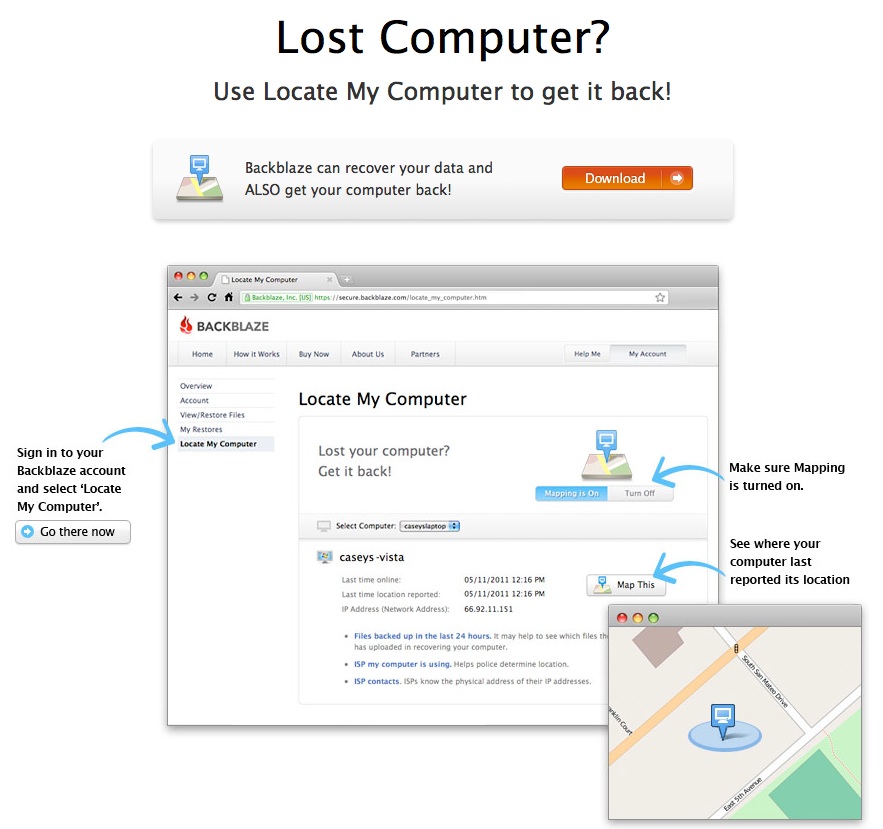
Locate My Computer

Another perk of this backup program is it allows you to locate your computer. Why would you need that option–how can you lose your computer? Consider this scenario. Your college-bound teen heads off to college with his new trusty laptop. Two opportunities might arise that he might need the “locate my computer” option. Forgetful as they are, students have been known to walk off and leave their computers. It happens. Or their laptop or computer might get stolen out of their dorm room and with this perk, you can locate it’s whereabouts using the “map this” option, and download all files before it’s ever recovered. This could save you thousands of dollars of replacement cost and stressful nights and days over papers, class notes, pictures and other documents stored on the computer.

BACKBLAZE

Giveaway

Backblaze is providing me with a coupon code for one year of backup service to one lucky parent or student. Just enter the giveaway below as many times as you like to increase your chances.

a Rafflecopter giveaway

Scholarships Friday: What are the odds?


Sign up for my FREE parent tips email and get my FREE Ebook on college financing!

scholarships

Most students hope for some sort of scholarship for college. Few are able to pay for the entire four years. Parents dream of getting that letter in the mail that says, “Congratulations, you have won a full ride for four years.” It happens, but it’s not the norm. The students who receive scholarships work hard and spend time searching and applying.

What are the odds?

Not everyone is going to win a scholarship. According to the 2007-08 National Postsecondary Student Aid Study (NPSAS), about 1 in 10 students enrolled full-time at 4-year colleges used scholarships to pay for their education, and the average amount was about $2,800. That sounds depressing and might cause you to think why bother; but keep reading to the bottom of the article for some hope and encouragement.

Athletic Scholarships

You will hear parents brag that their student is an athlete so they aren’t worried about scholarships; their student will get a full ride athletic scholarship.

Statistics rarely lie. And unfortunately, the numbers show that the recruiting game is a tough process to go through. There are more than seven million high school athletes, but there are college roster spots for just two percent of them. Getting to the NCAA Division I level is even tougher. Just one percent of those seven million student-athletes get a full ride to a Division I program. The recruiting process takes work, and earning an athletic scholarship is far from easy. It’s better to focus your time on academics, where your changes for a merit based scholarship are greater.

Here’s an infographic to demonstrate the point: Athletic Scholarship Statistics.

Here’s a chart that lists which athletic scholarships are available, how many, and the award amount: Scholarship Stats

It’s not all bad

Each year rumors and speculations arise around the topic of scholarships. You will hear statements like: there’s no way I will qualify so why bother applying; there are millions of applicants so I won’t win one; if you aren’t an A student you shouldn’t even bother. All of these, of course, are not true.

Scholarship Experts talks about myth vs fact: Scholarship Facts you won’t believe

What are my chances?

The best answer I can give you is your chances are ZERO if you don’t apply. Do the work, follow the rules and apply for the right scholarships by using a matching search engine like Zinch. Think outside the box and apply for scholarships with the fewest applicants (like local ones), thus increasing your chances.

The simple adage applies with scholarship searches: no pain, no gain. It may take you time and require you to push your limits, but the reward is worth it.


FastWeb Refer A Friend Scholarship

Eligibility: Scholarships for high school studens, undergraduate students, and graduate students

Deadline: October 31, 2013

Amount: $500

$2,000 “No Essay” College Scholarship

Eligibility: Scholarship for current students and those planning to enroll within 12 months

Deadline: October 31, 2013

Amount: $2,000

$500 “Define Yourself” Scholarship

Eligibility: Scholarship for high school seniors, college freshmen, sophomores and juniors who plan on attending a 4 year college in fall 2013 and register on the site above

Deadline: October 31, 2013

Amount: $500

– See more at: http://www.discusawards.com/#sthash.Ga2orroP.dpuf

FastWeb Refer A Friend Scholarship

Eligibility: Scholarships for high school studens, undergraduate students, and graduate students

Deadline: October 31, 2013

Amount: $500

$2,000 “No Essay” College Scholarship

Eligibility: Scholarship for current students and those planning to enroll within 12 months

Deadline: October 31, 2013

Amount: $2,000

$500 “Define Yourself” Scholarship

Eligibility: Scholarship for high school seniors, college freshmen, sophomores and juniors who plan on attending a 4 year college in fall 2013 and register on the site above

Deadline: October 31, 2013

Amount: $500

– See more at: http://www.discusawards.com/#sthash.Ga2orroP.dpuf

FastWeb Refer A Friend Scholarship

Eligibility: Scholarships for high school studens, undergraduate students, and graduate students

Deadline: October 31, 2013

Amount: $500

$2,000 “No Essay” College Scholarship

Eligibility: Scholarship for current students and those planning to enroll within 12 months

Deadline: October 31, 2013

Amount: $2,000

$500 “Define Yourself” Scholarship

Eligibility: Scholarship for high school seniors, college freshmen, sophomores and juniors who plan on attending a 4 year college in fall 2013 and register on the site above

Deadline: October 31, 2013

Amount: $500

– See more at: http://www.discusawards.com/#sthash.Ga2orroP.dpuf

How to Understand EA and ED


Sign up for my FREE parent tips email and get my FREE Ebook on college financing!

ea pr ed

EA (Early Action) and ED (Early Decision) have confused parents for years. Applying to college has become more competitive and more complicated. Years ago (long before my time), all you did was apply and everyone applied at the same time. But times have changed and so have college applications. If you break the terms down it’s easier to understand. I’ve turned to some experts to help you decipher the differences and understand the benefits and/or the downsides of applying EA or ED.

What is EA and ED?

The first comes from Patrick O’Connor, Associate Dean of College Counseling, Cranbrook-Kingswood School, and author of College is Yours 2.0:

Early Action: Also known as EA, colleges that offer this option promise a quick response if you submit a completed application by their early deadline. Students admitted EA don’t have to promise to attend the college; they just want to hear back sooner than usual. Students can apply as EA candidates to several colleges at the same time, as long as they are submitting a quality application that didn’t get thrown together at the last minute.

Restricted Early Action: Sometimes known as Early Action Single Choice, REA works much like Early Action, but the student is limited in the number of other colleges where they can submit early applications — and that number is often zero. Colleges do this for a number of reasons, but they most often want the student to show a special commitment to their college without having to promise to go there. This can reduce the number of students who apply early who aren’t really thinking about why the college is right for them , and still reward the students who feel a special bond to the school.

Early Decision: ED applications require a little more from students than EA applications. The process is the same — students submit a completed application by an early deadline — but if a student is admitted as an ED student, they promise to withdraw all other college applications at attend the college that admitted them ED. If this sounds like serious business, it is. Students should only apply ED to a college they absolutely, positively love, and cannot live without.

Read Patrick’s entire article on Huffington Post about how to determine if either of these is best for your student.

Tips for Potential ED/EA Applicants

Peter Van Buskirk, an acclaimed author and motivational speaker, excels at simplifying and demystifying what is often perceived as a complex and mysterious process—college admission. His creative programming, including his signature presentation of “The Admission Game®,” has informs parents and students about the ins and outs of the college admissions process.

Peter gives several tips for college applicants seeking EA/ED:

  • Read the fine print for each institutional offering and understand your commitments before initiating an early application of any sort.
  • Rather than looking for an “ED school,” focus on finding colleges that fit you well as you arrive at your short list of schools. If one of them becomes your absolute first choice, then ED should be a considered option.
  • Do not apply ED unless you are dead certain of your commitment to enroll if accepted.
  • Do not apply ED if you have not visited the campus first! Ideally, your visit will have included an overnight stay that enabled you to also attend classes and experience the campus culture.
  • Resist the temptation to act on impulse. The feelings you have for a college now might change greatly over time leaving you committed to a place that is no longer where you want to be. Give yourself at least a month to reflect on your intended application before applying ED.
  • Remember the ED Round II option. Many schools will give you the opportunity to “convert” your Regular Decision application during a second round of ED in January. The conditions are the same as with ED Round I, but you might be better prepared to make a commitment later in the year.
  • Resolve all $$ questions and concerns before applying ED. Once you are admitted, there can be no contingencies. Ask the school’s financial aid office to provide an “early estimate” of your expected family contribution (EFC) before you submit your ED application. Apply ED only if you are completely satisfied with the information you receive regarding your EFC.
  • Sprint to the finish! Even though you might hold an EA or ED acceptance letter, it is likely to be conditional on your completion of the senior at the same level of achievement that earned you the offer of admission. More than a few colleges are known to rescind offers of admission when final transcripts show performances that drop measurably after offers of admission are secured.

Read Peter’s entire article, Making Sense of ED/EA Options. for a look at the numbers, options and who benefits.

What is “rolling admissions”?

Schools with rolling admissions offer important options and opportunities that static deadlines don’t. Rolling admissions schools will accept and examine applications as they are sent in, instead of waiting to judge all applications concurrently. Schools with rolling admissions can be great for late admissions, or for finding out early on whether or not you are accepted, so you can change your plan accordingly.

Peterson’s provides an article about the Advantages and Disadvantages of Rolling Admissions.

What is regular admissions?

A discussion of EA and ED needs to include a discussion on regular admissions as well. Regular admissions require that the student submit their application before the application deadline (which is later than EA and ED). The advantage of this being that students have more time to prepare and have no restrictions on the number of schools they can apply to.

This pool of applicants is much larger and the competition for these slots will be more competitive. Colleges typically have lower admission rates for regular admission applicants.

College 101 provides a comparison table, which includes EA, ED, Rolling Admissions, and Regular Decision, to help decide which application deadline is right for you.


Mom-Approved Tips: Unsolicited Advice


Sign up for my FREE parent tips email and get my FREE Ebook on college financing!

unsolicited adviceEllen Snortland, author and Huff Post blogger states it simply in an article about unsolicited advice:

What makes these mediocre meddlers, these know-nothing-nattering-nabobs of the obvious, these kings and queens of blah, blah, blah, think that anyone really wants or needs their cheap irksome advice? Do I have “Please give me your most recent lamebrained theory on what I should do” tattooed on my forehead?

You know who they are: parents who want to give you all kinds advice about which college your student should attend and what they need to do to go to Harvard. There’s nothing wrong with asking other parents who have been through the college process for help. If you’re a parent of a college-bound teen you’ve most likely encountered people like this. Everyone has a story and a complaint. Some are useful and valid; most are not. The key is asking–and trusting the advice you get.

Here’s a sample conversation between parents:

Parent 1: If you want your kid to be successful after graduation, they have to go to an Ivy League college.

Parent 2: I’ve heard the Ivies aren’t all that great.

Parent 3: Someone told me that it’s impossible to get into the Ivies if your student doesn’t have a perfect SAT score.

Parent 4: If you have a B student, their options are limited to state universities or community college.

If you analyze each of these parents’ advice, there is some truth in each of them. But without reputable advice they might lead their students in the wrong direction.

Should you listen to unsolicited advice?

I heard a college counselor talk about a popular college forum recently reminding parents that you can’t trust these anonymous comments. Parents have no way of checking the accuracy of the posts or the validity of the information on these sites. That’s not to say all of this advice is bad; but you should always verify the information with the experts. What’s good for one student, is not necessary the best path for yours. Be selective and investigative about all the advice you will most assuredly receive.

Is all college advice accurate?

No. Just like not everything you read on the internet is true. I love that insurance commercial that is driving the point that not everything you read online is true. Even if it’s posted in a college parent forum it might not be accurate. Sift through the useful information and throw out the babble. Before you take it as gospel, verify it with other sources.

Where can I get the best advice?

Common sense says you should look for advice from the experts. Who are these experts? These are college professionals and parent advocates whose advice and instruction have been endorsed by others in the field of college prep. Any advice devoid of these endorsements is advice you should take with the grain of salt.

It’s your responsibility as a parent college coach to sift through all of this unsolicited advice and verify the accuracy of all of it. Trust the experts who have been endorsed by other experts; if you do this the college admissions process will be more effective and less stressful.


How to Compare Colleges


Every Thursday I will be sharing my best “How To” tips for the college-bound. Don’t miss a single post by subscribing to my blog, or liking me on Facebook (https://facebook.com/parentcollegecoach).

______________

compare colleges
Scattergraph of  American Colleges and Universities

Today’s topic is timely because parents and students are in the process of narrowing down their college lists for this year’s application season. Just exactly how do you compare colleges and determine which colleges should make it on the final list?

College Visits

Hopefully you’ve made some college visits either in the spring of last year or over the summer. Fall is the best time to visit those colleges that are on the short lists–the ones your student sees himself attending. College visits are a key element in comparing colleges. Your student can use those visits to compare students, campus facilities and even professors and courses if they sit in on some classes while visiting. All those factors play an integral part in the college selection.

Statistical college comparisons

Of course, as with any large purchase, you should also do price comparisons. You should compare value, financial aid awards, size, location, rankings and majors. The best way to do this is with side-by-side comparisons. I recommend using these three programs:

College Navigator

The National Center for Education Statistics has a comprehensive site with all the data collected to quickly and easily compare colleges statistically. Unfortunately, due to the government shut down, the site is currently down. But bookmark the site and hopefully it will be back up soon with all the current data.

FindTheBest

FindTheBest gathers information and build the tools that people need to make sense of it all, from visual icons to smart filters to scatterplots. It’s the ultimate research hub for making informed decisions.The program provides you with their smart rank, acceptance rates, total undergraduate students, average SAT scores, and tuition. You can adjust the data by adding various parameters as well.

Zinch

Like other college comparison tools, Zinch provides you with the parameters for each college and allows you to pick and choose the ones that fit your student. But Zinch takes it a step further and matches students with the colleges and colleges recruit them if they are interested.

College Factual

Unlike other college ranking systems, College Factual serves as a decision-making hub throughout the entire college search process, sharing outcomes-based data such as average student loan debt per student and default rates; how well colleges retain and graduate students; graduates’ starting salaries and earning potential; and return on investment based on cost of a degree.

Input from current students and faculty

Some of the best comparison information you can gather comes from current students and faculty. Fortunately the internet has made it easy to connect with these people and get a first-hand impression from the ones who know–current students and staff. Here are just a few ways your student can connect:

  • CollegeWeekLive.com-This is a virtual college fair where students can speak via video conference to current students, admissions officers, and financial aid officers. These fairs occur throughout the year and if you sign up on their site you will get notifications.
  • Facebook and Twitter-Social media is one of the best places to find other students and connect with the colleges and interact.
  • YoUniversitytv.com-This site posts videos of colleges, and they are not your typical campus tours.
  • Unigo.com-On this site parents and students can connect with other students and read student reviews, ask questions of college advisors, and watch videos of the colleges.
  • YouTube-YouTube is a good place to see videos posted by students and the colleges themselves.
Using these tools to compare colleges will help you and your student gather the information to make those final colleges lists.

Wednesday’s Parent: Surviving Standardized Tests


Sign up for my FREE parent tips email and get my FREE Ebook on college financing!

Wednesday’s child may be full of woe but Wednesday’s Parent can substitute action for anxiety. Each Wednesday Wendy and I will provide parent tips to get and keep your student on the college track. It’s never too late or too early to start!

Wednesday’s Parent will give twice the info and double the blog posts on critical parenting issues by clicking on the link at the end of the article from pocsmom.com to parentingforcollege and vice versa.

___________________

sat stressStandardized tests. Those two words or their acronyms are yelled, and screeched and treated with disdain in every college-bound household. Those two words cause fights, stressful days and nights, frustration over the teen’s lack of commitment, and absolute terror in the hearts of most college-bound teens. Nobody, and I mean nobody, likes taking tests.

Unfortunately for all of us, colleges use those tests to not only measure a student’s academic achievements, but to determine whether or not the student will be able to handle the rigorous academics of college. Whether your teen is taking the SAT, ACT, AP tests, or SAT subject tests it’s a given that fights will erupt. To quote a line from one of my favorite movies (The Devil Wears Prada), GIRD YOUR LOINS!

Parent Expectations

Parents expect their student to study hard, take practice tests, bone up on their vocabulary and prepare for the tests. They pay for tutors, use flash cards to drill them, and do just about anything to motivate them to do their best. Why? Because we know that the standardized tests will affect their college offers of admission.

But does any of this work? Not if your student isn’t invested in the game. I’ve talked to SAT tutors who tell stories of students barely paying attention, not trying and having a lackadaisical attitude about the test prep. All the test prep in the world won’t help if your student doesn’t see the value of preparation. You know  your student and you know what motivates them. Test preparation is just like any other activity–if they see the value of excelling, they will do their best.

Nancy Berk, author of College Bound and Gagged, sums up parent anxiety over standardized tests:


Student Expectations

If you don’t think your student is stressed about these tests, think again. Even the best students worry and fret about their scores. They have heard all throughout high school that the standardized test scores will make a difference on their college applications. Good scores = safety schools. Great scores = dream colleges. They know without you telling them the value of these tests.

Odds are, your student puts more pressure on themselves than you do. They may not show it and you may not see it but it’s there. Because they are stressed already, your stress level can make it even worse. They don’t want to disappoint you; they want you to be proud. If they sense you are anxious and interpret that as lack of faith in their ability, it makes it difficult for them to focus on the test.

What can you do to help? Remain calm and encourage them when you see them trying. Let them know that you expect them to do well but there’s no pressure on your part; test day will be much easier for them (and you).

College Expectations

Colleges, even if they say they don’t, use the standardized tests as a factor when considering students for admission. However, it’s not the only factor they use. Students with less than stellar test scores but stellar applications, often gain admission to their first choice college. Standardized tests are important, but they are not the most important component of the application. Colleges are looking for well-rounded students, not just brainiacs.

Putting too much pressure on the student to score high on these tests clouds the application process. In order to focus on the entire process, it’s best if parents and students look at the big picture. That means the essay, their academic record and their accomplishments play an integral roll in the application, just as the standardized test scores.

Stressing over tests just adds more stress in an already stressful process.

For more advice on surviving standardized tests, check out Wendy’s blog.

Making College Affordable


Sign up for my FREE parent tips email and get my FREE Ebook on college financing!

It’s a confusing process–figuring out how to pay for college. Not only is it stressful, but it’s overwhelming trying to understand all the ins and outs of everything to do with financing a college education. Two women, Jodi Okun and Celest Horton, are doing something about it. In two separate projects, each of them is doing their part in making college affordable while graduating without debt or minimal debt.

A Parent’s Guide to Making College More Affordable

making college affordable

Jodi Okun has partnered with Zinch to create A Parent’s Guide to Making College More Affordable for the busy parent who wants straightforward and simple, yet thorough answers on how to navigate the confusing process of paying for college. Jodi has been working in the college financial aid industry for over six years. She began working at Occidental and Pitzer College in their financial aid offices helping thousands of families as a financial aid consultant. Jodi is also the founder of College Financial Aid Advisors, where she works closely with families to successfully navigate the financial aid process.

A Parent’s Guide to Making College More Affordable consists of the following content:

– Over 30 video lessons covering:

          • The cost of college including creating financial aid timelines & using the net-price calculator
          • All about applications – FAFSA, CSS PROFILE, IDOC, NCP
          • What to do after you’ve applied including comparing packages and how to follow up
          • How to cover the gap through grants, loans, etc.

– 14 hours of live “office hours” with Jodi Okun where you can connect with her directly and privately to ask questions related to your unique family situation.

– Detailed, step-by-step walk-throughs on how to complete important applications: the CSS Profile (released in October) and the FAFSA (released in January) at no additional cost.

– college timeline, budget worksheets and a downloadable dictionary of key terms.

– Q&A postings after each lecture to ask Jodi specific questions.

– Lifetime access to all course content and a 30-day money back guarantee.

Every parent of a college-bound teen should review the specifics of this comprehensive course, especially if you are confused or need help with the financial aid process. Click the link below for a 30% discount (the entire course for $34!)

A Parent’s Guide to Making College More Affordable

How to Pay for College HQ

how to pay for college

Celest Horton is a mother of four kids: three of the four are teenagers now. She is a Chemical Engineer by trade and has spent most of her professional career in technical sales in the Oil Industry.  Yet, she wanted to help serve others too by solving a current fear that she has…paying for college for four kids. Having three of the four in college at the same time is her greatest financial concern.

She wants to help others understand how simple it can be with a little planning and preparation. To do this, Celest is producing and making available How to Pay for College HQ Podcasts.  It’s a weekly podcast that is comprised of interviews with industry experts to educate high school parents and students to help them plan and prepare early with the goal to earn a degree debt free.

The Podcast is available on iTunes and Stitcher Radio, and the best part…it’s FREE. You can subscribe and listen to the most recent podcasts as they become available. Here are the two links: