Category Archives: parenting

Sink or Swim: A Guide to College Graduation Rates


College graduation usually conjures up images of black hats getting thrown into the air and refrains of pomp and circumstance. What you don’t see, however, is the swell who started at the same time as the robe-clad flock but aren’t graduating — a number that would triple the size of grads (and make the ceremony even longer). In fact, at four-year colleges only 31.3% of students actually graduate from the school. The other 68.7% might be sitting at home, working a job that doesn’t require a degree, or maybe they’re still chipping away at the books after switching majors or signing up for a lengthy program. The latter is evident: The number swells to 56% who graduate within six years of starting. On the surface, it might seem like today’s student is lazy or lacks follow-through, but a closer examination reveals steep costs of schooling and family responsibilities a bigger decision-maker for college dropouts. Of course, the numbers vary widely across colleges when looking at college graduation rates, with some earning gold stars for graduating their students and others earning the nickname “dropout factories.” We take a closer look at the best and worst of 2-year and 4-year schools to help degree-seekers navigate to a college that will help them stay afloat.

For the full story, click the image below!
Sink or Swim: A Guide to Buoyant Colleges

Courtesy of OnlineColleges.net

5 ways to help your college student build a credit history


credit historyCollege students will be inundated by credit card offers the minute they take out their student loans, but most of these offers come with an abundance of fine print that could leave your student paying heinous interest rates for the most minor transgressions (like a payment that’s late by just a few days, for example). These options provide more ways to ruin credit than build it. So if you want to help your student start off on the right foot where his credit score is concerned so that he can buy a car or get a lease on his own after graduation, here are a few methods you can use to help your college student build a credit history:

Continue reading 5 ways to help your college student build a credit history

5 ways to go green on campus


green campusIf there’s one thing that’s almost universally true about teenagers it’s that they’re fairly self-involved, and getting them interested in altruistic pursuits can be a chore. But as they get older and start to figure out who they are and what drives them, it may become easier to get them fired up about social and environmental challenges. Most young adults are full of energy and they want to do their part to make the world a better place. If you want to give your own college student some direction, you might suggest that he join the ongoing crusade to make the Earth a cleaner, greener place for all of humanity through his eco-friendly efforts. And here are just a few ways that you can get him on board with doing his part for the environment, and hopefully urging others to go green on campus.

Continue reading 5 ways to go green on campus

Preparing for your college student’s first trip home


coming home from collegeOnce you’ve sent your teen off to the Ivory Tower to fill his head with knowledge, your first thoughts are probably of when you’ll see him again. You may have to wait until a holiday like Thanksgiving or Christmas, when he’ll have some time off from school, and that can be a long wait for a parent who has spent the last eighteen years seeing a child every day. So you may be tempted to smother him with parental love from the moment you pick him up at the airport to the second he tears himself away from your grasp to go back to school. But while you’ve been missing him he’s no doubt grown accustomed to living his own life. It’s the way of things. However, he’s likely been a little homesick, and when he comes to visit he’ll be jonesing for some of his faves. So here are just a few tips to prepare your college student for their homecoming.

Continue reading Preparing for your college student’s first trip home

How to set expectations for your soon-to-be college freshman


college freshmanIt seems like just yesterday that you brought your little bundle of joy home from the hospital, and now he’s a teenager preparing to leave home and head off to college. Luckily, you’ve done your job well, preparing him for the many trials that he’ll face when you’re not present to guide him. You’ve taught him to respect authority and treat others with kindness and compassion, although you’ve also instilled in him a healthy sense of caution, common sense, and self-preservation. He is confident and capable of caring for himself. So while you no doubt feel sad about his departure, you know that he is well-equipped to handle himself like an adult during his time in school. And yet, he may not be entirely prepared for some of the stresses and pressures he’ll encounter on campus as a college freshman. So as your last lesson before he leaves home, you might want to figure out how to help him set his expectations accordingly so that he’s not blindsided.

Academics

The first area you’ll probably want to address is academics, and they’ll likely be a bit more demanding than high school. Hopefully your teen has taken some AP classes, which are much closer to college-level requirements than standard high school courses. With any luck, the college he attends will accept some of these courses in lieu of general education credits, allowing your child a couple of light semesters to start off. Either way, though, he’ll be better prepared if he has taken AP coursework. However, he needs to understand that the onus is on him to attend class, study, and turn in his homework in a timely manner. This means setting a schedule that includes blocking out classes and study time and sticking to them. As a rule of thumb, every hour spent in class should coincide with approximately three hours of homework/study time.

Social activity

Next you should discuss social pursuits. College is not only a great time to make a new and diverse group of friends and participate in social activities and clubs, but it also provides myriad opportunities to network. However, your student should be prepared for the whirlwind that is social life on nearly every college campus. He could easily get sucked into partying and skipping class, and it’s not a bad idea to discuss the drinking and drug culture that seem to go hand-in-hand with college living. The hope is that your teen will stay away from these activities, which could easily derail his academic progress, but you’re fooling yourself if you think he won’t at least be confronted with such options. Talking it out ahead of time can help him to understand what’s out there and come up with a plan to have fun without hurting himself or others.

Consequences

College is a great time for students to test their independence. But it is also possible that those independent choices, right or wrong, will bring consequences. Remind your soon-to-be college freshman to think before they act and weigh the pros and cons of their decision. Help them understand that they will have to face the consequences of their actions and these consequences often affect their future.

The pressure to succeed in college is high, and it can definitely get to the average college freshman that has left familiar surroundings and a solid support network behind for the first time in his life. He may have his heart set on eventually attending criminal justice graduate programs or obtaining a PhD in medicine, but he’ll first have to make it through the stresses of freshman year. And the best way for you to help your student is to prepare him as best you can for what he’ll face in college. Armed with a plan of action he is more likely to proceed with confidence and go the distance.

Should your student attend a public or private university?


public or private universityThe student in your household has many schools to choose from when it comes to deciding where to attend college. And while you can definitely use college rankings and other resources to narrow down the list of possibilities, it might help to consider beforehand whether or not a public or private university is better suited to provide the coursework and degree your student needs.

However, you may not necessarily know the differences that separate a public institution from a private one. For all you know, they might offer exactly the same education. In truth, it could depend largely on the school in question, but there are some general features that can help you to differentiate a public university from a private one. Here are some things you’ll probably want to consider before you push the teen in your household to apply to one or the other.

The cost vs the benefits

The first thing you’ll no doubt notice is that private universities tend to be more expensive than public ones, all things considered. This is partially because they offer a certain amount of exclusivity, not to mention everything that comes with it. However, it is noteable that many private universities offer more merit aid because of generous alumni donors. This type of funding allows private institutions to be more selective when it comes to admittance, meaning they may require a better GPA or more extracurriculars or volunteer work than the average university. As you might imagine, the payoffs of getting accepted to one of these schools can be great. Class sizes tend to be smaller so that students receive more individual attention. If your student needs a bit more supervision to stay on track, this could definitely be a benefit of choosing a private institution.

Religious affiliation

In addition, some private universities are also religious in nature. So if it’s important to you that your child continues to receive religious instruction, a private institution, and specifically one that caters to your religion, may be in order. On the other hand, you’ll almost certainly want to make sure that your choice is based primarily on the academic features the school has to offer since the main goal of attending college is to earn a degree that leads to a fruitful career. All the same, many families are drawn to private schools that offer a religious aspect, and this could definitely play a role in the university you opt to send your child to.

Academic programs

Of course, you’ll also have to consider which universities offer the most highly rated programs for the type of career your student is interested in, and you might be surprised to learn that in some cases the public institutions beat out their private counterparts. You should also keep in mind that some schools have clout or connections within specific industries, which means they’re better equipped to offer internships, job opportunities, and even job placement in some cases. For instance, Texas A&M is infamous for their engineering network and the fact that alumni Aggies tend to hire Aggie graduates. Checking these stats ahead of time could help you to determine not only which type of university is better for your student, but which schools, in particular, are preferable.

Whether your student is looking to study medicine in California or head to a Vermont law institution, you need to look into both public and private universities in order to find the school that will provide the best education and the most opportunities. In some cases a public institution can provide just what you’re looking for, and probably at less expense. But often, private institutions offer the benefits of more merit aid, small class sizes, and an extensive alumni network. That’s why it’s important for parents and students to evaluate each university separately and determine which college is the best fit.

Comprehensive List of College Info Websites

college planning

Here’s a current comprehensive list of my picks for college info websites. Do you have any additional suggestions?

COLLEGE BLOGS

ParentingforCollege.com–You will find the MOST information ere olege news. Come here first to find the latest and bhest tools to hn our blog: college guidance, college planning, college coaching, and colelp you navigate the college maze.

TheCollegeSolutionBlog.com–An excellent resource for college-bound teens and their parents: admissions, testing, and financial aid.

UniversityLanguage.com/blog–Great blog articles about everything related to college admissions geared toward students.

GreatCollegeAdvice.com/blog–An excellent resource about the college admissions process providing expert advice helping students map their college journey.

USNews.com/Education–The education channel of U.S. News and World Reports providing the latest news and information related to college.

CollegeBasics.com–An excellent resource for information about college essays, college applications and high school resumes.

InsideHigherEd.com/blogs–Several different blogs related to higher education.

CollegeAdmissionsPartners.com/blog–An expert blog dedicated to helping students find the right college.

CollegeFocus.com/colleges–A virtual clearinghouse of blogs related to college life, parenting, college searches, etc.

Road2College.com–You can find just about any topic related to college prep at this site: financial aid, college planning, student loans, test prep, and more.

PARENT SITES

UniversityParent.com–A site where parents can ask questions, gather information, and download and view college guides and campus newsletters.

CollegeParentCentral.com–A blog created to give parents useful information about college and the college admissions process.

YourCollegeKid.com–A site with parent forums and other college prep tools.

CollegiateParent.com-A site dedicated to providing parents with information for their college students.

FINANCIAL AID

Fafsa.ed.gov–The official government website for the Free Application for Federal Student Aid.

SallieMae.com/plan–A FREE education investment planner that will help determine college costs, compare college costs, and provides information about student loan repayments.

SavingForCollege.com–Everything you need to know about financing a college education.

FinAid.org–An excellent resource for the answers to all your questions regarding college financial aid.

CollegeFinancialAidAdvisors.com–Help with the college financial aid process.

SCHOLARSHIPS

Fastweb.com–An extensive scholarship search website with a massive database of scholarships, along with articles and helps designed specifically for parents.

Chegg.com–A free service for students and parents where students can showcase themselves, connect with colleges, and search for scholarships.

Cappex.com–The place to go to find merit scholarships and academic scholarships from colleges across the country.

Scholarships.com–An extensive scholarship search engine that helps you search and schedule alerts for deadlines.

How2winscholarships.com–A guide for parents and students on how to effectively apply to and win scholarships.

COLLEGE VISITS

SmartCollegeVisit.com–Created to provide information about college visits, help parents and students plan, and view personal accounts from both parents and students.

CollegeWeekLive.com–A virtual college fair that sponsors free LIVE events with archived presentations, student chats, and college booths.

Youniversitytv.com–Learn about colleges by watching video tours, chat with students on campus forums, post questions and get answers.
CustomCollegeVisits.com–Offer custom tailored to your family’s needs, whether you’re visiting college & university campuses close to home, across the country or from overseas.

COLLEGE PLANNING

Cappex.com–A site created for students to help them simplify their college search, create a profile and search for scholarships.

CommonApp.org–The common application site used by 400 colleges and universities across the country.

PrincetonReview.com–The best value colleges list for public and private institutions across the country.

UPromise.com–UPromise partners return a portion of eligible purchase money back to you. Those earnings accumulate in your Upromise account until you decide to use it to invest in a 529 plan, help pay down eligible student loans or assist with college expenses—all tax-free!

CollegeBoard.com–It’s here you’ll find the CSS Profile application (required by many private colleges), register for the SAT, and read articles about planning for college.

CollegeXpress.com–A search site that groups colleges in categories and provides college “hot” lists (i.e. top college for late bloomers, colleges for students needing a second chance)

VolunteerMatch.org–Find local volunteer opportunities for your college-bound teen and teach them about the importance of giving back to their community with the added bonus of adding that service to their high school resume.

KnowHow2Go.com–A college planning site for college-bound students providing helps and aids from middle school to senior year: interactive and fun!

 BigFuture.collegeboard.org–A planning tool to help parents and students get ready for college.

TEST PREP / TUTORING

TutorsForTestPrep.com–An SAT expert and coach offering tips to help your college-bound teen improve their SAT/ACT scores.

FairTest.org–The site for the National Center for fair and open testing providing information about colleges who do not use the SAT/ACT for admissions decisions.

QuincyTutoring.com–A resource to find a tutor and schedule a tutoring session.

LaunchpadEducation.com–Tutoring to help students with learning disabilities and ADHD.

CramBetter.com–CramBetter uses bite-sized video lessons to help you focus on the material that’s most likely to show up on your exams in math, physics and chemistry.

TEXTBOOKS

ECampus.comFind textbooks, sell textbooks, search for college supplies and college apparel all on this one site.

Chegg.com–A hub for students to compare textbook prices, study for exams, and choose the right courses.

RECRUITING

NCSASports.org–The college recruiting site for athletes.

BeRecruited.com–If you have a teen that’s a student athlete, they can create an online profile here and help colleges and coaches find them and be recruited.

Exploring career options with your college-bound teen

Photo by Ian Schneider on Unsplash

Kids either know what they want to do with their lives or they don’t. Some kids might even know what they want to do with their lives at an extremely early age, which makes it a lot easier for parents. However, a lot of kids have no idea. In this case, it is up to the parents to work with their teen to start exploring career options and even gauge what some of their interests might be. It is crucial for parents to start before the child enters their first year of college, because this will determine what classes they should be taking and even what major they should declare. Here are some ways to explore career options with your college bound teen.

Assess their strong points

First off, assess what some of their strong points are. If they are good at writing and they are interested in language, there are a plethora of jobs tailored for them. If they are good at writing, this doesn’t immediately mean that they have to become a novelist or English professor, but they can also land a job in communications, advertising and any other field where having a grasp of language makes them an asset. So make sure you find out what your teen’s strengths are in order to go through the list of available job positions within a certain field – some of which they might not even know about. Moreover, if they are interested in a specific field, it is important to make sure you dispel any myths or rumors about the field.

Determine their passion

Next, what is your teenager passionate about? If they are passionate about politics you should encourage them to pursue their studies towards this particular field. If they are interested in the healthcare field, there are a number of degrees they can acquire to have a sustainable and fulfilling career in the healthcare field. After getting their undergraduate degree, they can acquire a health care management MBA to land a position in careers ranging from finance, to biopharmaceuticals, to insurance and beyond. If they are interested in current events, they might pursue a career in journalism, television or radio media.

Analyze Job Market Trends

In addition to exploring personal interests and strengths, it’s vital to consider the demand in your teen’s chosen career field. A practical approach is to look at trends in job availability and growth projections in various industries. For example, unfilled residency positions 2024 is quite common, indicating a potentially high demand in certain healthcare specialties. This insight can guide your teen toward professions with greater long-term stability and opportunity. By analysing these market trends, you and your teen can make more informed decisions about selecting a major and planning their educational path, ensuring that they not only pursue a career aligned with their passions but also one with promising future prospects.

Take a career test

Another way to explore career options with your teen is to find out what they are good at by having them take a standardized test. There are a number of tests your teen can take that will determine what they have a natural inclination for. This option is usually best for those teens that are really struggling with what they want to do with their lives. For instance, a test in math will determine whether or not they are good with numbers and another test might be able to determine that they are more inclined towards abstract modes of thinking. Either way, this is a great way to get quantitative proof of your child’s strengths and weaknesses, which can motivate your teen to really start thinking about their career aspirations.

At the end of the day, it is important to not get frustrated with your child and let them come to their own conclusions, especially if they are going off to college. They might need a few years to think about it and in the meantime they might even go undeclared. However, after a few years of college, your teenager will eventually realize what they want to do with their lives, which can be an incredibly relieving moment for most parents and well worth the wait.

Packing for College?


college-bound studentThere are plenty of things your student will want to take to college, including a massive wardrobe, appliances, furniture, bedding, bath supplies, decorations, and so on. Of course, if you have any knowledge of the standard dorm room, you know that all their stuff is not going to fit in the shoebox-sized space they’re allotted, especially since they’ll have to share it with a roommate. For this reason you’re probably going to have to pare down what they pack, and you should do it long before you start loading up the car. Consider compiling a list of everything your college-bound student wants to take when packing for college and then go through and cross off the things they really don’t need. But don’t forget to include items that they really can’t live without. Here are a few you’ll certainly want to add to the list.

  1. Comfortable bedding. College students are notorious for burning the candle at both ends, so when they actually have time to catch a few zees, comfy bedding is a must. Now, you might not think it’s necessary to purchase quality sheets, not to mention pillows, blankets, a warm comforter, and perhaps even a cushy topper for the mattress. But the more rested your student is, the more sleep he’s likely to get, improving focus, grades, and more. When you weigh the cost of comfortable bedding against the cost of a semester of school down the drain thanks to insomnia, you should be able to see your way clear to shelling out a little dough for the linens.
  2. Portable devices. A computer is great, but these days a portable device can provide a lot more use value for the average student. For example, a laptop or tablet (with a keyboard) can not only act as a dorm-room PC, but it can also carry an entire library of books (and other media). And thanks to numerous apps designed for college students, it can also be a notebook, a recording device, a way to deliver class presentations, a schedule, and more. In short, it can provide for all kinds of academic needs in a lightweight and portable frame.
  3. College cookbook. The freshman fifteen is more than just a clever quip. Students living in dorms have limited options for food preparation. Often, they are granted a meal plan, which can definitely help them to eat regularly and observe a balanced diet should they so choose. But many dorms restrict students to items like a mini-fridge and microwave, making it extremely difficult to eat healthy. So think about packing a dorm-style cookbook (there are several options to choose from) so that your student can stay on track with healthy eating.
  4. Noise canceling headphones. Living with a roomie is not going to be easy, even for kids that have had to share a room with a sibling. But the worst part may be listening to other students snore all night, talk in their sleep, or blast music or the TV as they fall asleep. Noise cancelling headphones can not only help your student to fall asleep, but they can also work for study sessions when a roomie or students on the other side of a paper-thin wall are making noise.
  5. Storage. Dorm rooms are infamously small and cramped. Dorm rooms like you see in the movies simply don’t exist, whether your student is at Texas A&M or the University of Florida. Ample storage solutions are a must. Vacuum-sealed space bags are an option, as are stacking and under-bed bins. A shower caddy, drawer organizers, and perhaps even a small file cabinet could also work wonders when it comes to maximizing usable space and keeping the dorm room free of clutter.

Summer is a busy time for families of college-bound teens. These five tips might help you with your to-do list and help relieve some of the anxious, stressful days ahead.


Getting the best college advice: POCSMom


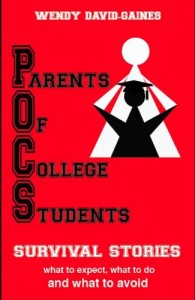
One of the joys of posting on this blog is that I get to recommend other college prep professionals. Over the course of the last few years, I have gotten to know Wendy David-Gaines (aka ParentsOfCollegeStudentMom). She offers some of the best college advice from the parent community. I’ve read her book, Parents of College Students: Survival Stories, and I’ve collaborated with her on blog posts. Not only is she a wonderful person, but her knowledge of the college-prep process and issues that occur once your student enters college is second to none.

college survivalWendy is famous for exposing the cliches about college. After giving the cliche, she gives you the “POCS reality”. In her book, Wendy does this effectively by compiling actual parent stories. The stories (both from pre-POCS and POCS) are simple, light-hearted, often humorous and an easy read. But here’s the clincher–they provide parents with added insight into each individual situtation. For instance, Wendy has a story about college touring in her book. The cliche: different strokes for different folks. The POCS Reality: just because a parent likes a college does not mean his student will. The story tells about the often-experienced reality of a college-bound teen not “feeling” a campus like his parent does. If you haven’t experienced it yet, you will.

Here are just a few comments from parents who have read her book:

“The cliches used in this story don’t seem like cliches anymore. The way David-Gaines reinterprets them makes these cliches into lessons that may otherwise be overlooked for parents who are about to send their children off to college. The short stories are quick, easy reads. I read the book through from beginning to end, but you could start with any particular chapter or even open to a random page for a good lesson and laugh. I recommend this as a fun, enjoyable, helpful read for parents who are starting or already involved in the college process.”

“Being the Parent of a College Student (POCS) is hard work and can be very frustrating. I felt like Wendy had been with me on my journey through the college admission’s maze. Her book is very entertaining and packed with lots of helpful information whether you are just starting the process or have a student in college. I thought I would skim through it, but I was hooked after the first story. I wholeheartedly recommend it!”

Wendy doesn’t stop with her book, however. She authors a blog on her website, and she also writes for Examiner.com on a regular basis. Do yourself a favor and check her out on Twitter (@pocsmom) as well because she tweets great information for both pre-POCS and POCS.

Get your copy of her book, Parent of College Students: Survival Stories today!