Category Archives: campus security

Wednesday’s Parent: Safety First


Wednesday’s child may be full of woe but Wednesday’s parent can substitute action for anxiety. Each Wednesday Wendy and I will provide parent tips to get and keep your student on the college track. It’s never too late or too early to start!

Wednesday’s Parent will give twice the info and double the blog posts on critical parenting issues by clicking on the link at the end of the article from www.pocsmom.com to www.parentingforcollege.com and vice versa.

This post is about how parents can convey the importance of academics to prepare their child for college:

____________________

Sign up for my FREE parent tips email and get my FREE Ebook on college financing!

safetyTeaching safety begins when your child begins to walk and touch things. “Watch out it’s hot!” “Be careful, you could hurt yourself.” “Look both ways before you cross the street.” When your kids go off to college you worry about their safety. Why? Because you won’t be there to protect them and see that they stay safe.

Apart from an act of random violence or the actions of a psychotic shooter, parents can train their kids through the stages of life to make wise choices to assure their safety when they leave for college. It’s never too late, or too early to start.

Avoid contact with strangers

This danger has taken on a whole new level with the advent of social media. Most kids know that they shouldn’t talk to strangers in real life; but have you taught them to avoid stranger contact online? It’s easy online for predators to build a relationship with a child and get them to trust them. Then, the next step is to coerce them to meet in person. Before your kid leaves for college, make it perfectly clear that this type of behavior is dangerous. Explain the dangers and use real stories if you must—it may seem harsh at first but until they see this is possible, they may not believe you.

Use the buddy system

Grade school, middle school, high school, and college—train your kids to use the buddy system. Teach them to never walk anywhere alone, go to a party alone, go to a mall alone, or anywhere they could potentially be unsafe. Remember Natalie Holloway? She might still be alive if she hadn’t broken this rule. This is a tough lesson to swallow and many adults don’t practice this safety tip. But in this world, being alone in any situation can put you in a place where danger is imminent.

Pay attention to your surroundings

Teach your kids to notice anything out of the ordinary. We all get that “gut” feeling when things just don’t seem right. They will know when something is amiss. Is there a car that doesn’t belong? Do they see someone that shouldn’t be where they are, like an adult hanging around a playground alone watching kids? Are there guys hanging around that make your daughters feel threatened? This one skill in itself could ensure their safety.

Follow the rules

We all teach our kids to follow the rules. It’s a basic tenant of growing up. Stand in line. Take your turn. Share with others. Do what your teacher tells you to do. When you hear the fire alarms walk calmly out of the building and stay with your teacher. But this learned safety tactic can also help them even more when they go to college. Rules are put in place to protect them on and off campus. If they learn this lesson early on they will carry it with them to college where their safety might be compromised.

Don’t make decisions that compromise your safety

Texting and driving have become a hot topic lately. When your teenager takes the wheel you nag and nag about not texting while driving. This is a decision that could cost them their life. Decisions become even more critical in college; especially in regards to drinking and driving, underage drinking, hooking up with strangers and walking around alone late at night. Making the wrong decision could mean the difference between having a good time, ending up in jail, or worse—dead. Scary stuff for parents. It should be just as scary for your kids.

Get help if you need it

Adults often overlook this simple lesson. But so many times, if we had just asked for help, outcomes might have been different. Teach your kids to always be comfortable asking for help. It won’t only translate well into all areas of their lives, but it will help assure they know to ask for help if they feel threatened or in danger.

With all the dangers in the world today, parents are even more concerned about the safety of their kids. If you teach them when they are young, they will carry those lessons with them to college.

Read POCSMom’s advice about putting safety first.
 

MIT got it right


If you’re a parent of a college-bound teen you’ve been watching the Boston Bombings and subsequent manhunt in “parental mode”. Quite simply, you are wondering in your student will be safe at college and what would happen if they are caught up in a similar situation at the college of their choice.

I can’t stress enough the importance of researching the college’s emergency procedures–before you sign on the dotted line accepting admission. The May 1 deadline is approaching so it bears repeating that colleges are responsible for your student’s safety and they should have policies in effect to protect your student while on campus.

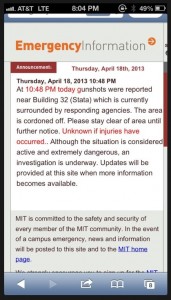
MIT got it right last week during the acts that occurred on their campus related to the Boston terror suspect manhunt. They have an emergency website dedicated to notifying the student body of imminent danger.

MIT Alert Page

MIT shooting

On this page you can sign up for email alerts and, more importantly, text alerts. Students always have their cellphones with them and this function should be available to all students on all campuses.

When the shooting of the MIT police officer occurred, administration immediately sent out an alert to students to stay away from the area. They also notified students there would be more updates to follow.

These 48 hours of tension among the Boston community and their heavy college student population serve to impress upon parents and students the importance of their college’s emergency notification system.

Heed this warning if you’re concerned about the safety of your college student. Do the research and find out what type of emergency procedures and guidelines are in effect. It will provide you with peace of mind and help you sleep a little easier at night.


Anxious moments after the Boston Marathon explosions


Parents all across the country watched and listened as the reports of explosions at the Boston Marathon began to flood the media. Since yesterday was a holiday in Boston, and for the colleges, students often attend the Red Sox game and/or the Boston Marathon. Almost immediately parents began to text and call their students who were attending college in Boston to check on their safety. The problem: cell service was immediately flooded with calls and eventually shut down to hinder any possible detonations using cellphones.

When I heard the news yesterday, I immediately posted on Facebook asking my Boston friends and family to check in–cellphone towers were down and I could not communicate with them. One of my Twitter contacts, @PreppedPolished (Alexis Avila) was running the marathon. I was receiving text updates of his progress but, of course, they stopped. I immediately posted on Twitter and Facebook asking anyone to let us know if they heard from him. Later that evening, he responded to my tweet that he was stopped at the 25 mile mark and his family and friends were safe.

Colleges used social media

Where did parents turn for immediate updates? Facebook and Twitter. Not long after the explosions, colleges took action using social media. Colleges began directing parents to their college websites where students could check in and parents could confirm their safety. Throughout the day, these colleges updated parents regarding the situations on campus and the measures that would be taken to secure the students’ safety. For many parents who could not connect with their students, this helped calm them until they made contact.

What can we learn?

This attack will evoke fear in the hearts of every parent whose student is attending college or preparing for college. But they should also gain comfort from the fact that the colleges in the Boston area had in place a plan to communicate with parents and ensure student safety. Colleges have emergency communication services in place for tragedies such as the terror attack at the Boston Marathon.

What should parents do?

Parents should know what systems are in place to contact them and notify students in the event of an emergency. “Like” the college’s Facebook page, follow the colleges on Twitter, and bookmark the college website. When visiting colleges, ask them about their emergency preparations and precautions, and ask about the methods they will use to communicate to parents and students.

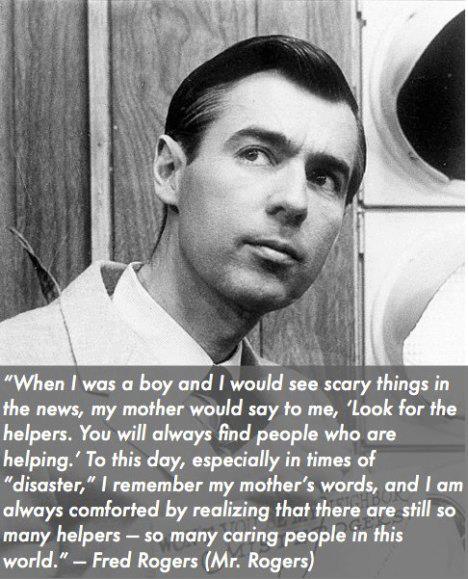
Tragedies like this tend to affect parents deeply. They worry about sending their kids off to college and being unable to protect them. But they can be comforted in knowing that even though there is evil in the world, there is also great compassion. I will close this post by posting a quote from Mr. Rogers that was circulating around Facebook yesterday that I saw on Kelly’s Facebook page ( @CollegeVisit):


mr. rogers quote


5 College safety tips for women


college safety for womenCollege can be an adventurous, validating and exiting time in a young woman’s life. Unfortunately, there are predators out there that put many of these young women’s innocence and lives in danger. According to statistics, college women are most in danger of being sexually assaulted or raped – up to 20% more likely. The numbers are staggering and college women are far more susceptible than other women in our society. While this is a sad and heartbreaking truth, there are a number of ways that women can stay safe and protect themselves. One of the best ways to do this is to be less vulnerable as possible and to be completely aware at all times. Here are 5 college safety tips for women.

  1. Always be prepared. It might be smart to take classes in self-defense. In many communities there are basic combat training programs that can teach a young woman what to do in the frightening instance that someone is trying to attack them. They will learn how to preform chokeholds, assault prevention tactics, and even learn how to use certain common items, like car keys as weapons. It might also be smart for young women to carry pepper stray in their purses.
  2. Always travel with one or two other people. If you are at a party, make sure to walk home with a friend or two. Or ask someone that you can trust to take you home, either by walking or by car. Most incidents of attacks and sexual assaults happen to women who are walking home at night, alone.
  3. Always be alert. If you are walking home alone and it is getting dark, be extremely aware of your surroundings. If you hear a sound or if you think someone is following you, immediately call the police or have your phone ready to dial 911. If you do get attacked, at least the police will be on the way to protect you and apprehend the suspect.
  4. Always keep an eye on your drink if you are out at a party or a bar. There are too many instances where a young college woman will be at a party, goes to the restroom and leaves her drink unattended. This can make you highly susceptible to a date rape scenario, because there are people just waiting to drug your drink in order to render you incapacitated. It can be extremely frightening for a young woman to wake up in completely unfamiliar surroundings and not know how she got there or if she has been taken advantage of. Go to a hospital immediately if this happens so that you don’t destroy evidence that can be used against your attacker and be sure to mention you have Florida health insurance or health insurance from any other state and you believe you have been attacked,
  5. Lastly, don’t ever be afraid to call the campus police to escort you back to your apartment or dorm room. It is always better to be completely safe, than sorry in the instance that you are out late and need to walk home in the dark. You’ll thank yourself when you are safe and sound in your room.

How universities are making emergency situations stress free for families

emergency response


Today it is perfectly normal for a parent to worry for the safety of their child in the classroom.  Tragically, it appears there is no safe place for a child, even in the grade school classroom.  It is natural for parents to be particularly concerned about the well being of their child once they send them off to receive a college education.  Universities are taking measures to deal with this, and are consciously forming plans for properly dealing with emergency situations.

Emergency Response Guides

Most universities provide their students with an emergency response guide.  This guide provides the student with emergency contact lists.  It also lays out the chain of command that is in place at the school to deal with emergencies.  It will make clear where information can be found during the event of an emergency.  It will give general outlines for how different types of emergencies will be dealt with.  For example, emergencies that are discussed may include the injury of a student, or a fire, chemical spill, disruptive riots or protests, natural disasters, or utility outages.

It is important for parents to familiarize themselves with the emergency response guides that are in place at the university their child will be attending.  This will ensure that there is a sound system in place in case of emergencies, and will also provide you with the information you will need in the event of an emergency.  Familiarizing yourself with the emergency response guides is a way to eliminate the anxiety and stress that can be caused by a fear of the worst possible situation.

Communication

Almost all universities follow three basic steps when dealing with an emergency.  These steps are preparedness, response, and recovery.  Universities have a formula in place that they will follow in the event of an emergency.  During the response, the disaster will be dealt with.  For example people will be rescued and the emergency will be put to an end, or endured until it naturally ends.  The response involves communicating with parents, the press and the general public.  Once the physical safety of the students is ensured, communication takes place.

This communication is particularly important to parents.  There is probably nothing more frightening than imagining knowing that your child is in the midst of an emergency but not begin able to communicate with them to find out how they are being affected.  Most universities will provide students and parents of students with telephone numbers that can be called in order to receive up to date information during the event of an emergency.  They will also provide parents with a web address that can be accessed online in order to find information.  Parents can also refer to Facebook and on campus text messaging systems to find information.

The Recovery step of dealing with an emergency on campus takes place after the emergency, and involves getting the daily functions of the university up and running again.

Weather

Although there is the chance of manmade emergencies, a major source of most emergencies that can strike during your child’s higher education is nature.  Some larger universities have received what is called a StormReady designation from the National Weather Service.  This means that weather is monitored on campus and that a hazardous weather plan is in place.

The weather is monitored 24 hours a day and the university is prepared to contact the students, parents and the public in advance of a major storm.  Parents that are looking to rest easy in regards to their child’s safety may prefer to send them to a university with the StormReady designation.

There is much that cannot be controlled during an emergency, but many universities are taking the steps they can to reassure families that they are prepared to deal with disasters in an efficient manner. These measures are being advanced and perfected through such studies as an Online Safety Degree.

More on campus safety

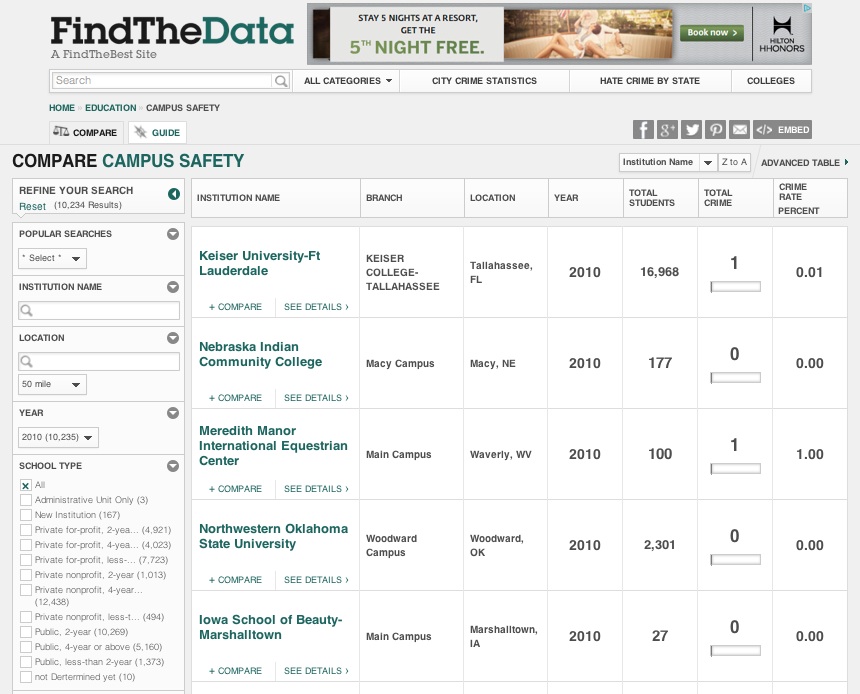
Regarding the last post on campus safety, FindTheData.com offers a free to use reference and comparison utility for parents and students.  You can use the search filters on the left to filter by institution name, location, school type, total students, total crime, and major individual crimes.  The individual crime filter lets you know how many reported cases of major crimes occurred in a given year, such as murder, forcible rape, aggravated assault, robbery, and burglary.

campus safety

However, it’s important to note that these are crimes that have been reported on campus.  It’s also useful knowing the crime rate statistics for the city that the college is located in as well.

Are you concerned about campus security?

UnknownAlthough the thought of your child attending college brings forth feelings of pride and anticipation, if they are going to be living on campus, it’s understandable why it may also evoke a certain amount of concern. We all have read the news stories of unfortunate crimes that have happened at various colleges and universities across the country prompting you to investigate the security and safety of your child’s prospective colleges.

As matter of fact, just this past January, the Huffington Post published an article that featured the “Top 10 safest colleges within the United States”. Some of the schools on that list included Southern University at New Orleans, Virginia Western Community College and Erkskin College and Seminary in Due West, South Carolina. However, if your child is planning to attend another school, thanks to the Office of Postsecondary Education of the U.S. Department of Education, there is something called the Campus Safety and Security Data Analysis Cutting Tool that provides up-to-date information on alleged criminal offenses that have been reported to campus security offices across the country (you can read more about this at Ope.Ed.Gov/security).

But, if you would like a checklist of things to inquire about as it relates to your child’s college campus and its level of security, we have provided you with five things that can help to put your mind at ease below:

Ask if there is 24-hour campus security. Every college campus has security officers and most of them have patrol cars, but not all of them necessarily have 24-hour security that is available should your child need to be escorted to their car or dorm room very late at night. Therefore, it’s important to not assume that there is this kind of assistance available. Make sure to ask.

Look to see if the campus is well-lit (at all times). Something as simple as a broken light in a parking lot or in an alley in between builds can lead to a criminal act. That’s why it’s vital that you tell your child to make sure that the campus is well-lit at night and if they see any broken lights to immediately report it to campus security or the administration.

Inquire about self-defense classes. One wonderful thing about college is that there tends to be classes for just about anything that your student can think of. So, encourage them to see if there are self-defense classes that are offered on campus and if so, let them know how smart it would be of them to take a few.

Mention Safe Place USA. There is a a great deal of petty theft that tends to happen on college campuses. While paying the cost of a home security system for a dorm room doesn’t make the most logical sense, there is an alternative. If your child needs a place to store expensive jewelry and other really valuable items, one option to consider is Safe Place USA. It’s a company that specializes in providing in-room safes for universities. (SafePlace-USA.com)

Ask if it is mandatory to wear student/staff IDs. Another thing that sometimes leads to criminal activity is when people who are not students or staff are hanging out, constantly, on campus. One way to determine who is supposed to be on the grounds and who is not is for students and staff to have their ID on their person at all times. It might seem a bit tedious to do, but if it can help to keep people safe by making everyone aware of who is entitled to be on campus and who is not.

Top 5 college safety tips for students

Unknown-1By the time you’re prepared to head off to college you are likely certain that your parents are merely overprotective. But they have experience, much of which they have probably declined to share with you, that makes them cautious. In many ways they may understand the world and its ills better than you can imagine. But you are young and eager, and you have many lessons to learn on your own. The unfortunate truth is that some will be unpleasant. However, there are precautions you can take on behalf of your own safety. After all, a failure to look out for your own best interest really only stands to hurt one person (that would be you).

Here are a few college safety tips that you should at least consider:

  1. Speak softly and carry a big stick. Teddy Roosevelt surely knew how to turn a phrase (although he attributed this one to a proverb). These days it has come to signify being prepared for any turn of events, having soft options (like negotiating) at your disposal, but being prepared to use harder ones (such as pepper spray) should the situation call for it. As a student on campus you need to be able to protect yourself from all manner of threats, from peer pressure or from a would-be attacker. So having a variety of tools at your disposal is essential, whether that means finding the words to stand up for yourself and what you know is right or whipping out some pepper spray to stave off an attack.
  2. Avoid open containers. Parties are part of the college experience, and since there’s little chance that you’re going to spend the next four years avoiding social interaction, you can at least set some safety ground rules for yourself. For one thing, you should always arrange for backup, meaning someone sober to drive you home and watch your back. Take turns with your friends being the designated driver. But even if you walk to and from parties to avoid the driving issue altogether, consider a hard and fast rule that entails shunning open containers. This protects you from having drugs unknowingly placed in your drink during a party.
  3. Use protection. Pepper spray is great to have on hand if you find yourself walking on campus alone at night (although you’re better off walking with a buddy). In addition, especially for young women, it’s important to know some simple defensive steps that will also help if confronted with an unexpected assailant.
  4. Get vaccinated. In some cases you don’t even have to come into direct contact with another student in order to contract a dangerous disease. Take the measles, pertussis (whooping cough), meningitis, or even the flu, for example. All of these illnesses are airborne, but there are also vaccines available that protect against them. So if you want to keep harmful germs at bay, make sure that you get all relevant vaccines before and during your time on campus.
  5. Don’t be a target. You no doubt want to be the life of the party, having at your disposal cool sayings, impressing everyone with your wit  and wisdom. But when you act foolish you could turn yourself into a target. Drinking too much at parties, walking alone at night, and posting your whereabouts and plans on Facebook for anyone to see could make you a target for all kinds of criminal activity, from personal harm to dorm room robbery. Exercise a little common sense and some self-preservation so that you don’t paint a target on yourself during your time in college.

Remember to use caution, restraint, and common sense while in college. During this time of independence it’s even more critical. Take care of yourself while you’re away and come home safely during breaks and after graduation.


Preparing for College: Safety First

In a few short weeks, your child is going away to college – either for the first time or another year. That reality brings with it an overwhelming number of emotions for most parents. Excitement for the new experiences they will have, but also worries for their safety and ability to thrive on their own. So many questions run though your mind as the countdown begins. Have you prepared your child for this big step? Will he or she be able to take care of themselves? Make the right choices? But most important of all, is your child safe? Thanks to the wonders of information technology, you can send your child to college with powerful safety tools that keep you connected no matter the miles between you.

Creating a virtual safety tool kit for your child’s Smartphone is a great way to take advantage of the latest information technology. It’s as easy as downloading a few key apps. One basic app that can be useful to your child in all kinds of situations is a simple flashlight app. Downloading this app, for example, can help your college student locate their keys before entering an apartment or dorm at night. More involved applications like the WebMD app, put tons of valuable health information at your child’s fingertips. WebMD allows you to document any conditions your child may have, such as any allergies; it lists nearby hospitals, pharmacies, and doctor’s offices and includes a first aid guide for emergencies.

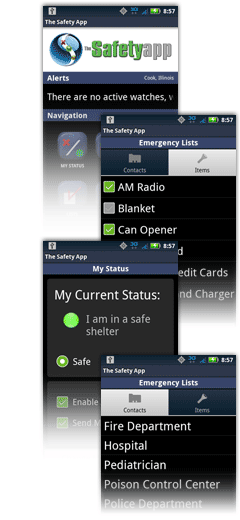
An all-in-one emergency response app can be beneficial to your child’s safety too. Apps like The Safety App Plus allow parents to request the safety status of their college student, giving them an instant visual update of their child’s current or last known address. The app also helps you to prepare your child for weather emergencies, by providing real-time emergency weather alerts. Its patented technology allows The Safety App Plus to send and receive text messages even when voice and data networks are overwhelmed which is common during disasters and emergencies.

The Safety App Plus can be used by both you and your college student to…

  • Request a safety status, automatically supplying you with the GPS location of your college student or of a lost or stolen phone.
  • Access real-time emergency weather alerts, a checklist of emergency supplies and important online resources while on a road trip.
  • Send group or individual messages when data and voice networks are overwhelmed, such as during large campus events or disasters.

As an incentive for more families to benefit from the robust features of The Safety App Plus and in observation of National Preparedness Month, the app is now only $0.99.

Sending your child away to college doesn’t have to be wrought with worry for you or your child. With the right tools, you can stay connected and help them stay informed and prepared in the event of a weather or other emergency. For more information on The Safety App Plus visit www.thesafetyapp.com or follow them on twitter @thesafetyapp.

____________

Today’s guest post was contributed by Lisa Barclay DiBenedetto, the president and founder of LDB communications, a successful marketing company. Lisa is the mother of four children, the oldest of whom is a junior at Northern Illinois University. Keeping her family safe has always been a priority, as well as spending as much time with her teenage children as they will allow.  

School shootings–What’s a parent to do?

Police officers investigate the scene of a shooting near Texas A&M University on Monday in College Station, Texas

I just got a news update on my iPhone saying that police had shot and killed a gunman at Texas A&M University this afternoon. The details are sketchy right now but it made me think about the importance of campus alert systems and some of the questions parents need to ask during the selection process.

Texas A&M responded quickly:

Texas A&M issued a Code Maroon — the university’s emergency notification system — at 12:29 p.m. CT (1:29 p.m. ET), telling people to avoid the area where there was a report of an “active shooter.” The entire ordeal lasted around 15 minutes, with an 12:44 p.m. update also posted on the university’s website indicating the alleged gunman was by then “in custody.”

Every parent of college-bound teens should ask this question during the campus visit (preferably not in the presence of your student):

What systems do you have in place to protect my child in the event of an emergency such as the Virginia Tech shooting?

The American Council on Education published a list of questions school leaders should ask themsleves. Parents should expect answers to these questions when discussing this issue with campus security:

  1. Has the school done a full assessment of potential catastrophic risks, and does it have plans in place to address these risks?
  2. Does the school have an appropriate emergency team in place? Do team members regularly participate in emergency preparedness exercises?
  3. Does the school have multiple means to communicate with students, faculty, and visitors in the event of an immediate, ongoing emergency situation? Do plans exist to direct people to a safe location?
  4. What communication and coordination networks exist among campus security leadership, local law enforcement, political officials, first responders, and health officials, both on an ongoing basis and in case of emergency? Is there a specific integrated emergency response plan? Do all the agencies who might be involved in emergency run drills on campus to prepare?
  5. Is the training of campus security personnel appropriate to potential risks?

The president of Virginia Tech also mandated several internal reviews following the VT tragedy to evaluate the school’s existing emergency plan. The review committees’ recommendations included the following (things you should expect from your own school’s emergency plan):

  1. Classroom door locks that are modified.
  2. Video surveillance cameras, centrally located and monitored.
  3. Electronic key cards for controlled access to facilities.
  4. Mass communication outlets (e.g., phones and Internet access) within classrooms.
  5. Frequent emergency drills.
  6. Emergency response protocol with awareness education.
  7. Campus security committee and master plan.

Before sending your child off to college, do your homework. Make sure that if something bad does happen, the incident and the students get the attention they deserve. If you know the plan and have assurance that the college has implemented specific procedures to facilitate it, you will worry less and sleep better at night.

More on campus safety:

 6 Talking Points on Campus Safety

Prepping your college-bound student in campus safety