Category Archives: campus security

When a School Shooting Hits Home

school shooting

When news breaks about a school shooting on a college campus, it lands differently for families. Even if the incident occurs far from home, it can feel uncomfortably close, especially for parents with teens who are already in college or preparing to go.

The recent shooting at Brown University forces many families to confront a painful reality: college campuses, once widely viewed as safe and sheltered environments, are not immune to violence. For parents and students alike, the emotional impact can be immediate and overwhelming.

Continue reading When a School Shooting Hits Home

When College Feels Less Safe: What Parents Are Worried About After the Charlie Kirk Tragedy

charlie kirk

On September 10, 2025, conservative activist Charlie Kirk was shot at a public event on the campus of Utah Valley University. The suspect reportedly fired from a rooftop, striking him in the neck during an outdoor speech attended by thousands.

For many parents, this event has stirred deep fears about what safety means in higher education today. Below are some of the main concerns parents are grappling with — and what they might do in response.

Continue reading When College Feels Less Safe: What Parents Are Worried About After the Charlie Kirk Tragedy

Lock Socket®: Keep Track of Your Student’s Charging Chords

Whenever I come across a product or service that I think will help students and/or their parents, I like to share it. Check out Lock Socket® if you have a student heading to college or your high school student keeps losing their charging chord!

lock socket®

Lock Socket® has introduced its patent-pending phone charger and cable lock that provides a creative solution for a common problem. Keeping track of a smartphone or tablet charger and cable can be an arduous task, especially in high-traffic areas. Lock Socket® charger locks are designed to fit factory provided chargers and keep them in place in outlets where they belong.

Continue reading Lock Socket®: Keep Track of Your Student’s Charging Chords

Keeping Your Student’s Valuables Safe

valuables safeMove-in day is approaching and students are deciding which items to take to college and which should be left behind. Knowing the nature of a college dorm room, students are hesitant to  take anything valuable with them to college. Even with supposed secure dorm entrances and locks on doors, most students do not take advantage of these safeguards.

Students allow other students to enter dorms without a key card and often leave their doors open or unlocked when going to class or other campus activities. No matter how conscientious your student is, they can’t count on a roommate to follow the same guidelines. Laptops, expensive textbooks, iPhones and other electronics are easily stolen in an instant if left unattended or secured.

This genius invention from a parent who met their student’s need is a must-have for any college student. It’s easily assembled by the student and it’s affordable–worth every penny you will spend. Watch the video below to see how it works and click the order button afterwards. Your student will love how easily it’s assembled and how it doubles as a computer stand, charging station and night stand while keeping valuables safe.

Keep Your College Valuables Safe With This Genius Parent Invention

I can’t tell you how excited I am to share this great invention from the parent of a college student. Sometimes necessity becomes the mother of invention. And that’s just what happened with this student and her father.

If you are sending your child to college this fall or in the near future, this investment can save you money and heartache over the next four years by keeping your student’s college valuables safe. Read their story and get yourself a BunkTrunk today!

________________________________

When our daughter went off to college in the fall of 2015, we were excited for her and she was ready to begin the next chapter in her life. While there are many things that are “known” with respect to the college experience, there are also many “unknowns.”

It turns out, that one of the “unknowns” was the genesis of an idea that led to the start of a small business. It turned out that our daughter had a roommate that grew up not having a need to lock, or even close doors. So when she moved into my daughters dorm room there was some immediate tension.  My daughter was worried about losing her laptop or some of her expensive textbooks, because so many times she would come back to an opened or unlocked dorm room.

After trying to remedy the situation with her roommate and several calls home to express her frustration, I decided she needed a secure storage solution. Since we’re dealing with an 18 year old who’s just moved away for the first time I realized any viable solution would have the following requirements:

  • It had to be easy to use or it wouldn’t be use
  • It had to be big enough for her laptop and some of her expensive textbooks
  • It would be a bonus if she could put her purse, medication, and jewelry in it
  • It could not take any desk space or floor space, because she had none to spare
  • It could not be ugly because, lets face it, that just would not fly for a girls’ dorm room
  • It could not require screws or bolts or other types of fasteners, because the college would not allow anything but command strips for hanging, mounting, or attaching anything to college property / furniture

So, after scratching my head for a while, I realized the best option for locating a storage device was the space above her bed (she was on the top bunk) and the BunkTrunk was born.

After a few revisions, driven by our experience with early prototypes, we finalized a design (see picture below) that met all the requirements and provided additional value.

With her laptop and phone locked up while charging inside, she was feeling much better about her dorm situation. She also had room to lockup her expensive textbooks, purse, medication, jewelry and more. But, with the door to her BunkTrunk opened, it also made a great work surface.  So when she needed to study late into the night, and didn’t want to bother her roommate by studying at her desk with the light on, she could now study on her bed.

Because she was on the top bunk, she didn’t have a nightstand next to her bed and the BunkTrunk makes a pretty good nightstand.

So we went from:

  • Fall 2015 – “Dad, I have a problem” & first prototype created
  • Winter 2015 – Provisional patent filed, design finalized and website goes live
  • Spring 2016 – a new small business is started
  • Summer 2016 – Patent filed and BunkTrunks shipped to over 20 colleges

We are now in our second year and expect to ship between 200 and 300 BunkTrunks.

August 2016 marked another milestone for us, as we filed our patent with the U.S. Patent Office.

And there you have it! Necessity is indeed the mother of invention, and in our case, led to a new small business too! Who knew…

If your college student is experiencing similar frustrations, have them check out the BunkTrunk.

Scholarships That Pay All Your College Expenses

scholarships

Everyone wants a free ride for college. Unfortunately, it’s not that easy. Even athletic scholarships rarely provide students with a full ride for athletes.

Scholarships that pay all college expenses are available, however, if you know where to look. Here are four ways your student can win enough scholarship money to pay for all their college expenses.

Colleges with merit-aid

Good grades, good test scores, a stellar volunteer record and essay, can mean thousands of dollars in merit aid from the college. If your student is applying to one of the colleges on this list, he or she could score enough money to pay for all their college expenses.

Merit Aid Scholarship Directory

Colleges with great scholarships for National Merit finalists

The PSAT is one way to win a full-ride scholarships. If your student is a National Merit finalist (which isn’t that difficult with a little preparation), he or she would be offered a full-ride scholarship and more. Here’s a list of colleges that offer scholarships to National Merit finalists.

Colleges With Scholarships for National Merit Finalists

Colleges with full-ride scholarships

Full-ride scholarships are offered to the students who are at the top of the applicant pool. The bar is set pretty high, but if your student is one of them, they could score a scholarship that pays all their college expenses. How does your student get to the top of the applicant pool? Apply to colleges where their SAT scores and GPA are higher than other students. This list will help you find those schools.

Comprehensive List of Full-Ride Scholarships

Winning multiple outside  scholarships

If your student works hard at applying for scholarships, it’s entirely possible to win enough scholarship money to pay for all their college expenses. Monica Matthew’s son, with her help, won $100,000 in scholarships. If you want to know how she did it, read her story and while you are there, purchase her simple how-to guide.

Finding and winning full-ride scholarships can be done. But it takes some effort: searching for the right colleges, doing the work in school, and applying for scholarships.

What Parents Need to Know About Campus Security

campus security
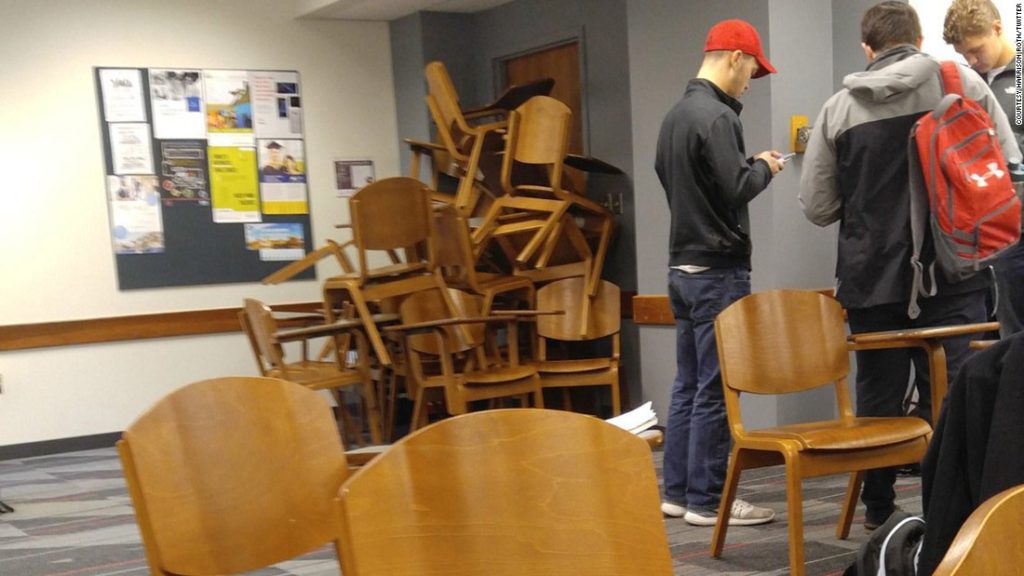
photo provided by CNN

It happened again yesterday. Our college students were face-to-face with someone who wanted to do them harm. Ohio State responded quickly and forcefully by stopping the perpetrator and avoiding student fatalities.

At 9:55 a.m., the school sent out a campus alert reporting an active shooter incident.

“Buckeye Alert: Active Shooter on campus. Run Hide Fight. Watts Hall. 19th and College,” Ohio State Emergency Management tweeted at 9:56 a.m.

“Run, hide, fight” is a safety protocol for active shooter situations promoted by the Department of Homeland Security and other law enforcement agencies. It offers a plan of action for those who find themselves in the midst of a mass shooting: Your first defense should be to evacuate if possible. If not, the next course of action is to find a safe place to hide and stay out of view in silence. As a last resort “and only when your life is in imminent danger,” says DHS, you should take steps to incapacitate the shooter and “act with physical aggression.”

In an article posted by CNN, Ohio State President Dr. Michael Drake and others credited the school’s active shooter training and the campus alert system for helping the community maintain order while the scene was secured.

What should you know about your student’s prospective college in regard to campus security?

Not only are colleges running practice scenarios with campus police, colleges all across the country are training students for this type of threat. Ohio State students used that training yesterday morning. Some piled desks and chairs up against doors in classrooms. Others barricaded themselves in bathrooms and dorms.

Your student may not be concerned about this type of scenario but every parent today knows this is a possibility. It’s up to you to ask those tough questions during campus visits (preferably away from your student’s ears).

The American Council on Education published a list of questions parents can ask when discussing this issue with campus security:

  • Has the school done a full assessment of potential catastrophic risks, and does it have plans in place to address these risks?
  • Does the school have an appropriate emergency team in place? Do team members regularly participate in emergency preparedness exercises?
  • Does the school have multiple means to communicate with students, faculty, and visitors in the event of an immediate, ongoing emergency situation? Do plans exist to direct people to a safe location?
  • What communication and coordination networks exist among campus security leadership, local law enforcement, political officials, first responders, and health officials, both on an ongoing basis and in case of emergency? Is there a specific integrated emergency response plan? Do all the agencies who might be involved in emergency run drills on campus to prepare?
  • Is the training of campus security personnel appropriate to potential risks?

How should you discuss campus security with your student?

Discuss the importance of contacting you in the event of this type of action. Don’t, under any circumstances, call your student to check on him. A phone ringing can alert an attacker to his whereabouts if he is hiding.

The purpose is not to scare your student, but equip him with the information and the tools he needs to be calm during this type of scenario. In an article I wrote for Smart College Visit, I outlined three steps you should take as a parent to prepare your student:

1st-Arm your student with apps to help him get in touch with help if needed: MyForce (for iPhone, and Android) and OnWatch (for iPhone and Adroid).

2nd-Make use of cellphones. Suggest using social media or texting. Remind him to immediately turn his phone to silent/vibrate and keep it in hand to view updates from campus security while the threat is in place.

3rd-View this video from the Center of Personal Protection and Safety together with your student.

Before sending your child off to college, do your homework. Make sure that if something bad does happen, the incident and the students get the attention they deserve. If you know the plan and have assurance that the college has implemented specific procedures to facilitate it, you will worry less and sleep better at night.

Wednesday’s Parent: The Safety Formula in College Prep


safetyCollege prep not only entails the typical kinds of prep: college applications, scholarship searches, test prep, essay prep and financial aid; but it should also include safety preparation. When you talk about safety, parents cringe. Their biggest fear in sending their student off to college is the concern that they will be safe away from their constant supervision. But keeping your student safe personally is just part of the equation.

Wendy David-Gaines, the Long Island College Prep Examiner and POCSMom, has this advice:

Concern about safety comes with the parenting territory. For parents of the college-bound, the word safety encompasses both the physical and the financial varieties. Fortunately, the following safety tips for the former also apply to the latter, making it easier to teach.

It makes perfect sense to prepare your students for the ramifications of financial irresponsibility and physical threats. Before they leave for college, have discussions about the topics listed below and set your mind at ease about their safety.

Physical and financial college prep safety pointers

For more information on safety concerns, read these posts: Top 5 Posts about Parent Safety, 6 Safety Apps for Students, and Preparing for College: Safety First.


6 Safety Apps for Students


safety appsIt’s sad that we live in a time when we don’t feel safe at school. Schools used to be the safest place for kids, protected by teachers and staff and away from predators. Not anymore. As evidenced by the recent school shootings in Oregon and Washington, and the frightening Virginia Tech massacre, parents are naturally concerned about sending their kids off to college. And it’s not just college, the Newton shootings and the Columbine shootings make it clear that kids of all ages are at risk.

Today’s App Tuesday post addresses the need for safety apps. A pay phone or flagging down a police officer used to be our only defense against dangerous criminals and psychotic shooters like the gunman on the University of Texas campus years ago. But today, students are armed with a valuable weapon: their smartphone with safety apps—giving them instant access to authorities, parents and other students.

Following are six safety apps you should arm your students with during high school and college:

1. Guardly

Students can instantaneously connect with friends and family in emergencies with Guardly. With a few taps, users can dial for help or send out an alert. Triggering an alert enables real-time location tracking. Students can also capture and send photos to mobile contacts or authorities in non-threatening emergencies. On the app’s map, users can see which friends and family members are nearby. Another in-app defense lets students sound off a blaring siren to “deter would-be attackers” and “signal for help.”

Price: Free iOS, Android and Blackberry app with $1.99 monthly subscription or $19.99 one-year subscription. App comes with a few free features.

2. Circle of 6

The Circle of 6 app is designed to help college students out of potentially dangerous situations. On the app, users should connect the phone numbers of up to six close friends. These should be classmates, roommates or trusted individuals in the area. In uncomfortable situations, users can safely and discreetly send a mass message for help. By pressing the car icon, users send out a text complete with your current GPS location. Your safety network will get your message and pick you up. Tapping the phone icon will send out a message that says, “Call and pretend you need me. I need an interruption,” to the six preset numbers. For true emergencies, students can call 911 from within the app. The app’s chat icon links users to information online about healthy relationships.

Price: Free iPhone and Android app

3. MyForce

When you’re walking home at night or crossing a desolate part of campus by yourself, just pull out the MyForce app in case of emergencies. By hitting the app’s bright red button, you’ll trigger a discreet alarm. Once the alert is triggered, MyForce will start recording your call and pinpoint your present location. The monitoring operator who you connect with will determine it’s an emergency and call 911. Your emergency contacts will also be alerted.

Price: Free iPhone, Android and Blackberry smartphone app (with monthly subscription)

4. OnWatch

This personal safety app lets college students alert friends and authorities immediately in emergencies. There are six app functions: calling 911 and friends, calling 911 only, calling campus police, the “Watch my Back” setting (timed alert that must be disabled with passcode), contacting friends, and the “I’m here” setting. When you walk home and want to let friends or family know you’ve arrived safely, the “I’m here” setting does just that. The “I’m Here” text, call 911 only and call campus police functions are free with the app. The emergency friends, flashlight and alarm functions are available for a $2.99 fee. The complete package is available for $4.99 a month.

Price: Free iPhone and Android

5. Watch Over Me

Watch Over Me is a personal safety app designed to help look out for you when you need it the most. The app automatically turns your iPhone into a powerful personal safety device for daily use. If you’ve ever called a friend while feeling unsafe, this is the app for you. Whether you’re going for a run, walking to your car, walking home, taking a cab, or meeting someone for the first time, all you have to do is let Watch Over Me know and it’ll watch over you via GPS throughout your journey. If you fail to check-in safely once you’re done, Watch Over Me will alert your emergency contact list immediately and provide them with your location on a map. Subscriptions are available to enhance the app.

Price: Free iPhone and Android

6. OnCall Defender

Advanced Mobile Protection (AMP) cares about safety and prevention. The app delivers 24-hour personal security and medical assistance coverage at your finger tips. You can download the app for free and choose the subscription plan that’s best for you. The subscription is $19.99 a month. However, a special promotional offer is available to save over 40% on the year subscription if you choose to pay in advance.

Price: iPhone with subscription

 

Campus safety tips for new students on campus


campus safetyCollege students have enough to think about as they set off on the road to higher education. However, in addition to classes and socializing, students have to think about all aspects of their safety. This includes physical safety as well as other forms of security. College students can take a few proactive steps to help reduce the chances that they will fall victim to a crime by following these campus safety tips.

Learn About Campus Security

One of the first things college students need to do is find out about what types of services campus security offers. For instance, some security services may include escort services during the evening while some campuses even provide safe ride services. Of course, knowing when campus security patrols the area can also help when making plans to leave and enter various areas of campus that appear less safe than others. This can also help with getting access to buildings after hours for those who work with student functions.

Many campuses will also include other services such as sending student alerts to crimes in the area. Many may send alerts to email addresses, but some allow students to receive text messages for more immediate alerts. It is also a good idea to find out if campus security has a social media presence on sites such as Twitter or Facebook as well as a mobile app that can keep students updated on campus issues.

Learn the Campus

Learning about campus security also means learning about the campus itself. Most larger campuses take many steps to ensure the safety of students. For instance, many include lighted pathways for students. It is also a good idea to learn layouts within buildings to check for emergency exits in case of fire and other emergencies that can occur at unexpected moments.

Protect the Digital Footprint

These days, it is also very important for students to protect themselves online. Many people use online platforms such as social media to harass and stalk others because they believe they are anonymous. Unfortunately, many times the authorities will not act on such instances until they have reached advanced stages, so students need to be careful about how much and what kind of information they share about themselves online.

Students also need to protect themselves in other ways when it comes to using their online technology. Information can be stolen from laptops, smartphones and other mobile devices, so students should lock them and secure them in other ways so that unauthorized persons cannot steal their personal information. This also means protecting passwords by changing them every once in a while and making sure they are not obvious passwords such as the names of pets, family members or friends.

Be Proactive

Of course, students can also take a few proactive steps to help prevent them from falling victim to a crime. Students should plan accordingly when they know they will be on campus late so that they can make arrangements and have someone walk with them back to dorms or apartments. They should also make sure cell phones or smartphones are charged and have emergency numbers programmed into them in case of an emergency.

While it is important to focus on the educational aspects of the college experience, it is also very important to make sure college students keep themselves safe during their tenure. Students need to know how to navigate their way around campus. They also need to know what types of help they can expect from campus security resources. These days, students also need to know how to protect themselves online to prevent a number of cyber crimes including harassment and identity theft.

__________________________

Author Bio

Sarah Daren is a writer who creates informative articles relating to the field of health. In this article, she offers safety tips to new university students and aims to encourage further study with an Emergency Management Masters Degree.