Category Archives: admissions

The Top 3 Mistakes Students Make on the Common App


common appWe are in the midst of the application season, probably one of the most stressful, scary, and overwhelming times for most teenagers and their parents. I want to share with you the top three mistakes students make on the Common Application and how you can make sure your children don’t make them and get into the colleges of their dreams. 

1. Not Telling Their Unique, Compelling Story

Schools are looking for well-rounded student bodies NOT well-rounded students. The admissions committee and anyone else should be able to read through your child’s application and get a sense of exactly who they are and what they care about. This doesn’t happen if your child is president of every club, plays every sport, and volunteers at 20 different organizations.  Your child’s application should focus on depth not breadth, quality over quantity. Don’t just take my word for it. This is what Harvard has to say about your child’s activities:

We are much more interested in the quality of students’ activities than their quantity so do not feel you need to fill in the entire grid! Contributions students make to the well-being of their secondary schools, communities and families are of great interest to us.

Everything from the activities to honors to courses to essays should come together and tell your child’s unique, compelling story. Getting an outsider’s look at your child’s complete application can really help with this.

2. Underselling Their Activities

I’ve seen students do it over and over again. The activities are seen as an afterthought, and students give very little attention to them. They also tend to underestimate the time spent on their activities. This is where your child sets themselves apart from all the other high test score, high GPA students. This is where they become “that girl” or “that guy” – the socially responsible athlete, the engineer who cares about social justice, the piano player who wants to help autistic kids. 

Students are only allowed 150 characters to describe each activity, so the descriptions need to be compelling and concise. All of the tips that apply to resumes apply to this activity list. Your child needs to focus on numbers, like the number of new members they brought into the club, the amount of money they earned/got donated/managed, the number of participants at their events. Make sure they put numbers in every description. If the honors they listed previously were associated with an activity, be sure they tie that back in. The activities should sound as impressive as possible. One tip I absolutely love for this section is to include a website for the activity if there is one.

3. Rushing Through the Supplements

Each college has questions and many of them require writing supplements. These are just as important as the Common Application itself. Students often leave this until the end and struggle with it. Make sure your child spends as much time on and with their supplements as they do with the rest of their application.

Many writing supplements ask “Why School X?”. One tip I give all the students I work with is to mention specific activities, programs, and professors at the school that they’re excited to work with and be involved in. Remember, what the supplements are really asking is why your child should be admitted to that particular college. Make sure their application and supplements describe how they will contribute to the school and its legacy. 

Now that you know the top three mistakes students make on their Common Apps, you can help your child avoid them and get into their dream college. Get my Ultimate Guide to the Common App plus worksheets and tools to help your child create their best application and my favorite college admissions resources and websites. All totally FREE!

_______________________

Today’s guest post is from Jessica Yeager, a grad of Harvard and MIT, and a tutor and college coach for high-achieving students and their parents at Impress the Ivies. You can get her Ultimate Guide to the Common App for free.


Live Admissions Chat Sponsored by University Parent


live admissions chat

Wednesday, Oct. 28 at 7 p.m. Eastern Time

Join University Parent as they ask the experts at Admissionado your parent questions during a live admissions chat. They will cover topics for parents of current seniors, as well as those earlier in the college preparation process.

The chat will take place on Google Hangouts on Air. The livestream will be embedded on this page, or you may access it here. They will also post the conversation here after the event. Ask a question, meet the contributors, or watch the livestream.

Don’t miss this informative conversation with admissions experts and don’t forget to add your question for them to answer during the chat.

Helping Your Student Make the College Decision


making the college decision

The College application season has begun. Students are now feeling the pressure of the college weight on their shoulders, as their future planning starts becoming a reality. But for parents, this may also be an even more stressful time. As a parent, how are you supposed to increase your child’s chances of getting into their top school, and, after that, how will you afford to help pay for the skyrocketing costs of planning and attending a University? I’ve outlined a few key tips that will elevate your child’s application, help you make the college decision and some tips on how you can save costs.

1. College Visits

  • If you are serious about getting your child into their top school, a college visit is a must. College visits provide students with the opportunity to explore the campus and get a feel for the atmosphere they’ll be entering, and it sometimes offers the chance to interact with students and faculty members. However, the cost of college campuses will add up, so it may behoove families to take advantage of guided virtual reality tours, like those offered by SchooLinks; which hosts tours of over 600 high-ranked colleges, including Harvard, Stanford, UCLA, and more.

2. Connect with Admission Officers

  • This may seem intuitive, but there are countless families who think a college visit is enough. It is important to get in front of an admissions officer if you plan to visit a college campus. Book an appointment with an admissions officer to show that you are interested in attending the college, and ask questions regarding the applications, school, etc. to show your continued interest in the school. You may not always have the time to meet with multiple admissions officers in person, but you can reach them via email or on SchooLinks where students can connect and interact with School Admission Officers.

3. Financial Aid

  • As I mentioned before, getting into a college may seem stressful, but figuring out how you will afford to pay for college is an even bigger headache. The go-to solution for financial aid is filling out the FAFSA form or searching for scholarships, but even when searching for scholarships, students often overlook many scholarships they may be eligible for. Parents should urge their students to start applying to scholarships early on, as early as 9th grade. My best advice for winning scholarships is to apply to multiple small scholarships, amounting to awards of $250-$500. Those scholarships normally have a lower number of applicants are yield a greater chance of winning. For an easy scholarship entry, parents can have their children enter the SchooLinks $5000 Scholarship, which has no application or essay requirement.

__________________________________

Today’s guest post was provided by SchooLinks, an online free resource to help parents and students organize and plan college application submissions as well as scholarship applications. Students can connect with School Admission Officers, view guided virtual reality tours, or receive help from consultants. Upon joining, students should fill out their profiles completely, with all of their personal and academic information, in order to provide schools with all the important information they require. This will also allow SchooLinks determine which scholarship students are eligible, which makes the list of scholarships to research much more narrow. To get started, create a profile today!

Preparing Your Teen for College: Finding the Balance Between Well-Rounded and Burnt Out


Today’s guest post is from Ryan Hickey, the Managing Editor of Peterson’s & EssayEdge and is an expert in many aspects of college, graduate, and professional admissions.

______________________________________________________________________

preparing your teen for collegeIt may seem like everyone you know is boasting about how their child effortlessly juggles advanced classes with guitar lessons, volunteering at the senior home, and learning Cantonese. It’s enough to give you a complex about whether or not your teen can even compete when applying for colleges. 

Well, fear not. Here are five things you can do to ensure your own student’s trajectory is on the fast track toward college acceptance while preparing your teen for college.

1. It’s okay to put all your eggs in one or two baskets.

The Rushmore syndrome of encouraging your child to join every club in sight results in a student that seems like a jack of all trades and master of none. Admissions committees are no longer fooled by a student who suddenly seems to be interested in 30 different projects the summer before junior year. Instead, focus on your child’s specific interest and let them actually achieve a level of proficiency. It is much more important to demonstrate genuine skill and commitment. Also, it often leads to a solid topic for an application essay.

2. Leadership is better than variety.

On a similar note, by applying meaningfully to just one or two extracurricular projects, a student can begin to build a level of responsibility. This kind of maturity is something colleges particularly look for in applicants.

3. Looking for something to add fast? Volunteer!

Community service is not only a great way to help others, it can help your teen too. If you feel like something is missing in your child’s transcript, volunteering can be a low-level commitment addition. Also, it is generally relatively easy to gain a leadership position quickly in a volunteer setting just by showing some initiative.

4. What are you going to do with your life?

Specific career goals post-graduation can differentiate your child from other applicants. Make sure you have a conversation about this and keep in mind that this goal is not something that goes on any permanent record. The larger idea of presenting oneself as forward-thinking in an application gives your teen the desirable aura of confidence in their direction. Maybe your daughter wants to be a veterinarian—check to see if it’s possible for her to shadow a local vet. Again, it’s not imperative that he or she actually adheres to this once they get into college, put admissions committees like to see that kind of drive.

5. Be true to your school

A great way to stand out in your applications is to know exactly what you want in a university. One important metric that colleges use to compare to each other is called “yield ratio”—that’s the number of students that accept admission after it is offered. Schools like to feel wanted, and therefore one of the best ways to prepare your teen is to help identify exactly what he or she is looking for in a school and then narrow down choices to ideal places. This requires a little research and some tough decisions. It also means trying to make an official visit, if possible.

Don’t feel tempted to nudge your student into another program just because it might look good on a transcript. Like everything else, honesty is the best policy. It all boils down to specifics. If your child can demonstrate commitment and leadership in one subject that makes them focus on a future academic goal that can be linked to a particular university program, that is superlative application fodder. No need to know a word of Cantonese.


About the Author

Ryan Hickey is the Managing Editor of Peterson’s & EssayEdge and is an expert in many aspects of college, graduate, and professional admissions. A graduate of Yale University, Ryan has worked in various admissions capacities for nearly a decade, including writing test-prep material for the SAT, AP exams, and TOEFL, editing essays and personal statements, and consulting directly with applicants.


Wednesday’s Parent: A Quick Look at the Updated College Scorecard


college scorecard


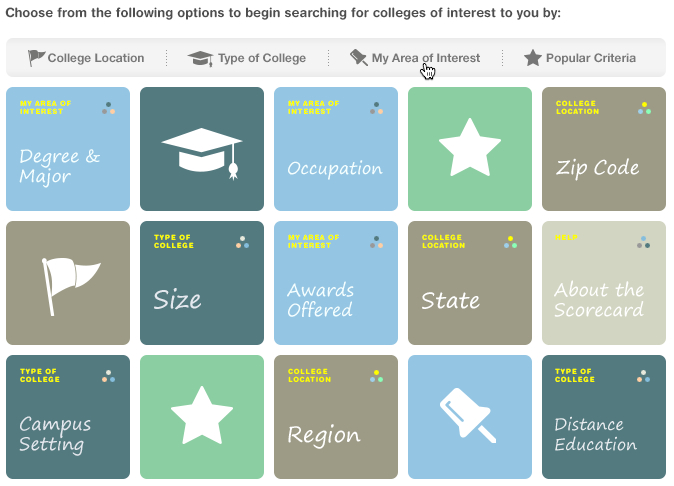
This past Saturday, President Obama unveiled his new College Scorecard. “You’ll be able to see how much each school’s graduates earn, how much debt they graduate with, and what percentage of a school’s students can pay back their loans,” the president said in his weekly address.

College Prep Expert and Long Island College Prep Examiner, Wendy David-Gaines, explains how the scorecard works:

Information about the performance of U.S. institutions was collected from over 7,000 colleges and universities over a period of 18 years. In addition to families using the College Scorecard to personalize their own college ranking list, the national and comprehensive data can be used by policymakers and researchers for their own analysis. “The old way of assessing college choices relied on static ratings lists compiled by someone who was deciding what value to place on different factors. The new way of assessing college choices, with the help of technology and open data, makes it possible for anyone – a student, a school, a policymaker, or a researcher – to decide what factors to evaluate,” according to the White House Fact Sheet.

Parents and students can use the scorecard to make more informed, wise decisions about the ROI of a college education. For further information on the college scorecard, read:

College scorecard revamp heavy on outcomes


Tips for Dads of the College-Bound


tips for dadsWith all the advice for moms, one of my Twitter followers (@PeachtreeCP) chimed in: “What about tips for dads?” I had to respond, “I’m not a dad, so I can’t speak for them.” But, it occurred to me that I did know some dads, one in particular, my brother. Both his children went to college. His daughter had a relatively typical college experience. His son, on the other hand, always marched, and still does, to the beat of a different drummer.

When I asked my brother to share his best advice, man to man, he graciously agreed to help. Here’s his response, word for word:

I’m not sure where to begin.  I assume that the dad who wrote you wanted advice about the college process.  I guess I’ll just share how I approached this with Cameron.  Since he’s not the typical kid, my approach was unique to him.  But this is how I did it.

  • I gave guidance, but didn’t try to push him into my expectations for him
  • I stressed the importance of education while he was thinking about what to do after high school
  • I tried to show him how his interests (video production, photography, etc.) would be greatly enhanced by more education
  • I gave him permission to make mistakes and take his time in determining his major
  • I didn’t give him a completely free ride to college – we required that he have some investment
  • I encouraged him to get a job while going to school
  • I encouraged him not to get into debt with loans, but to pay as he could, semester by semester
  • I finally recognized that college may not be his thing, so I gave him permission to say, “I want to do something else”, then I gave him my blessing

In retrospect, I think we could have done a better job of setting him up for a better first year away at college.  We found a garage apartment for him to live in, but he lived alone.  I think it would have been a better experience for him if he had other roommates going through the same struggles at college.

_______________________

Cameron chose to get a “real life” education, self-taught on the entrepreneurial route. It has not been an easy path, but he has certainly discovered his strengths and weaknesses while learning much about himself through self-discovery. He’s working at a job in a field he loves: video production.

For all you dads out there, the key here, according to my brother, is to know your child, give guidance when needed, stress the importance of an education, and give them the freedom to explore their own path in life. The college prep process has it’s own set of challenges and fathers can provide that stabilizing influence and strong support their college-bound teen needs.

One-Week Online Common App Bootcamp

common app boot camp

Everyone knows the importance of the college application. Books are written about it, articles published, and seminars taught about how to complete it. One of my Twitter colleagues and an essay expert, Ethan Sawyer @CollegeEssayGuy, knows how to craft the perfect college essay and personal statement, and he’s offering help with an upcoming common app boot camp webinar.

If a private university or college is in your future, the Common App is your one-way ticket. You’ve got one shot at a winning application, and Ethan Sawyer, the College Essay Guy, is here to help!

Using the Secrets of Screenwriting to Write Your Personal Statement is his five-part webinar series for students and counselors that runs July 13-17.

In just five days, you’ll finish your:

  • First draft of your Common App main statement
  • Activities list
  • Additional info section

Plus you’ll get tons of tips and step-by-step help to conquer the Common App.

Click here for more info.

Can’t make a particular session? No worries: He’ll email what you missed.

Can’t afford it? Don’t worry, there’s a pay-what-you-can option.

Are you a counselor? You’re invited too!

Click here to reserve your spot.

The Summer Before Senior Year of High School (10 Tips for Moms)


seniorIf your life isn’t crazy enough right now, it’s about to get even crazier. Once your child becomes a high school senior, your time is not your own. Anything and everything is focused on college. Your family (not just your teen) will eat, drink and sleep all things college. Before the year ends you will wonder how you will survive mentally, physically and emotionally. It will be a rollercoaster of highs and lows for both you and your college-bound teen.

We entered the beginning of my daughter’s senior year with anticipation and halfway through I began to think we would never survive. By the time she walked across the stage at graduation we were both exhausted. Senior year begins with a slow pace and amps up in January, culminating in a feverous pitch in April and May.

Here are some tips to help you keep your sanity and navigate the college maze productively.

1. Do the prep work

Get ready for the mounds of catalogs, test prep booklets, flyers and email reminders. Start your filing system now, before school starts. Set up an email account (firstname_lastname@gmail.com), purchase a small thumb drive for filing computer files, create a landing zone for all college-related materials, start adding tasks on a calendar (either a wall calendar or an app that can be synchronized with the family. Here are 5 Free Apps for College-Prep Organization.

2. Do your best to control your emotions

It’s going to be an emotional time for both you and your student. Angry words will be spoken if you don’t make a conscious effort to bite your tongue, count to 10, and take a deep breathe. You are the parent and your teen needs emotional stability during this time, not an emotional basket case.

3. Prepare for rejection

The upcoming year will most likely mean that your student (and you) will have to deal with rejection. It’s not personal, but you will feel like it is. I know it’s tempting to spew platitudes like, “Everything happens for a reason”, or “I know how you feel”, or “They didn’t appreciate you.” But the reality is, all the platitudes in the world aren’t going to remove the disappointment. Once the dust has settled, however, it might be good to offer some words of wisdom from those “in the know” about the college admissions process: The Truth About College Rejection Letters.

4. Decide what role you will take

Please. I beg you. Do NOT be the parent that shoves, manipulates, and actually does the work for their student. Be the parent who encourages, supports and offers help and advice when needed. Be a coach, not a bully. Decide before things ever get crazy to let your teen OWN the process, or “drive the car” as one admissions officer often told me.

5. Prepare for emotional outbursts

This is one of the most stressful times in your family. There will be emotional outbursts as the stress intensifies. Your student will say things she does not mean. You will lose your temper and wish you didn’t. Just remember that most of what is said is fueled by the stress of the process and when it’s all over everyone will breathe a sigh of relief, hug and move on.

6. Discuss the money

If you want to avoid disappointment when offers of admission arrive, have the “money talk” before your student applies to colleges. Decide what you can afford, what you will be willing to contribute toward the costs, and what you expect your student to contribute.

7. Accept there will be consequences to actions

Your student will most likely fail or mess up at some point during senior year. When she goest to college, your student will have to fix her own problems. Let her do it now, while she lives at home, and it will be easier for her once she is gone. Rescuing your kids all the time only makes them into dependent adults and colleges aren’t impressed with those type of students or the parents that come with them.

8. Be open and not pragmatic

Be open to any college choices your student might make. You will not be the one attending the college and it’s not up to you to choose for her. You can give your advice and direct her in what you think would be the best path for her; but don’t shove her toward your alma mater or toward a college with a prestigious name if that is not her choice. If your teen mentions a gap year, don’t panic. Gap years are becoming more popular and it might be exactly what your teen needs. Read this post for some insight on gap years: What Parents Need to Know About a Gap Year.

9. Don’t push-it simply won’t help

If your student is unmotivated, it’s not going to help to nag her and push her to do the college prep work. If there is one thing I learned with both of my kids (and clients), if your student is not invested in the college process she won’t be invested in college. Save yourself some time, money and heartache and wait until she is. If not, she can learn from the college of hard knocks (as my son did)–minimum wage jobs are the BEST motivator! Here’s a post about my son and how he finally saw the light: Motivating an Underachiever Toward College?

10. Enjoy the journey

This is an exciting time in the life of your teenager. She has worked hard and will be planning her future. You can be proud as well. Enjoy the next year, even when you feel stressed and overwhelmed. It will pass all too quickly and before you know it she will be walking across the stage accepting her diploma and heading to college in the fall.

Wednesday’s Parent: 5 Reasons You Should Not Rely on College Ranking Lists


college ranking listsEvery year the college ranking lists roll out: U.S. News-America’s Best Colleges, Forbes list of America’s Top Colleges, Princeton Review’s The Best 379 Colleges and more. Parents often use these lists to create a list of dream colleges for their student. These lists may be jumping off points, but putting too much emphasis on them can harm your student.

Here are five reasons you should NOT rely on college rankings lists:

  1. Colleges and universities often cheat. Read this post from Lynn O’Shaughnessy about the cheating that goes on when colleges send incorrect, inaccurate and inflated data to the list makers. (Colleges and Universities That Cheat)
  2. Rankings don’t measure what sort of job a college or university is doing to graduate its students. No list even attempts to measure the education students receive or the quality of that education.
  3. Rankings encourage colleges to favor the rich. O’Shaunessy explains, “Many teenagers end up as collateral damage in the rankings race because schools that are more selective are rated higher, which encourages them to accept more wealthy students. US News awards schools which generate higher test scores and grade point averages from their freshmen. This focus on selectivity has been a boon for affluent high school students, who tend to enjoy better academic profiles. These teens can afford expensive test-prep courses and are more likely to have attended schools with stronger academic offerings.” The most elite schools boast that they reserve their aid to the families who need financial help to attend college, but most of these institutions offer admissions to a shamefully low percentage of needy students.
  4. The rankings encourage admission tricks. The US News rankings favor schools that spurn more students. Colleges increase rejection rates by recruiting students they have no intention of accepting.
  5. Rankings encourage debt. Rankings ignore how much debt students are incurring at the colleges. The colleges at the top of the lists are expensive and middle income students who aspire to these schools and are accepted are often forced to take out huge student loans in order to pay the high tuition. In this case, the prestige of the college often outweighs the cost in the mind of the student and the minds of the parents.

The bottom line: don’t rely on these rankings to create your college list. Create your own list by researching the data yourself. Websites like CollegeData and CollegeNavigator will provide you with data that is not inaccurately reported or inflated to rank the college higher on a list.

Read Wendy’s post: 7 Great Ways to Use College Rankings Lists

++++++++++++++++

Wednesday’s child may be full of woe but Wednesday’s Parent can substitute action for anxiety. Each Wednesday Wendy and I will provide parent tips to get and keep your student on the college track. It’s never too late or too early to start!

The bonus is on the fourth Wednesday of each month when Wendy and I will host Twitter chat #CampusChat at 9pm ET/6pm PT. We will feature an expert on a topic of interest for parents of the college-bound.

Wednesday’s Parent will give twice the info and double the blog posts on critical parenting issues by clicking on the link at the end of the article from parentingforcollege to pocsmom.com and vice versa.

Mom-Approved Tips: Student Behavior Can Impact College Admissions


student behaviorDid you know student behavior in high school can have an impact on college acceptance? The vast majority of colleges and universities use disciplinary records to help determine whether to accept or reject a student’s application, according to a new study discussed in an Education Week article.

The study, released on Friday, was conducted by the Center for Community Alternatives, a New York-based organization that advocates on behalf of students who’ve had prior court involvement. It found that roughly 3 out of 4 colleges and universities collect high school disciplinary information, and that 89 percent of those institutions use the information to make admission decisions.

The study, titled “Education Suspended: The Use of High School Disciplinary Records in College Admissions,” also found that half of all high schools disclose such information to colleges, even though they are not required to do so.

Is this discipline sharing fair?

Defenders of the use of disciplinary records in college admission decisions say it is an important way for universities to keep students with a history of behavioral problems off their campuses as they build incoming classes of freshmen. But opponents say high school disciplinary records have little predictive value, needlessly stigmatize students for infractions that are often minor, and reduce their opportunities for higher learning.

They also argue that the practice is a civil rights issue because of the well-documented fact that students of color and students with disabilities face disciplinary actions in K-12 schools at disproportionately higher rates than other students.

What are the implications for parents?

These findings make it even more critical for parents to begin creating students who respect authority and submit to the instruction and guidance of authority. In today’s world of helicopter parenting, it’s easy to step in and help students avoid the consequences of their actions. But that type of parenting only produces entitled children who rebel against teachers and school administration. Students should understand that the consequences of their bad behavior will quite possibly affect their college admissions options.