
Category Archives: academics

Wednesday’s Parent: Choosing Courses to Impress Colleges


coursesHelping your college-bound teen choose the right courses is one of your most important jobs as a Parent College Coach. Along with your teen’s high school counselor and after doing a little research, you should be well prepared to guide your teen in choosing courses that will challenge them academically. There is no substitute for a solid academic, college focused education. Your teen’s transcript will be the cornerstone of their college application and college admissions counselors weigh the content of that transcript to determine your teen’s ability to handle a rigorous college course load.

A college education builds on the knowledge and skills that your teen has acquired during junior high and high school. Most selective colleges with the highest admission requirements look for students who have taken challenging science and math courses beyond the basics. Basic computer skills are essential, along with three or four years of a foreign language.

Advanced Placement (AP) Classes

Many high schools offer AP (Advanced Placement) courses and exams. AP courses are college level courses in approximately 16 different subjects helping students to prepare for college level work while still in high school. After the course is completed, your teen can take an AP test in the subject and many times receive college course credit. There is a difference between Honors classes and AP classes. Honors classes are advanced classes. AP classes and AP Honors classes offer the opportunity for testing once the course is completed. Having these difficult courses on your teen’s transcript communicates that they are up for the challenge of college and they can successfully complete college-level courses.

Dual Credit Courses

Many schools also offer an opportunity to take Dual Credit courses. A dual credit course is a college course taken by a high school student for which the student earns both college and high school credit at the same time. Some courses are taught at the high school campus during high school hours while others are taught at local colleges during the day, evenings, and weekends. By participating in the dual credit program, it enables your teen to make substantial progress toward their college degree before finishing high school. Students who begin taking courses in their junior year can earn thirty or more college credits by the time they graduate from high school if they also take summer classes at the college. It is possible to earn sophomore status even before they start college full time.

Electives

As you begin to plan your teen’s high school curriculum add any electives that might interest them: art, music, theater arts, JROTC, computer science, and business to name a few. If they are interested in pursuing a college education in theater arts, they should definitely add Drama to their curriculum. My daughter felt like that was what she wanted to do after high school. But after taking a few Drama courses, she realized it was not for her. It saved us thousands of dollars in the long run because she would have had to change majors in college and most likely increase the time of attendance. Letting them experiment in high school will also cement their interest and help in choosing the college that is best suited for their specific interest.

Your teen’s high school counselor should be able to offer additional help in the selection process and answer any questions you might have regarding specific college course requirements.

Read Wendy’s Post: High School Courses and College Admissions

_________________

Wednesday’s child may be full of woe but Wednesday’s Parent can substitute action for anxiety. Each Wednesday Wendy and I will provide parent tips to get and keep your student on the college track. It’s never too late or too early to start!

Join @pocsmom and I tonight with a #WednesdaysParent version of #CampusChat at 9PM ET with guest Nicole Lentine (@nlentine), Admissions Counselor at Champlain College, Co-Host of Admissions Live on the #HigherEdLive network discussing “How to Choose High School Courses.

Wednesday’s Parent will give twice the info and double the blog posts on critical parenting issues by clicking on the link at the end of the article from parentingforcollege to pocsmom.com and vice versa.
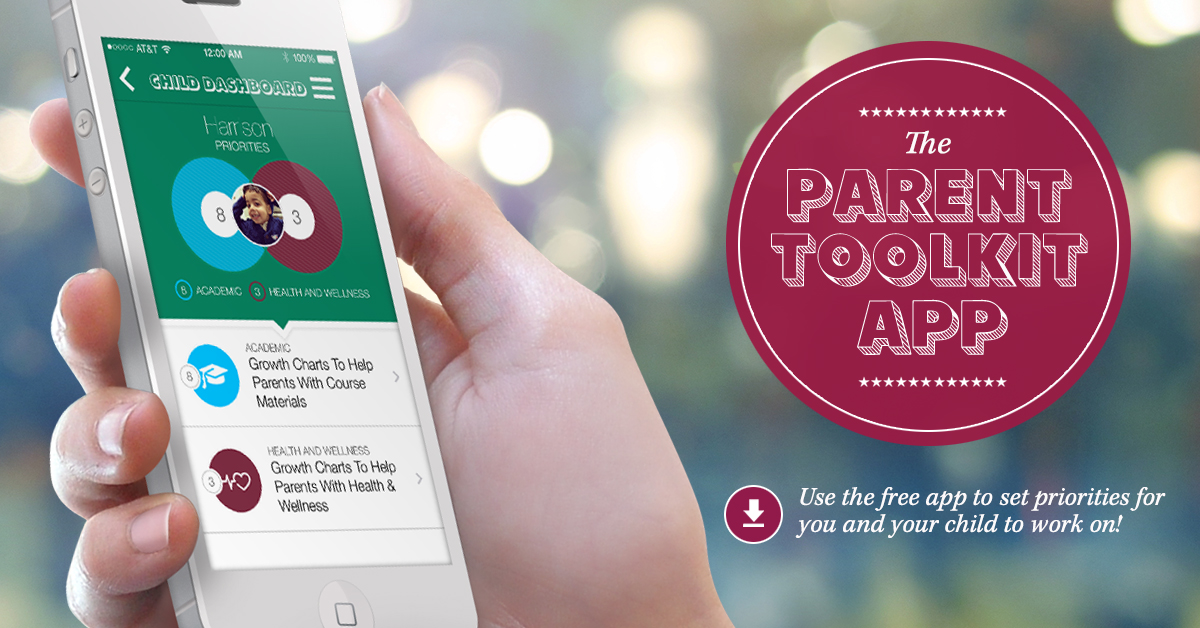
Parent Toolkit App


parent toolkit app

The Parent Toolkit App is designed to help you navigate your child’s growth and development from Pre-K through 12th grade in the classroom and beyond. For each grade, the app offers benchmarks to see what your child will be learning in school, and recommendations for diet, sleep and physical activity. The grade-by-grade tips work into your everyday schedule to support what your child is learning and promote a healthy lifestyle.

Choose whether you want to browse through academic or health and wellness benchmarks and tips. The academic information will help you ensure your child is on the path to success. It also provides helpful advice on homework, parent-teacher conferences and supporting learning at home. In the health and wellness section, you’ll find tips on encouraging physical activity, eating a well-balanced diet, and ways to make sure your child gets enough sleep.

Set priorities for you and your child to come back to using The Parent Toolkit App. A priority is an item that you mark as important to your child’s development. It can be something you want to review later, or a tip you want to remember to try. Use the “+” button to mark items as priorities and create a list for review later. You can then mark items as completed once you’ve accomplished your goals. You can also share helpful information and tips throughout the app with family, friends, and more using social networks or email.

The Parent Toolkit App is produced by NBC News and sponsored by Pearson. It has been accessibility tested and works with VoiceOver. Download The Parent Toolkit App in English or Spanish and get started today — it’s free!

You can download your FREE mobile app here: http://lksn.se/toolkit 

Or text “Toolkit” to 33733

Academic Writing Tools


recommendation letterMany people view academia as “pretend” – as something separate from the real world. While there are many things about school that don’t translate well into real life, there are many things that do. The process used for writing a dissertation, and in fact writing anything, can be a good foundation for how to approach any real-life problem.

Formulate An Idea

This is probably the hardest part of writing. You need something to write about. There are a lot of ways to come up with ideas, but one of the best is to think about what you’re most passionate about, what needs further research in your field of study, and then find the crossover point.

Poll your professors, other students, and alumni for answers. You can also hire a company like Ivory Research to get the wheels turning. Companies like these are professional research companies that help with the research and writing process. But, they’re not just good for a dissertation. They can help you write practically anything.

Start With Brainstorming

A good brainstorming session begins with a clear, yet focused, mind. You must clear your thoughts of all distractions. A good way to do this would be to do some meditation before you write, or go for a walk in the woods – somewhere where you can find peace and tranquillity. When you’re ready to write, get rid of all distractions.

You should silence your phone, shut off access to the Internet, and close and lock your door for privacy. Then, start writing. Don’t think too hard about what you’re writing – this is a mistake most students make. This is not a time for editing anything. This is a time to write from your subconscious.

Your first draft should look almost like a stream of consciousness. You might veer off onto tangents. That’s fine. You’ll go back and edit it later. Eventually, your drafting process will become cleaner so that extensive editing won’t be necessary. However, and especially if you’re not an experienced writer, your first draft will be quite ugly.

Do not edit anything. Resist the urge to edit as you type. This not only slows you down, but it can kill the creative writing process, which is necessary to make your dissertation, or research paper interesting as well as informative.

When you’re out of college, this technique is useful for just about any problem-solving you will do. You can whip out a sheet of paper and start writing down questions and problems you’re facing – even if they initially don’t make sense. Then, you can go back and analyse them.

Analyse The Draft

There’s a lot that won’t make it into the final draft. The editing process is where you decide which takes priority. This is the time when you can be objective about your writing. Before, it was purely subjective. You were tapping your subconscious for ideas – powerful, emotionally-driven ideas. Now, it’s time to justify those ideas with logic and reason.

Think about the process itself and uncover patterns you might have developed subconsciously.

Think About The Process

The writing process itself is a learning experience. Thinking about your process consciously and objectively can teach you about how your subconscious reacts to certain situations, ideas, and how you feel about things.

Naturally, this carries over in real life. When you’re feeling distressed about something, or happy, you can use writing to write out all of your emotions, questions, and ideas. Then you can think about the processes going on inside your head. Why did you think or feel a certain way?

This can help you uncover hidden motivations in your writing, patterns that limit your writing, and even processes that strengthen your writing.

_________________

Jenny Wescott has been an online tutor for some time now. She likes to share her insights to help others research and write better. You can find her blog posts mainly on education, research and writing websites. 


How to prepare for college level language courses


language coursesLearning foreign languages is an exciting challenge that opens up a world of possibilities. Students who wish to explore other countries during summer vacations should definitely try to learn a language or two to get the most out of the experience. Fresh graduates will find it quite helpful to be multi-lingual, especially during their job hunting. Lots of positions nowadays require proficiency in a second language.

Spanish is spoken by millions of people in the US, South America, Europe, and the rest of the world. It’s a great choice for college students who are looking to expand their education. It is extremely useful yet not as difficult as others such as Greek or Japanese. Here are some ideas on how to prepare for college level language classes:

Check Out the Books at the Library

The school library should have plenty of books and other resources that can help in the study of languages. The most important one is the professor’s preferred textbook for class as it will contain the specific examples that will be discussed. It is essential to have a copy of it when getting ready for recitations. However, students should not limit themselves to this alone. Look for other reading materials that use different techniques in teaching Spanish. They might clarify concepts that are unclear in other sources. Hunt for English-to-Spanish dictionaries, light Spanish novels, and the like.

Bookmark Online Resources

The Internet is rich filled with educational materials. Anyone can find them after a few minutes with a capable search engine. Bookmark these resources so that they can be retrieved quickly when needed. Students who are planning to get foreign language credits can read these in advance. Doing so will allow them to breeze through the lessons in class and impress their peers. Many of these are free such as Wikiversity’s language courses, Qué Onda Spanish’s fun word games, and Spanish-Resource’s innovative learning platform. Online translators will be useful as well.

Install Helpful Mobile Applications

Nearly everyone is glued to a phone all day so why not install a Spanish app to make it a learning tool? Mobile developers have come up with a variety of applications that aid language learners with their studies. These include dictionaries, phrasebooks, basic lessons, vocabulary builders, translators and games. Some of these can be set to notify the user that it’s time for a certain lesson. This is effective in cultivating consistency, which has been found to be the key in boosting retention. More established software brands are also available for desktop and laptop computers.

Listen to Audio Recordings

Audio tapes have been a staple of language learning for a long while. These allow learners to get a good grasp of the sounds so that a foreign language soon comes across as quite natural to the ear. The companies behind these tapes can approach the lessons quite differently. Some focus on providing instructions in a very organized manner. Others make their tapes more conversational and spontaneous. The rest offer a mixture of these schools of thought. The best approach is a matter of personal preference. The only way to know is to try and fortunately most have samples on their official websites.

Watch Foreign Language Films

Make learning more enjoyable by watching foreign language films at every opportunity. There should be plenty of Spanish movies for rent on DVD and online streaming services. Try to find copies that have the original audio with subtitles. This can be distracting at first but stick with it and the patience will be rewarded. It’s a fantastic way to learn more about language and culture — two things that are truly inseparable.

______________________

Author Bio

Fred Johnson is a writer and blogger who focuses on the areas of education and language. This article helps students prepare for university language classes and promotes language comprehension tools such as those at http://spanish-resources.com/


The GPA isn’t everything. Or is it?


Sign up for my FREE parent tips email and get my FREE Ebook on college financing! Or subscribe to my blog on the left and get email updates.

gpa
Photo courtesy of Zinch

GPA’s enter our teen’s world in high school. Everything they do academically affects their GPA. If they start out strong and stay consistent, that GPA could mean offers of admission from multiple colleges. Colleges look at a student’s GPA to determine their capabilities to perform well in a college academic setting. Less that stellar grades, or even average ones, could communicate a lack of commitment or even an attitude of laziness.

If their grades begin to falter, not all is lost. There are things they can do to bump up their grade point average and get back on the path to improved academics. Is it easy? No. Is it worth it? Absolutely.

Our friends at Zinch have given us some simple tricks that can save your GPA. Follow their simple steps and your student could see rapid improvement and also improve their chances of getting into the college of their dreams.

Read Zinch’s “Simple Tricks That Can Save Your GPA”