Category Archives: academics

Should Your Student Work With a Professional Test Prep Tutor?


professional test prep

Should your student work with a professional test prep tutor? Bobby Hood, of Noodle Pros, says YES! 

Bobby has been tutoring professionally for 7 years. He is a member of the Triple Nine Society, an association of individuals with IQ scores above the 99.9th percentile. After graduating high school as valedictorian with an SAT score of 800 Math and 790 Verbal, he attended Texas Christian University on a full-tuition scholarship.

Before he began tutoring, Bobby had two prior careers as a CPA and attorney respectively. Bobby worked as a CPA for two years before attending The University of Texas School of Law.

After 10 years of practicing law, Bobby returned to his love of teaching and began tutoring students. He tutors the SAT, ACT, LSAT, GMAT, GRE, GRE, and MCAT CARS.

I spoke with Bobby about why he tutors, how to prep for the SAT or ACT, when to start studying, and the advantages of working with a professional test prep tutor.

1. After 7 years, why do you still do it?

When I worked as a CPA and as an attorney, I never felt like I was actually helping make a positive difference in the world. Now I make a difference in students’ lives every single day. It’s rewarding and affirming, and it never gets boring, because every student is different.

2. A course and/or many tutors would be a lot cheaper, why should students not take a course? Why work with a super-tutor?

Most courses are designed with a “one-size-fits-all” approach; generally, test prep courses are geared toward students who are scoring below or near the median. A student at that level may benefit greatly from starting with a course or other prep material in order to master the underlying content needed to earn a high score on the test. However, in order to move significantly above the median (say, above the 84th percentile or so), a student will need to focus on the patterns of the test in a very individualized way.

Today’s students generally have very busy schedules, and need to balance test preparation with studying for challenging AP courses and participating in extracurricular activities and organizations. Individual attention from a tutor with a great deal of experience in adjusting the preparation to the needs of the student can in most cases result in the highest improvements quite efficiently, allowing the student to focus on all of those other important facets of the high school experience.

3. What are three things that all students can do that will improve their scores?

  1. Focus on the fact that your past educational background has already prepared you to answer most or all of the test’s questions correctly, as long as you know the patterns of the questions and the proper way to approach them.
  2.  Take the test in a mindful, deliberate manner, choosing to work the questions and passages that will be easiest for you first. Save the questions that require the most work until the end, when you can focus on them without worrying about other remaining questions. In the end, the test is more a test of your attitude and approach than it is of knowledge or ability.
  3.  Practice intelligently. Learn the strategies, then take a practice test under timed conditions and apply those strategies. Spend at least half as much time reviewing the test as you did taking it. What questions did you miss or spend too much time on? How can you change your approach to similar questions in the future?

4. What should people look for in a good tutor?

Good tutors are flexible and will take the time to explain how they will approach the tutoring and how it will apply to your student. If a tutor is not responsive to questions up front, then the tutor is not likely to do a good job of communicating with you or the student as the tutorial progresses.

5. What happens if you are just not a good test taker?

Almost every student describes himself or herself as “not a good test taker”, and this is almost never true. Standardized tests are designed to make students feel like they are not good test takers; the primary goal of my tutoring is to disabuse students of this notion, and help them realize that once they know the patterns of the test, they will gain the confidence that they are just as good at test-taking as they are talented in other endeavors of their life.

6. How many times should you take the ACT/SAT?

As part of your preparation, you should take practice tests until you are consistently earning a score that you would be happy with and that represents your skills and background appropriately. Once you are consistently achieving those scores on practice tests, you should take the actual test and look to achieve a similar (or higher) score. Of course, anyone can have an off day, so you might need to take it multiple times to get the score you’re looking for. That said, once you’ve earned the score you want, there’s no need to continue.

7. How early should you start preparing?

Trigonometry is the highest level of math tested on both the SAT and the ACT. So, you can begin as soon as you have learned Trig (generally, at the end of Algebra II). You can begin earlier if you like, but you won’t be prepared to earn the highest possible score until you have gotten through Trig.

The best way to decide when to start preparing is to work backwards from your goal. Since you would prefer to spend the summer before Senior year visiting colleges and preparing your college application, you should have your scores in hand by the June tests of Junior year at the latest. Therefore, you should start your preparation in the Spring of Junior year at the latest, or earlier if possible. Sophomore year is usually a bit early to begin preparing, but not out of the question if the student is already taking Algebra II.

If there is any chance that the student will be a contender for National Merit Finalist status, then preparation should begin in the summer before Junior year, leading up to the PSAT/NMSQT test in October of Junior year, since that is the test that is used to determine National Merit Finalist awards.

8. What is important about practice tests?

Practice tests are the only way to realistically assess whether you are prepared to take the actual test. It’s important to take practice tests under timed conditions and in surroundings that best approximate the actual test. Many students mistakenly focus only on whether they are capable of answering questions correctly, when the important question is whether they are able to answer questions correctly under the time pressure of the test.

9. When should students stop worrying about their score?

You should never begin worrying about your score. Think about it this way: there are questions on the test that, based on your past educational background, you are “supposed to get right.” There are also questions on the test that you are not supposed to get right. Your goal is to use strategies to make sure that you approach the test in the right way and get right all of those questions that you’re supposed to get right, instead of rushing through the test and making errors on lots of questions.

If you do that, then you should be proud of your score, because it properly represents you and your educational experience. Now, if the strategies also help you get some of those questions that you WEREN’T supposed to get right, well… that’s a nice bonus.

10. Many students say they insist on in-person tutoring versus online tutoring, what do you say to that?

In my experience, online tutoring is substantially more effective than in-person tutoring. It sounds counter-intuitive, since effective online tutoring has only been possible for a few years now. However, it fits with the way today’s students tend to learn. I began to notice in recent years that students in a classroom will often take a photo of problems worked on the board in a classroom, and then refer back to that photo later when studying. In online tutoring, everything we do – every strategy I teach – is written on the whiteboard and you save it at the end as a PDF file.

When tutoring is face-to-face, you have to divide your attention between listening to what I’m saying, looking at what I’m writing down, and taking notes for future reference. This slows things down and leads to less comprehension. In online tutoring, we discuss and work through problems together, and everything goes onto the whiteboard for your own future reference. You really have to try it to see how amazing it is. Many students have mentioned to me after their first sessions that they were not expecting it to be so effective, and generally they leave the sessions enthusiastic to continue the tutoring.

11. Are you just teaching test strategy tricks or are you really teaching a student how to read or do math?

I’m definitely not teaching you to read or to do math. However, I’m definitely teaching you how to read well and how to do math well. In other words, tutoring is all about learning how to think critically: to note the way questions and answers are worded, and what that tells you about how to approach the problem, and what answers to eliminate before you fall into a trap. These critical thinking skills don’t just improve your scores on the test; they will make every test you ever take easier, and probably make you much better at reading college textbooks for your courses in a more engaged and efficient manner.

12. What are some good resources that are available to all students?

A student who is at or below the median test score probably needs to do work to get the basic content down. Khan Academy is an excellent free source that can help students learn and practice basic content. However, don’t make the mistake of thinking that Khan Academy teaches test strategy. Khan Academy is the free starting point for mastering content areas that you are weak in; after that, move on to actual test strategies.

For test strategies, the books Cracking the ACT and Cracking the SAT by The Princeton Review are excellent resources to start with. Learn the strategies, and then practice applying them on actual ACT and SAT tests. For the ACT, the Real ACT Prep Guide is the only approved source of actual ACT tests. For the SAT, use the actual SAT practice tests on the College Board and Khan Academy sites – but focus on tests 5, 6, 7, and 8, which are actual real SATs that were released as practice tests after being administered.

13. Is there a moment or a story you can think of that has had a large impact on your career as a tutor?

One of my former ACT students returned four years later to prepare for the MCAT. He told me that the critical thinking skills he had learned while tutoring with me had helped him study in college efficiently and do very well on the demanding pre-med curriculum. At that point it hit home to me that tutoring isn’t just about taking one test, but instead is about a mindful approach to learning that applies throughout your lifetime. It’s really helped me to appreciate how important attitude and critical thinking are not just for standardized tests, but for approaching life in general.

14. If you knew then what you know now, what would you do differently on the ACT or SAT?

Haha well… I used Cracking the SAT and Cracking the ACT to prepare, even way back then, and I only missed the perfect score on each test by one question. So I wouldn’t do anything differently on the tests themselves, but perhaps I would rather have realized much earlier that my passion in life is teaching and tutoring.

This is a sponsored post and I have received compensation for this interview.

 

Get the Most of College by Sampling College Courses


college courses

Going to a college is one the biggest decisions anyone can make in their lives, especially as a young person. College can open so many doors into careers that we couldn’t get otherwise, even if it takes time. If your teen is having trouble finding their way into the major program, but absolutely don’t want to miss out on the university experience, help them consider some of the options below as secure routes that will keep them interested.

Take a Physics Course

If a young person is academically minded and likes the thought of maths or statistics, considering a career in the sciences is probably the best route for them. STEM courses are extremely popular and always looking to take on new applicants, but looking a little further afield to topics on developing new technologies and studying the universe will always have something more to give. It’s also a slightly underdeveloped field in comparison, and you know you’ll be among the cleverest people in the room.

A lot of people are turned away from the sciences at a young age due to their difficulty and the concept of being challenged isn’t considered right for some, particularly affecting young woman. Learn about the natural world around you and how it works in the most in depth way possible? It’s a win win notion when it comes to a physics course as whilst it can be challenging, it’ll set you up for life.

Jobs that take physics degrees and expertise are some of those lucky ones that don’t get hit by the recession. The world is always going to need scientists and engineers to fix its problems, so you’re guaranteed a position that’ll keep on paying. Physics is also incredibly important in medical.

Take a Philosophy Course

Philosophy isn’t just for old fogies, outdated ideas, and cigar smokers. Philosophy contains some of the most interesting concepts known to man. The research opportunities alone are endless, and having a PhD in philosophy looks incredible on a resume. You’ll come across as a thinker and problem solver due to the general belief of philosophy alone: that you can take complex issues and solve them in simple ways.

Philosophy is a science into thinking, and if you’re the type of person to get lost in thought a lot, you might as well get paid to do it. You can also learn to spot common mistakes con men make in their sales, and have a better basis on telling when people are lying. It can also answer your religious questions and help you find faith or put the whole thing aside entirely.

Philosophy is also a gateway into politics. It allows you to better understand party stances and what a leftist or rightist leaning means. You can even prepare yourself against the common mind tricks used on the voting population by governments since time immemorial!  

Take a Law Course

Out of the other options on this list, taking a law course can come in the biggest of forms due to its sheer versatility. For those of you with a social conscience, it will be one of the best decisions you could make if you love the idea of justice and bringing it into people’s hands.

Additionally, if you’re interested in criminal law, and want to be able to take a practical field approach to it,  looking at posts such as What Is Required to Earn a Bachelor of Criminal Justice? can help you find the course you need. Similarly, they give you a comprehensive list of what you need to do to be considered for such a degree.

People who have a criminal justice degree, or even higher, can really reach for the stars with their education. It will help them better with learning real world skills, such as communication in both oral and written form, and how to keep healthy relationships. You’ll also learn temperance more than you would in any other course, so it’s a good suit for restless people with a thirst for knowledge!

Take A Latin Course

Learning Latin can be considered a bit of a wildcard, and it may seem like it won’t do you any good, but is always a talking point whether it’s a casual conversation or a job interview. Similarly, Latin may be thought of as a dead language by some, but learning it is very much possible. Furthermore, if you know how to read Latin, you have a surefire path to walk into the Ancient History and Classics world. A history degree is one of the most interesting and enriched study areas you can choose, and learning about ancient civilizations can teach you a lot about our own roots and society.

A lot of the most common languages in the world have their roots in Latin, so learning more about its functioning and where it came from is the next step in phonics and working on your own language. It cuts your work in half when trying to learn new languages as you’ll already know where to start with pronunciation and meaning. Plus it’s very intelligent to know how to read ancient inscriptions or tombstones when you find yourself abroad on research trips or indulgent holidays. Yes, those will still be possible with a Latin degree!

Latin also goes hand in hand with the sciences, as their terms come from Latin roots. Because of this it can be a gateway into medical degrees or further learning in medical school. By understanding the fundamentals you place yourself in the best position to succeeding in the health sector.

Sampling these courses can help you determine areas of interest and might lead you on a different career path than you had originally imagined.

Back to School? Here’s What To Do!


back to school

The summer vacation is almost over and back to school your kids must go! But what do they need ahead of a new semester? And how can you help prepare them for a new school year? We’ve pulled together some handy tips to ensure students can make the most of what’s to come.

Follow these useful tips – and work with your son or daughter to ensure their upcoming school year is the best yet – and in no time at all you’ll witness them receive their hard-earned diploma.

Make a Date with the School Counselor

If your child hasn’t met their school counselor yet, maybe it’s about time they did. Face-to-face conversation is the way to go, as the counselor really will make your son or daughter make sense of the school year and their choices for the future.

Apply for SAT/ACT

Even if your child’s already taken a standardized test like this, there’s no harm in taking it again. Many students opt to improve their scores a second time around, bettering themselves ahead of their next academic or career step.

If your son or daughter is yet to take the tests, there’s plenty of time to register. It isn’t a requirement to submit SAT or ACT scores by any means, but it may improve your child’s chances of a better career later down the line.

Put Some Prep Time in Now

If your child is worried about their performance in a particular school subject, it can make sense to put some preparation time now – while they’re not up against it during the semester. The vacation is a perfect opportunity to dust off those books and get ahead for the new school year.

Discuss Finances

School can come with costs; from books and stationery to bus and food money – but if you have the conversation with your child now, they’ll be more than prepared when the new semester comes around. Will they need to take a job during the vacation, for example, to earn some extra funds? If so, encourage them to look for the right job, which will ensure they can get out of the house to meet new people, and save some much-needed school money.

Read!

As well as getting ahead by putting in some time to study, students can improve their knowledge by reading. Find relevant books, or even novels, and help your child create a reading list that will benefit them when they go back to school. If they’ve shown an interest in a specific subject or discipline, do some research together to find books featuring great success stories from those who’ve followed a similar path. That way, they’ll have a role model in mind when completing their studies, giving them even more reason to put the time and effort in.

Have Fun, Too!

While the summer vacation should be spent planning the new school semester, it isn’t all work and no play. A vacation is just that, after all – and your son or daughter should also find plenty of time to relax and have fun. That way, they’re more than ready to tackle whatever the new school year has to throw at them.

Consider Extra-Curricular Activities

As well as the books we mentioned earlier, there’ll be a whole host of fun and beneficial extra-curricular activities available for sign-up during the summer vacation. Are there any seminars on, for example? Or maybe there’s a useful team-building summer camp, or motivational day to consider? Anything your child can do now to get ahead will stand them in good stead later.

Did you enjoy this blog post? What are your top tips to prepare your child for their upcoming school year? We’d love to know.

5 Ways to Find Education Beyond the Classroom


education

No matter what stage they’re at in their educational journey, your kids should appreciate that the classroom only provides a platform. If they truly want to maximize the capabilities of learning to experience its greatest rewards, they must be willing to do more.   

Frankly, going that extra mile is the hallmark of a champion. Here are five simple tricks that will fire your child to greater results than you ever thought possible. What are you waiting for? Let’s get to work.

Find Direction

 Becoming well versed in various subjects is important. Ultimately, though, they will eventually need to choose a pathway en route to creating a great career for themselves. While youngsters shouldn’t feel forced into making a definitive decision, it doesn’t hurt to think about the future career ASAP. After all, this will help them know which subjects need to be prioritized or what courses may be taken further down the line. Apart from anything else, that vision will serve as great motivation throughout the journey ahead.

Complete Autonomous Study

 Whether your child is a school pupil or a university student, you cannot expect the teacher to provide everything. They are a fountain of knowledge, but they can’t be expected to know everything. Their advice can form the basis, especially with regards to exam prep. Nonetheless, using services like GradeBuddy to enhance their knowledge of key topics should be on your child’s agenda. With that coupling of personal progress and class education, they should gain a deeper understanding. This should come as a huge help in both academic and practical ways.

Develop Key Skills

 Education isn’t just about increasing their knowledge. You are ultimately trying to prepare your child for the best career and lifestyle. As such, encouraging them to take the time to invest in key transferable skills is an essential part of the process. This is especially true when you actively recognize a lack of confidence in public speaking and similar areas. Their studies are the perfect opportunity to work on those weaknesses as well as their strengths. Find the right balance to boost your hopes of success in the real world, and it will pay dividends in the long run.

Put The ‘U’ Into Education

 Passing exams is one thing, but driving themselves towards a great career is another altogether. No two people are identical, and their education should be tailored to personal needs. Making education about the individual can be achieved through many methods. Learning a new language with DuoLingo, alongside a chosen field, allows your child to chase the dream of working abroad. Meanwhile, using practical approaches is far more rewarding for your personal tastes. Essentially, doing the best thing for them is the key to even greater success.

Gain Experiences

 There’s more than one way to enhance your knowledge of a subject. Frankly, experience is just as vital as education, and is something colleges and employers actively seek. This is why extracurricular activities can become your secret weapon for future applications. Apart from impressing others, it’s a great way to boost their self-confidence and capabilities within a chosen field. If your son or daughter is looking for the perfect finishing touches to their strategy, this is the only answer they’ll need.


What is Plagiarism and How Do You Avoid It?


This article is timely, considering all the discussion about Melania Trump’s speech at the Republican National Convention.

plagiarism

We always use the word “ethical” if we want to describe something that is right, made or done according to rules and involves some moral values. Why then should we refer plagiarism to ethical issues too? Let us specify what plagiarism is. There are several activities that are referred to the notion: substantial copy-paste, intentional paraphrasing, use of one’s ideas representing them as your own ones, avoidance of crediting the source etc. All these actions are immoral and can be considered to be a violation of widely accepted ethical rules, consequently, plagiarism is one of the main ethical issues nowadays. At the same time, there are such cases that can’t be called unethical. Think only about self-plagiarism or accidental one: these issues can be hardly called intentional, so plagiarism remains a rather controversial term.

Gray areas or inability to give a definite answer

Is it always possible to answer the question: is it plagiarized? Despite the number of various software like Noplag.com Plagiarism Checker, for example, it is always difficult to give the only right answer to this question. The standards of plagiarism depend on many different points: this might be a genre of writing, the field of writing (lawyers are allowed to copy some pieces into their speeches, while politicians are not), a person, who has written the text (a school graduate or an experienced philologist) etc. Many people will admit that some of these cases can’t be called unethical, but in reality, everything must be decided only in the court. And if the situation is recognized to be a fraud or even a crime, the punishment will be rather severe. On the other side, plagiarism does not belong to the list of crimes and copyright does not cover all the misdeeds that are regarded to be this illegal activity. That is why it is extremely important to draw a line between what plagiarism is and where its ethical boundaries are located. Let us look at the gray areas of this notion that despite being extremely controversial are not considered to be plagiarized:

  1. Self-plagiarism: a situation, when a writer uses his thought or statement, which has already been published in the different source, in his next text. It is impossible to convict the writer as it is his own idea, but it is always advisable to recycle the content.
  2. Patchwriting: composing a text of passages from various sources. It can be called a unique style of writing, though it can’t be called an original piece of writing.
  3. Paraphrasing: rewriting some piece using your own words. Though this point has some connection with stealing ideas or viewpoints, all of us are taught to paraphrase at schools, so consequently, it might be called a criminal activity.
  4. Allusion: offering another source as an example is a very tricky thing, but it is also a good way to clear off the accusations of plagiarism.
  5. Ghostwriting: the process of creating some content under the another author’s name can’t be called plagiarism too as you still create something new even calling yourself a different person.
  6. Collaborative writing: if a book or article has several authors, it does not mean that all of them are credited the same and each of these representatives can pull a suitable part from other works.

All these issues can’t be evaluated only as completely right or completely wrong ones, so our relation to them is the only right answer for us personally.

How to spot plagiarizing

There are several indicators to help you to recognize a plagiarist:

  1. Intentional omission of citations and references;
  2. Figures of a completely different style than previous ones;
  3. Very old researches and information according to which there have been no other ones conducted recently;
  4. Sentences are not connected by content;
  5. Abrupt changes of writing style etc.

At the same time, the best thing that may help you to spot plagiarizing is a free online checker such as Noplag.com, for example. It will show you all the parts that were copied from other writers or intentionally paraphrased. By checking each your text your moral state will be always perfect and you will never suffer from self-reproach.

Plagiarism: ethics of stealing

In any case, if you make intentional efforts to use one’s work, idea or statement and avoid citing it, this action can be considered a literary theft. You commit an immoral illegal crime, which is known to everyone as a theft. Each original work is protected by copyright laws and violating intellectual property you commit a crime. As a result, if to speak about ethics, you must realize that plagiarism is the ethics of stealing and it may result in not very good consequences both for a plagiarist and the author of the original text.

__________________________

Lesia Kovtun is an ex English teacher who helps parents/students and organizations with educational planning. She is tech savvy, loves education and technology that makes studying process more convenient and collaborative. She currently works with Noplag.com team as a consultant.

How to Excel in College


excel in college

It takes years of hard work to get into college and on the path to your dream career. If you’ve made it to college, congratulations are in order – you’ve passed high school and got onto the course you need to be on. Of course, once you’re in college there’s a lot of pressure to do well. Most of the pressure comes from the worry of not getting high enough grades, as college classes are a lot harder than high school ones. The difference in the level of learning can be a shock to the system when you first start college.

A lot of college students struggle to get the grades that they need, so if you’re finding it hard, you’re not alone. The good news is that in most cases, there are plenty of ways you can help to improve your grades. You’ll be amazed at how making a few small changes can have a big impact on how well you excel in college. Take the below tips on board and you can give your grades the boost that they need.

Go to class

This might be an obvious one, but it needs to be said. Lots of students skip classes and then wonder why they struggle to achieve good grades. If you want to do well at college, you need to attend all of your classes. Unless you’re sick, you have no excuse for not being there. If you’re serious about getting high grades, you need to make an effort to attend every class.

Copying your friend’s notes won’t let you catch up properly, as there will always be little things that you miss. The slides from the lecture might be uploaded onto the college internet, but that still won’t allow you to catch up completely. In class, there will be discussion, examples, and so on, that if you’re not there, you will miss. It’s simple, if you want to do well, you need to attend each and every class.

Understand each lecturer

Every lecturer or professor has a different method of teaching. If you’re going to do well, you need to make an effort to understand each lecturer’s way of teaching. Each professor wants something different from their students, so finding out what this is early, is a must. You’ll find that by understanding what your lecturers want from you, you’ll do better in their classes.

Your grades aren’t just down to assignments but also your in-class contribution. So it’s essential that you know what your professors want from you. Else, you could get marked down because you’re not doing what you’re supposed to be. Don’t be afraid to tell your professor that you’re struggling to keep up – they’re there to help you.

Get organized

Being a successful college student is all about learning to multi-task, and the key to this is organization. The chances are that at any one time, you’ll have various assignments to work on. That’s why it’s so important that you’re organized about your studies. Else, you’ll end up being overwhelmed with due dates and work that needs to be done; you might even forget something. If you’re organized about your studies, you can ensure that you spend adequate time working on each task. You won’t need to stress about forgetting anything, as you’ll have everything under control.

The best tools for staying organized while at college have to be planners. Day planners are fantastic as they allow you to schedule your classes, assignments dates, and any other tasks you need to do. There’s also room to jot down when you’re working. This allows you to ensure that you’re on top of everything and that nothing important gets missed out.

Use your time wisely

This links to organization. If you want to ensure that your grades are good, you need to use your time wisely. Of course, having a planner to schedule your time helps with this, but that’s not all it takes. In periods of free time, if you have a task to do, complete it. Don’t waste your time, use every minute wisely.

Of course, you need time to chill out and see your friends, but that shouldn’t take up a large part of your day. You need to prioritize your time, so that your studies always come first. It’s also important to break big projects into smaller parts, and schedule time to focus on each part. This makes getting the work done easier, as it won’t be too overwhelming.

Take notes in class

Another important reason for ensuring that you’re in every class is taking notes. If you want to ensure that you remember everything from the lecture, you need to note the important things down. This will mean that when you come to write an assignment, you can look back at the notes you’ve taken in class about the topic.

After class, it’s worth typing up your notes. For each class, write the notes up on your computer and save them in a file with the module name. That way, should you lose your notebook, you’ll have all your notes safely stored. You could opt to print them out for revision and use them to make mind maps and memory cards.

Improve your essay writing

A large chunk of your overall grade is down to your essays and assignments. This means that if you want to do well, you need to ensure that your writing is at a high standard. It’s not just about improving your writing style and tone; you also need to think about your punctuation and grammar. To improve your punctuation and grammar, Grammarly is a fantastic tool for checking your work. It points out any errors and makes suggestions of what you should change them to.

If you struggle when it comes to finding essay topics, you can find help online. (A lot of professors only give an outline of what they want, and ask students to choose the topic themselves.) There are examples of good argumentative essay topics online, as well as examples of various assignments. These can be incredibly helpful when it comes to improving your essay writing.

Buy the suggested books

Last but not least, buy the recommended books. Your professors will give you a reading list for a reason, so make sure to take advantage of it. The books on the list might be expensive, but they’re worth investing in, especially if you want to do well. They’re a great source of research and are ideal for looking up anything from your classes that you’re unsure about.

If you can’t afford to buy them, most of the recommended books will be available in your campus library. Or you could consider getting them second hand from older students or online. Don’t let the cost hold you back, get the books that you need to be successful.

Hopefully, this advice will help to improve your grades and get you the degree that you need.


My Daughter Turned Down a Full-Ride Scholarship


full-ride scholarship


During this financial aid award season, several years ago, my daughter had to make a difficult decision: which college would receive her acceptance of an offer of admission. Of the many colleges she applied to, they included private colleges, state universities, and trade colleges. Some offered her financial aid, others did not. It was a heart-wrenching decision for her: choose the college that offered the best financial aid package with a full-ride scholarship, choose her dream college that gapped her offering no financial aid, or choose the college that was her perfect fit.

For me, it was a no-brainer. One college offered her a full-ride scholarship, along with the major she wanted to pursue. It was in the city she wanted to live in. All the boxes were checked off. There was one problem, however. Since the college was over 2000 miles away from her home, she applied without ever visiting the campus.

Still stuck on her dream college, we scheduled college visits to the other colleges on her list. Here’s where the emotional issue of choosing a college entered into the mix. For teens, the college choice is always more emotional than practical. For parents, this factor makes it even more difficult for you to guide your student in the best decision.

After visiting three colleges in the same city, one her dream college, she was faced with a difficult choice. If it were up to her, she would have chosen her dream college. Knowing this decision would put her into debt, I was able to convince her to look at the other schools.

One of the other colleges offered her a full-ride scholarship; but when we drove onto the campus she immediately balked. Her reaction was so severe that she wouldn’t even get out of the car. My reaction—total anger and frustration. But I knew that I would regret forcing her to consider this college when she was so adamantly against it. So we drove away and moved on to the next college; knowing full well this meant she was turning her back on a full-ride scholarship.

The next college was a slam dunk. She loved the campus. She loved the tour and the students she met. She loved the location, its surroundings, and the total college experience it offered her. It was a small campus and since she would be so far away from home, it would be easier for her to assimilate in this type of environment. Since it was a liberal arts college, she could minor in English—something she had always wanted to do. The next best part, their financial aid package was doable. With her scholarships, grants and work study, she would only have to take out minimal student loans.

Seeing her turn down a full-ride scholarships was a tough pill to swallow. As her parent, I was completely focused on the financial aspect of the decision. But once I saw how excited she was about the other college and saw the smiles on her face, I knew this was the right decision.

Letting her make an emotional college choice (coupled with some financial sense) was the right decision. She flourished at that college. She met lifelong friends. She was able to get a well-rounded education and graduate with a degree that was employable. She still thanks me every day for letting her make that emotional choice and for also standing firm on the impracticality of her dream college.

Choosing a college is a highly emotional decision for your student. Your job as a parent is to guide them into a practical choice while taking into account that you want a happy student going off to college. Although financing should be a key part of the decision, it’s not always about the money.

Wednesday’s Parent: Dual Enrollment Pays Double


dual enrollment

In my book, anything that saves you money on college is a good investment of your student’s time and your financial resources. Dual enrollment can not only prepare your student for college level courses, but can save you money on college. These courses are offered in conjunction with local colleges and students can take both high school courses and college courses at the same time.

According to Wendy David-Gaines, the Long Island College Prep Examiner and POCSMom, dual enrollment courses offer huge benefits:

Mom-Approved Tips: Insist Your Student Graduate in 4 Years or Less


Did you know that at most public universities, only 19 percent of full-time students earn a bachelor’s degree in four years? Even at state flagship universities — selective, research-intensive institutions — only 36 percent of full-time students complete their bachelor’s degree on time.

Nationwide, only 50 of more than 580 public four-year institutions graduate a majority of their full-time students on time. Some of the causes of slow student progress are inability to register for required courses, credits lost in transfer and remediation sequences that do not work. Studying abroad can also contribute to added time and credits lost when abroad. According to a recent report from CompleteCollege.org some students take too few credits per semester to finish on time. The problem is even worse at community colleges, where 5 percent of full-time students earned an associate degree within two years, and 15.9 percent earned a one- to two-year certificate on time.

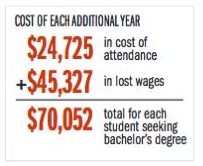
graduate in 4 yearsWhat is lost when a student doesn’t graduate in 4 years?

MONEY! My good friend, and college counselor, Paul Hemphill of Planning for College put it into perspective recently. (See chart to the right). It’s not just the cost of the education that your student loses, but the earning potential over the additional year or years. Nothing speaks louder than cold, hard numbers.

What can parents do to ensure on-time graduation?

It’s not a difficult task, although the numbers might speak otherwise. Taking control of the process and making a plan will go a long way in ensuring on-time graduation

Show your student the numbers—Nothing speaks louder than showing your student a loss of thousands of dollars in earning potential if they don’t graduate on time.

Help them plan their major and degree plan, ensuring it can be done in 4 years—Help them plan, ask questions of their advisors, and have solid discussions about their career and/or major.

Encourage AP testing and dual-credit courses—With AP testing and dual-credit courses, a student can enter college with multiple credits out of the way. The cost of these tests and courses pales in comparison to the cost of a college credit and extra money paid if they don’t graduate on time. It’s conceivable that with the right planning, a student can graduate in less than 4 years.

Attend community college for the basics during the summer before college—Not only will your student get some courses out of the way at a cheaper rate, they will enter college with credits under their belt.

Use some tough love—Explain the importance of graduating on time and explain that you will support them for 4 years only. After that, the cost is on them. Nothing motivates a teen more than realizing they will have to pay for college themselves.

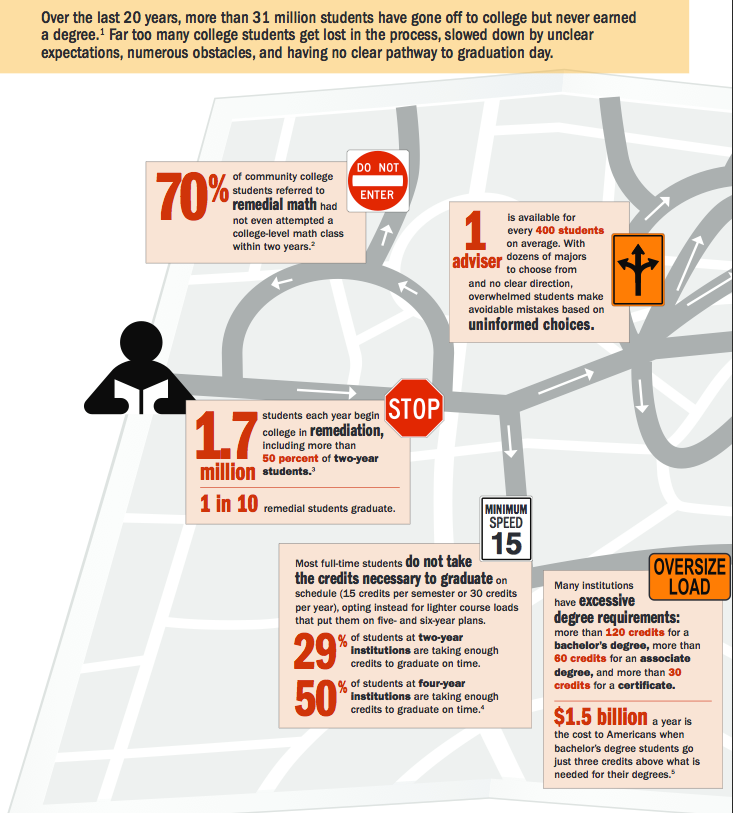
Below is a neat little graphic (courtesy of Paul Hemphill) breaking it down for you.

graduate in 4 years

Payscale’s 2015 College Salary Report


salary reportWith college costs rising, along with student debt, it’s more important than ever for parents and students to look carefully at college ROI (return on investment) when creating the college list. Payscale recognizes the importance of choosing a college major that will be a good return on investment and has released their 2015 College Salary Report.

Following are just a few of the categories covered in the data:

Majors That Pay You Back (Associate and Bachelor’s Degrees)

When somebody tells you they are headed to a college or university, whether it’s for an associate degree, bachelor’s degree, master’s degree, MBA or PhD, the first question out of everybody’s mouth is “Where are you going to school?” In reality though, the choice of major can have a much bigger impact on your future earnings than the school you attend. PayScale ranks the top college majors by salary to help you figure out how much you can earn after graduation.

Most Recommended Majors (by alumni)

What makes graduates recommend their major to students trying to pick a major today? One look at this list of most recommended majors shows us that the majors that people rave about are the ones that allow them to easily find a job in their intended field. It’s not necessarily how much money a person makes, but the likelihood that they can find work doing what they want to do.

Best schools for particular majors (by earning potential)

Choosing a college and deciding to get a degree are big decisions, so do your homework and choose the degree and school that will set you up for the career of your dreams. PayScale’s 2015 College Salary Report ranks undergraduate and 2-year colleges by the highest earning graduates.

Common jobs for particular majors

Choosing a college and deciding to get a degree are big decisions, so do your homework and choose the degree and school that will set you up for the career of your dreams. PayScale’s 2015 College Salary Report ranks undergraduate and 2-year colleges by the highest earning graduates.

College Comparison Tool (compare up to 5 colleges side by side)

Trying to decide which college or university to attend? PayScale has alumni salary data about more than 1,000 schools. Select up to five schools and see how they compare based on earning potential and more.

Most Meaningful Majors

When it comes to choosing a career and picking a college major that will help you achieve your goals, money isn’t everything. Job meaning counts for a lot too. That’s why PayScale asks everybody who takes our survey if they feel like their job makes the world a better place. This list ranks 207 college majors by the percentage of graduates in each major who answer that question with a resounding “yes.”

Here’s an article published in Money Magazine, “Choosing a College Major by Age 16 Pays Off”, proposing that students should think about choosing a major early to avoid spending more for the college education than necessary.

A college choices isn’t all about the money, but it should certainly factor into such a large financial investment. Parents and students should do their homework, just as they would if purchasing any other big ticket item.