All posts by Suzanne Shaffer

The Summer Before Junior Year of High School (10 Tips for Moms)


Your student’s junior year will begin in the fall. It’s time for you and your teen to sit down and evaluate goals to make sure you are on-track for the college application process. As you go back through all the grades, papers, awards and accomplishments you will be able to see your teen’s progress and that progress will encourage them to keep focused and keep their eye on the prize: graduation and college acceptance.

1. The Junior Year GPA

If your teen has been working hard, their GPA should show it. College admissions counselors will be looking hard at their GPA from their junior year. It’s an important year to show them that the grades are at the least consistent, and at the best rising from the previous year. Falling grades are an indicator of lack of focus and could hurt them down the road when their application is reviewed. This is a good time to schedule a meeting with your high school guidance counselor and discuss your teen’s progress, and verify that their courses are on-track for graduation and for the colleges under consideration.

2. Take the PSAT

This is the all-important PSAT year. Even if your teen took it last year as practice (and hopefully they did) they need to register again, because this is when it counts. This is the year that their scores will qualify them for the National Merit Scholarship program and scholarships. Follow the calendar deadlines and register EARLY. If they took the test last year review the answers that they missed and make sure they know why they missed it and take some time to study the correct answers.

3. Take SAT and ACT practice tests

Register for the SAT or ACT and spend this year doing some practice tests online and studying vocabulary. Cramming rarely helps, but studying over a period of time and preparation will help them approach the test with confidence and the knowledge they need to test well.

4. Preparing for the Essay

Research some college applications and look at the essay topics. Encourage your teen to start thinking about the essay and drafting some preliminary essays. The college essay can often push the admissions officer over the acceptance edge if it’s done well and is unique. Look through the past essays they have written in high school and see if any could be adapted for the college essay. The worst thing your teen can do is submit a misspelled, grammatically incorrect essay as part of their college application. Early preparation will assure time for proofing and re-writes.

5. Time for some college fairs and college visits

Junior year is a perfect time to begin attending those college fairs and visiting college campuses. Many schools allow for excused college visit days. Check with your high school registrar for specifics, because you might have to complete forms to get the absences excused. Collect business cards and contact information and keep track of them using a database program. These contacts will help later if you have a question regarding a specific school or need a personal contact during the admissions process.

6. Intensify the Scholarship Search

Junior year is the time to “hunker down” and get serious about those scholarship applications. As you get closer to senior year, you’ll find that many are age and grade specific. If you’ve done your homework, you’ll have a concise catalog of those scholarships ready for your application. If not, don’t panic. There’s still plenty of time to do some research and jump on the scholarship bandwagon. Remember that every scholarship you receive, no matter how small, is FREE money that you don’t have to pay back. Don’t forget to investigate private scholarships and school-specific scholarships to assure you apply by the specific deadlines.

7. Discuss Family Finances

Summer is a good time to have that money talk with your student. How will you pay for college? What do you expect your student to contribute? What can your family afford? This will help as they begin to finalize the college list and start applying to college early in the fall of senior year.

8. Review your high school progress

Look at the past two years to see if there are any gaps in your teen’s resume. Have your teen answer these questions:

  • Do you need to do some volunteer work?
  • Are you involved in some type of leadership capacity in at least one activity?
  • Do your courses and grades show their college level success?
  • Have you established a relationship with a member of the faculty and with your high school guidance counselor?
  • Are your extracurricular activities “all over the place” or are they focused?

It’s not too late to remedy any of these situations. Your teen still has time during their junior year to get involved, volunteer, get to know their teachers/counselor, and exhibit leadership.

9. Begin refining the college list

It’s time to get serious about the college list. This list will dictate your college visits during junior year and be the guidebook for all your research and financial questions. Do the research, gather all the data, and narrow the list down as your student approaches the end of their junior year.

10. Don’t overparent

If you feel yourself pushing or nagging, take a step back. Don’t fall into the “competition” trap that will begin when school starts. Parents will begin to brag and you might find yourself falling into that admissions game. Don’t do it. Your student needs to find the place that’s right for him, not the place that gives you the greatest bragging rights. Help him find that college and support his decision.


Scholarship Friday: Scholarships for Women


I came across this great list of scholarships for women at onmogul.com.

scholarships for womenComputer Science, Engineering & Business-Focused Scholarships:

Best Value Schools STEM Scholarship for Women: Female U.S. students who are majoring in science, technology, engineering, or mathematics at the undergraduate level. Applicants must have a grade point average of 3.0 or higher, and an SAT score of 1100 or higher; $2,000 annually, non-renewable; Application Deadline: October

Dell Scholars Program: High school seniors; In addition to winning $20,000, students become part of a Dell Scholar community. These scholars also receive the latest technology equipment from Dell so that they can succeed in college. They receive textbook credits, PCs, laptops, printers, ink, and other supplies; Application Deadline: unknown

ESA Foundation Computer and Video Game Scholarship: U.S. high school seniors and undergraduate students who are pursuing degrees leading to a career in computer and video game arts. Students must be female or a minority, and must have a grade point average of 2.75 or higher; $3,000 annually, non-renewable; Application deadline: May

The Generation Google Scholarship: Created to assist aspiring computer scientists excel in technology and become leaders in the field; $10,000; Application deadline: March 5th (for high school seniors) and January 15th for current college students

General Electric: Women entering fields such as engineering or business; up to $5,000; Application Deadline: unknown

Microsoft Technical Scholarships for Minorities and Women: Must be enrolled in university and actively pursuing a degree in computer science, computer engineering, electrical engineering, math, physics, or other STEM-related field; either full or partial tuition for the entire academic year; Application deadline: unknown

NCWIT Award for Aspirations in Computing: U.S high school females with grade point average of 3.0 or better; a $500 cash award; a laptop computer (provided by Bank of America); an engraved award for both the student and the student’s school; and a trip to attend the Bank of America Technology Showcase and Awards Ceremony; Application Deadline: accepted between September 15th and October 31st

NSHSS Foundation STEM Scholarship: U.S. high school seniors who will be attending college in the fall. Applicants must be a member of an underrepresented group, have a minimum 3.5 grade point average and be pursuing a major in a STEM field; Science, Technology, Engineering, and Mathematics; $1,000 annually, non-renewable; Application Deadline: unknown

STEM Scholarship for Women: Female currently attending or enrolled at an accredited post-secondary institution (under-graduate or graduate) and be majoring full-time in a science, technology, engineering or mathematics program; $2,000 scholarship, twice per year; Application deadline: October 31st or April 15th

Read more . . .

9 Tips to Make the College Essay “Pop”


college essayYou’re filling out your applications; you are trying to make yourself look as well-rounded as possible, listing all of your school and community-based activities and leadership roles; you know your grades and SAT/ACT scores are good enough to meet the requirements of the few colleges you have selected. There is just one more hurdle – that essay! This piece of the application process has you a bit nervous, because you are unsure of your competition and of your ability to write an essay that will really stand out. So here are a 9 tips that should help you craft a college essay that will get noticed, impress the reader(s), and be memorable.

1. START EARLY

I cannot emphasize this enough. This is not the type of essay you can throw together at the last minute. If you are using the “Common Application,” you should already know that those prompts are published in advance, and they do not change often. In fact, for 2016 admissions, the prompts are the same as they have been for the past 5 years. Get online, read through the prompt options, and select the one that most appeals to you. If your prompt comes directly from the college, get the application material during the summer, so that you have plenty of time to look at those options and select one.

2. KEEP A RUNNING LIST

As you think about your prompt, get a small notebook and keep it with you. As something comes to mind that would be a good fit for the prompt, write it down. Don’t worry about whether it is the best thought or not – just get it down at this point. For example, suppose you have selected a prompt that asks you to speak to a life-changing event that significantly changed you in some way. You may, indeed, have several big evets in your life thus far. As they come to mind, write them all down.

3. REFINE YOUR LIST

As you get closer to the time to actually write the essay (1-2 months before it is due), go through your list. Eliminate the items that are least relevant or least likely to get a response from a reader; combine those that can be combined. Finalize that list with the point or points you intend to cover. Going back to the sample prompt of an event in your life that changed you, if you had a sick pet that you nursed for days that eventually died, that is sad. It may appeal to the emotions of a reader; however, that event is meaningless unless it has motivated you to study biology and the go into veterinary medicine. Then there is significance. If you spent a summer tutoring inner-city kids and were appalled at their lack of basic skills, then that may have been the motivating factor in your selection of elementary education, so that you can one day teach in an inner city.

4. READ SAMPLES OF “WINNING” ESSAYS

These are all over the Internet, and can get a “feel” for the types of essays and the styles that really impressed admissions decision-makers. Take ideas from these as you think about how you will write your essay.

5. DEVELOP YOUR OUTLINE

It doesn’t have to be formal – just get on paper the order in which your body paragraphs will be developed and what will be contained in each of them.

6. WRITE THE BODY PARAGRAPHS

There should be a minimum of 3, and each needs a topic sentence and a good transition that leads to the next paragraph. Once written, re-read, revise, ad re-write until they are perfect – not one grammatical or spelling error, and good diversity of sentence types. Don’t be afraid to use humor if it is appropriate, and don’t be afraid to elicit emotions from the reader(s).

7. YOUR INTRODUCTION – THE CRITICAL PIECE

If you have not engaged the reader with your first sentence, you are “toast.” A short, simple “stunner” sentence that gives an amazing fact or leads into an anecdote is required here. The rest of this paragraph introduces your topic and ends with a solid thesis statement.

8. YOUR CONCLUSION

Tie back to your introduction. If you plan to study auto-immune diseases in dogs, with a goal toward prevention and cure, say so; if you plan to be the teacher that turns poor-performing children into success stories, say so!

9. STEP BACK; TAKE A BREAK; LET OTHERS READ IT

Get someone who is an English composition “master” to review and edit your essay; let friends or relatives read it and tell you honestly if they were intrigued and engaged by your first sentence. And don’t over-revise – you’ll lose authenticity!

______________________________

About the author: Great desire to make the world better – that’s what caused Julie Ellis to write. Wide experience of work with students in the role of Chief Editor PremierEssay allows her to communicate to readers with only relevant and interesting information. Follow her on twitter to find more interesting articles.

Creative Organization Ideas for College Dorm Rooms


My guess is it happens to at least one of every two college freshman each fall. Living on campus has been something they have dreamed about since that day they caught their little brother reading their diary in seventh grade. Everything about it is new and exciting, including the freedom and the novelty of it all. Yet sometimes it may come as a surprise when they arrive and realize just how cramped their new college dorm rooms can be. In most cases it doesn’t matter because the simple truth remains: they are living on their own.

Along with that comes the opportunity to personalize the new space, which we think can be made a little more fun by using some of these creative and space-saving ideas:

Dress up that plastic storage

Chances are at some point in college, you will find yourself in need of plastic storage. Not only are these handy vessels essential to staying organized in small space, but they are portable for those multiple moves you may make throughout the college years. Make them a bit more private and a lot nicer to look at by giving them an inexpensive makeover.

college dorm rooms
via LW Designs

Think outside the box

Why buy one of those tiny space-saving ironing boards you will only use for four years when you can repurpose something you most likely already own? A foldable TV tray can serve the same function when covered with some batting and fabric. Not only is it space-saving, but it’s cute and could double as a desk or other surface in a space that generally lacks surfaces to work on.

college dorm rooms
Via Like A Saturday

Don’t waste hidden storage opportunities

Finding a place for everything is probably among the biggest challenge in dorm living, especially if your roommate also has way too many pairs of shoes. Make life a little simpler by remembering to use every empty space that could be otherwise forgotten, including under the bed.


college dorm rooms
Via The Berry

Simplify the shower

If your dorm room has its own bathroom, chances are you are sharing it with at least one roommate, if not several suite mates. Simplify your shower storage by adding a second shower rod inside the shower where you can hang extra essentials like loofahs and shower caddies, without having to lug them around everywhere each time.

college dorm rooms
Via By Dawn Nicole

Get crafty

In a small space there may not be room for a bedside table, but that doesn’t mean you don’t need a place to keep your book and glasses after all those all-nighters. To avoid having the little things accumulate in random places, consider making a bedside caddy that suits your space needs.

college dorm rooms
Via My Poppet


Reinvent the white board

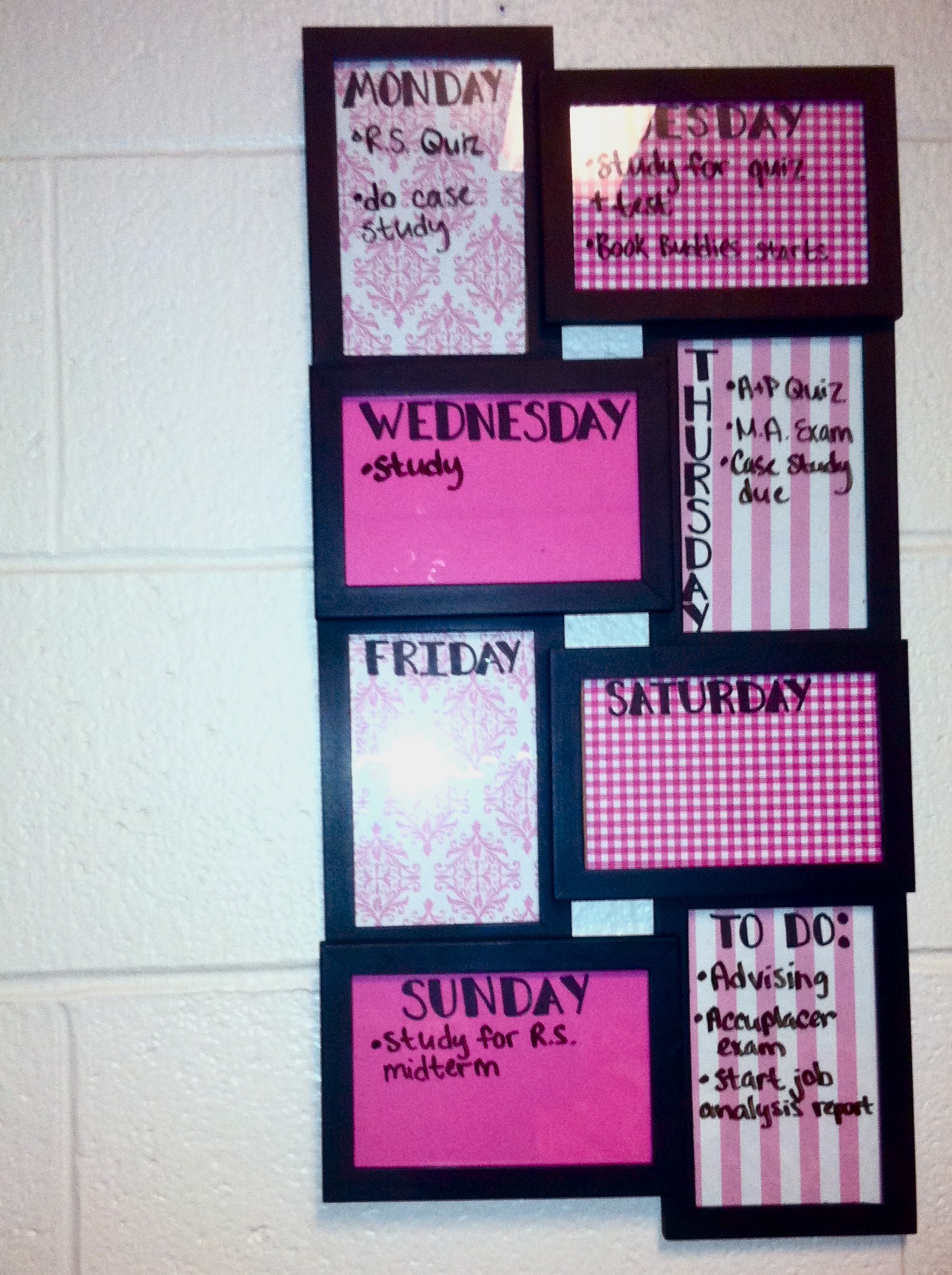
White boards and calendars are a must in dorm rooms for keeping up with multiple busy schedules. But it’s okay for you to think beyond the white. Dress up the traditional organizational concept by using fun alternatives, like a photo collage piece.


college dorm rooms
Via Dormify

Make the space your own

Function meets style with the right furniture choices. If your budget allows, consider investing in cube storage that can not only create additional storage options, but act as a room divider.


college dorm rooms
Via: Ikea

Today’s post was written by Tyler Schmidt. For more design ideas, head to Modernize.com.

Get Your Dorm Room Organization On!


dorm organization

Who wouldn’t like a dorm makeover? Those dorm rooms are small, cramped and devoid of any style. If your college student is heading to college in the fall, you can sign up for the College Savings Weekend at their nearest store, students will be entered to win one of ten $1,000 Dorm Room Makeovers!  Don’t miss the Container Store’s Weekend event:

_____________________________

college dormAt The Container Store, we’ve been helping college-bound students and their families prepare for the big move-in for almost 37 years now!  We’ve also been hosting fun shopping events for over 20 years to help make the dorm prep process an easy A. No one focuses on dorm room organization like The Container Store does all year round – and especially during the summer months leading up to college move-in!!

This year we are SO excited to host a College Savings Weekend in our stores nationwide, Friday – Sunday, July 10 – 12, where college customers will receive 20% off their purchases ALL WEEKEND LONG!  We will have surprises, prizes and great savings in stores for our college-bound customers and their friends all weekend!  To sign up and to check out our expert dorm tips, checklists and more, students and their friends should visit our Dorm homepage at www.containerstore.com/college.

REGISTER BY JULY 8 TO RECEIVE ALL THE SPECIAL OFFERS

In addition to our shopping weekend, we offer many great tools, resources and services to help college-bound students and their parents stay organized with their college move. Our website features videos from real college students utilizing our products in their dorm room, an organized dorm checklist and our tried-and-true Dorm Room Basic Six™ – the six areas to focus on when organizing your dorm.

Also, we know many students will be traveling near and far for their first day of college this Fall. At The Container Store, we make it easy to shop and transport purchases to save space and time during the big move. No more worrying about fitting everything in the car in one trip! When customers use our GOSHOP! Service, they can shop at their favorite store or online and we’ll make sure their order is ready to pick up at a store near campus when it’s convenient for them! How cool is that?!

The Summer Before Sophomore Year of High School (10 Tips for Moms)


Not much advice is given for the sophomore year of high school. It’s almost as if it’s not an important year in high school. But it is. Every year in high school is important if your child wants to move on to higher education.

Your teen has jumped in and is now a “seasoned” high schooler. Hopefully you have both gotten use to the high school routine. Sophomore year brings your teen closer to their goal of attending college. It’s during the 10th grade that your teen will begin to take some baby steps toward realizing their goal of a  college education. The focus for this year should be: preliminary testing, looking at careers, delving deeper into the college search, and getting heavily involved in a few activities.

Here are 10 tips to help parents prepare for sophomore year:

1. Begin talking about life after high school

Is your student drawn to traditional college or more toward a technical education or even entrepreneurial endeavors? These are important discussions to have as your student proceeds through high school and on to graduation. Technical colleges like Penn College address both issues by providing hands on training and a liberal arts education. But if your student wants only the technical training which is often a shorter time frame, you should also explore these options as well. Just remember, however, that this is only a discussion. Your student may change his mind many times over the next few years; but be open to any possibility.

2. Do Preliminary Testing

This is the year to take the PSAT (preliminary SAT) and PLAN (preliminary ACT). Why take them so early? First of all, because it doesn’t count and it’s great practice; secondly, because it will give your teen an idea of their testing strengths and weaknesses while they still have time to make improvements.

The key to utilizing these early tests is for your teen to get the scores and the test booklet and review the questions to find out which ones were answered incorrectly. Don’t just take the test, file the scores, and cross that task off your list. The whole point of testing early is to utilize every resource available to help your teen achieve testing success. There is nothing more disappointing than receiving low test scores when your teen excels in academics in school. Testing is all about being relaxed and knowing what to expect. These preliminary tests will help alleviate the stress of the unknown and help your teen prepare for the ones that really matter.

3. Explore careers

By now, your teen should know what interests them in school. Are they drawn to the sciences? Or is drama their cup of tea? Do they excel in math? Or are they interested in literature? These interests will serve to guide your teen down the right career path. It would be useless to pursue a career in the medical field if science and math are your teen’s least favorite subjects. It would also be frivolous to head down an acting career path if your teen does not like being on stage in front of people. Analyze their interests and strengths to guide them in choosing the career that would best suit them and feed their passion.

4. Take personality and/or career inventory tests

You can start here: http://www.allthetests.com/career-tests-job-quizzes.php and search for other tests online. Most of them are FREE and can be used as a tool to further determine the direction your teen might be heading in the college/career search. Many schools have software and testing as well that they offer to their students to help them find the right match.

5. Attend career days

Many cities offer career days with speakers from various walks of life. Encourage your teen to attend these and ask questions. Find out where the speaker attended college and the types of classes he/she might recommend if your teen is interested in that career. There’s nothing more beneficial than speaking with an actual doctor, lawyer, engineer, actress, musician, teacher, fashion designer or entrepreneur.

6. Delve deeper into the college search

You’ve done some internet surfing, looked online at some colleges that might appeal to your teen, and done some preliminary reading. This is the year that you increase the depth of your college search. As you progress through the process and the research you should get closer to narrowing down the schools that best fit your teen.

7. Start making a preliminary list

This is your teen’s list of college possibilities. Every teen has their “dream” college. They may not voice it, or allow themselves to think about it, but most of them have that name sitting in the back of their mind. Once they begin to know what their interests are and what is important to them, the list will start to take shape.

8. Take some online college tours

You and your teen can take some virtual tours of college campuses, and even purchase DVD’s of specific colleges if you want more in-depth information. These preliminary tours will give you and your teen a feel for the campus and prepare you when summer comes along and you start visiting some campuses. These visits are extremely important, and I will go into greater detail during the junior year plan. However, getting an early jumpstart, especially with some colleges within driving distance, will help your teen get an indication of what to expect when the tours become more focused as you begin to narrow down the final college choices.

9. Get heavily involved in a few activities

Admissions counselors have antenna for students that “pad” their high school resumes. These are the ones that dabble in a little of everything but never get involved in depth. While it’s important to try many different activities during high school, it is also important to settle on the few that interest you and stick with them. The goal is to eventually take on leadership positions or an active role in the mechanics of the organization. Help your teen to find the one activity that interests them and stick with it throughout high school. My daughter got involved in NJROTC and eventually became an officer in the corps. She also joined the drill team and the academic team, showing a level of commitment and focus.

10. Don’t forget the scholarship applications

You should encourage your teen to continue applying for scholarships. This task becomes more important during the next few years because many scholarships have age requirements and restrictions. Stay on top of the application deadlines and don’t get the “sophomore slacker” attitude. Your teen is headed into the home stretch and junior year is looming on the horizon.

The Freedom to Choose

freedom

Today is Independence Day and along with all the fireworks, barbecues and festivities, we should always reflect on the meaning of freedom. Our college bound teens would tell us that freedom means they don’t have to be under the constant supervision of parents when they leave for college. Our upcoming seniors would say freedom means they have the right to choose the college they apply to and attend.

While the freedom to choose is at the center of our independence, we are also responsible for those choices and the consequences they might bring on ourselves and others.  That’s why it is extremely important that parents explain the consequences of a wrong college choice. What constitutes a wrong college choice:

  • Choosing a college that you simply cannot afford causing you to incur too much student loan debt
  • Choosing a college that you really know nothing about based on the choices of your friends
  • Choosing a college because it’s far away from home or close to home without investigating other factors like graduation rate, course availability and student population
  • Choosing a college because your boyfriend and/or girlfriend is going there and you don’t want to be separated
  • Choosing a college that does not match your social interests (i. e. a college that everyone goes home on the weekends, or a college with a predominant Greek life culture that doesn’t interest you)
  • Choosing a college because someone else has chosen it for you (parents, friends, teachers)

As you can see, all of these choices will result in an unhappy student who will most likely drop out freshman year and result in a large monetary loss as well as student loan debt that will have to be repaid. Teach your teens who crave for the freedom of choice that along with it comes the responsibility of making that choice. Choose wisely after you have all the facts.

Happy Independence Day! Enjoy your family and your freedom!

The Summer Before Freshman Year of High School (10 Tips for Moms)


freshman yearThe summer is a good time for you to have a conversation with your future high school student. Sit down and have a discussion about the value of an education, how you see your role as a parent, some basic expectations, courses your student will take, the value of a good reputation, good citizenship and work ethic. This conversation will make the next four years easier because your teen will understand your expectations and start the year off with a good plan.

Your young teenager is preparing to embark on a high school education as freshman year approaches. In their mind, they are entering the first phase of adulthood. In your mind, they are still children and those feelings that you are “losing them” begin to creep in. High school means that you will be less visible as a parent, but it does not mean you are to be uninvolved. In fact, you will be even more involved behind the scenes as a parent coach.

Here are 10 tips to help you start your teen’s high school years off right:

  1. Make a visit to your teen’s counselor– Do this at the beginning freshman year. Let the counselor know that you intend to be an involved parent and establish a relationship at the start. The counselor is an important source of information and of course guidance regarding your teen’s college pursuit.
  2. Establish relationships with teachers and staff– Since most parents tend to drop out when their teen reaches high school, it’s crucial that you make it clear to the educators that you will be a partner in educating your child. Keep in touch and verify your teen’s progress via email if it’s available and attend any teacher conferences or parent meetings that are scheduled. Show up at PTA meetings and parent information sessions, making you visible to the staff.
  3. Read all school information– Once you have stressed to your teen the importance of ensuring that ALL information gets home to you, you must take the time to READ it. This means reading the school handbook, teacher handouts, letters to parents, guidance department newsletters, any rules and policies, and homework and attendance rules. Discuss these with your teen to alleviate any future misunderstandings that might arise over failing to follow school guidelines.
  4. Stress the importance of good attendance– Attendance is key in high school. Missing even one class can put the student behind. Schedule appointments, when possible, before and after school. If there is an absence, make sure your teen does the make up work in a timely manner. If the absence will be for an extensive period of time, coordinate with the teachers to assure the makeup work is completed.
  5. Encourage strong study habits– These habits will follow your teen to college. Set aside a regularly scheduled study time. Studying needs to be a priority before any added activities. GPA rules in the college admission process and good study habits will assure your teen enters the process with an impressive one. Don’t allow your teen to procrastinate and go into overdrive because they waited until the last minute to complete a project.
  6. Stress regular contact with teachers and counselors-This contact will play an important role when your teen needs recommendation letters. It will also establish in the minds of these educators that he or she means business. They will see that your teen is there to learn and excel and ask questions. Those students are the ones that are recommended for leadership positions and academic awards. It can be something as simple as saying hello in the hallway or using the counselor’s office to research scholarships.
  7. Be the organization coach– My mantra for high school was: Preparation Prevents Panic. If you know where everything is, have a schedule and a plan, you won’t get stressed and frustrated. Sometimes the only filing system a teen has is their floor. It’s your job as their parent coach to help them start and maintain good organization for their date planners, notebooks, folders, files and college related materials.
  8. Stay informed and involved– This does not mean camp out at the school every day and follow your teen around (although that is tempting). It means monitoring quizzes, grades, daily homework assignments and long-term projects. If you begin to notice any problems, schedule an appointment with the teacher and work out a plan for tutoring if it’s necessary. Don’t wait for the report card to lower the boom. If you stay proactive and informed, you and your teen will be able to fix any problems before they become catastrophes.
  9. Know your teen’s friends (and their parents)– Your teen’s out of school activities will always affect in-class behavior. In high school, it’s as much about social activity as it is about academic success. Assuring that your teen’s friends share the same values and goals will make a difference in their focus in and out of school. Encourage them to make friends that have college as a goal and have the same study habits. Take the time to meet and get to know your teen’s friends parents. Make sure they share your values and understand your position on smoking, drinking and drugs.
  10. Be proactive when you encounter problems– All types of problems arise in high school: academic, behavioral and even social. There is a logical solution for all of them, but the key is to be aware when they arise and address them quickly. Academic problems require additional teacher help, tutoring, and possibly study skill courses. If you encounter behavioral problems contact the school counselor or principal and discuss with them recommendations for the particular situation. Coaches can often help, along with a mentor. Sometimes professional counseling is warranted. Don’t ever be afraid to ask for help. And don’t make the mistake of turning your head and going into denial. Problems only get worse if they are ignored, especially in high school.

Don’t assume that this will be an easy transition for either of you. It’s another milestone in your student’s life and yours as well.

Wednesday’s Parent: Questions to ANSWER and ASK on a College Interview


college interviewLast year, I wrote two blog articles for TeenLife Magazine about the college interview. Since I feel they are great tips, I’m sharing them today on Wednesday’s Parent.

If you’re going to college, expect to be interviewed by a college representative. It’s a vital part of the college admissions process. Why? Colleges want to get to know you: Who you are, what your goals are, and how you will contribute to the student population. They also want to see how you answer questions, how informed you are, and your views on other topics.

When my daughter was in the midst of her college search, she was interviewed by a representative of Boston University. Since this was her first choice college, she was nervous. She wanted to make a good impression and appear intelligent and confident. She prepared for some interview questions. Not all of them were asked, but it helped her go into the interview more relaxed. Although she wasn’t a top candidate according to their applicant statistics, the interview resulted in an offer of admission.

Here is a list of 10 interview questions colleges might ask and suggestions on how to respond. Can your student answer these 10 college interview questions?

Click here for the original article.

Not only is it important to answer the interviewer’s questions, it’s also important to ask questions at the interview.It might seem like the college is interviewing you when you sit down for that appointment. But in truth, you are also interviewing them.

The answers to the questions they ask you are important. But the questions you ask them can be just as important and can also help you make your final college decision. In the end, it’s not just them choosing to admit you, it’s you choosing to accept their offer of admission.

Here are 5 questions you should ask, even if they don’t ask you, “Do you have any questions?”

Click here for the original article.

College interviews can be scary but they are a key element of expressing interest in a college. Don’t make the mistake of neglecting to schedule an interview. These tips should help your student prepare.

Read Wendy’s Post: Interviewing the College Interviewer

++++++++++++++

Wednesday’s child may be full of woe but Wednesday’s Parent can substitute action for anxiety. Each Wednesday Wendy and I will provide parent tips to get and keep your student on the college track. It’s never too late or too early to start!

The bonus is on the fourth Wednesday of each month when Wendy and I will host Twitter chat #CampusChat at 9pm ET/6pm PT. We will feature an expert on a topic of interest for parents of the college-bound.

Wednesday’s Parent will give twice the info and double the blog posts on critical parenting issues by clicking on the link at the end of the article from parentingforcollege to pocsmom.com and vice versa.

How to use Google for Essay Research


google

You can use Google as a search tool to help you write your essays, and you can manipulate it to save your time, effort and hard work. If you are smart about it, you can cobble together an essay fairly quickly if you use Google. Once you have the raw materials from Google, you can start refining the work, altering the flow and making sure it is correctly weighted, checked and correct.

Run a Google Search for Other Essays

http://tinypic.com/r/2z6ds3o/8

The trick is to copy and paste your questions into the Google search engine. It will kick up any other essays that have been written on the subject, along with blog posts and journals that may answer your questions.

The truth is that many professors use the same questions over and over again, especially if they are listed in the textbooks, and many students upload their work to the Internet or sell it when they finish college. You can take advantage and look up what other people have written.

Don’t copy it verbatim, but make note of their better points and take a look at their reference sections to see if there are any good research materials you can use.

Use Google Scholar for Ready-Made Citations

http://tinypic.com/r/102umpk/8

Having to write out your reference section “correctly” is boring and annoying, even if you have a good citation generator. Instead, search Google scholar for the reference material you are using (books, journals, etc). If it is listed on Google scholar, you can click the cite link and copy and paste a ready-made citation. It saves time and a lot of effort.

Use the Index Section at the Bottom of Wikipedia Pages

http://tinypic.com/r/2lto8s5/8

On almost every subject you can research, you will find an entry on Google for a Wikipedia page. You are not allowed to reference Wikipedia in your essay because it is not considered reliable. However, some of the links and references at the bottom of the individual Wikipedia pages are very credible. Follow them and they may lead you to some great research material. They may also give you references you can add in to your essay.

For example, if you have just made a point, you may find a similar point made on Wikipedia. If it has a number next to it, which is a link to the reference, you can click on it and copy the reference to prove your point (as it echoes the one on Google).

Use Other People’s Ideas Online

http://goodmenproject.com/wp-content/uploads/2015/02/CoupleWorkingHome.jpg

When you Google the questions on your essay, don’t just look at journals and other essays and such. Search around people’s opinions and thoughts on the subject and topic. Use them to spur your creativity and expound on their ideas making them your own.

Search for Proof after You Have Made Your Point

The usual routine is to find, think up an idea, research it, find proof and turn it into a point or argument that you put in your paper. This is all fair and good, but there are many times when you know you are right and you can turn your idea straight into a point that you enter and expand upon in your essay.

The trouble is that at this point you have no evidence to back up your point or even to back up your idea. You are not going to get top marks if you cannot nail down every point with suitable evidence. So, all you do is search for the evidence after you have made and expanded upon your point.

Search out similar points in other people’s work and see whom they referenced, then verify those references. Just make sure that the point that person is making is very similar to yours and that the reference is suitable.

++++++++++++++++++++

Today’s guest author is Linda Craig, a writing enthusiast and a professional editor at assignment help http://www.assignmentmasters.co.uk. Her passion is modern British Literature and digital education tools