Netflix recently released a documentary/re-enactment of the Varsity Blues scandal over college admissions. You probably heard the news last year about rich parents paying bribes to get their less than stellar students into elite universities. If you have the time, have a student heading to college, or are simply interested to see how the scandal unfolded watch the documentary.
As I watched I realized how much the media highlighted the celebrities involved and neglected to examine why this happened. The college admissions system is broken. Granted, there has always been those who benefit from huge donors, legacies and connections. But the overwhelming desire to get into the “prestigious” colleges has caused parents and students to step outside the normal boundaries and into illegal and damaging practices.
I won’t go into details about the sting, or the characters involved, but I think it’s important to focus on some take-aways from the documentary and also think about what we learned from all of it.
Covid-19 has certainly thrown a wrench into every aspect of our lives. If you have a college-bound teen, you know that the college admissions landscape has changed.
Before the pandemic, test scores were at the top of every college’s list—not true any longer. Before the pandemic, students freely visited colleges, meeting students and admissions officers—not true any longer. Before Covid, the financial aid landscape was simply held in information on the FAFSA—not true any longer. Before the pandemic, the college application and it’s components were set in stone for every college—not true any longer.
Since the college admissions landscape has changed, I’m going to spend a few days outlining the changes to help parents and students understand what’s happening in college admissions since the pandemic.
A quick look at several changes
Road 2 College, one of my favorite sites for college admission information, outlined some Covid-19 developments in a video that you should know about:
1. The vast majority of colleges and universities are now test-optional. That includes more than 90% of all highly selective and elite schools.
2. Because two-year-old tax returns are used when completing the Free Application for Federal Student Aid and the CSS Profile, many a family’s financial information will be inaccurate when the financial aid forms need to be completed. More families will want to appeal their financial aid awards.
3. It’s not just need-based aid awards that can be appealed. At many schools, students can appeal the merit award they receive. In this environment, it’s likely that more students will be successful.
4. At least for high school seniors planning to start college in the fall of 2021, the merit awards that some schools offer will be greater. Institutions that are more likely to offer better deals include private colleges not located in major cities on the coasts and in areas where there is a shrinking pool of teenagers.
5. You don’t want to select a college that could close or experience severe financial issues. In the video, I talk about an easy way to determine if a school could be in trouble.
In addition to these, the college essay options have changed. Choosing a college has become more difficult based on the in-person visits being hindered at many colleges. Grades are being evaluated in a different way by colleges, due to the absence of test scores and the decision to become test-optional.
Due to the pandemic, the college admissions system has been forced to adapt.
Last year’s group of graduating high school seniors and soon-to-be college freshman, could not visit colleges due to the nationwide response of sheltering at home to flatten the curve.
In addition, students dealt with problems regarding standardized testing online causing many colleges to eliminate or pause standardized testing requirements. Students will have limited access to traditional extracurricular and volunteer opportunities. In addition, sports programs have been shortened or eliminated at many high schools.
Parents and students are wondering how all these changes will affect the college admissions environment and will it change what colleges expect from this year’s crop of future students.
To answer these questions, The Harvard Graduate School of Education’s Making Caring Common project coordinated with admissions leaders to detail what exactly should be considered in the application process during the school year ahead. After interviewing 315 college admissions professionals, they published a joint statement:
“As admission and enrollment leaders, we recognize that we and the institutions we represent send signals that can shape students’ priorities and experiences throughout high school. This collective statement seeks to clarify what we value in applicants during this time of COVID-19. We are keenly aware that students across the country and the world are experiencing many uncertainties and challenges. We primarily wish to underscore our commitment to equity and to encourage in students self-care, balance, meaningful learning, and care for others.”
These admissions leaders emphasized that students should communicate if and how the coronavirus pandemic has negatively impacted them, including if they have not had access to the internet or a quiet place to study or if they have had increased family responsibilities such as taking care of sick relatives, supervising younger siblings or working to provide family income.
To sum it up, they will value five aspects in the upcoming admissions year: self-care; academic work; service and contributions to others; family contributions; and extracurricular and summer activities.
Following are the specific explanations provided for parents and students from the college admissions professionals outlined in their statement:
Self-care.
Self-care is of high importance, especially in times of crisis. We recognize that many students, economically struggling and facing losses and hardships of countless kinds, are simply seeking to get by. We also recognize that this time is stressful and demanding for a wide range of students for many different reasons. We encourage all students to be gentle with themselves during this time.
Academic work.
Your academic engagement and work during this time matters to us, but given the circumstances of many families, we recognize that you may face obstacles to academic work. We will assess your academic achievements in the context of these obstacles. In addition, we will assess your academic achievements mainly based on your academic performance before and after this pandemic. No student will be disadvantaged because of a change in commitments or a change in plans because of this outbreak, their school’s decisions about transcripts, the absence of AP or IB tests, their lack of access to standardized tests (although many of the colleges represented here don’t require these tests), or their inability to visit campus. We will also view students in the context of the curriculum, academic resources, and supports available to them.
Service and contributions to others.
We value contributions to one’s communities for those who are in a position to provide these contributions. We recognize that while many students are not in this position because of stresses and demands, other students are looking for opportunities to be engaged and make a difference. This pandemic has created a huge array of needs, whether for tutoring, contact tracing, support for senior citizens, or assistance with food delivery. We view responding to these needs as one valuable way that students can spend their time during this pandemic.
We also value forms of contribution that are unrelated to this pandemic, such as working to register voters, protect the environment, combat racial injustice and inequities or stop online harassment among peers. Our interest is not in whether students created a new project or demonstrated leadership during this period. We, emphatically, do not seek to create a competitive public service “Olympics” in response to this pandemic. What matters to us is whether students’ contribution or service is authentic and meaningful to them and to others, whether that contribution is writing regular notes to frontline workers or checking in with neighbors who are isolated.
We will assess these contributions and service in the context of the obstacles students are facing. We also care about what students have learned from their contributions to others about themselves, their communities, and/or their country (Please see Turning the Tide for additional information about the kinds of contributions and service we value). No student will be disadvantaged during this time who is not in a position to provide these contributions. We will review these students for admissions in terms of other aspects of their applications.
Family contributions.
Far too often there is a misperception that high-profile, brief forms of service tend to “count” in admissions while family contributions—which are often deeper and more time-consuming and demanding—do not. Many students may be supervising younger siblings, for example, or caring for sick relatives or working to provide family income, and we recognize that these responsibilities may have increased during these times. We view substantial family contributions as very important, and we encourage students to report them in their applications. It will only positively impact the review of their application during this time.
Extracurricular and summer activities.
No student will be disadvantaged for not engaging in extracurricular activities. We also understand that many plans for summer have been impacted by this pandemic, and students will not be disadvantaged for lost possibilities for involvement. Potential internship opportunities, summer jobs, camp experiences, classes, and other types of meaningful engagement have been cancelled or altered. We have never had specific expectations for any one type of extracurricular activity or summer experience and realize that each student’s circumstances allow for different opportunities. We have always considered work or family responsibilities as valuable ways of spending one’s time, and this is especially true at this time.
It’s a new world; especially in college admissions. What we did last year at this time has been obliterated by the coronavirus. Future college students (upcoming seniors) will have to adapt. Current college students are faced with all sorts of dilemmas.
Just for parents, I’ve compiled some of the articles I’ve found about navigating college during COVID-19. I hope you find them helpful for you and your student.
Amy Romm Lockard of Dovetail College Consulting in Portland, Oregon works with high school students nationwide to look at careers, majors, colleges and other post-secondary options as well as all the pieces in between (testing, financial aid, teacher recommendations, scholarship applications and more).
High school juniors may be wondering how the pandemic will affect their college plans. Your student may be asking:
How is this virus going to affect my future college application?
Are these abridged AP exams going to count?
I worked so hard this year, took a rigorous curriculum, but now how can this pass/fail grading highlight my improved grades?
My prestigious summer program was just canceled—what can I do for the next several months?
With all the seniors currently asking for gap years, will this mean there will be fewer spaces in future years?”
We can’t know the future, but we can deal with what we know now. As time progresses, the options will change, but for now, here is some helpful information.
We looked at the kinds of challenges and changes that rising high school seniors may face this fall.
Here’s what we found.
All schools that return to on-campus learning will have new procedures in place for keeping students and staff healthy. That includes whatever the state mandates for the number of students allowed in buildings, mask use, how far apart they can sit, where they can eat, hand-washing routines, changes in how clubs and extracurricular activities are handled, and whether sports are played and can be attended.
Collaborating with the Making Caring Common project at the Harvard Graduate School of Education, college admissions professionals have jointly issued “Care Counts in Crisis: College Admissions Deans Respond to COVID-19.” The statement focuses on five points students need to keep in mind this year: Self-care, academics, service, families, and extracurricular activities.
Before the COVID-19 pandemic, rising high school seniors would likely be spending some time during the summer and fall visiting prospective colleges, attending college fairs, or meeting with college recruiters who visit their high schools. But what about now? As you might expect, researching college options for the Class of 2021 just got very interesting! Let’s take a look at what some of these formerly typical activities might look like this year. It’s the COVID college search year!
As college move-in day approaches, parents around the country have understandable concerns about online vs. in-person instruction.
Many parents wonder if the quality of instruction will be the same if classes are conducted remotely, and if it’s worth the high cost of tuition they’re paying.
Parents are also expressing anxiety about student safety — both health safety because of the pandemic and physical safety in communities where protests and violence continue. Unlike the decision about how classes will be held, your student may have a choice about whether to return to campus or study from home (unless their school has closed all residential facilities or is permitting only certain grades to return).
If you’re still up in the air about this, or just want to prepare your student as well as possible for a safe and healthy fall semester, here are some things to know and talk about.
We looked at the kinds of challenges and changes that entering freshmen and current college students may face this fall.
Here’s what we found.
All schools that return to on-campus learning will have new procedures in place for keeping students and staff healthy.
That includes whatever the state mandates for the number of students allowed in buildings, mask use, how far apart they can sit, where they can eat, handwashing routines, changes in how clubs and extracurricular activities are handled, and whether sports are played and can be attended.
COVID-19 has impacted many families financially — including their ability to pay for college. What may have been a positive financial outlook in the fall of 2019, when students applied and accepted admission, has changed dramatically for many families with the nationwide shutdowns and changes in employment.
Student athletes have been hit hard as many colleges are cutting programs to save money and stay afloat. Needless to say, athletes aren’t the only students who are impacted. Many students who’d planned to use family funds to pay for college are now faced with financial hardship and left wondering how they will be able to afford college. Families are being forced to get creative and look for funds in the form of scholarships and grants if they wish to avoid borrowing to pay for college.
If you find you are short on funds to pay for college, use these tactics before you decide to take out loans.
As freshmen and upperclassmen start thinking (dreaming?) about heading to college this fall. They’re going to be packing more supplies than usual, however. What will be different on campus this year, due to the continuing COVID-19 pandemic? Maybe more elbow bumps than hugs! Here are five things you may not have thought of. Make some preparations if possible!
In one of the most challenging periods in the last century, the Coronavirus has roiled healthcare systems and everyday life, with citizens wondering what the ramifications are for society and their everyday lives.
While public health and government officials are providing their expertise to the specifics of health and everyday life, high school students, college students, and their parents face special complexities in managing their finances and their college experiences.
When you have children, you know that you always have to play the right kind of role in their lives. And that can feel quite overwhelming. You need to keep them safe, you need to ensure that they’re healthy, and until their old enough to make the best decisions for themselves, you also need to guide their futures too.
This is why we’re often so interested and invested in the college process. When it comes to college prep, you’ll often know that you need to be actively involved. But sometimes, you won’t know what that looks like, or what you should be doing in order to help them prepare. So let’s take a look at some of the things that will help.
Grades
To start with, you’re going to want to make sure that the basics are covered – grades. Because your kids will need to have good grades to get into the best colleges. Or, at the very least, you need to know what the grade requirements are, and ensure they can keep up. This needs to be seen as the base.
Extracurriculars
But you do have to remember that college is about more than just grades. So many kids have fantastic grades, so it’s important to standout in other ways. This is where extracurriculars come in. There are lots of impressive extracurriculars that your kid could try. Think about their interests and where their strengths lie, and then sign them up as early as you can to see where they flourish.
Tutoring
Now, it’s also a good idea to think about tutoring. When it comes to getting in, a college prep tutor could be great. Your child many not necessary need tutoring academically, but it can often help to work with someone that knows the process, and can help you get in!
Summer Camp Prep
From here, you’ve then also got camp to be thinking about. Summer camp can be so rewarding for your kids, alongside tutoring. So why not think about enrolling them in a camp that can help? You could look into something specialist, such as CT STEM classes, or just a general camp that covers off a wealth of different areas. Either way, this experience can help them develop for the future.
That Je Ne Sais Quoi
Finally, you may also want to think about the little things that will help your child get into their dream college too. Now, not everyone will want to go Ivy League – but even other top schools can be competitive to get into. And it’s nice for you to think about ways for them to stand out. Do they have special interests? Any experiences that they can press? Having that little special something, or je ne sais quoi, can really help when it comes to applications. So pinpoint their special qualities and run with it.
You can talk to experts and read all the articles online, but nothing compares to listening to other parents and their experiences with college admissions.
Knowing there are other parents struggling with the same questions, problems and unexpected outcomes can help you feel less alone. But where do you find that information? There are two excellent Facebook groups to help: Paying for College 101 and Grown and Flown. With thousands of parents posting and commenting daily, you can ask any questions (even specific ones) and someone will most likely have the answer.
Parents have asked about testing, financial aid, homesickness, the college admissions process and much more. There are plenty of other parents available to offer their advice and non-judgmental help. According to a survey by Paying for College 101, “the most common words participants used to describe the admissions experience were “stressful,” “exhausting,” and “overwhelming.” Most parents can certainly relate to those feelings.
Other results of the survey include:
Most of the families responding (68%) were going through the college admissions process for the first time
27% of students applied to 10 or more colleges
39% applied to 1 to 5 schools
34% applied to 6 to 9 schools
42% of students were waitlisted
17% of these students being waitlisted at 2 or more schools
89% of responders received some form of financial aid. Of those receiving financial aid, 57% received only merit scholarships, 6% received financial aid based on need, and 37% received a combination of merit and need-based aid
66% of responders were either OK, Satisfied or Very Satisfied with their financial aid offer
62% of responders chose not to appeal their financial aid award
It’s important for parents to stay informed about the college admissions process. Fortunately, there are so many opportunities for you to gather valuable information without leaving home or paying for expensive college prep advice. Sonia Lal, M.Ed., a former Harvard interviewer and founder of Ivy League Potential LLC. organized the telesummit “Your Child’s Best Future: How to get your child into a top college and set for a happy successful life!”
Parents, students and educators concerned about college admissions are invited to attend the online summit “Your Child’s Best Future” to hear valuable advice from thought leaders and experts in the field. This free summit is open to all and can be accessed by signing up at yourchildsbestfuture.com.
The telesummit begins July 7 and concludes July 28, with a new interview every day of the event. Discussions focus on preparing students to gain admission to top schools, but will also cover related topics like financial aid, essay writing tips and personal development. The guest speaker list includes representatives from tutoring companies, time management consultants, essay writing advisors and financial aid experts.
Mike Williams, president of the David Allen Company, is one of the guests on the summit. His company teaches an advanced time-management strategy detailed in the book “Getting Things Done”. Visitors will also hear from Lisa Strasman, president of NCSA Athletic Recruiting, as well as Joanna Graham, director of academics at Veritas Prep. Graham read over 9000 applications while on the admissions committee at Georgetown University.
The summit is designed to share effective strategies, tips and advice that high school students can use when applying to college. It also addresses standardized testing and financial planning so that students incur less debt while studying in college.
Education is one of the biggest issues facing the nation in the years ahead, so it is essential for both parents and students to have access to accurate information and resources. Listeners can benefit from practical advice on all aspects of college admissions or focus on the topics most relevant to their concerns.
_____________________________
About Your Child’s Best Future Telesummit
The telesummit is hosted by Sonia Lal, M.Ed., a former Harvard interviewer and founder of Ivy League Potential LLC. She organized the telesummit “Your Child’s Best Future: How to get your child into a top college and set for a happy successful life!” to help parents and students successfully navigate the college admissions process. Lal loves helping high school students learn more about themselves and encourages them to pursue their passion.
Today’s guest post is from Ryan Hickey, the Managing Editor of Peterson’s & EssayEdge and is an expert in many aspects of college, graduate, and professional admissions.
It may seem like everyone you know is boasting about how their child effortlessly juggles advanced classes with guitar lessons, volunteering at the senior home, and learning Cantonese. It’s enough to give you a complex about whether or not your teen can even compete when applying for colleges.
Well, fear not. Here are five things you can do to ensure your own student’s trajectory is on the fast track toward college acceptance while preparing your teen for college.
1. It’s okay to put all your eggs in one or two baskets.
The Rushmore syndrome of encouraging your child to join every club in sight results in a student that seems like a jack of all trades and master of none. Admissions committees are no longer fooled by a student who suddenly seems to be interested in 30 different projects the summer before junior year. Instead, focus on your child’s specific interest and let them actually achieve a level of proficiency. It is much more important to demonstrate genuine skill and commitment. Also, it often leads to a solid topic for an application essay.
2. Leadership is better than variety.
On a similar note, by applying meaningfully to just one or two extracurricular projects, a student can begin to build a level of responsibility. This kind of maturity is something colleges particularly look for in applicants.
3. Looking for something to add fast? Volunteer!
Community service is not only a great way to help others, it can help your teen too. If you feel like something is missing in your child’s transcript, volunteering can be a low-level commitment addition. Also, it is generally relatively easy to gain a leadership position quickly in a volunteer setting just by showing some initiative.
4. What are you going to do with your life?
Specific career goals post-graduation can differentiate your child from other applicants. Make sure you have a conversation about this and keep in mind that this goal is not something that goes on any permanent record. The larger idea of presenting oneself as forward-thinking in an application gives your teen the desirable aura of confidence in their direction. Maybe your daughter wants to be a veterinarian—check to see if it’s possible for her to shadow a local vet. Again, it’s not imperative that he or she actually adheres to this once they get into college, put admissions committees like to see that kind of drive.
5. Be true to your school
A great way to stand out in your applications is to know exactly what you want in a university. One important metric that colleges use to compare to each other is called “yield ratio”—that’s the number of students that accept admission after it is offered. Schools like to feel wanted, and therefore one of the best ways to prepare your teen is to help identify exactly what he or she is looking for in a school and then narrow down choices to ideal places. This requires a little research and some tough decisions. It also means trying to make an official visit, if possible.
Don’t feel tempted to nudge your student into another program just because it might look good on a transcript. Like everything else, honesty is the best policy. It all boils down to specifics. If your child can demonstrate commitment and leadership in one subject that makes them focus on a future academic goal that can be linked to a particular university program, that is superlative application fodder. No need to know a word of Cantonese.
About the Author
Ryan Hickey is the Managing Editor of Peterson’s & EssayEdge and is an expert in many aspects of college, graduate, and professional admissions. A graduate of Yale University, Ryan has worked in various admissions capacities for nearly a decade, including writing test-prep material for the SAT, AP exams, and TOEFL, editing essays and personal statements, and consulting directly with applicants.
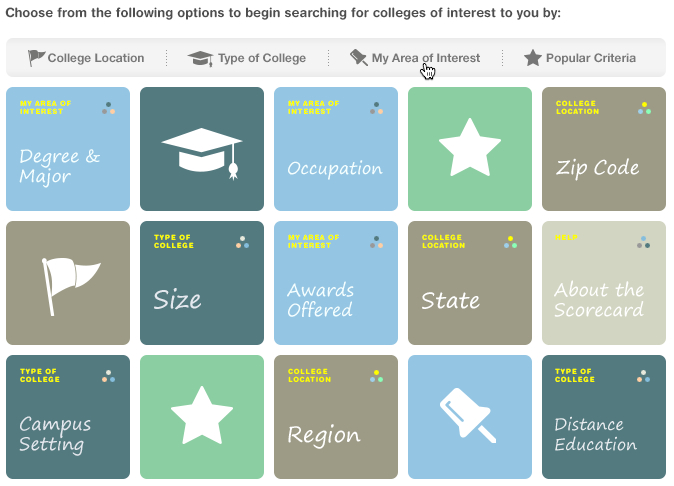
This past Saturday, President Obama unveiled his new College Scorecard. “You’ll be able to see how much each school’s graduates earn, how much debt they graduate with, and what percentage of a school’s students can pay back their loans,” the president said in his weekly address.
College Prep Expert and Long Island College Prep Examiner, Wendy David-Gaines, explains how the scorecard works:
Information about the performance of U.S. institutions was collected from over 7,000 colleges and universities over a period of 18 years. In addition to families using the College Scorecard to personalize their own college ranking list, the national and comprehensive data can be used by policymakers and researchers for their own analysis. “The old way of assessing college choices relied on static ratings lists compiled by someone who was deciding what value to place on different factors. The new way of assessing college choices, with the help of technology and open data, makes it possible for anyone – a student, a school, a policymaker, or a researcher – to decide what factors to evaluate,” according to the White House Fact Sheet.
Parents and students can use the scorecard to make more informed, wise decisions about the ROI of a college education. For further information on the college scorecard, read:
Did you know student behavior in high school can have an impact on college acceptance? The vast majority of colleges and universities use disciplinary records to help determine whether to accept or reject a student’s application, according to a new study discussed in an Education Week article.
The study, released on Friday, was conducted by the Center for Community Alternatives, a New York-based organization that advocates on behalf of students who’ve had prior court involvement. It found that roughly 3 out of 4 colleges and universities collect high school disciplinary information, and that 89 percent of those institutions use the information to make admission decisions.
Defenders of the use of disciplinary records in college admission decisions say it is an important way for universities to keep students with a history of behavioral problems off their campuses as they build incoming classes of freshmen. But opponents say high school disciplinary records have little predictive value, needlessly stigmatize students for infractions that are often minor, and reduce their opportunities for higher learning.
They also argue that the practice is a civil rights issue because of the well-documented fact that students of color and students with disabilities face disciplinary actions in K-12 schools at disproportionately higher rates than other students.
What are the implications for parents?
These findings make it even more critical for parents to begin creating students who respect authority and submit to the instruction and guidance of authority. In today’s world of helicopter parenting, it’s easy to step in and help students avoid the consequences of their actions. But that type of parenting only produces entitled children who rebel against teachers and school administration. Students should understand that the consequences of their bad behavior will quite possibly affect their college admissions options.