Protect Your Tech at College


tech at college

Young people love their tech, and love sharing content — movies, music, pictures, software and games, not to mention information for classwork and projects. They also go all over the Internet to make purchases, sign up to websites and access information, often putting important personal and financial data online. The fact that most colleges do not offer great Internet in dorms or on campus can only mean that there’s often a great deal of sharing that goes on.

The problem is that as tech savvy as college students usually are, they haven’t had much experience facing up to the consequences of carelessness. Malware infections could wipe out important data, projects included, lose people money, and spread among friends.

There is of the problem of actual theft and damage, too

Hundreds of colleges publish detailed antitheft guides for the benefit of students. They do it because it’s a prevalent problem — each campus reports around 100 laptop test thefts each year. Libraries, study areas and cafés tend to be high-risk areas.

Colleges aren’t well-prepared

Going by a study by BitSight Technologies, colleges simply aren’t well-prepared when it comes to protecting the interests of their students when they use their tech in college. Not only do college students experience high levels of infections by trojans, worms and viruses, there is often the possibility of adware infection, as well. Surprisingly, Apple computers, which tend to be popular on campuses, tend to be particularly under assault with malware such as Flashback that is specific to OS X. Colleges are not particularly well-prepared against physical theft, either. Most colleges do not buy insurance to cover their students. It’s every man for himself.

Students, who tend to be under considerable financial strain paying for college, can hardly afford to have their tech stuff damaged by malware, to lose money to identity theft (which tends to be a particularly serious problem in Britain), or to lose or break their stuff. It’s important to take precautions. 

Protecting your tech against online attacks

Malware: Colleges tend to offer students free anti-malware scanning and security software such as antivirus. It’s always a good idea to ask for it, rather than pay. When it comes to mobile devices, it’s important to use devices that haven’t been jailbroken or rooted. These processes can undermine inbuilt security measures. It is also important to learn how to discriminate between good software and bad (usually free) software.

Theft of financial information: Since students tend to do a lot of their internet use at public access points such as cafés and libraries, they tend to be exposed to a far greater level of risk than people who do their work at home. It’s important to remember to never access bank accounts or use credit cards at public places. It’s a far better option to do such work on a safe, personal connection — such as might be provided on a mobile Internet access plan. 

Protecting your tech against physical damage

College tech stuff tends to not be very long-lived. Whether it is dropping a laptop or gaming console or spilling liquid in one, bad things happen to good equipment in colleges. Improper use is also a prevalent problem. Students, for instance, may attempt to save money on their personal printers by using ink refill kits, or purchasing remanufactured cartridges at stationery stores. It’s a far better idea both for print quality and equipment life to simply look for discount cartridges online. Discount HP, Epson and Canon ink cartridges can be sourced here, for instance.

Protecting against theft

Finally, making sure that no one steals your stuff comes down to simple common sense — you don’t want to leave your equipment in a dorm room that isn’t locked, or leave it on a table at the library when you go to the bathroom. Theft is common.  Installing encryption and tracking software can be a good idea, too, if someone does get their hands on your computer.

John Sollars started Stinkyink.com in 2002, a printer cartridge supplier in the UK. He knows a thing or two about printing and he enjoys sharing his ideas and insights online through blogging.e

10 Lists of Gifts for Soon-to-be College Students

gifts

With the holidays approaching, parents are searching for gifts for soon-to-be college students. Heading to college in the fall, students have many needs (and wants). #CyberMonday is the perfect time to begin shopping for these unique gifts. This comprehensive list of gifts ideas from other websites should give you plenty of ideas when shopping for your soon-to-be college student.

1. 28 Useful Gifts for College Students

http://dodoburd.com/gifts-for-college-students

2. 10 Gift Ideas from Parents to College Students

http://www.usnews.com/education/best-colleges/slideshows/10-gifts-ideas-from-parents-to-college-students

3. 20 Great Holiday Gifts for College Students

http://www.cbsnews.com/news/20-great-holiday-gifts-for-college-students/

4. 17 Smart Gifts for College Students

http://www.forbes.com/sites/vanessamcgrady/2015/08/08/gift-guide-17-smart-presents-for-college-students/

5. 20 Great Holiday Gifts for College Students

http://wreg.com/2015/11/28/twenty-great-holiday-gift-ideas-for-your-college-student/

6. Stocking Stuffers for Students

https://www.pinterest.com/studentrate/stocking-stuffers/

7. My Favorite Gifts for College Students

http://www.amazon.com/lm/2F1DRI578IMWQ

8. 5 Free Priceless Gifts for the College Bound

http://www.examiner.com/article/5-free-priceless-gifts-for-college-bound

9. 12 Gifts for College Bound Students

http://www.parenting.com/child/education/12-high-school-graduation-gifts-college-bound-students

10. Top Holiday Gifts for College Students

https://www.universityparent.com/topics/dates-events/top-holiday-gifts-for-college-students/

Mother’s New Little (College Application) Helper


Today’s guest post is from Lisa Sloan of Portland, Oregon who is currently going through the admissions process with her son.

apply101

I am a master juggler. I don’t flip fire torches or bean bags, but as a parent, I am constantly keeping all of the balls in the air––meals, carpool, school project supplies, orthodontist appointments, etc. If you’re a parent, I’m sure you know I could add a hundred more things to the list.  At the time of maximum juggling, it’s time for my son to apply to college! Yay, more balls…

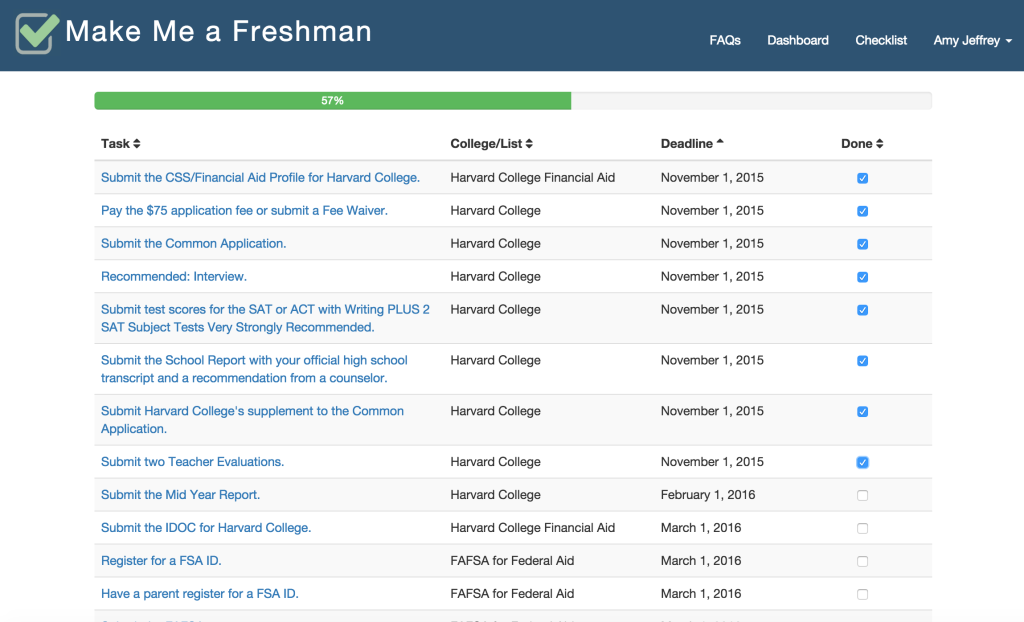
I was absolutely thrilled to learn about apply101. My son was able to select the schools he is interested in, and his calendar populated with all of the tasks and timelines he needed. I am able to monitor his progress through the app without having to constantly ask him if he’s done something, and having the timeline laid out for him makes it easier for him to stay on track. It’s not unlike keeping on top of homework or other assignments. I also appreciate that I can add as task that he will see without having to remember to talk to him about it. These days, those face-to-face opportunities can be hard to find, and then I have to remember what it was I needed to tell him when I do see him. Not always easy with everything else on my mind; apply101 to the rescue!

apply101

This past weekend is a great example. We had discussed letters of recommendation while we were in the car.  He was looking at university websites on his phone, and of course, each school wants things differently. One school wants the letters mailed to them, which means my son needs to address and stamp envelopes to give to the teachers he asks for recommendations. Another wants them submitted online, so that means emailing the teacher with the link. A third wants it through Naviance. While I drove, my son noted each task (and address) in apply101 so he didn’t have to waste time later figuring it out again. We also brainstormed about who he would ask for the recommendations, and he noted that too. When we got home, I gave him envelopes and stamps and I left the rest up to him.

At first I thought that since his high school uses Naviance that we didn’t need apply101, but then I learned that Naviance is a vehicle to request transcripts and sometimes, letters of recommendation, and although it has great college search tools, it doesn’t provide the calendaring of timelines and deadlines that apply101 does, so it’s not redundant. They work really well together.

I think it is important that the college process be something my son owns, not something that I drive. I honestly believe that his engagement at this point is indicative of his commitment, and it foreshadows how well he will on his own in college when I am not checking in on him all the time. I also know that senior year is crazy-busy for kids, so they need someone to have their back to make sure their balls stay in the air. That’s why I like apply101. It keeps him organized and lets me peek without hovering.


Online Resources to Craft a Great Scholarship Essay


scholarship essay

Writing an essay is always a challenge. You need to come up with a great idea, organize your thoughts into a concise, easy to follow structure, find supporting resources, and find the right words to make it all make sense. When you are writing an essay for a scholarship, it can be even trickier. There’s more on the line. These online resources will help you write a thoughtful scholarship essay to give you the best chance of success.

Essay Punch

Essay Punch is an interactive tutorial that takes students through all parts of the academic essay writing process. You will work with writing prompts to practice the organizing, writing, editing, and publishing stages of the process.

Thesis Builder

Your thesis is arguably the most important part of your essay. Without a strong thesis, the rest of the paper cannot take shape. And if your thesis isn’t well supported, your paper will likely fall flat. So, it’s very important that you construct a strong, easy to defend thesis. Thesis Builder will take your topic and help you come up with a great thesis.

Ask Petersen

Julie Petersen is an ESL tutor with an awesome website to help writers at all stages of the writing process. The website features educational articles, sample essays, study guides, and tools to help you succeed. There’s also a blog that offers writing tips and student life hacks. So, once your essay gets you into college, you can continue to flourish.

Help.PlagTracker

PlagTracker will make sure your scholarship essay is completely free of plagiarism. If you used any sources as references, even if they were re-written in your own words, it’s possible that the similarities will still be strong and show up as plagiarism. PlagTracker eliminates these sentences and replaces them with original content so your essay is 100% you own.

Step By Step Essay Writing Guide

Imagine that you’re stressed, extremely busy, and panicking because your essay is due tomorrow and you haven’t started yet! If this is the case, head over to EssayMama blog, and read their step-by-step guide to composing an essay in a pinch.

Teen Ink

This online magazine features articles and essays written by students. You can find fiction, non-fiction, and poetry. Use the site for inspiration for your own essay ideas or become a contributor.

Hemingway Editor

When you are writing a scholarship essay, it might be tempting to write long, eloquent sentences to show off your intelligence. This can easily backfire and can actually make it hard for your readers to understand your writing. Hemingway Editor will scan your document to make it readable. It will find any confusing or long sentences so you can re-write them. It will also point out instances of passive voice so you can change them to a more assertive active voice.

Citation Machine

When you’re writing an academic essay, you need to include references to show your research. But creating the references page is time-consuming and tedious work. Citation Machine can easily build your reference page for you. All you need to do is choose your citations style and medium and enter the data in the pre-determined fields.

 Writing.com

Become a member of Writing.com (for free!) and you’ll be able to make an online writing profile, get writing tips, and receive feedback on your writing from other members. There are also contests and writing activities to keep you motivated and help improve your writing.

Do you feel better prepared to go out and write that killer scholarship essay? I hope so! Don’t expect the process to be easy. There will be bumps along the way. You’ll get frustrated and want to quit. But remember that there are tools, tutors, and other students to help you through the process and keep you focused. Visit one or more of these sites for inspiration, organization, advice, samples essays, and even one-on-one help. So, go out there and get started. What are you waiting for?

A Parents Predicament: Balancing College and Affordability


It’s every parents predicament: balancing college and affordability. How to do pick a best value college? This infographic from Money Magazine should help.

balancing college and affordability


Words of Advice for Parents of College Bound Teens


encourage your child
Image by Flickr

It can be a nervous time for any parent who is sending their child off to college. I know, I have done it all before myself. However, it is easy to get consumed by your own nerves that you forget to really encourage your child.

Going to college is a huge step, and if you are nervous, imagine how your child feels. As a parent, the best way you can be there for your child is to show them support. Here are some of the best ways to encourage your child throughout their college years.

Give them space

You might be dying to hear about all their activities, but your child is out to enjoy their time! Don’t pester them by constantly phoning and texting. With the occasional message you will show you are always there. Your child will then get in touch at the times when he or she needs you the most. The best thing you can do as a parent is to give them space but be there for them when they need you most.

Learn more about their course

There are so many college courses to choose from and it is hard to keep up with them all. Even if your child is studying a more traditional subject like English or History, take the time to understand their course. Find out what they are reading. Get to know what essay topics they have to write about. This way you will be able to hold an educated conversation with them about something that matters to them. You can also use this knowledge to be able to discuss their academic goals. Help them plan out the things they want to achieve during their college years and think about what sorts of grades they want.

Get to know their friends

When your child leaves home you will no longer have any control over who they hang out with. However, you can take the initiative to get to know your child’s friends. This way you understand what sort of personalities they are attracted to and what people they tend to like. Every time you visit, have a chat with their roommate. Maybe you could even take a few of their friends out for a meal or coffee. This is great too because when your child phones you to let you know what has been happening lately, you will be able to put a face to a name.

Encourage all opportunities

At college, your child is likely to be faced with an abundance of amazing opportunities. Just because you want them to stay nearby, doesn’t mean you should discourage them. Your child has to live their life in the way they want to. One of the options that may present itself could be the chance to study overseas. Many parents feel worried about sending their child off to a foreign place. But studying abroad is one of the best opportunities you can have. Your child will discover a new culture and possibly even a new language. They will find a new independence and have friends all across the globe.

Don’t voice your fears

If you are nervous about your child leaving home, don’t let it show. You might scare them more than you want to by letting your fears rub off on them. Be supportive and enthusiastic talking about all the great experiences they will find when they are away.

Teach them about money

If your child has never lived away from home, they will more than likely not have had to fend much for themselves. However, as a student you need to be able to manage a budget and know how to control your finances. Teach them how to do this. Let them understand the value of money. If you have any tips on how to save, make sure you let them know. If you help them with this, they will be able to avoid debt after graduation.

National Scholarship Month: Kicks off with a $5000 Scholarship from Sallie Mae


To celebrate National Scholarship Month, Sallie Mae is offering student’s the chance to win $5000 toward the cost of college. All you have to do to be entered is to register for their scholarship search engine.

Here’s a short video on how it works:

Don’t pass up the chance to win FREE money for college!

Strategizing Paying for College


paying for collegePaying for college is an uphill battle filled with mindboggling FAFSA paperwork and a steady stream of education bills. Stress due to how individuals will pay for college, housing, textbooks, and extra fees can be a continual buzz at the back of the mind. In order to avoid thousands upon thousands of dollars in student loans, college students and their families can strategically make financial and professional decisions that will maximize the amount of federal and company student aid they will receive.

Employer-Provided Educational Assistance

Students, prospective students, and parents can decrease the out of pocket cost of college by pursuing a job at a company that has educational assistance or scholarship programs. Many smaller companies have a long history of providing scholarships for their employees and their employee’s children.

On April sixth of this year, Starbucks led the employer educational program charge by offering to pay for the tuition for all part and full-time employees. Employees can choose any one of the 49 undergraduate programs at Arizona State University online program. Beyond Starbucks, there are dozens of employers who have educational benefits programs. The majority of the programs offer anywhere from $1,000 to $5,250 in educational aid per year.

Students should also look into deducting their education from their taxes as a work-related fringe benefit. Educational fringe benefits help professionals seek the education required when they meet one of the following requirements:

  • They are required to receive the education by their employer or the law to keep their salary, status, or job.
  • The education will help improve or maintain a skills needed for your job.

They also cannot:

  • Allow you the possibility of entering a new field.
  • Allow you to receive minimum educational requirements for your field.

Does it sound like you might qualify? What individuals can deduct is just as expensive. You can dive further into the topic here.

Extended Family Contributions

Your grandma or grandpa planning on helping you pay for college? Before they write you a check, you can strategize how and when the grandparents help you pay for college to minimize what they pay in taxes and maximize how much financial aid you receive.

First off, grandparents can maximize the financial benefits of aiding their grandchildren by sending the tuition money directly to the college. Paying the tuition directly qualifies the educational contribution as a gift tax exclusion. What does this mean? The grandparents will not need to report the contribution to the IRS.

It should be noted that only tuition is considered a gift tax exclusion. If family members want to help students with other educational expenses, the money qualifies as a gift tax expense. The family member should tally the amount given to the student. If the amount is less than $14,000, the amount given does not need to be reported. Anything over the $14,000 must be reported by the individual who gave the gift. No taxes will need to be paid on the gift until the individual has given more than $5.34 million.

Don’t rush off to tell your grandparents the good news yet. Here’s the bad news: If they help you pay for college this year, it will decrease the amount you will receive in financial aid next year. Unfortunately the people at FAFSA assume if they help you this year, they’ll continue to offer the same amount of aid the following year. You can prevent this fatal mistake by advising your grandma or grandpa to wait until the last year or two of college before helping out.

Paying for college can be expensive, but it can be manageable by developing a game plan. Business educational assistance and familial educational gifts utilized at the right time can be the beginning to a successful financial strategy to pay for college.

____________________________________

Today’s guest blogger, Samantha Stauf, was a first generation college student. Since Samantha graduated two years ago, she’s spent her free time writing articles meant to help current students succeed. You can find her on Twitter at the hashtag @samstauf.

Wednesday’s Parent: Dual Enrollment Pays Double


dual enrollment

In my book, anything that saves you money on college is a good investment of your student’s time and your financial resources. Dual enrollment can not only prepare your student for college level courses, but can save you money on college. These courses are offered in conjunction with local colleges and students can take both high school courses and college courses at the same time.

According to Wendy David-Gaines, the Long Island College Prep Examiner and POCSMom, dual enrollment courses offer huge benefits:

10 Tips for Parents of the College Bound


10 tips for parents

Parenting a college-bound teen is a challenge. How much should you push? How much should you help? Where do you draw the line? How involved should you be? How do you help your student fulfill his college dreams?

Here are 10 tips for parents that should answer your questions:

10 Tips for Parents of High School Students

1. Don’t overparent

Much has been written lately about the damages overparenting does to students. Step aside and let your student take the wheel.

2. Make a visit to your teen’s counselor

Let the counselor know that you intend to be an involved parent and establish a relationship at the start. The counselor is an important source of information and of course guidance regarding your teen’s college pursuit.

3. Establish relationships with teachers and staff

Since most parents tend to drop out when their teen reaches high school, it’s crucial that you make it clear to the educators that you will be a partner in educating your child. Show up at PTA meetings and parent information sessions.

4. Read all school information

This means reading the school handbook, teacher handouts, letters to parents, guidance department newsletters, any rules and policies, and homework and attendance rules.

5. Stress the importance of good attendance

Attendance is key in high school. Missing even one class can put the student behind. Schedule appointments, when possible, before and after school. If there is an absence, make sure your teen does the make up work in a timely manner.

6. Encourage strong study habits

These habits will follow your teen to college. Set aside a regularly scheduled study time. Studying needs to be a priority before any added activities.

7. Stress regular contact with teachers and counselors

This contact will play an important role when your teen needs recommendation letters. It will also establish in the minds of these educators that he or she means business.

8. Be the organization coach

If you know where everything is, have a schedule and a plan, you won’t get stressed and frustrated. It’s your job as their parent coach to help them start and maintain good organization for their date planners, notebooks, folders, files and college related materials.

9. Stay informed and involved

This does not mean camp out at the school every day and follow your teen around. It means monitoring quizzes, grades, daily homework assignments and long-term projects.

10. Be proactive when you encounter problems

All types of problems arise in high school: academic, behavioral and even social. There is a logical solution for all of them, but the key is to be aware when they arise and address them quickly.

10 Tips for Parents of Seniors

1. Do the prep work

Get ready for the mounds of catalogs, test prep booklets, flyers and email reminders. Start your filing system now, create a landing zone for all college-related materials, start adding tasks on a calendar.

2. Do your best to control your emotions

It’s going to be an emotional time for both you and your student. Angry words will be spoken if you don’t make a conscious effort to bite your tongue.

3. Prepare for rejection

The upcoming year will most likely mean that your student (and you) will have to deal with rejection. It’s not personal, but you will feel like it is.

4. Decide what role you will take

Please. I beg you. Do NOT be the parent that shoves, manipulates, and actually does the work for their student. Be the parent who encourages, supports and offers help and advice when needed.

5. Prepare for emotional outbursts

This is one of the most stressful times in your family. There will be emotional outbursts as the stress intensifies. Your student will say things she does not mean. You will lose your temper and wish you didn’t.

6. Discuss the money

If you want to avoid disappointment when offers of admission arrive, have the “money talk” before your student applies to colleges. Decide what you can afford, what you will be willing to contribute toward the costs, and what you expect your student to contribute.

7. Accept there will be consequences to actions

Your student will most likely fail or mess up at some point during senior year. Rescuing your kids all the time only makes them into dependent adults and colleges aren’t impressed with those type of students or the parents that come with them.

8. Be open to all possibilities

Be open to any college choices your student might make. You will not be the one attending the college and it’s not up to you to choose for her.

9. Don’t push-it simply won’t help

If your student is unmotivated, it’s not going to help to nag her and push her to do the college prep work. If there is one thing I learned with both of my kids (and clients), if your student is not invested in the college process she won’t be invested in college.

10. Enjoy the journey

This is an exciting time in the life of your teenager. She has worked hard and will be planning her future. Enjoy the next year, even when you feel stressed and overwhelmed.

Helping parents with all aspects of college prep