Category Archives: careers

How to Help Your Student Prepare for College


Part of my goal here is to help parents find the tools they need to prepare for college. In today’s post, I’m featuring a free site that helps your student choose a career and find the right college fit.
prepare for college

As a parent, you most certainly think about your child’s future. You may see them as an engineer, a teacher, or a doctor. You may picture them at your alma mater, or being the first in your family to attend college. Maybe you just hope they find a passion and pursue it. Whatever you hope, you want what is best for your child and to support them in achieving their goals.

If you read parenting blogs, books, or articles, you know family support impacts a student’s academic success and transition to college, career, etc. You also likely know that the earlier students set goals and start preparing for life after school, their chances of reaching those goals are increased. Preparing for college as a freshman looks different than as a junior, but it is just as important for both students to connect their work today to the outcomes of their future tomorrow.

When students plan for the future early-on, they are more likely to enroll in rigorous courses, sign up for appropriate electives, become involved in extracurriculars, and consider their overall academic performance more seriously. More importantly, they learn the expectations of their goals, such as a necessary GPA, test-scores, course-load, leadership experiences, etc. By understanding these expectations early, students are empowered to take action over many years, rather than finding out it is too late, as a senior applying to schools.

While you may know what your child should do, it is not always clear how to help your child do it. With your best intentions in hand, you may ask ‘Where do I start?’ or ‘What resources are available?’

There are many resources that help with college searches, including the College Board, College Search, College View, and Princeton Review. However, there has never been a resource that combines all of the different aspects of college and career planning into one platform, and certainly not for free. As a result, we are excited to introduce you to Overgrad.

Overgrad is a completely free platform, which helps students and parents plan for life after high school. Students discover different careers and colleges that match their interests and abilities, and then receive personalized feedback, highlighting areas of improvement throughout high school. For example, you may wonder ‘Is my son’s GPA currently on track to gain admission to his ideal college?” or  “Is my daughter taking the appropriate classes to be prepared for an engineering program?” Overgrad is a tool that will answer these questions.

Other specific features:

How can Overgrad help you and your student?? 

  1. Explore Careers and Colleges

Thinking about the future is often daunting, and when it comes to choosing colleges and careers, students might not be sure where to start.

To help solve this issue, have your student take the Overgrad Career Interest Survey. Overgrad uses this survey to generate a list of possible careers aligned to your student’s indicated interests. Students can retake this survey as many time as they like, as we know interests change. This survey however, is merely a starting point. Students can also search over 1,000 other opportunities on the Overgrad “Careers” tab using filters such as “projected job growth, industry type, salary, etc.”

Students are also matched with colleges in a similar way. Overgrad uses your student’s current academic progress (GPA, test scores, courses) to match them with universities that are currently on their level. Students can use other filters such as type of university, location, graduation rates, etc. to narrow down their college list.  We also will allow them to view a unique profile for each college to to learn more before choosing their top schools.

  1. Choose the right classes

It is important to pay attention to your child’s class schedule to ensure they are meeting their high school’s graduation requirements and the basic admission requirements for colleges. In addition, colleges often take into consideration the rigor/difficulty level (honors, AP, etc.) of students’ schedules. Overgrad helps, by tracking what classes your student is taking and comparing their current courses to the expectations of the colleges on their list. If a college expects a more rigorous course load, you and your child will know.

  1. Take Action

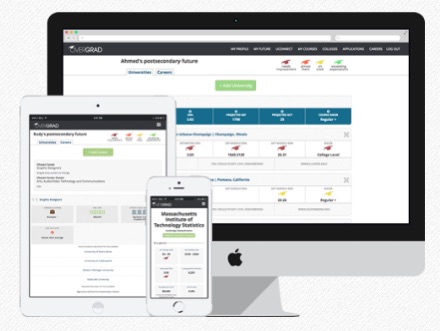
Once your child has found the best career and college matches, they add these goals to their personal “My Future” page by clicking “follow”. Their My Future page shows all their future college and career goals, as well as helps students track their progress towards meeting them. Additionally, students will see both their strengths and areas they might want to improve to increase their admissions chances for each college on their list. In the example below, Angelica is able to use the colored graduation caps to see how her GPA, test scores, and courses compare to each of her top schools admissions requirements. As students improve overtime, they can actively monitor their progress, and even see a college they are interested in change from a “reach” school to a “match”.

Interested in exploring Overgrad? 

Overgrad is accessible on any device—including laptops, phones, tablets, and PC’s and is absolutely free!

To start using our resources simply visit overgrad.com to create an account with your student.

We also offer Overgrad as a free resource to any school so feel free to talk to your school principal and/or guidance counselor if you would like to see Overgrad provided as a resource for all students.

If you have any additional questions along the way, feel free to email erin@overgrad.com.

How to Choose a Career Path Before College


career path

Many college students would like to get a job as soon as they graduate from college. However, this is not always the case for many of them mainly because they had not decided on which career path to take before college. Unfortunately, this situation is replayed in the lives of many graduates making it clear that the decision on which career path to take should be made before applications to colleges are sent out.  Here are some tips to ensure that you do not fall in the same trap of selecting a college before deciding on the best career for you.

  • Work backwards

After high school many students typically start looking for colleges that they would want to attend, then select a major and finally decide on the career they would like to pursue. However, this is not right and things should actually be done the other way round, with the choice of a career path being decided on first and then the rest follow. You should picture yourself filling in application forms for a job that you are passionate about many years after college.

  • Choose  a career you love

Do you know what you enjoy doing? In most cases, the answer to this question will make it easier to choose a career that you are passionate about. Always look into career possibilities that match your personality and in the long run will satisfy your needs for years to come. If your interests seem to be all over the place consider narrowing them down to at least three areas and choose a career that will march them perfectly. Also you can try out online tests that help people find a career path that go with their personality.  

The goal of a good career test is to match you to a group of careers based on certain parameters.  Career tests are typically multiple choice and take under 30 minutes to complete. They match you based on your personality.  For example, they could match you to specific careers based on your skills, interests, abilities, etc. A good career test will not give you absolute confidence in choosing a specific career.  However, they certainly can help you develop or narrow down a specific group of careers and that is half the battle in making your career plan. Here is a free career test that takes a few minutes to complete and custom matches you to over 1000 well paying careers. 

  • Select the right college

When you have settled on the career path you would like to pursue in the future, it is time to choose a major and a corresponding college. Although colleges to choose from are many, research on the best ones in the field that want to pursue so that you get the best education possible in the area. These colleges are also likely to offer several options in terms of majors that you can selecting according to your interests.

Overall, having an idea of the career you want to have in the future as you select colleges will keep you focused and motivated to work towards your dream profession.

________________________

Today’s guest post is from Aaron Ramsey, the owner and writer for Eapplicants.com, an online resource for job seekers to find all the information they need on today’s largest companies.

What Are the Alternatives to Traditional College?

traditional college

If traditional college isn’t for everyone, what’s the alternative?

Yesterday I posted an article: “Should Every Child Go To College?” The answer: It’s not for every child and parents shouldn’t push if it isn’t happening. You know your child better than anyone. Think outside the box and help your child find the right path.

Here are some other options beyond the traditional college path:

Community college

Many graduating seniors have decided to take the community college path. They made that choice for several reasons: cost, academic preparation, and the freedom to stay at home for the first few years. Community colleges aren’t just training grounds for technical careers, they are also the first stop for about 4 in 10 of college-bound high school graduates.

A gap year

More and more students are considering a gap year (or gap years) after high school. This time would be to explore career options, travel to discover yourself and gain cultural experience, volunteer for a year in a community service job or abroad, or work with the goal of saving money for college.

The military

While the military is not for everyone, it is a viable option for many students. Not only will you learn discipline, organization, and teamwork, but you will also gain job experience. The military has numerous career options to choose from that will transition into the workforce after your term of service is over. An added benefit is the education benefit veterans receive, allowing you to attend college using government funding.

Work and community college

Another option you might choose is working while attending community college. You can take as few courses as your time permits and ease into the college level courses. Working during community college also allows you to pay for college as you attend, avoiding large amounts of student loan debt.

Trade school or apprenticeship

The trades and/or apprenticeships are certainly overlooked as a path after college. Pursuing a trade ensures job security and future earning potential. You can go to a specific career school such as an art or fashion institute or a culinary institute, or you can work in with a professional learning their trade. Another option would be to consider a college that focuses not only on academics but also on hands on education. One such college is Pennsylvania College of Technology. You can read all about them in these series of articles.

Internships

Students can also work at paid or unpaid internships after high school. These internships will help you discover your interests and gain insight into various careers and what training or education you would need. Many employers offer paid education benefits while working and will often hire you as a full time employee after completion of the internship and/or education.

If your student seems unmotivated or uninterested in college have a serious discussion about his plans after high school. Make it clear that he needs a plan and help him formulate that plan. If they become part of the planning process and are involved in the decision making, they will be much happier with their choices.

Should Every Child Go to College?


college

I published this article about five years ago, but I feel it’s content is still true today. Too many parents push students to go to college when they are not prepared either academically, emotionally or financially. So many students go and fail because college is simply not for them.

_____________________

I read an article a few years ago in The Atlantic: “In the Basement of the Ivory Tower, that gave me some food for thought. It’s been on my mind for quite awhile, especially since I have a close friend who is a financial aid counselor at one of those infamous “for profit” colleges.

She would answer my leading question with a loud and emphatic, “NO”, based on her experience dealing with those who are not prepared to attend college and don’t understand the consequences of borrowing money they can’t pay back. They have been convinced that without a college education, they can’t get a job or pursue a career. They’ve been told by someone that it doesn’t matter how much money you borrow as long as you get that degree. Once you get that degree you can earn enough money to pay back what you’ve borrowed. But we all know that’s not often the case.

In the above mentioned article, the English professor makes an interesting point:

America, ever-idealistic, seems wary of the vocational-education track. We are not comfortable limiting anyone’s options. Telling someone that college is not for him seems harsh and classist and British, as though we were sentencing him to a life in the coal mines. I sympathize with this stance; I subscribe to the American ideal.

Sending everyone under the sun to college is a noble initiative. Academia is all for it, naturally. Industry is all for it; some companies even help with tuition costs. Government is all for it; the truly needy have lots of opportunities for financial aid. The media applauds it—try to imagine someone speaking out against the idea. To oppose such a scheme of inclusion would be positively churlish.

I’ve come to realize that Americans truly are snobs. We brag about what we have and what we have obtained. Like it or not, we are a classist society. We snub our noses at those who haven’t been to college and brag heavily about our numerous degrees as if they are badges of honor. And while graduating from college is an accomplishment, so is learning a trade.

Often, we push our kids to attend college when we know it’s not for them. Why? Because we are a society that measures success by the number of degrees hanging on a wall or the dollar signs that can be found on our bank accounts. It is noble to dream big and education is always a noble goal. But so is being a plumber, a carpenter, a cosmetologist or a civil servant like a police officer or fireman.

What’s my point? My point is that you need to know your child. If they want to go to college and have the skills and knowledge they need to be successful there, then encourage them to go. But if they aren’t interested or motivated, save yourself some heartache, disappointment and money by letting them pursue a trade or career and even consider a college that offers both. There are so many fabulous careers out there that they can do without higher education. You will be happier, they will be happier and they will fill an important role in society. College really isn’t for child.

Wednesday’s Parent: Consider a Career Focused College


planning for a career
Penn College students preparing for careers

With all the news about students graduating without job prospects, parents and students are researching alternatives to traditional higher education. One alternative is a career college. What would that look like? It would be a college that focuses on the career along with the degree–a career focused college.

One such college is Pennsylvania College of Technology in Williamsport, Pennsylvania. This college marries a liberal arts education with preparing students for a career after graduation by providing hands on career experience while attending. Students learn to weld, work on airplanes, construct houses, work on automobiles, and much more. Each career path offers a balance between education and career preparation. For more information on Penn College, check out my series: Degrees That Work on my blog.

Another college would be Northeastern University in Boston, Massachusetts. Northeastern offers a Co-op program: an educational program in which you alternate semesters of academic study with semesters of full-time employment in positions related to your academic and/or career interests in the U.S. or globally. Northeastern explains, “We do this through our experiential learning model which is, simply put, learning by doing. While experiential learning can and does happen in classroom, lab and studio situations, it is much more powerful and robust when students have opportunities to use their knowledge and practice their skills in authentic, real-world situations”.

When searching for colleges, consider a career focused college that focus on preparing students for careers after graduation.

Read Wendy’s post: College and Career Game Plan

++++++++++++++++++++++++++++

Wednesday’s child may be full of woe but Wednesday’s Parent can substitute action for anxiety. Each Wednesday Wendy and I will provide parent tips to get and keep your student on the college track. It’s never too late or too early to start!

The bonus is on the fourth Wednesday of each month when Wendy and I will host Twitter chat #CampusChat at 9pm ET/6pm PT. We will feature an expert on a topic of interest for parents of the college-bound.

Wednesday’s Parent will give twice the info and double the blog posts on critical parenting issues by clicking on the link at the end of the article from parentingforcollege to pocsmom.com and vice versa.

Is Your Student Considering a Career in Nursing?


nursingObamacare is changing the face of healthcare, and with it the nursing profession. Here’s what you need to know if you’re considering this field.

LPN

An LPN is one of the most widely-recognized types of nursing degrees out there. LPNs are licensed practical nurses and perform a variety of tasks under supervision of an RN. They administer medication to patients, check vitals, and give injections. They can also take blood.

RN

A registered nurse, or “RN,” is what you probably think of when you think of a nurse. It’s an individual with an associate or bachelor’s degree in nursing. They often assist physicians in hospitals and have extensive job responsibilities that can include management. But, they are also responsible for hands-on care of patients. Then consider upgrading your RN to a BSN here: RN to BSN San Antonio.

Clinical Specialist

A clinical nurse specialist is an advanced practice nurse. This type of nurse is proficient in diagnosing and treating illnesses within a specialized niche. These types of degrees are available through online colleges in Florida or specialized nursing schools.

A clinical nurse can focus on patients and families, staff management, or administration. They are often placed in leadership roles because of their extensive medical knowledge.

Nurse Practitioner

A nurse practitioner might work under the supervision of a doctor, but more and more of them are becoming autonomous and taking on the role of a physician. NPs can diagnose and treat diseases, prescribe medicine, and initiate treatment plans for patients. This is basically the nurse equivalent of a medical doctor.

Nurse Case Manager

A nurse case manager coordinates long-term care for elderly or disabled patients who need long-term skilled nursing care.

They often choose to specialize in treating people with diseases like cancer or the elderly.

PhD

Getting your PhD in nursing almost always means you’re headed into teaching or some kind of educational role. A PhD in nursing is heavy on theoretical knowledge, but also allows a nurse to gain a deeper understanding of the practical application of the nursing profession.

Travel Registered Nurse

This type of nurse works in temporary jobs across the country or in foreign countries, sometimes for weeks at a time, and even years at a time. Travel nurses may perform many of the same duties as a traditional RN, but often work for an agency that needs to supplement core staff at a facility.

Staff Nurse

A staff nurse works in a variety of different settings, including rehab centers psychiatric wards, ICUs and critical care, and outpatient facilities. They often provide direct care to patients and administer medications, perform IV therapy and assist LPNs and RNs.

Emergency Room/Triage Nurse

This type of nurse treats patients in an ER, and often works with trauma victims, though many types of individuals enter an ER and a triage nurse needs to be quick on his or her feet in order to address emergency and life-threatening situations. The job is stressful, but the pay is commensurate. If you don’t mind working in constant chaos, this job is for you.

______________________________

Audrey Lovett works in a senior role involved with medical recruitment. She likes to be able to share her insights and experiences with an online audience. Her thoughts have been published across a variety of different websites.

5 Things That Make an Educational Company Great to Work For


When you were young, school didn’t seem like somewhere a person would choose to work. For the few who defy their younger selves by venturing back into the halls of learning in adulthood to help educate a new generation, a deeply rewarding and well-regarded career awaits. Here’s a few things that make an educational company great to work for.

1. A culture of positivity and purpose

School are now, more than they’ve ever been, a place of purpose and positivity. This is reinforced through every layer of the establishment, from faculty to the student body. Great educational institutions will place a huge premium on both the distribution of knowledge and generation of a positive atmosphere for all on campus. Places like these make every part of the school a much more pleasant place to work.

2. Growth opportunities abound

Many companies have a big focus on growth opportunities for long-term employees but that doesn’t always mean sticking to a traditional career path. Depending on the way the school apportions their budgets and manages their facilities, you may find that while your position does not change much over time, evolving technology, training and equipment may allow you to be much more effective at your job.

3. The opportunity to work with people you respect and admire

As an educator, being surrounded by like-minded people who hold a similar set of values to your own is one of the best parts of working at an educational institution. It allows you to network, hear different opinions and explore new areas of thought and study. You’re able to learn from people whose work you respect and literally train with the best. Institutions such as Evocca College place a large emphasis on providing a high degree of training and support for their educators – you can find out more information here.

4. You face new academic challenges daily

Problem solvers make great teachers and educators. Becoming an educator is an excellent career for those who like to be challenged by their profession. Figuring things out, cracking codes, making important breakthroughs – it’s something we as a species thrive on and nowhere is this itch better scratched than when working in the educational sector.

5. You get to make a difference

One of the very best parts of the job is knowing that you’ve helped shape a new generation of people, hopefully for the better. You’ve provided them with all the tools they need to not only survive in a hostile world but to make it better. You’ve managed to truly touch or even change lives with the knowledge you had to give and that is the kind of reward that’s not easy to come by in any other profession.

A great company is somewhere that allows you to do amazing things and enjoy yourself alongside like-minded people who desire the same things. That’s what you get when you go to work for an educational company, and it’s why they’re pretty great to work for.

What Path Should You Take For an Investment Career?


college applicationsInvestment careers, although challenging, can nevertheless be very rewarding and fulfilling. The investment industry is quite a dynamic industry which is ever changing. If you wish to make a career in the sector, you need to be willing to work hard and put in long hours, but the rewards are well worth it.

A wide variety of investment careers

There are various investment careers that one can embark on in the investment industry. They include:

  • Investment managers, who handle the clients’ money and invest it in equities and bonds. Their role also involves providing sound investment advice and options to their clients.
  • Research analysts, who undertake fundamental investment research as well as valuation. Their main role is to determine the growth potential as well as the future outlook of the investment in question.
  • Investment bankers, who assist in the sale of stock by businesses and governments to members of the public. They can also assist these entities in floating their shares in the stock market.
  • Client account managers, whose main role is to maintain good and fruitful relationships with clients by communicating regularly with them about ongoing investments.

A mathematics degree, while not essential, would help you get into an investment career since number crunching is an important skill to have. A finance degree or an MBA would be even better to have. You should also not expect to enter into investment management straight after graduating, but should aim to start off as an investment research analyst first then build up from there.

Wesley Edens: an investment management success story

Wesley Edens is a successful investment manager who serves as a good example of just how much you can achieve in the investment world if you work hard and diligently. Mr Edens is a principal as well as the Co-Chairman of the Board of Directors of Fortress Investment Group LLC. He is in charge of the company’s private equity business as well as a wide variety of publicly and privately traded portfolio companies. In the past Mr Edens has also worked for BlackRock Financial Management Inc. and Lehman Brothers as a managing director in both companies.

Investment careers require you to put in a lot of work and grueling long hours, the compensation can be extremely high. The nature of the work is also not only demanding but also unpredictable. All the same, it remains an exciting and very rewarding way to make a living.

Stay Employed With These College Majors


college majorsLook to the future and what do you see? Flying cars? Steampunk kids riding hoverboards? Downtrodden dystopias with Harrison Ford-alikes running around in long brown overcoats?

Well, while these visions of the future might never happen, one thing is certain – some jobs will be obsolete, so you have to make your education count.

It’s a tough call to make. But some jobs will always be vital, no matter what era we live in.

So here are a few future-proof college majors for you to study, whether we move into a glistening or a downbeat future.

The children are our future

Despite declining birth rates in the western world, the need to look after and understand the needs of children is greater than ever.

But that doesn’t exclusively lead you towards childcare. For high wages and the chance to work out your brainbox, try studying for a degree in child psychology. Relative to other medical fields, psychology itself is in its relative infancy, making the possibilities for unique advancement high.

Knowing the inner workings of a child’s mind will never go out of style.

Digital love

You can see the impact of the internet on businesses already. As high street stores close their doors and indie retailers struggle to stay afloat, internet giants like Amazon dominate the marketplace.

The future is now in the digital world. As the tech for the internet unfurls before us, the reality is clear – the net is going nowhere.

As such, there are now countless avenues of study for a life in the digital world. Web development, computer programming, app design, game design – the list goes on. Some colleges even offer the chance to study the cultural impact of the web on society.

Not only is the world of the web putting convenience at our fingertips – it’s giving us the jobs of the future.

Get arty

We’ve all dreamed of it in some form or another – wearing a beret on the south bank of the Seine, Paris, you pen your latest novel, pursing a cigarette between your lips and living the life of the moody artiste.

But the successful artist – be they pretentious poet, literary heavyweight, beard-stroking filmmaker or agent provocateur raconteur – is usually one in a million. Yet however precarious a career as an artist might be, it will never go out of date. While the modes of distribution might change, the need for art won’t.

A degree in fine art, illustration or any other creative subject, won’t guarantee you a job straight off the bat. However, many people learn to combine a side job with their artistic aspirations. Creation may not pay amazingly – but it’ll never age away.

Preparing For a Career in Finance


career in financeAs a parent, you obviously want your children to achieve success in their education and careers. It is often easy to guide your children when they follow your example, but when they show aptitude in subjects and topics in which you are unfamiliar, then it can be difficult to know how to help.

This guide provides you with practical advice to ensure your son or daughter will be fully prepared to enter the competitive and rewarding world of finance.

Why should you help?

Some parents take the attitude that once their children reach higher education it is time to stand back and allow them to find their own paths. However, many young adults in school have little idea about how the working world operates, and while colleges and universities provide some career advice, it usually comes from scholars who have spent most of their working lives in academia.

By taking an active role in preparing your children for their careers, you will greatly increase the chances of them landing a role that will offer excellent prospects for the future.

How you can help

There are many ways to prepare your children for a career in finance, such as understanding more about their education and interests and how this may fit opportunities. Start by talking about what their main interests are in finance. The financial industry requires more than just accountants and investment managers. Firms require business development managers, client service executives, data analysts, human resource managers, IT systems support, and marketing officers.

After gathering details from your children, begin researching the career paths that will allow them to reach their goals. To achieve the best positions in finance, they will need to obtain financial certificates and further qualifications. Students who begin studying for these qualifications as soon as they graduate will give an excellent impression to prospective employers.

The best way to determine which courses are required is to review job listings and read the qualifications. Many websites will list the latest opportunities, and the qualifications and experience required for each role.

Many roles ask for candidates to have knowledge and practical experience with specific computer packages; many of these can be studied online and courses can provide a good foundation in using them.

Although your child will not beat out somebody with several years of experience, in the recruitment process, they may well come across as the best of all graduates, if they can demonstrate they are familiar with the computer systems used.

Teach interview skills

Interview skills are possibly the most important part of landing a good career. How a person performs in 30 minutes in a room with two total strangers can determine his or her entire career.

What many students do not appreciate is that an interview is an opportunity to sell themselves; this is where you can help. Encourage your children to list all of their most positive aspects, their best skills, and their educational strengths and get them to talk candidly about these.

People who can casually talk about their best aspects come across as being confident, articulate, and professional. An interview is not the time to highlight to an employer all the things that you do not know; it is a time to sell yourself as an asset they cannot afford to lose to a competitor.

What companies are the best?

This is one of the most common questions asked by parents. Many people assume the best companies must be the huge financial organizations that are in the news every week. Although J.P. Morgan Chase, Bank of America Corp, and Citigroup are the largest in America, they do not necessarily offer the best career prospects; competition within the banking industry is extremely tough and they all take on hundreds of graduates each year.

It is often better to look to the smaller investment companies that provide a more bespoke and personal approach. In a smaller company, it is often easier to impress and rise through the ranks to board level, which is ultimately most people’s ambition.

Some excellent local opportunities that are an ideal match for your child may be available, so research the local area. Small regional offices can often be a great place to start a rewarding career in finance.

Supporting your children during this time is a challenge, but with a little information and some research, you can help guide them and hopefully they will land the career they have been dreaming of, or at least, the one they would have been dreaming of, had they known what opportunities were out there.