Category Archives: admissions

Mom-Approved Tips: Insist Your Student Graduate in 4 Years or Less


Did you know that at most public universities, only 19 percent of full-time students earn a bachelor’s degree in four years? Even at state flagship universities — selective, research-intensive institutions — only 36 percent of full-time students complete their bachelor’s degree on time.

Nationwide, only 50 of more than 580 public four-year institutions graduate a majority of their full-time students on time. Some of the causes of slow student progress are inability to register for required courses, credits lost in transfer and remediation sequences that do not work. Studying abroad can also contribute to added time and credits lost when abroad. According to a recent report from CompleteCollege.org some students take too few credits per semester to finish on time. The problem is even worse at community colleges, where 5 percent of full-time students earned an associate degree within two years, and 15.9 percent earned a one- to two-year certificate on time.

graduate in 4 yearsWhat is lost when a student doesn’t graduate in 4 years?

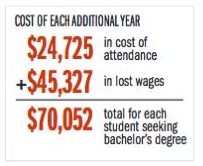
MONEY! My good friend, and college counselor, Paul Hemphill of Planning for College put it into perspective recently. (See chart to the right). It’s not just the cost of the education that your student loses, but the earning potential over the additional year or years. Nothing speaks louder than cold, hard numbers.

What can parents do to ensure on-time graduation?

It’s not a difficult task, although the numbers might speak otherwise. Taking control of the process and making a plan will go a long way in ensuring on-time graduation

Show your student the numbers—Nothing speaks louder than showing your student a loss of thousands of dollars in earning potential if they don’t graduate on time.

Help them plan their major and degree plan, ensuring it can be done in 4 years—Help them plan, ask questions of their advisors, and have solid discussions about their career and/or major.

Encourage AP testing and dual-credit courses—With AP testing and dual-credit courses, a student can enter college with multiple credits out of the way. The cost of these tests and courses pales in comparison to the cost of a college credit and extra money paid if they don’t graduate on time. It’s conceivable that with the right planning, a student can graduate in less than 4 years.

Attend community college for the basics during the summer before college—Not only will your student get some courses out of the way at a cheaper rate, they will enter college with credits under their belt.

Use some tough love—Explain the importance of graduating on time and explain that you will support them for 4 years only. After that, the cost is on them. Nothing motivates a teen more than realizing they will have to pay for college themselves.

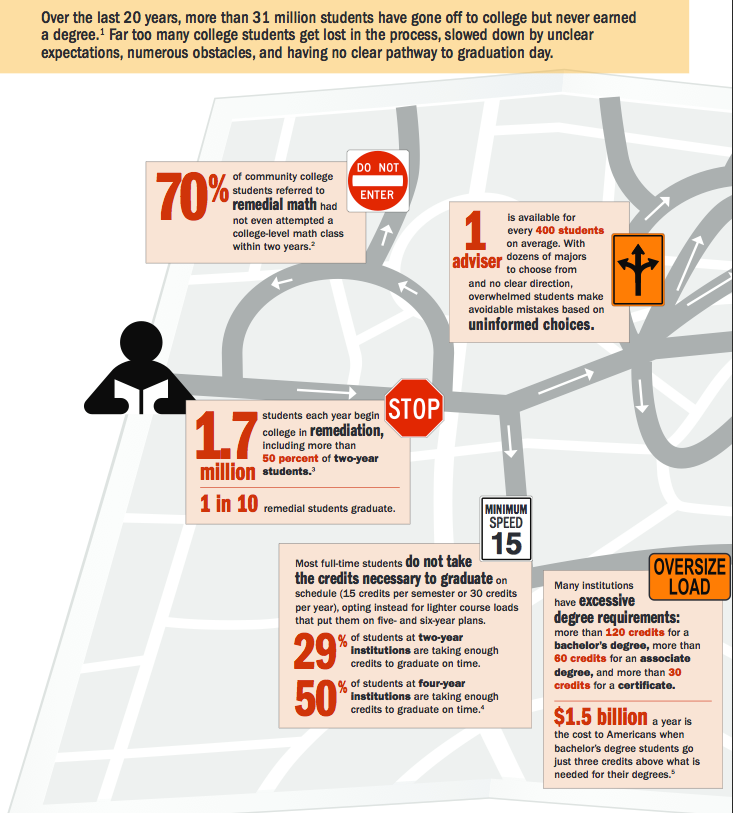
Below is a neat little graphic (courtesy of Paul Hemphill) breaking it down for you.

graduate in 4 years

Mom-Approved Tips: Be Wise-Apply to Backup Schools


Being admitted into your first choice school is a challenge and not a guarantee. No matter how positive you are about your application, no matter how hard you’ve worked to be an ideal applicant, it is important not to assume that gaining admission to your top choice for college is a sure thing. But don’t get dejected or cynical! Here are three ways to increase your chances of being accepted by applying to backup schools.

backup schools
Photo Courtesy of Andre Lüd

Why You Should Apply to Backup Colleges

Rather than be overly confident or too doubtful during the college application process, try to balance your reason with your desire by applying to more than one school. The responsible way to deal with the possibility of being rejected from your first choice is to apply to backup schools. Applying to more colleges and keeping your options open will only increase your chances of being accepted somewhere. Since it is possible that you’ll get in to a backup school over your ideal school, it’s a good idea to take the time to consider several colleges that you’re interested in attending.

The Number of Colleges You Apply to Matters:

Application fees can be costly, but it’s a good idea to invest your time and funds on more than just a few applications. For most students, anywhere from 5-7 applications is a good number. If you under-apply, you run the risk of not getting in anywhere; if you over-apply, you may get overwhelmed and unable to complete the whole process.

Although quantity is vital in increasing your chances of getting in, the quality of your applications also affect your chances of being accepted. Many state schools have one application portal for every school location, which makes applying to more than one school easier. Regardless of whether you’re interested in public or private, try to apply to a manageable number of colleges without overexerting your energy.

Applying to the “Right” Colleges for You

When choosing backup schools to apply to, think thoroughly about major options, location, tuition fees, and each school’s unique application process. If you’re undecided about your major or open to changing it in the future, apply to schools that have many strong programs.

Even if you’re not adventurous, try to picture yourself living in more than one college town. Consider affordability and look for schools that have good scholarship or work study programs. Research what schools like in an applicant and how they accept students to see if you’re their ideal candidate. For instance, if you’re a poor test taker but have a high GPA or write great application essays, apply to colleges that rely more heavily on the latter.

 Photo Courtesy of Minh
Photo Courtesy of Minh

Bottom line: widen your educational horizons by keeping an open mind. When you apply to several schools, you give yourself the opportunity to have a variety of options or the chance to be surprised by your acceptances. It’s likely that the “right” college for you picks you rather than you pick it.

Due to intense competition and circumstances beyond your control, you may not get in to the college of your choice or be able to afford it. If you’re serious about higher education and gaining a degree, then be wise and apply to backup schools. If you want to make the best of your college experience, be open and pro-active during your application process.

++++++++++++++++++++++++

Javaher Nooryani is a writer and editor based in Denver, CO. She has a BA in American Literature & Culture from UCLA and a Masters in English & American Literature from NYU. As a former private tutor and college prep advisor, Javaher is passionate about higher education and is happy to share her knowledge on CollegeFocus, a website that helps students deal with the challenges of college. You can follow CollegeFocus on Twitter and Facebook.

A Book to Help with the Admissions Essay


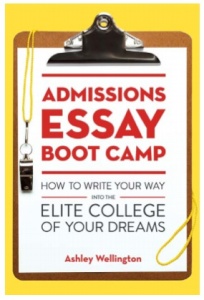
Periodically, I review books for authors who write about the college prep process. Today’s review is on Admissions Essay BootCamp (How to Write Your Way into the Elite College of Your Dreams). If your student needs some help with the essay, check it out.

_______________________________

admissions essay“From the founder of elite college prep agency Mint Tutors comes this hardhitting essaywriting advice manual tailored to each student’s strengths and potential pitfalls, inspiring students to write as if guided by their own personal college admissions tutor.”

The book begins by helping students identify what type of applicant they are and then helps them think through the essay process.

According to Ashley Wellington, the book’s author:

By nurturing the voice of the student as an individual [it] gives tailored advice that empowers real students to craft higherquality essays that will get them into Ivylevel institutions. Admissions Essay Boot Camp replicates an editing session with a private tutor who knows how to dish out both encouragement and tough love—and get results.

What I like about the book

  • It outlines the five prompts on the Common app essay and pairs them with the student’s personality type
  • It helps you organize your thoughts and get them down on paper
  • There’s a much-needed grammar lesson
  • It helps the student craft their own version of the essay prompts by giving examples and analyzing the good and bad points
  • It helps students recognize the “red flag” topics and how to tackle them

Why can this book help student’s with the essay?

If you student needs help brainstorming and recognizing the strong aspects of their essay along with the negative ones, this book will help. Sometimes, a little brainstorming and some examples of how to handle topics is all a student needs to begin crafting an amazing essay.


Wednesday’s Parent: EA and ED–Just Get It Over With (and other reasons)


early decisionToday’s topic: applying EA (early action) and ED (early decision). It’s the first week of November and those applications will be arriving at the colleges. Granted, it’s a quick process to complete once school begins in the fall, but there are some good reasons to take advantage of these options.

Your application arrives with fewer applicants (you stand out)

It stands to reason that the bulk of the students will be applying regular decision, which falls in early January. If you apply EA or ED, your application will be at the top of the stack.

My colleague and good friend, Paul Hemphill, talks about the choice to apply early, in Applying to college: How early? Which “early”? “Applying early,” claim the authors of The Early Admissions Game, “provides a significant admissions advantage, approximately equivalent to the effect of a jump of 100 points in SAT-1 score.”

You get to cross that task off your list (and relax)

When the holidays arrive, your applications are complete and you can load up on all the sweets and turkey your heart desires. You can relax during the break and know that you are ahead of the game.

You get your acceptances early (and it’s done!)

ED decisions usually arrive in December. EA decisions arrive in January or February. You don’t have to wait until April when all the other offers of admission arrive. If you are applying EA, you have more time to make your final decision.

You can focus all your energy on scholarships (it’s all about the FREE money)

Now that you know you’re accepted, you can focus your time and energy over the next few months on searching for scholarships. You will need to pay for that education. And there’s nothing better than FREE money to pay for that huge price tag.

You can focus on your academics (don’t fall prey to senioritis)

You’re in—but that doesn’t mean you can skate through senior year. Colleges have been known to pull offers of admission. Final transcripts are important so use the extra time you have to bump up that GPA.

Read Wendy’s Post: Choosing an Admission Program is Like Buying a Mattress

______________________

Wednesday’s child may be full of woe but Wednesday’s Parent can substitute action for anxiety. Each Wednesday Wendy and I will provide parent tips to get and keep your student on the college track. It’s never too late or too early to start!

The bonus is on the fourth Wednesday of each month when Wendy and I will host Twitter chat #CampusChat at 9pm ET/6pm PT. We will feature an expert on a topic of interest for parents of the college-bound.

Wednesday’s Parent will give twice the info and double the blog posts on critical parenting issues by clicking on the link at the end of the article from parentingforcollege to pocsmom.com and vice versa.

5 Things Admissions Officers Look For in the Application Essay


essayWithin your college application, your personal statement is your one opportunity for the admissions officer to “meet you”, to visualize the person behind the numbers. While no essay can save an unqualified application, an outstanding essay can push an otherwise mediocre application into the “yes” pile.

However, writing a good application essay is hard. Many students write essays that are too cliché or too shallow; others write essays that are impersonal and uninformative; some are even unfortunate enough to write essays that cause their own rejection.

This isn’t surprising. The application essay is drastically different from the typical high school assignment—deeply personal, rather than merely informative.

Well, let me give you a glimpse through the eyes of an admissions officer. Working for the admissions office of a university with single-digit admission rates, I have reviewed numerous applications and “graded” a wide variety of application essays. Here are five things a college admissions officer looks for:

1. Can the applicant write?

The first thing the application essay does is to prove that you can write well. In college, you are going to write, write, write and write—and the application essay allows the admission officer to judge whether you will be able to cope.

On a structural level, your essay should be well organized and coherent. It should have a well-thought-out idea development and be properly paragraphed.

Your writing should be engaging and expressive. A big part of this depends on your personal style, but in general, you should use the active voice and vary your sentence structures. A note though: essays on both ends of the extreme usually don’t work—essays which are too gimmicky and stylized, or too academic, rigid and formal.

Lastly, of course, your essay should be free of grammar and spelling mistakes.

2. What does the essay say about the applicant?

This seems like an obvious point, but many applicants end up writing essays that do not actually shed much light on themselves. No matter how beautiful your descriptions are, or how emotionally moving your content is, if you do not relate these thoughts back to yourself as an individual, your essay will be ineffective.

A strong application essay allows us to visualize the applicant behind the numbers, and to know exactly what type of person you are. The essay should make us feel that we have gotten to know you on a personal level, as if we have met you face-to-face.

3. Are there deep, personal reflections?

To allow the admissions officer to get to know you, your writing needs to include reflections that are deep and personal. Without these reflections, an essay will seem shallow or even generic. Conversely, mature reflections will bring personality and depth to a topic that might seem commonplace at first (for example, community service).

To put it another way, the most important thing in the essay is not the “what”, but the “why”. We have the “what” from the list of your extracurriculars, scores and awards. We now want to know the “why”, the motivations that drive you.

This is also why it is a bad idea to try to cover too much in your essay. To put it yet another way, while the other sections of your application focuses on describing the breadth of your activities, in your personal statement, you should aim to reveal depth in one area.

4. What will the applicant bring to the community?

So what should you highlight about yourself? Well, the admission officer wants to discover what you can contribute to the college. If your application allows the reader to visualize you as an active, contributing and successful member of the community, you are in.

This does not mean that you need to be mind-blowingly unique. The qualities you can most effectively highlight are the genuine ones. A good essay requires a good deal of introspection, to arrive at a keen self-knowledge of what your strong points are, and how to best portray them.

On the flip side, you should avoid topics (and writing tone) that portrays you in a negative light. Be careful of writing about failures that highlight negative characteristics. Stay away from more controversial and potentially offensive topics. Avoid sounding naïve, lacking in self-awareness, or patronizing (a major problem, especially in essays about community service).

5. Do the qualities represented in the essay resonate with the rest of the application?

The advice goes that you should not rehash the rest of your application in your essay. For example, if you have already included multiple debate activities and awards, your essay should not be about debate.

The caveat to this is that while the specific activities should vary, there should be a consistent portrayal of personal qualities. If your essay represents you as a boundary-pushing activist, but the other parts of your application portrays you as respectful and soft-spoken, flags will be raised.

An application is a lens into a single person, so consistency is important. You should thus consider your application holistically, and put some thought into how you want to represent yourself, and what characteristics you want to highlight. Good luck!

_____________________________

Today’s Guest Blogger 

David works for the admission office of a university with a single-digit acceptance rate. In his spare time, he provides expert coaching to students on their college application essays. Visit his website, www.essayscoach.com to learn more about how to write outstanding essays.

Mom-Approved Tips: 7 Most Common Organizational Mistakes During the College Application Process


college prepGaining admission to your college of choice is going to take some time and effort. However, with so much else happening in your life, making sure that you stay on top of the college application process can be a challenge. Avoid these seven common pitfalls so that you can beat the last minute rush.

1. Not Having a Plan

Basic as this may sound, you need to know when your deadlines are and when you are going to make time to complete each step of the application process. OK, so you know that you need to write your essays. When are you going to brainstorm? When are you going to create an outline? Don’t simply write down that you need to have it completed “no later than” a particular date. Dedicate time within your schedule to get these things accomplished and stick to it.

2. Assuming That You Have All the Information You Need

As you complete the application process, you’ll probably need to look up some information that you may not have readily available. What is the physical address of your employer or place of volunteer service? Do they want your immediate supervisor’s phone number or should you use the phone number of a central office that can verify your information? What was the name of that youth director — who no longer attends your church — who coordinated your service trip to Guatemala? It may take a few phone calls and some time for people to get back to you, so start now.

3. Not Knowing All of the Steps

Strong as your reading comprehension skills may be, read through the application again and make sure that you understand all of the steps you need to complete it. If you overlook a step and wait until the last minute, you may not be able to submit your application because pieces are missing. Double-checking now can save you a lot of stress in the long run.

4. Not Asking for Recommendations Early

As stated above, it may take you some time to get into contact with people. Also, they’re going to need to find time in their busy schedules to write a recommendation for you. Moreover, the people you want to write your recommendation are probably going to get quite a few requests and not be able to accept them all. Improve your odds by asking early. Expecting that a person will help you and expecting them to help you at the last minute could leave you a recommendation short.

5. Procrastinating on the Essays

This is probably the most famous of the mistakes that applicants make in the college admissions process. Don’t fall into this stereotype or this trap. Exciting as it might be to complete your essays just in the nick of time, quality will suffer. Good essays take time.

6. Thinking Everything Will Go Smoothly

It won’t. You might get turned down by a potential recommender. You might get saddled with an extra project the same week you planned to write your essays. The very day you had hoped to work on gathering information might be the day that you come down with the flu. Life will continue to happen as you progress through the application process, so create a cushion in your schedule for when things don’t go according to plan.

7. Not Reaching Out

Bring everyone possible in on your goal: family, friends, guidance counselors, supervisors, etc. Let the people in your life know where you’re at in the process and seek help immediately if you feel lost or get behind. The longer you wait, the worse it will be when you finally do reach out to others. There’s nothing wrong with saying that you don’t understand a certain step in the process or don’t know how to complete a step. Finally, discussing the process and the personal milestones you have set will help keep you focused and on track.

________________

Today’s Guest Blogger 
Ryan Hickey is the Managing Editor of Peterson’s & EssayEdge and is an expert in many aspects of college, graduate, and professional admissions. A graduate of Yale University, Ryan has worked in various admissions capacities for nearly a decade, including writing test-prep material for the SAT, AP exams, and TOEFL, editing essays and personal statements, and consulting directly with applicants.

Mom-Approved Tips: Dressing Up for a College


When my kids were little, Halloween was for them. They dressed up in costumes and went trick or treating door to door. My how times have changed. It’s become a family event. Parties are planned, events are scheduled for the kids, and parents get involved in the festivities. Dressing up is part of the fun and also a necessary component of the Halloween celebration.

When applying to colleges, “dressing up” for a college is more than fun–it’s necessary. What do I mean when I talk about dressing up for a college? 

Show interest

Colleges want to know you are interested in attending. They don’t want to be just another name on your college list. They want to know that if you apply, and are offered admission, there is a good chance you will accept and attend. You can show interest by taking an official campus tour, connecting on social media, and meeting with admissions officer for an interview. Colleges keep track of how many times you have showed interest.

Market yourself

You’re basically saying “pick me” to the colleges. Although you are the consumer, the ball is in their court for the first phase of this process. Take every opportunity to market yourself to them. They want to know you and see what you have to offer their college community.

Make a positive impression on social media

Use all avenues of social media positively. Post pictures of your volunteer activities on Facebook and Instagram. Converse with colleges on Twitter. Set up a profile on LinkedIn and connect with colleges there. The key word here is POSITIVE.

Unlike Halloween, you do not want to wear a costume and pretend to be someone you are not. Colleges want to see the real you underneath the costume, not a version of a person you think they want to see.

Payscale’s 2015 College Salary Report


salary reportWith college costs rising, along with student debt, it’s more important than ever for parents and students to look carefully at college ROI (return on investment) when creating the college list. Payscale recognizes the importance of choosing a college major that will be a good return on investment and has released their 2015 College Salary Report.

Following are just a few of the categories covered in the data:

Majors That Pay You Back (Associate and Bachelor’s Degrees)

When somebody tells you they are headed to a college or university, whether it’s for an associate degree, bachelor’s degree, master’s degree, MBA or PhD, the first question out of everybody’s mouth is “Where are you going to school?” In reality though, the choice of major can have a much bigger impact on your future earnings than the school you attend. PayScale ranks the top college majors by salary to help you figure out how much you can earn after graduation.

Most Recommended Majors (by alumni)

What makes graduates recommend their major to students trying to pick a major today? One look at this list of most recommended majors shows us that the majors that people rave about are the ones that allow them to easily find a job in their intended field. It’s not necessarily how much money a person makes, but the likelihood that they can find work doing what they want to do.

Best schools for particular majors (by earning potential)

Choosing a college and deciding to get a degree are big decisions, so do your homework and choose the degree and school that will set you up for the career of your dreams. PayScale’s 2015 College Salary Report ranks undergraduate and 2-year colleges by the highest earning graduates.

Common jobs for particular majors

Choosing a college and deciding to get a degree are big decisions, so do your homework and choose the degree and school that will set you up for the career of your dreams. PayScale’s 2015 College Salary Report ranks undergraduate and 2-year colleges by the highest earning graduates.

College Comparison Tool (compare up to 5 colleges side by side)

Trying to decide which college or university to attend? PayScale has alumni salary data about more than 1,000 schools. Select up to five schools and see how they compare based on earning potential and more.

Most Meaningful Majors

When it comes to choosing a career and picking a college major that will help you achieve your goals, money isn’t everything. Job meaning counts for a lot too. That’s why PayScale asks everybody who takes our survey if they feel like their job makes the world a better place. This list ranks 207 college majors by the percentage of graduates in each major who answer that question with a resounding “yes.”

Here’s an article published in Money Magazine, “Choosing a College Major by Age 16 Pays Off”, proposing that students should think about choosing a major early to avoid spending more for the college education than necessary.

A college choices isn’t all about the money, but it should certainly factor into such a large financial investment. Parents and students should do their homework, just as they would if purchasing any other big ticket item.

Mom-Approved Tips: How to Choose a College


Today I’ve opted to post an article written by a young woman who has worked as a financial aid officer and wants to spread the word about financial literacy and money management skills for college-bound teens. She has witnessed parents and students make some unwise decisions about college. She offers some excellent advice on how to choose a college.

__________________

Choosing which college to attend is a family decision.  Rather, it should be a family decision.  Especially if the family (i.e. parents!) will commit to covering the college expenses.

What the Experts Say

There are a number of factors to consider when choosing a college.  Some experts suggest  considering the national college rankings.   Others recommend choosing a college by the potential debt it might incur.  The College Board’s Big Future suggests a number of factors to consider when choosing a college, including size and location.  Some experts recommend visiting the college, speaking to students, alumni and faculty. Others recommend getting to know the resources available at the college and speaking to the admissions officers.  There are TONS of things to consider when choosing a college!

Almost all of the advice out there suggest that the decision should be based on information gathered by researching – and there’s not much of an emphasis on getting input from the family.

choose a collegeTaking a Different Approach

During my time as a financial aid counselor I helped many families learn about the college costs – AFTER the student had already enrolled in the college.  At that point, the student is already invested in the school and so is the family.

Also at this point many of the families (both parents and students) had regrets about their decisions and felt that it was too late to change course – it was the middle of the semester after all.  They had regrets about not evaluating their ability and willingness to pay for the college costs BEFORE having made the decision to attend.  Ability to pay is important – but even if a family has the ability to pay, doesn’t necessarily mean they have the willingness to pay.  Are they willing to pay $65,000/year for a private college?  Are they willing to take on the debt?

In many cases, by the time families came to me to explore their options about how to finance the college costs, they learned that they had very few options to make it work:

  • Borrowing Federal Parent PLUS Loans
  • Taking out home equity loans
  • Using credit cards
  • Dipping into their retirement accounts

The families were able to move forward with these decisions, but they had many hesitations about doing so.  Taking out a home equity loan, for example, was a common option that families chose.  But they were very uncomfortable with the decision.  The result?  Families ended up compromising their financial goals.

I recall some families would come up with other creative options like selling their cars or getting a second job.  I especially remember speaking to a father who admitted that he “sold the family gold” (I had no idea this was common practice!) to pay for his son’s education!

These families didn’t realize what they were getting into. Parents wanted to accommodate their student’s decisions, but I could tell that they were uncomfortable with the limited options.

This is why I strongly believe that choosing a college is a family decision. Because, like it or not, this decision affects the entire family – especially if there’s an expensive private college on your student’s radar.  It’s best to stay involved in this part of the process; and to make this decision together and compromise if necessary.

Does this make you feel uncomfortable?

It’s weird, right?  You’re probably thinking that choosing a college should be the student’s choice, not yours.  You don’t want them to feel guilty about wanting to choose an expensive college over a more affordable one that would make your life easier.  And you definitely don’t want to stand in the way of your child’s dream college.  It might even feel like you’re overstepping your boundaries by wanting to be involved in the final decision-making process.

This is normal.  In fact, it’s so normal that we forget that this is even a thing!  It’s called individualism and it places more value on the individual rather than the collective.  Merriam-Webster defines it as, “the belief that the needs of each person are more important than the needs of the whole society or group.”  Individualism is so deeply ingrained in our culture, that we don’t even question it.  Today, I want you to be critical of this deeply ingrained mindset.

Think about the differences between Eastern and Western philosophies.  In Western cultures, we place more value on the self, on our individual talents and accomplishments.  Eastern cultures place more value on collectivism which emphasizes the importance of groups, like the family, community, state, or country.

I believe that there is value in both Eastern and Western perspectives – and it’s important to balance between individualism and collectivism.

Individualism is a philosophy that we live by everyday and we don’t even notice it.  I want you to notice it today.  And when the time comes, I want you to notice it as it relates to choosing which college to attend.

How to Have the Conversation

I’d like to offer just ONE tip for you to work towards making this family decision: Next time you’re discussing college plans, you can say something like, “You can go to any college you want, but there may need to be some compromises.  We’re a team and we’re going to have to work together to make this decision work.”  Bottom line: the best thing to do is be direct, honest, and offer your support.

_____________

Katie's HeadshotAs a financial aid counselor, Katie has witnessed the lack of financial literacy among college students. That’s why she’s a big believer in learning money management skills early in life. Sign up for her newsletter where she shares tips about how to prepare your teen to make smart financial decisions: http://planningwithpoise.com/

Infographic: How College Rankings Work


College rankings are important to millions of incoming students a year, yet few actually know how the rankings are compiled. To give viewers a more clear look at what’s involved with compiling college rankings at the top rankings organizations, the editors at College Choice have created this graphic to explain methodologies.


How College Rankings Work
Source: CollegeChoice.net